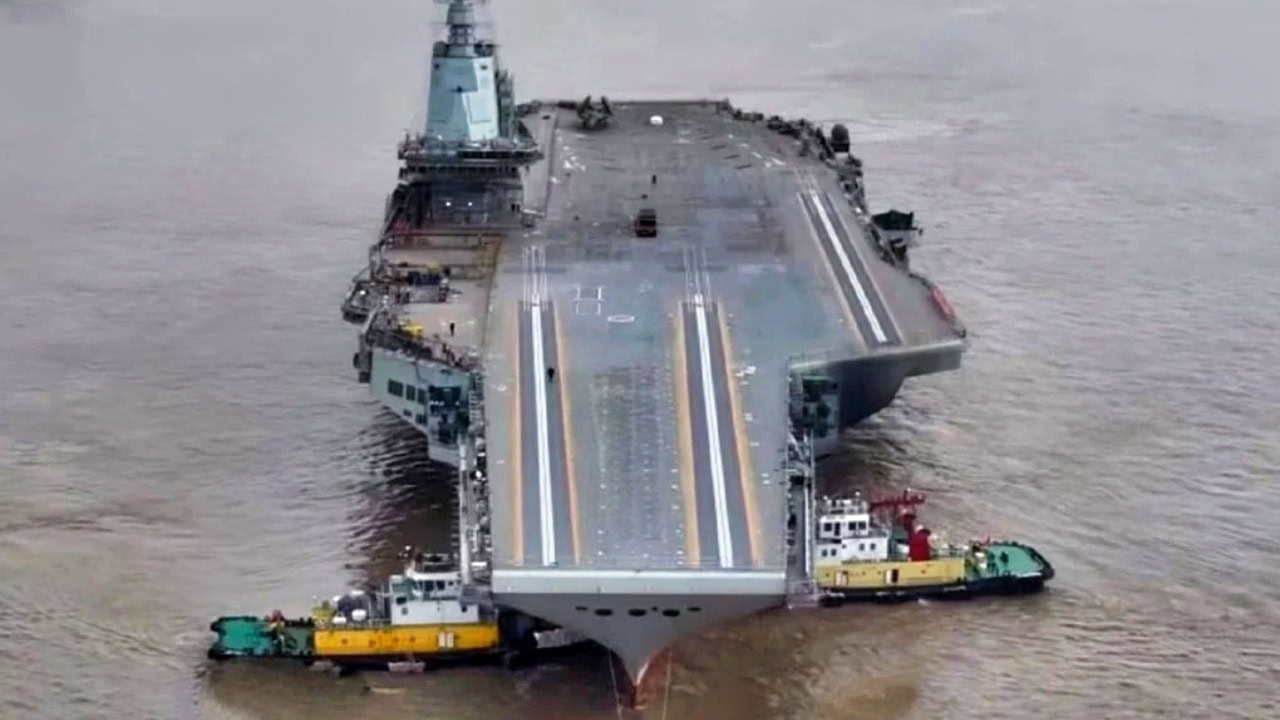
China’s newest aircraft carrier, the provisionally named Type 004, is moving right along, with construction ongoing.
New satellite images from Vantor, a satellite imaging firm, reported by TWZ, a website, show the carrier at port, with construction seemingly in full swing.
The carrier is not the first built for the People’s Liberation Army Navy, though it is likely to be the first nuclear-powered carrier for the PLAN. China’s progress in building aircraft carriers has come a long way since the first PLAN carrier, the ex-Soviet Navy Varyag, in the late 1990s.
China’s second aircraft carrier, the Shandong, was, in essence, a domestic Chinese copy of the Varyag, a Kuznetsov-class carrier.
In contrast, the third Chinese carrier, the Fujian, a catapult-takeoff but assisted-recovery, or CATOBAR carrier, was the first purely domestic design.
But the Type 004 promises to be a head above the rest.
A Nuclear-powered Aircraft Carrier
The advantage of a nuclear-powered aircraft carrier is quite clear: virtually unlimited range, endurance limited only by crew food requirements, and virtually unlimited power generation.
With that much electrical potential, the carrier can power a number of all-electric systems for its lifetime.
The carrier’s growth potential is therefore quite high, and future weapons such as defensive laser systems, more powerful sensors, and other advanced, energy-intensive systems can be integrated as they mature.
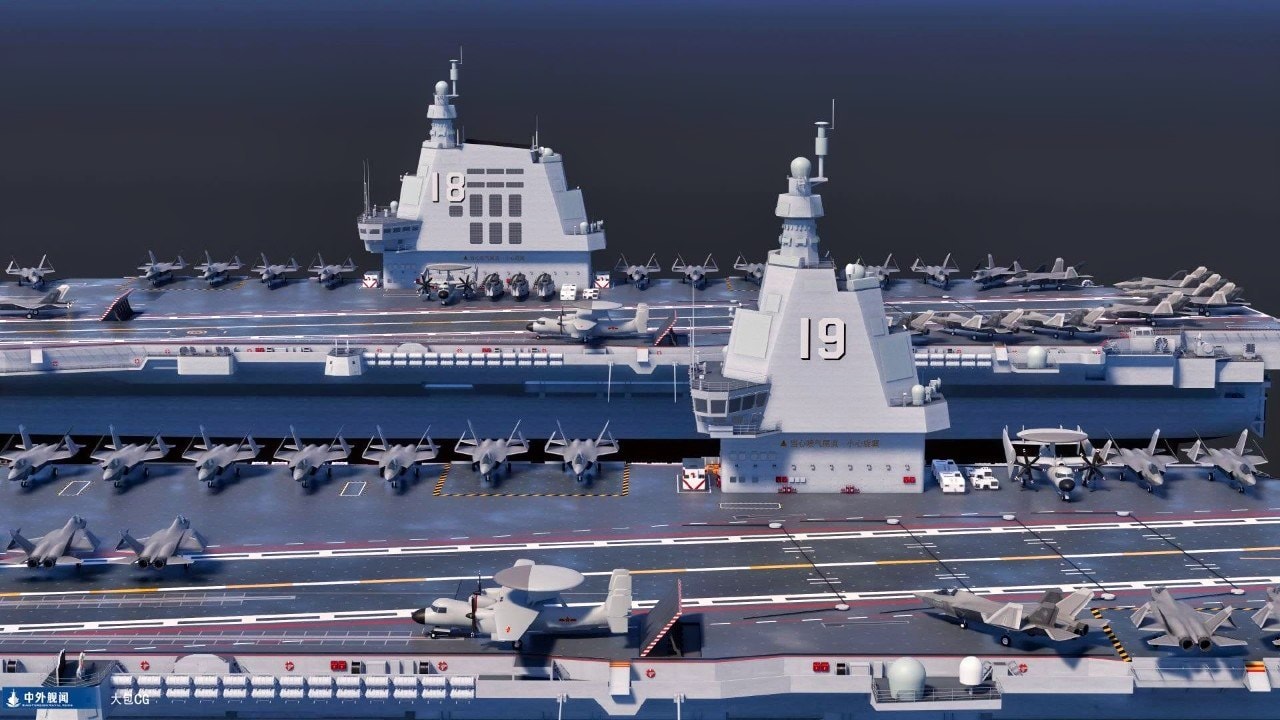
China Aircraft Carrier Models. Image Credit: Creative Commons.
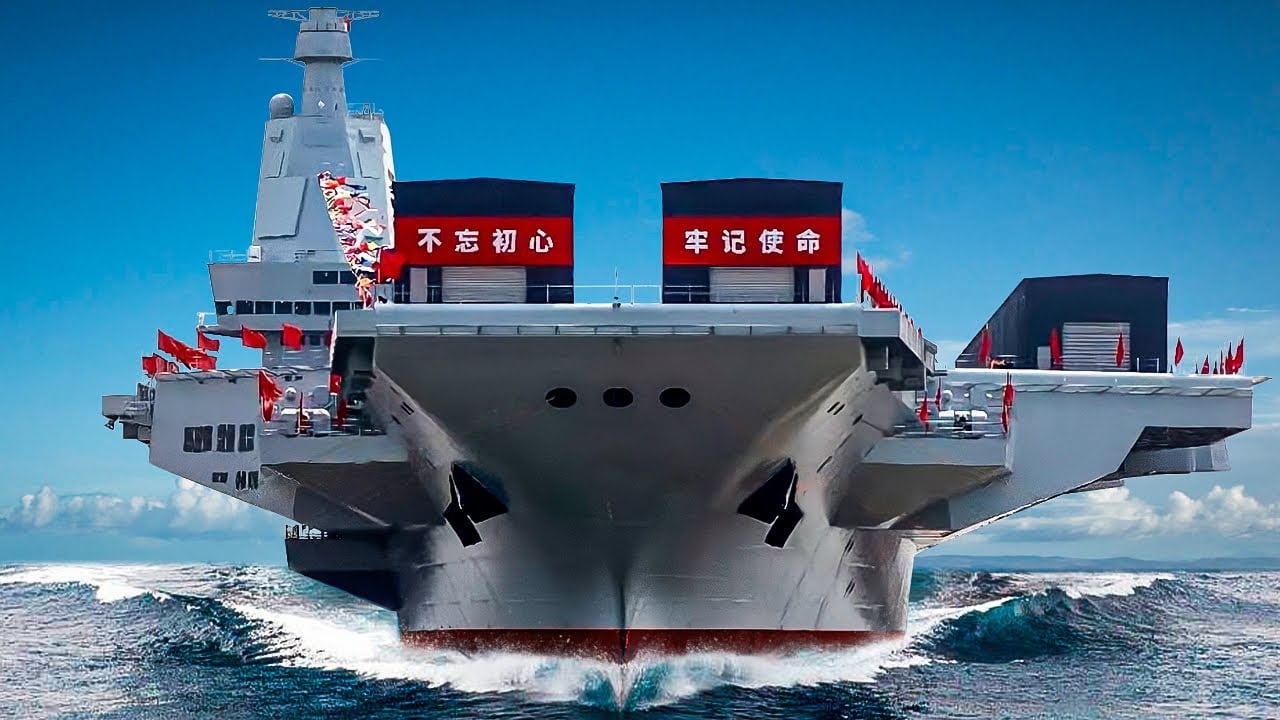
China Aircraft Carrier. Image Credit: YouTube Screenshot.
The PLAN’s third carrier, the Fujian, sports an electromagnetic catapult for launching carrier aircraft from the flight deck, a feature that is almost certainly to be retained on the Type 004.
Somewhat ironically, American President Donald Trump has directed the United States Navy to scrap the upcoming Gerald R. Ford-class in favor of the older, steam-powered aircraft catapults that have been part of carrier operations for decades.
The president has also asked the U.S. Navy to reconsider the placement of the class’s island structure from the rear toward the middle of the flight deck, seemingly for aesthetics alone.
The PLAN’s Carrier Air Wing
While the Type 004 is not yet ready for initial sea trials, let alone beginning aircraft qualifications, speculation has already emerged about the composition of its carrier air wing.
China’s J-35, a fifth-generation stealth fighter outwardly somewhat similar to the United States’ F-35, is a prime candidate for the Type 004.
China’s J-15 fleet of multirole combat aircraft may feature on the new aircraft carrier, along with helicopters for anti-submarine warfare and various unmanned aerial vehicles.
A Blue-water Navy: the Sum of all Capabilities
Of crucial importance to the People’s Liberation Army Navy is not just their burgeoning aircraft carrier capabilities, but also the other warships and submarines that would accompany them while on patrol.
As the Center for Strategic and International Studies, a defense and security think tank, astutely notes, “While aircraft carriers are the centerpiece of a blue-water navy, they do not operate in isolation.
They are escorted by other vessels, typically including some combination of cruisers, destroyers, frigates, large replenishment ships, and sometimes nuclear-powered attack submarines.”
China’s shipbuilding capacity is the largest in the world.
Though its warships may not yet rival those of the United States Navy in terms of sophistication and capability, the sheer number of vessels China can build is staggering.
One Pentagon analysis suggested that the PLAN would like to have nine aircraft carriers in service by 2035 and would therefore require many dozens of support and replenishment vessels, destroyers, submarines, and other warships to accompany those carriers while out on patrol.
In stark contrast to the amount of tonnage the People’s Liberation Army Navy has, the United States’ domestic shipbuilding is struggling to build enough submarines to meet its commitments to the United States Navy, building a paltry 1.3 submarines per year.
But, CSIS notes, “if China does build out such an extensive carrier fleet, it would represent a sea change in the global balance of military power.
Doing so would allow it to not only close the quantitative gap with the U.S. Navy’s eleven-carrier fleet, but also the qualitative gap if many of its new carriers feature advanced capabilities like nuclear propulsion.” Furthermore, “a larger fleet of aircraft carriers would offer China transformative capabilities to project naval and air power farther into the Indo-Pacific and beyond.”
About the Author: Caleb Larson
Caleb Larson is an American multiformat journalist based in Berlin, Germany. His work covers the intersection of conflict and society, focusing on American foreign policy and European security. He has reported from Germany, Russia, and the United States. Most recently, he covered the war in Ukraine, reporting extensively on the war’s shifting battle lines from Donbas and writing on the war’s civilian and humanitarian toll. Previously, he worked as a Defense Reporter for POLITICO Europe. You can follow his latest work on X.