
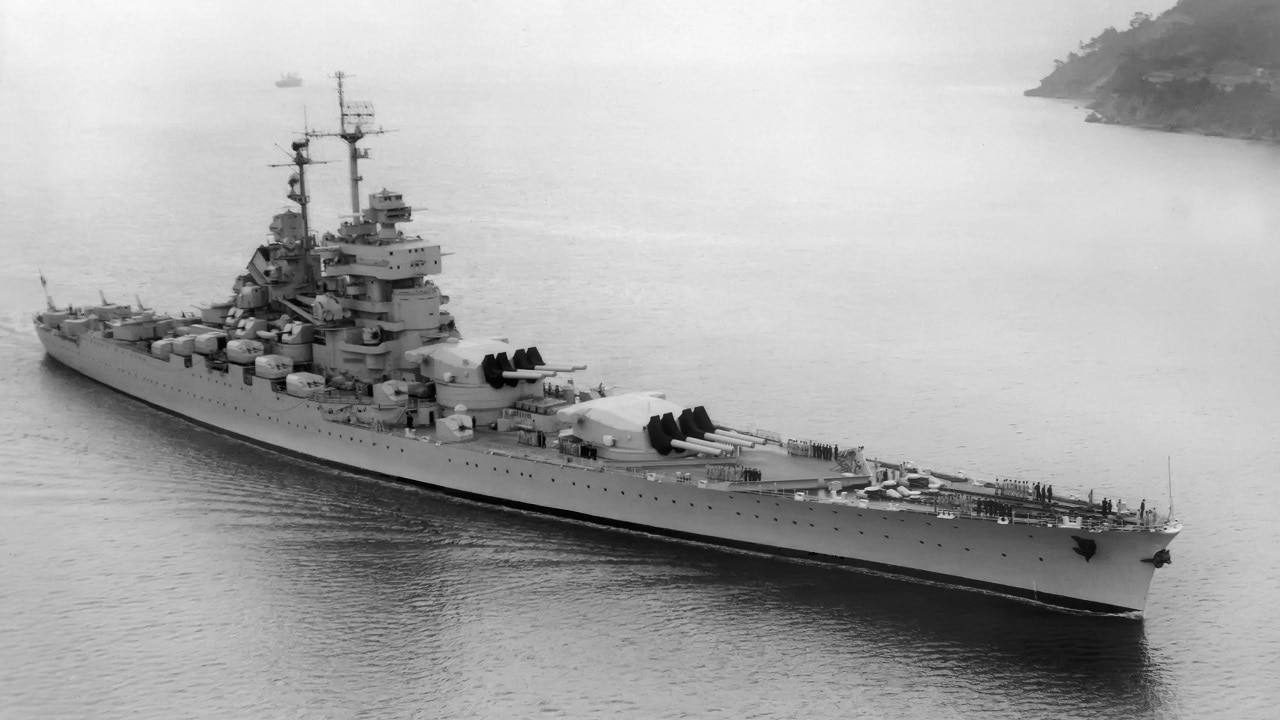
When discussing the battleships of World War II, France’s battlewagons tend to get short shrift coverage-wise compared to their counterparts in the U.S. Navy, Britain’s Royal Navy, the German Kriegsmarine, and the Imperial Japanese Navy.
This is probably due to such inauspicious factors as the disastrous defeat in the Battle of France in 1940, the sycophancy of the Axis puppet Vichy French government, and the egotism of Charles de Gaulle in his leadership of the exiled Free French forces.
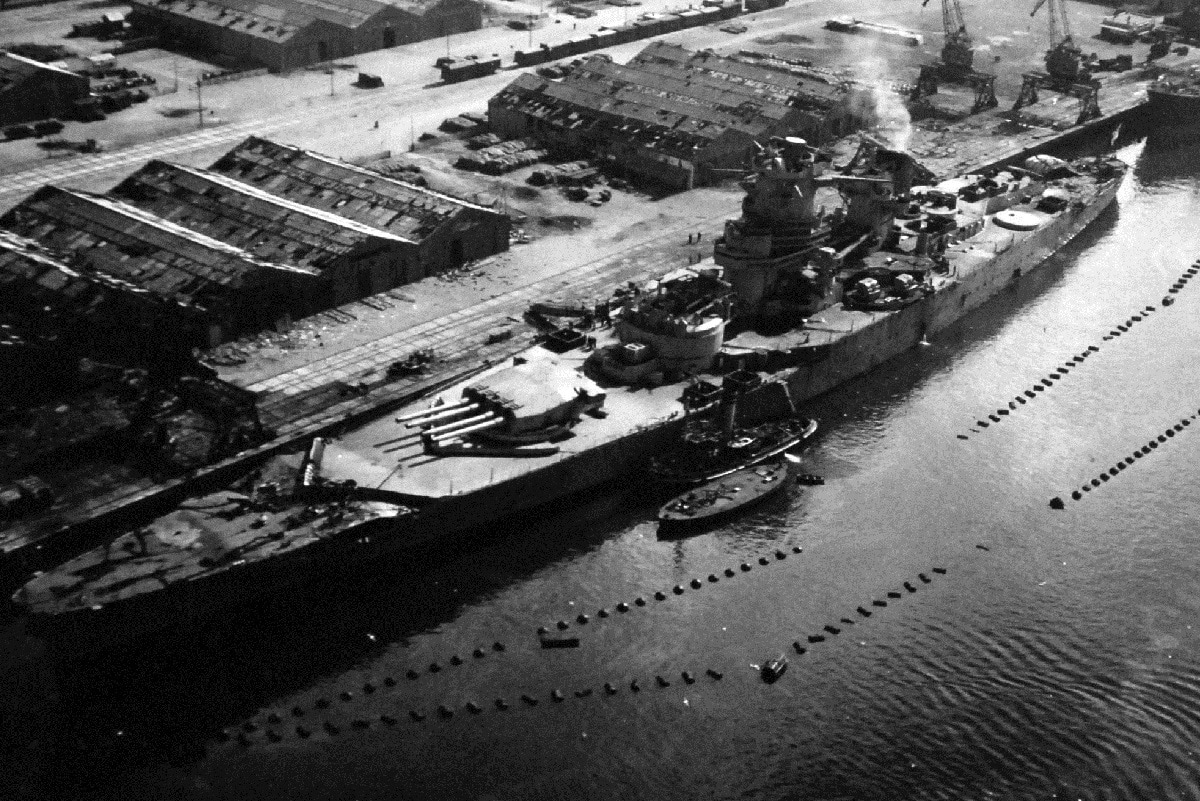
80-G-37325: Operation Torch, Battle of Casablanca, Invasion of North Africa, November 1942. View of French battleship Jean Bart, following attack by Allied gunfire and aerial bombardment. Aerial photograph taken by aircraft from USS Ranger (CV 4), 11 November 1942. Official U.S. Navy Photograph, now in the collections of the National Archives. (2014/4/3).
However, an unbiased reading of sources such as A.B.C. Whipple’s 1981 book “The Mediterranean”—part of Time-Life Books’ excellent WWII series—reveals that the French Navy also produced its fair share of capable capital ships. Arguably the most famous of the bunch was the Jean Bart.
What’s In a Name? Jean Bart’s Namesake
A total of nine French warships have borne the moniker Jean Bart, named for a Franco-Flemish naval commander and privateer who lived from 21 October 1650 to 27 April 1702.
For example, during the First World War, there was a battleship of the Courbet class, built between 1910 and 1914.
Alas, the Courbet class was arguably among the 5 Worst Battleship Classes of All-Time, and this particular Jean Bart contributed to that dubious distinction by getting damaged by a submarine-launched torpedo at the end of 1914.
WWII Jean Bart Initial History, Premise, and Vital Stats
As for the WWII iteration of Jean Bart, she was the second and final member of the Richelieu class—named for 17th-century statesman Armand-Jean du Plessis, Duke de Richelieu, AKA Cardinal Richelieu which was developed in response to the Italian Littorio-class, AKA the Vittorio Veneto-class battlewagons.
The Littorio class was in turn constructed in response to the French Dunkerque-class battleships, which goes to show that the historic tit-for-tat games of one-upmanship between France and Italy went far beyond just making fine wines.
To comply with the displacement limitation terms of the Washington Naval Treaty of 1922, the Richelieus sported the same concentrated arrangement as the Dunkerques for the main battery: two quadruple 15-inch gun turrets placed forward.
Secondary armament consisted of nine 6-inch guns, twelve 100 mm anti-aircraft guns, eight 37 mm AA guns, and twenty-four Hotchkiss M1929 13.2 mm machine guns.
Other tech specs included a hull length of 813 feet 2 inches, a beam width of 108 feet 6 inches, a draft of 32 feet 6 inches, and a fully-laden displacement of 43,992 long tons.
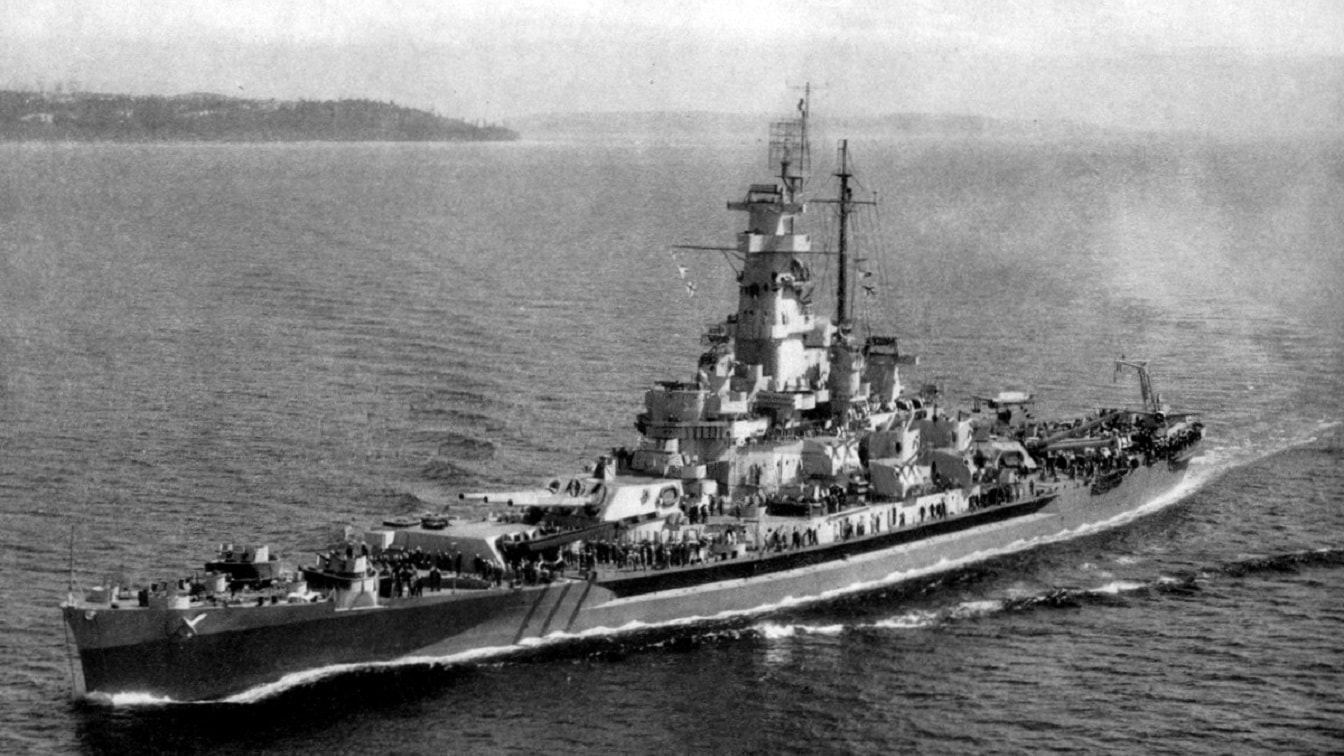
The U.S. Navy battleship USS Massachusetts (BB-59) underway, most probably after her refit at the Puget Sound Naval Shipyard, Washington (USA), circa in July 1944. She is painted in Camouflage Measure 22.
Max speed was 32 knots. Crew complement was 1,569 commissioned officers and enlisted seamen. The main armor belt was 12.9 inches at its thickest point.
Shipbuilding was carried out at the Chantiers de l’Atlantique—Europe’s largest shipyard—
in Saint-Nazaire, France. Jean Bart made history as the world’s last battleship to be completed. Ironically, that completion didn’t actually take place until after WWII ended! She was laid down on 12 December 1936, and launched on 6 March 1940…but not commissioned until 8 January 1949 and finally entering full operational service with the
So, why the long gap?
Operational History in Brief
By the time Nazi Germany won the Battle of France in late June 1940, Jean Bart was only 77 percent complete, with only one of her main turrets installed, along with a handful of anti-aircraft guns.
She still managed to escape to Casablanca, Morocco, in order to avoid capture by advancing Wehrmacht soldiers and Kriegsmarine sailors. She ended up under the control of Vichy personnel, who attempted to prepare the ship for action as much as was possible in light of limited infrastructure and the parts to complete the vessel; they managed to slowly increase anti-aircraft armament and to fit a search radar in 1942
In November 1942, the American and British Forces launched Operation Torch, the invasion of Vichy-controlled North Africa.
Initially, Jean Bart’s crew resisted the Allied invasion, engaging in a gunnery duel with the USN battleship USS Massachusetts (BB-59); however, she was soon knocked out of action by five 16-inch shell hits from BB-59 and aerial bombs from Douglas SBD Dauntless dive bombers.
Before too long, the surviving French troops in the region came to their senses and rejoined the Allied side. Jean Bart was now back in Free French hands, and she spent the rest of WWII as a training ship in Casablanca.
Ergo, Jean Bart finally attained completion in the heady days of the Cold War. She would have one last hurrah in combat, participating in the 1956 Anglo-French-Israeli Suez Crisis operation and bombarding Egyptian shore facilities.
Thus, it came to pass that Jean Bart made history in one other arena, i.e., as the last non-U. S. battleship to fire her guns in anger.
Where Is She Now?
Alas, unlike her U.S. Navy counterparts, Jean Bart wasn’t preserved for posterity as a floating museum. She was stricken from the naval register and sold for scrap in 1970.
C’est dommage (“That’s a shame”)!
About the Author: Christian D. Orr
Christian D. Orr is a Senior Defense Editor. He is a former Air Force Security Forces officer, Federal law enforcement officer, and private military contractor (with assignments worked in Iraq, the United Arab Emirates, Kosovo, Japan, Germany, and the Pentagon). Chris holds a B.A. in International Relations from the University of Southern California (USC) and an M.A. in Intelligence Studies (with a concentration in Terrorism Studies) from American Military University (AMU). He is also the author of the book “Five Decades of a Fabulous Firearm: Celebrating the 50th Anniversary of the Beretta 92 Pistol Series,” the second edition of which was recently published.