
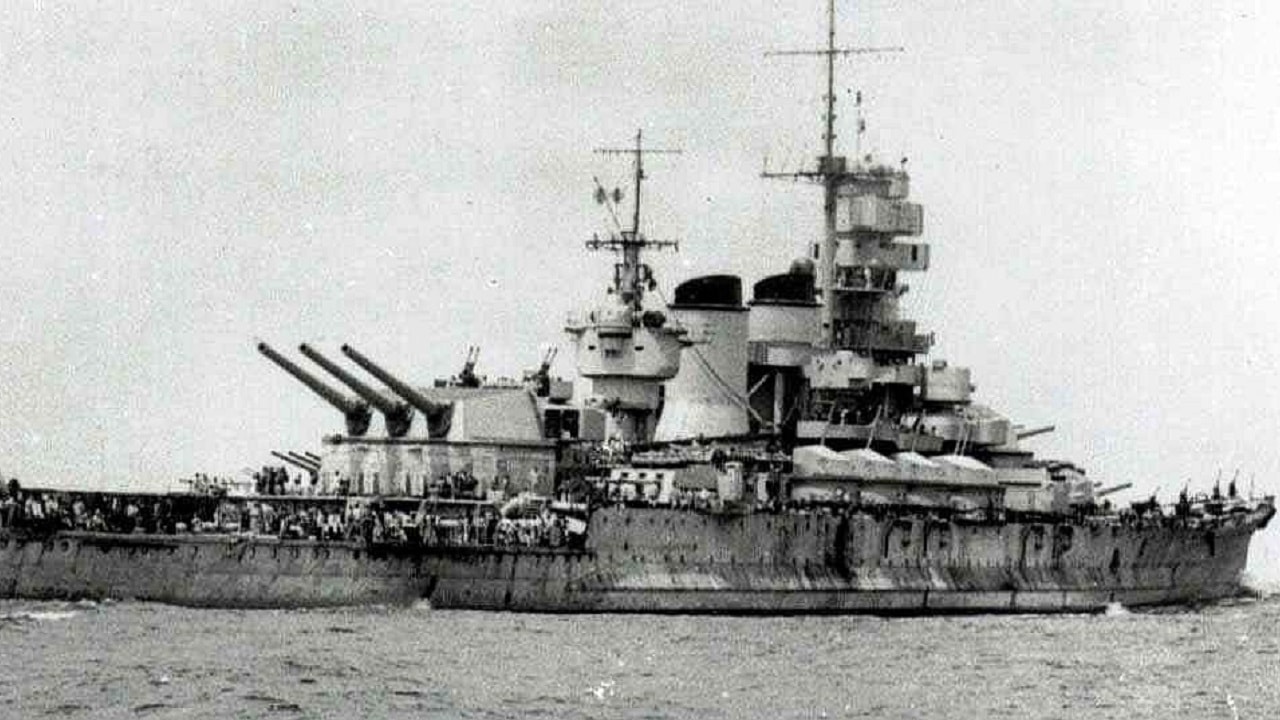
The Royal Italian Navy produced a fine class of battleships that didn’t reach its full potential due to Il Duce’s early exit from the war: the Littorio-class, AKA the Vittorio Veneto-class battlewagons. While these were no Iowa-class battleships, for sure, they were powerful.
Littorio-Class Initial History, Premise, and Vital Stats
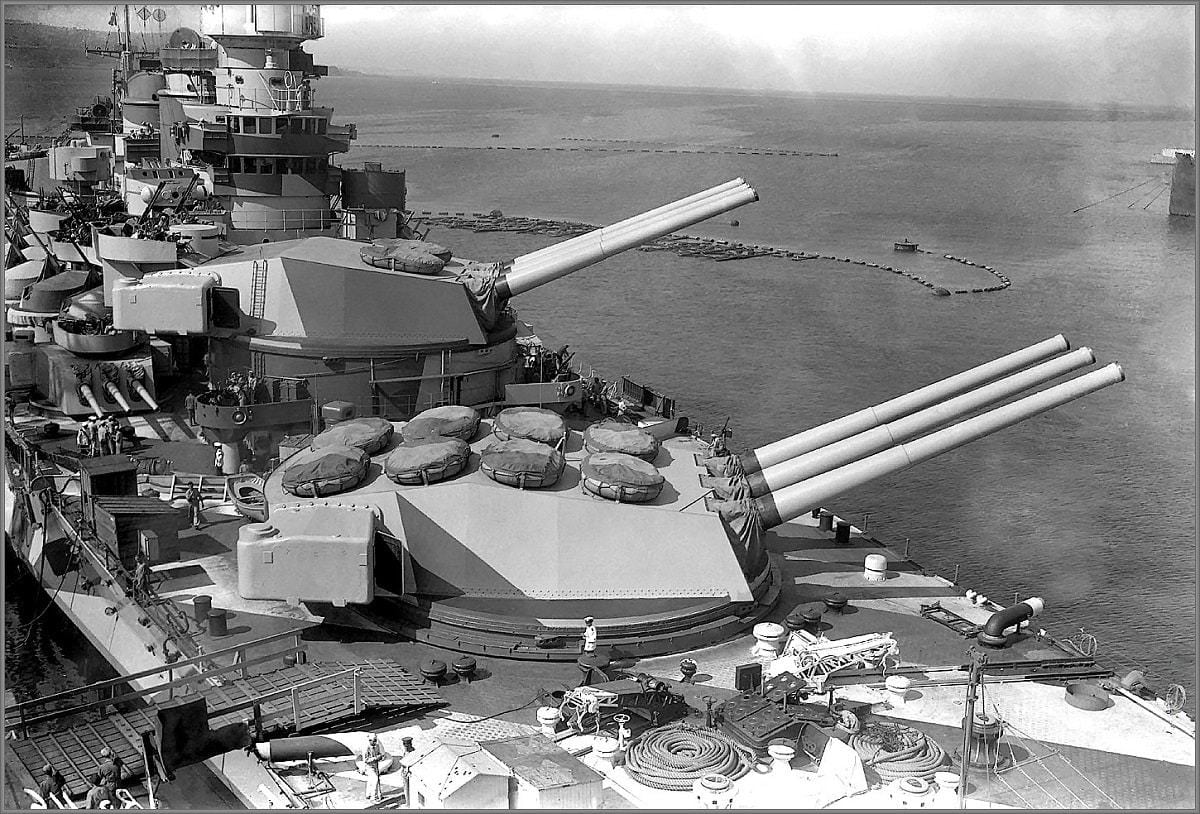
Italy Roma Battleship. Image: Creative Commons.
The class was developed in response to the French Dunkerque-class battleships, and took advantage of the terms of the Washington Naval Treaty of 1922, which allotted Italy an additional 70,000 long tons of total capital ship tonnage, which could be used between 1927 and 1929, whilst the other powers were observing the “holiday” in battleship construction prescribed by the treaty.
Shipbuilding duties were split evenly between the Cantieri Riuniti dell’Adriatico (C.R.D.A; “United Shipbuilders of the Adriatic”) in the northeastern seaport city of Trieste and the Ansaldo engineering company in Genoa. Out of four Littorio-class warships planned, three were completed:
-The Littorio, the eponymous lead ship of the class, was laid down on 28 October 1934, launched on 22 August 1937, and commissioned on 6 May 1940.
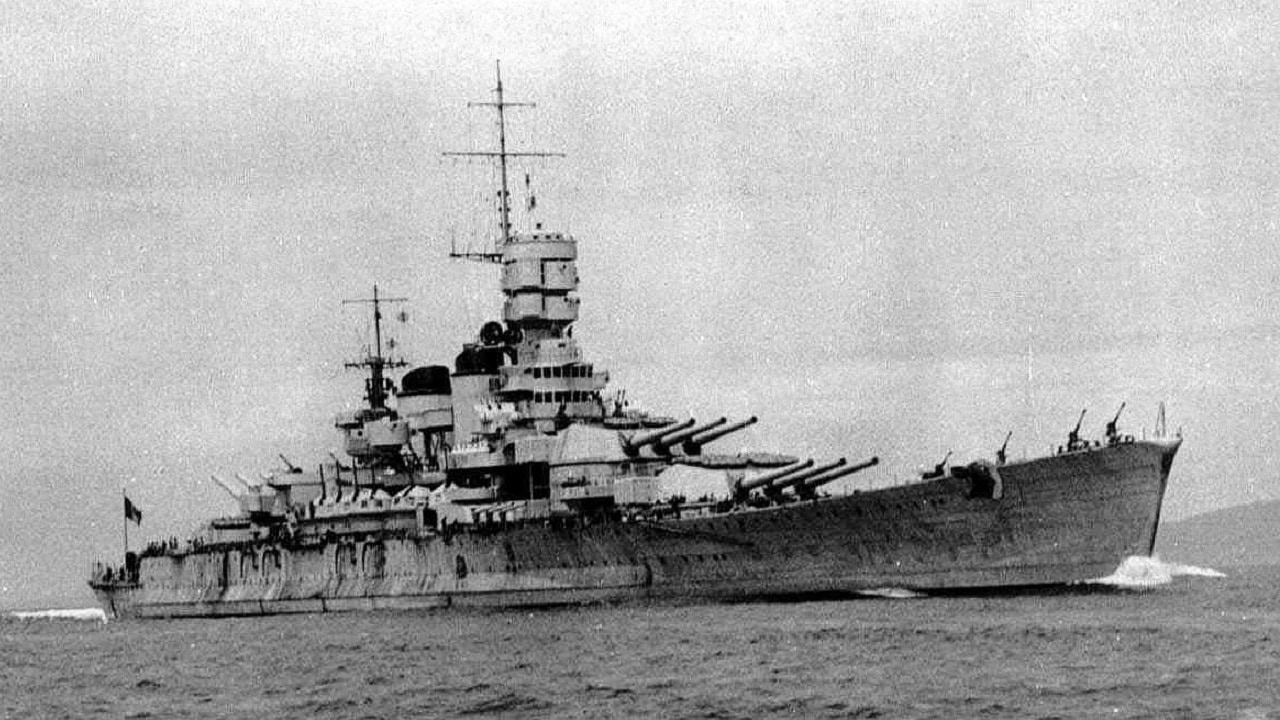
The Italian battleship Roma.
-The Vittorio Veneto, laid down on the same day as Littorio, launched on 25 July 1937, and commissioned on 28 April 1940.
This ship’s namesake is a particularly proud one in Italian military history, as she was named for a major Italian military victory in the First World War that took place from 24 October to 4 November 1918 and helped bring about the collapse of the Austro-Hungarian Empire.
-The Roma was laid down on 18 September 1938, launched on 9 June 1940, and commissioned on 14 June 1942.
Meanwhile, the would-be fourth ship of the class, the Impero, was laid down on 14 May 1938 and launched on 15 November 1939, but was never actually commissioned.
Armament-wise, the main guns of Littorio and her sister ships were nine 15-inchers divided amongst triple-barreled turrets, two fore and one aft.
Secondary armament consisted of a bristling battery of twelve 6-inch guns, four 4.7-inch guns, twelve 3.5-inch anti-aircraft guns, twenty 37mm guns, and an additional twenty 20mm guns.
Other tech specs included a hull length of 780 feet 1 inch, a beam width of 107 feet 8 inches, a draft of 31 feet 6 inches, and a fully-laden displacement of 45,237 long tons.
Max speed was 30 knots. Crew complement was 1,950 commissioned officers and enlisted seamen. The main armor belt was 14 inches at its thickest point.
Operational History in Brie
The Vittorio Veneto had the most prestigious WWII service record of the bunch, serving as the flagship of the Regia Marina’s Mediterranean Commander-in-Chief, Admiral Angelo Iachino (1889-1976).
During the Battle of Cape Matapan from March 27-29, 1941—which was Italy’s greatest defeat at sea—the Veneto managed to escape with a single torpedo hit from a Fairey Swordfish biplane; in turn, the Veneto’s anti-aircraft gunners inflicted the Brits’ only casualties of the battle by shooting down the plane and killing its crew of three.
Veneto was also lucky enough to survive several other close calls: (1) the November 1940 Swordfish raid on the Italian fleet at Taranto Harbor; (2) a torpedoing by the British submarine HMS Urge (Pennant No. N17); and (3) severe damage in an Allied bombing raid on La Spezia in June 1943.
In turn, she showed she could dish out punishment in addition to taking it; during the Battle of Cape Spartivento, she damaged the light cruiser HMS Manchester (Pennant No. 15).
Littorio and Roma weren’t as lucky; the former was hit by a torpedo during that aforementioned Taranto Harbor raid and torpedoed yet again in June 1942; both vessels were also damaged in the same June 1943 La Spezia raid that afflicted the Veneto.
Littorio took her fair share of licks during the Second Battle of Sirte on 22 March 1942, badly damaging the destroyers HMS Havock (Pennant No. H43) and HMS Kingston (Pennant No. F64).
After the Italian surrender in September of 1943, the Littorio was renamed the Italia, and all three operational battleships were redirected to Malta.
En route to Malta, they were attacked by Luftwaffe warplanes wielding Fritz-X radio-guided bombs; Italia was damaged, and Roma was sunk, but both Italia and Veneto made port and were interned.
As for the incomplete Impero, Impero was seized by the Germans and used as a target ship until she was sunk by American bombers in 1945, then refloated in 1947.
Where Are They Now?
Alas, unlike their U.S. Navy counterparts, none of the Littorios were preserved for posterity as floating museums.
-Littorio was scrapped at La Spezia between 1952 and 1954.
-Vittorio Veneto was stricken from the naval register on February 1st, 1948.
Her hulk was then sold for scrapping, which took place between 1951 and 1954 in La Spezia. Part of her did live on for an additional four decades, however: some of her guns were obtained by Yugoslavia and employed as coastal batteries, thus surviving until the 1990s.
-Impero was consigned to scrapping in 1948 in Venice, barely a year after her refloating, with the scrap job finished in 1950.
MORE – The Biggest Battleship Ever Took 17 Bombs and 19 Torpedoes to Sink Her
About the Author: Christian D. Orr
Christian D. Orr is a Senior Defense Editor. He is a former Air Force Security Forces officer, Federal law enforcement officer, and private military contractor (with assignments worked in Iraq, the United Arab Emirates, Kosovo, Japan, Germany, and the Pentagon). Chris holds a B.A. in International Relations from the University of Southern California (USC) and an M.A. in Intelligence Studies (with a concentration in Terrorism Studies) from American Military University (AMU). He is also the author of the book “Five Decades of a Fabulous Firearm: Celebrating the 50th Anniversary of the Beretta 92 Pistol Series,” the second edition of which was recently published.