
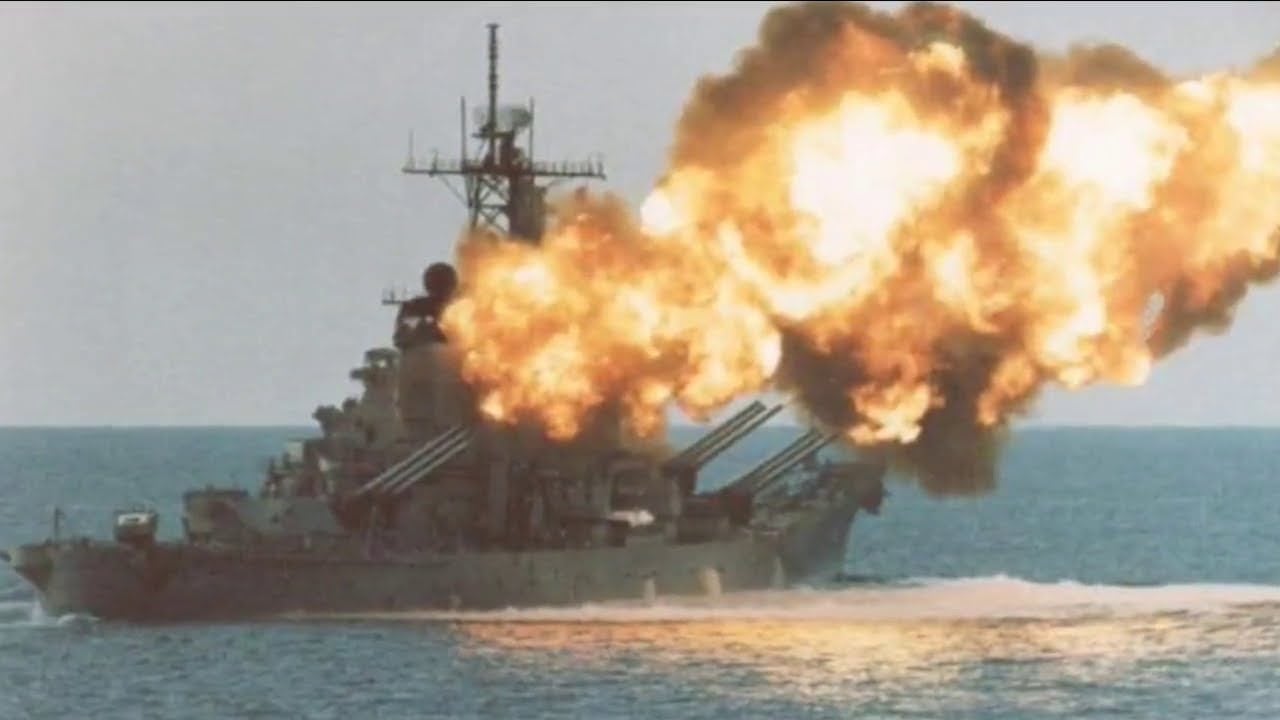
All Four Iowa-Class Battleships Fought North Korea
We’ve said it a bazillion-and-one times already, we’ll say it a bazillion-and-two times more: the United States Navy’s Iowa-class battleships are the crème de la crème of the battleship world.

Inside USS Iowa. Image Credit: Harry J. Kazianis for 19FortyFive.com
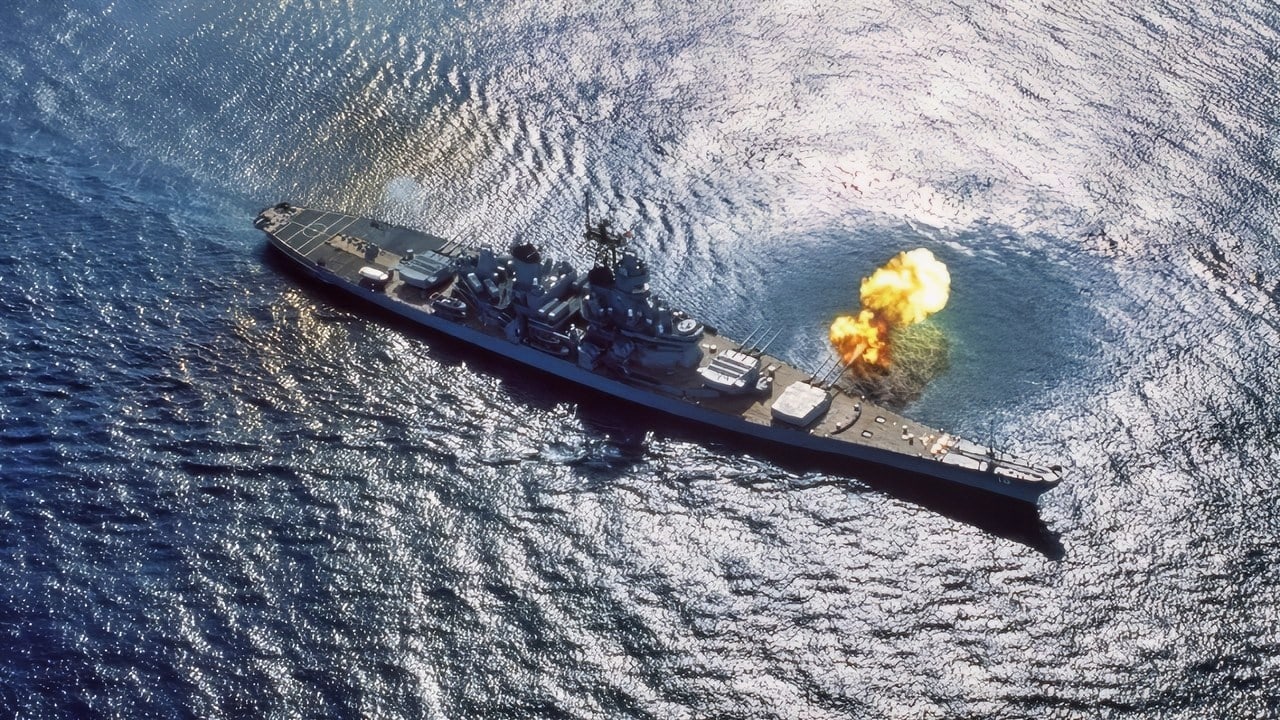
Iowa-Class Battleship Firing Guns. Image Credit: Creative Commons.

Iowa-Class Battleship at Rest. Image Credit: Creative Commons.
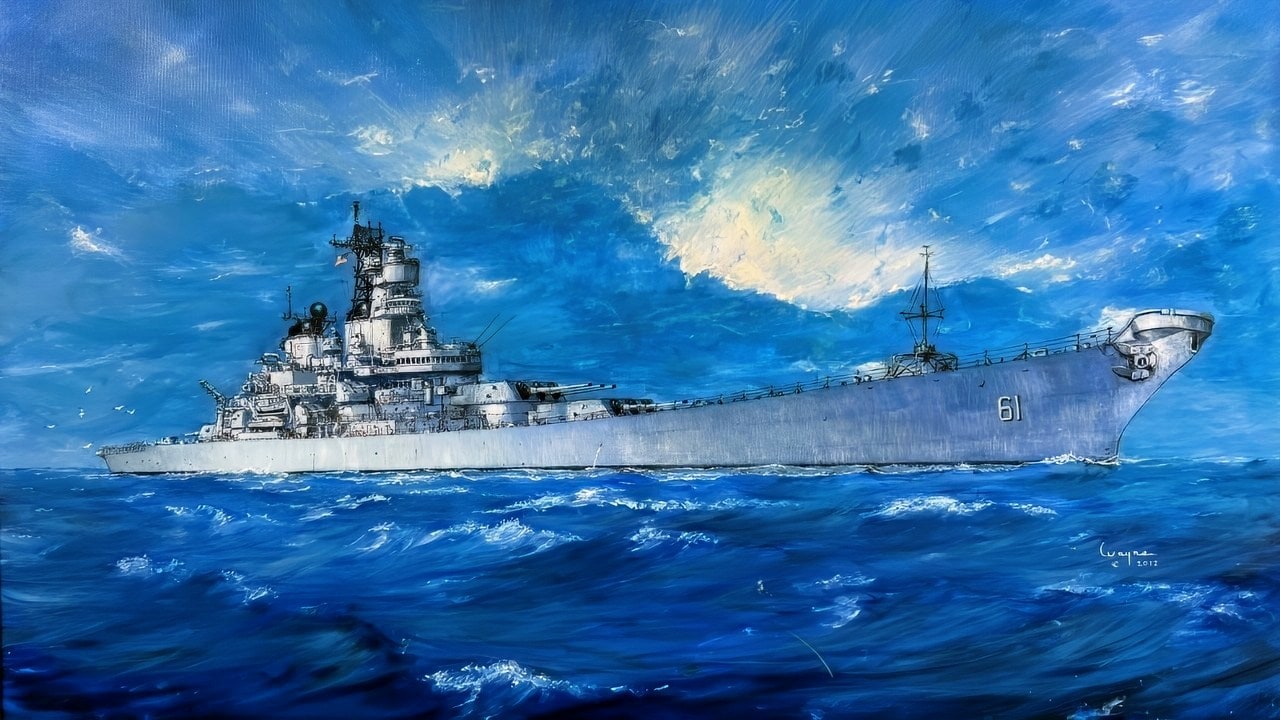
Image taken by Harry J. Kazianis aboard the USS Iowa on August 15, 2025. Image is of a painting of the USS Iowa of the Iowa-Class. USS New Jersey is also a Iowa-Class battleship.
They certainly claimed the longevity crown by lasting five-and-a-half decades and becoming the last battleships from any country to fire their guns in anger.
All in all, the Iowa-class behemoths fired their massive 16-inch guns in four major wars of the 20th century.
One of those four wars was the Korean War, which is unfortunately ofttimes referred to as “The Forgotten War.”
Well, all four of the Iowas contributed to the fight against Communist forces during that conflict, and that’s an achievement record that deserves to be remembered and immortalized, not forgotten.
We’re now going to recognize each Iowa-class battleship’s ship’s Korean War contributions on an individual basis.
USS Iowa (BB-61)
Might as well go in chronological order of the hull numbers and start with the eponymous lead of the class, eh?
As noted by the Pacific Battleship Center info page: “After a brief post-WWII retirement, the USS Iowa (BB-61) was recommissioned on August 25, 1951, in response to the outbreak of the Korean War. As tensions escalated on the Korean Peninsula, Iowa brought massive firepower, mobility, and deterrence back to the Western Pacific.
During her Korean War deployments, she provided naval gunfire support, shelled strategic positions, and protected aircraft carriers. Her presence was both a tactical asset and a psychological force — a reminder of American strength and resolve in a new and uncertain Cold War era.”
Among the particulars of Iowa’s Korean War combat accomplishments:
-April–September 1952: Fired over 2,000 16-inch shells in support of ground forces.
-April 13, 1952: Bombardment in support of I ROK Corps, killing 100 Communist troops, destroying six gun emplacements and seriously damaging divisional headquarters.
Iowa deployed a second time, from April 1953 to September 1953, staying in-theatre two months after the signing of the armistice.
USS New Jersey (BB-62)
Next, we come to “The Big J”, AKA “The Black Dragon,” the most decorated battleship in U.S. history.
The Korean War was the catalyst for a half-dozen of those decorations: the Korean Service Medal with four battle stars, the National Defense Service Medal, and the China Service Medal.
New Jersey first arrived in-theatre on May 12, 1951, whereupon she had the honor of serving as the flagship of the Seventh Fleet under Admiral Harold Montgomery Martin, who had commanded an aircraft carrier during the epic WWII Battle of Leyte Gulf.
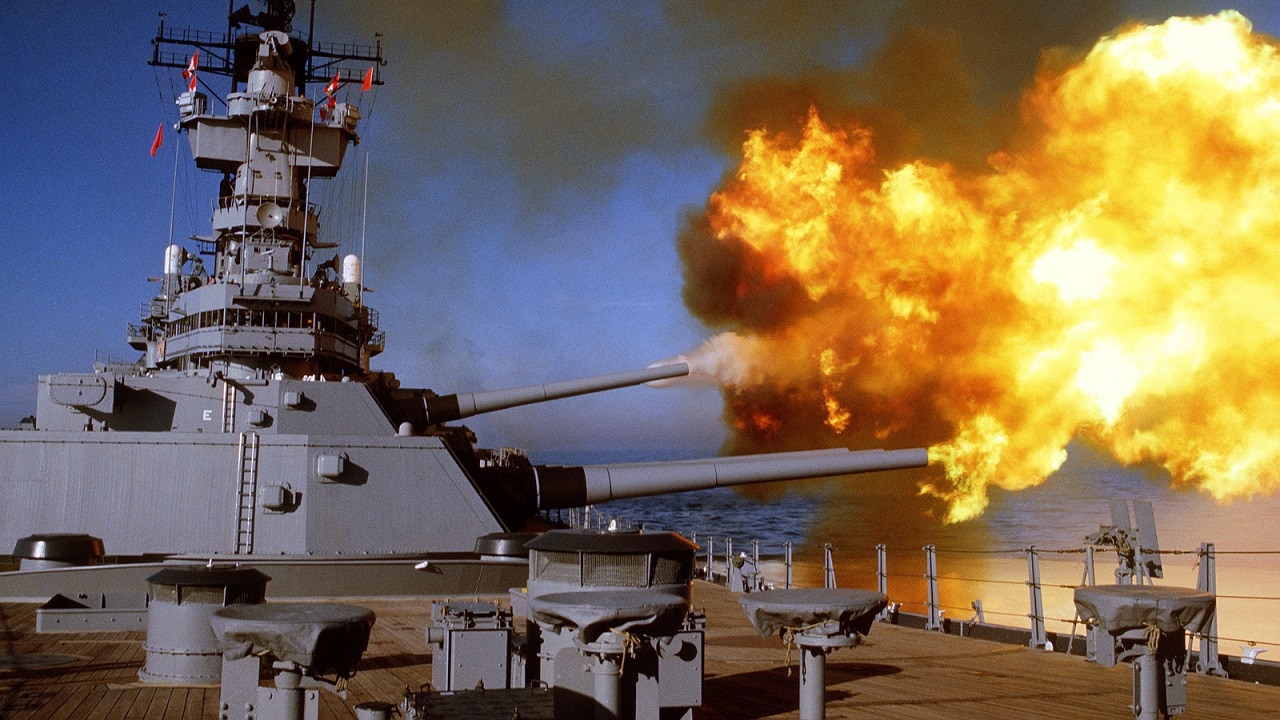
The Nos. 1 and 2 Mark 7 16-inch/50-caliber guns are fired to starboard during a main battery firing exercise aboard the battleship USS NEW JERSEY (BB-62).
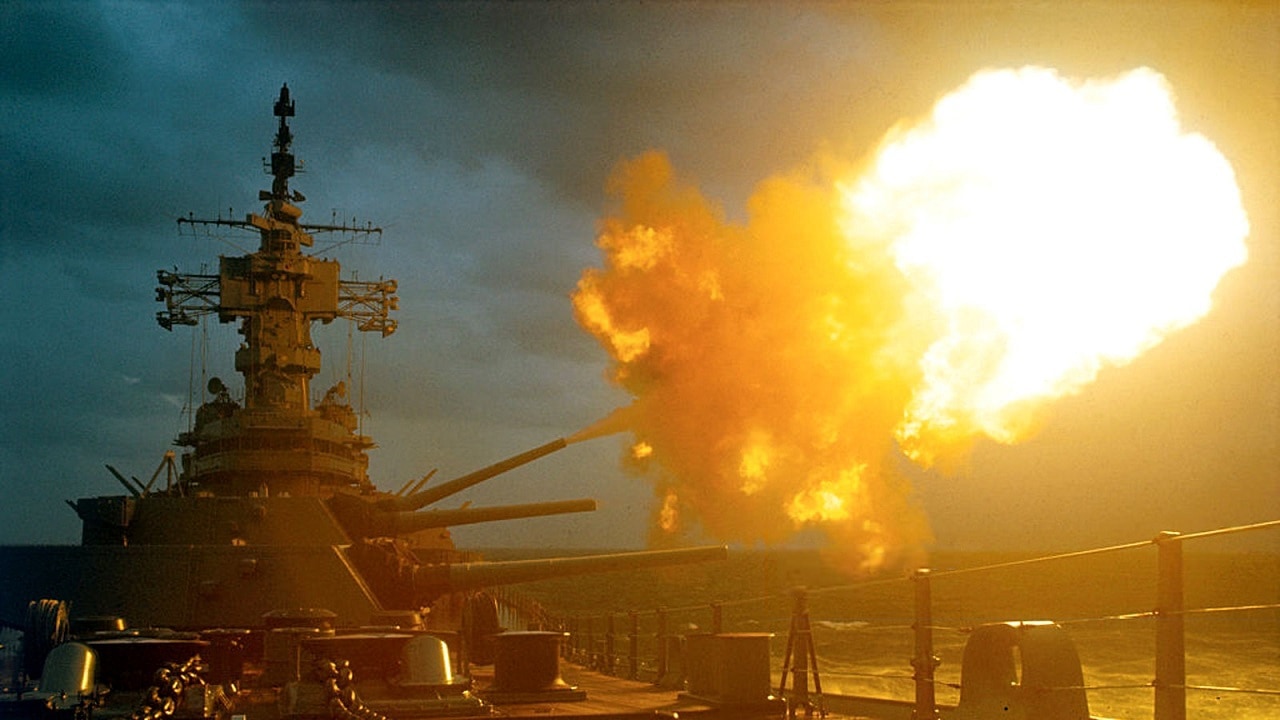
30 Sep 1968 — The battleship USS New Jersey fires its 16-inch guns into the demilitarized zone here 9/30. These were the first shells fired by the New Jersey in the Vietnamese war. The vessel is the only battleship on active duty in the U.S. Navy.
She first fired her guns at Communist forces a week after her on-scene arrival, doing so at Kansong—just above the 38th Parallel—to interdict enemy supplies in response to a major Red Chinese offensive against General Edward Mallory Almond’s U.S. Army X Corps near the east coast.
There is an element of tragedy to this story: “There [at Wonson], on May 21, 1951, a North Korean shore battery scored a direct hit that did no significant damage to the heavily armored Turret I, and a near miss that sprayed the ship with shrapnel, killing Seaman Robert Oesterwind. He was the only sailor ever killed in action on the New Jersey throughout the many conflicts in which she participated over her four commissionings. The New Jersey returned fire and quickly obliterated the shore battery.”
“Big J” deployed to the Korean Peninsula a second time, whereupon she made history by firing the last salvo of the war at Wonson when the armistice was signed on July 27, with a New Jersey delegation coincidentally present.
USS Missouri (BB-63)
The “Mighty Mo” is, of course, best remembered as the vessel aboard which Imperial Japan’s surrender was signed, thus finally signaling the official end of World War II. However, bearing witness to the end of that literally earth-shattering conflict did not mean that her wartime service was over. Far from it.
As her floating museum’s official history page notes, “USS Missouri returned to the Pacific for the Korean War. Deployed from September 1950 to March 1951 and again from September 1952 to March 1953, the battleship supported the final days of the Battle of Inchon by providing shore bombardment and was present for the Battle of Chosin Reservoir, providing fire cover for the Marines. Throughout the war, she steamed with and provided anti-aircraft cover for aircraft carriers in their task force in addition to bombarding Korea’s coastline.”
USS Wisconsin (BB-64)
“On, Wisconsin!” goeth the battle cry and fight song of the University of Wisconsin Badgers sports teams. Though “Big Wisky” may have been the last of the Iowa-class battlewagons to be laid down and commissioned, she was certainly not least when it came to taking the fight to the Communist menace.
On November 21, 1951, Wisconsin relieved New Jersey as Admiral Martin’s flagship. It was on December 2 of that same year that she first fired her gun in support of the Korean War effort, as noted by her museum history page: “[S]creened by the destroyer Wiltsie (DD-716), provided gunfire support for the Republic of Korea (ROK) Corps in the Kasong-Kosong area.
After disembarking Admiral [Francis Compton] Denebrink on 3 December at Kangnung, the battleship resumed station on the Korean ‘bombline,’ providing gunfire support for the American 1st Marine Division. Wisconsin’s shellings accounted for a tank, two gun emplacements, and a building. “
Not to be outdone by her sister ships, “Big Wisky” actually deployed thrice to Korea. Her final combat action of that conflict was from March 15-19, 1952, off Songjin. That first afternoon, she sustained the first enemy direct hit in her history, when one of four shells from a communist 155 mm gun battery struck the shield of a starboard 40 mm mount, causing little material damage but injuring three seamen.
Wisconsin gained quick revenge by destroying that battery with a 16-inch salvo, reportedly prompting either the destroyer USS Buck (DD-761) or the destroyer USS Duncan (DD-874) (depending on which account you believe) to jokingly signal “Temper, temper.”
About the Author: Christian D. Orr, Defense Expert
Christian D. Orr is a Senior Defense Editor. He is a former Air Force Security Forces officer, Federal law enforcement officer, and private military contractor (with assignments worked in Iraq, the United Arab Emirates, Kosovo, Japan, Germany, and the Pentagon). Chris holds a B.A. in International Relations from the University of Southern California (USC) and an M.A. in Intelligence Studies (concentration in Terrorism Studies) from American Military University (AMU). He is also the author of the newly published book “Five Decades of a Fabulous Firearm: Celebrating the 50th Anniversary of the Beretta 92 Pistol Series.”