
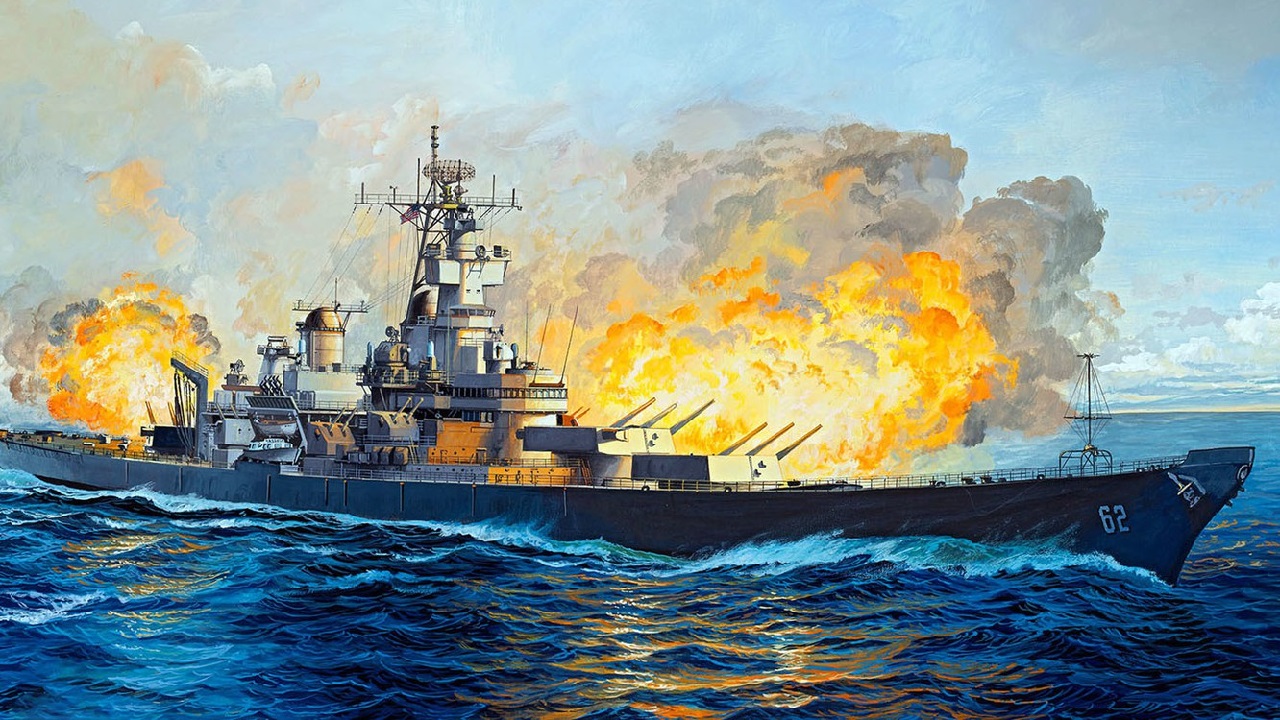
Key Points and Summary – This article argues that today’s “Trump-class battleship” idea has historical echoes in the Navy’s recurring fascination with oversized, heavily armed surface ships.
-During WWII, U.S. planners explored converting Iowa-class hulls into carrier-like vessels as carrier shortages loomed in the Pacific.
-Decades later, a late-1970s concept revived the idea: an Iowa “interdiction assault ship” with a V-shaped flight deck for AV-8B Harriers, a new hangar, embarked Marines, upgraded guns, and a massive field of Mk 41-style missile silos—an arsenal bigger than many modern strike platforms.
-The conclusion: nostalgic, novel, and likely impractical.
Why the Iowa-Class Battleship ‘Aircraft Carrier’ Never Made it (And Why the Trump-Class Battleship Could Fail)
U.S. President Donald Trump announced in December that the U.S. Navy would pursue development of a new “Trump-Class Battleship.”
In a speech typical of the president, he declared it would be “the fastest, the biggest, and by far, 100 times more powerful than any battleship ever built.”
Mark Cancian, a senior adviser at CSIS, wrote on December 23 that “this ship will never sail.”
Cancian is probably right. However, the Navy has continually tinkered with deploying larger, more capable weapons at sea.
The Navy once considered aircraft carriers armed with 16-inch guns. These theoretical vessels were referred to as battlecarriers.
The U.S. Navy Once Wanted a Battlecarrier
The battlecarrier concept would have modified a battleship to include a flight deck aft, where gun turret #3 would normally be located. The magazines would be removed, and a hangar deck built in.
While Iowa-class battleships were never built with flight decks, proposals to do so were made in the early days of World War II, and a design was considered as recently as the late 1970s to convert them into battlecarriers with a flight deck for Harrier jump jets.
These plans never came to fruition. The Iowa-class battleships carried floatplanes during World War II—Vought OS2U Kingfisher and Curtiss SC Seahawk planes—and later, helicopters. But these were primarily used for spotting and rescue rather than dedicated flight operations.
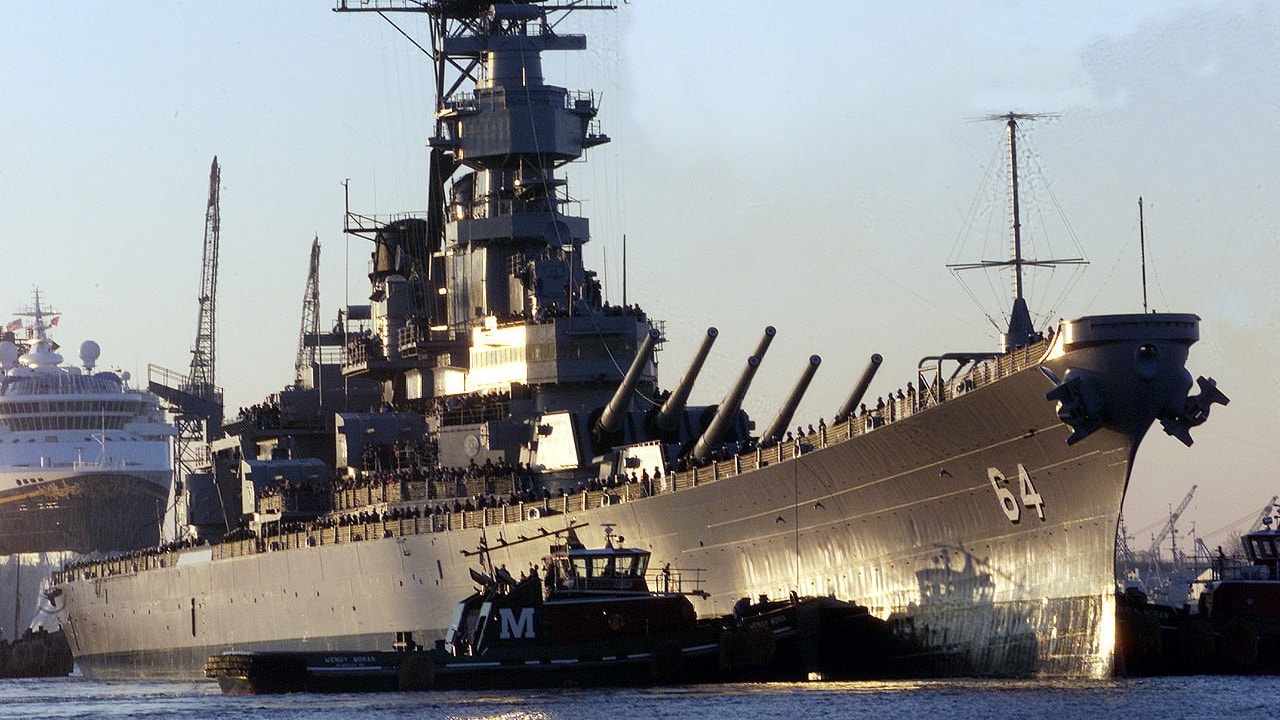
A tug boat nudges the bow of the battleship USS Wisconsin (BB 64) as the ship is pushed from the Norfolk Naval Shipyard to the Nauticus Museum in Norfolk, Va., on Dec. 7, 2000. The Wisconsin will be the centerpiece of a four-part exhibit on the battleship’s role in Naval history.
Original Design Did Have Aircraft
After Pearl Harbor, the Navy learned that the day of the aircraft carrier had come. The big battleships were still valuable, but they were no longer the kings of the seas.
In June 1942, plans were prepared to explore carrier conversions of warship hulls already under construction. These were Iowa-class hulls and would have produced ships similar in external appearance to the Essex-class.
Context is key. While the U.S. stopped the Japanese during the Battle of the Coral Sea and sank all four of Japan’s frontline carriers (the Akagi, Kaga, Sōryū, and Hiryū) during the Battle of Midway, the Japanese still held a numerical advantage in carriers. The U.S. had lost the Lexington (CV-2) in the Coral Sea and the Yorktown (CV-5) during Midway.
That left the U.S. with just two carriers, the Enterprise (CV-6) and the Hornet (CV-8). Japan had two fleet carriers and four light carriers. The Hornet would be sunk during the Battle of Santa Cruz in October 1942.
The U.S. sank one light carrier (the Shōhō) during the Coral Sea action. She was hit by at least 13 bombs and seven torpedoes and sank in four minutes. Nonetheless, the United States was desperately short of carriers in the Pacific, with only two usable flattops to cover a vast ocean. This may be why the Navy considered converting some battleship hulls into carriers.
In the 1970s, The Navy Wanted To Convert Battleships
In the late 1970s, proposals were made to convert the Iowa-class battleships into battlecarriers with a flight deck capable of supporting short take-off and vertical landing aircraft operations.
One specific proposal, known as the “Interdiction Assault Ship,” envisioned a V-shaped flight deck replacing the #3 turret, along with missile silos and upgraded gunnery.
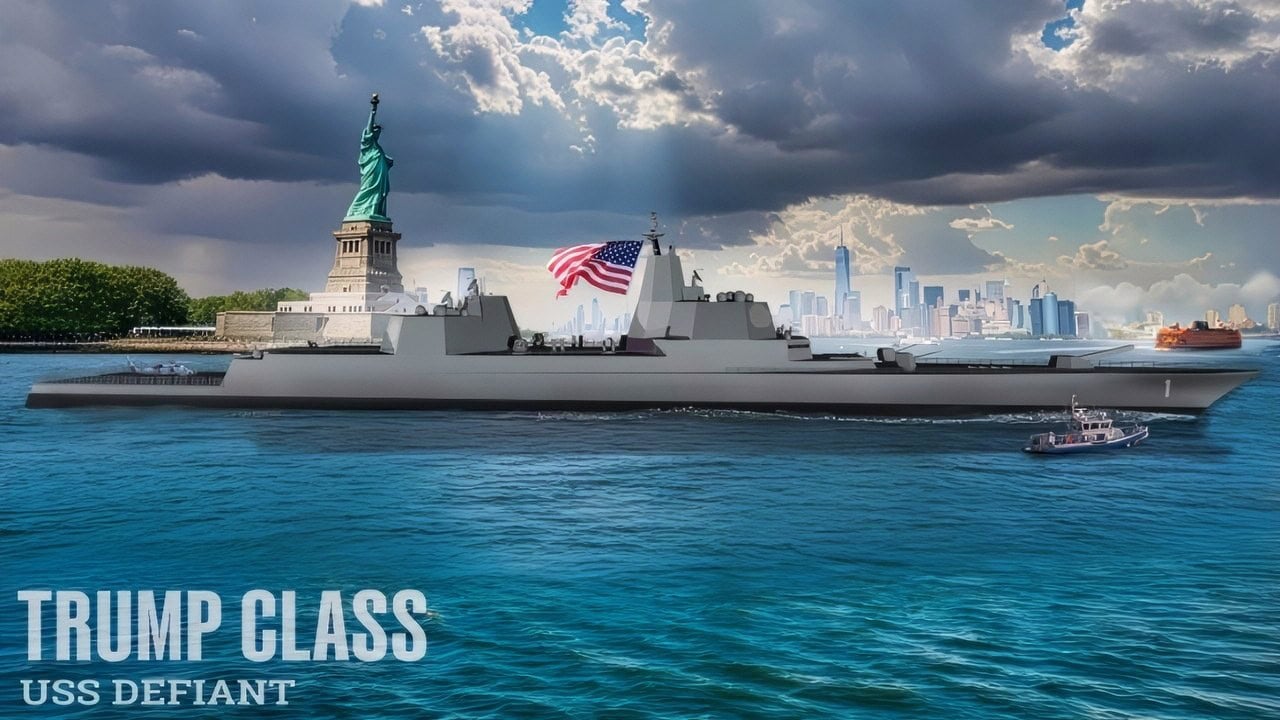
Trump-Class Battleship. Image Credit: Creative Commons/White House.
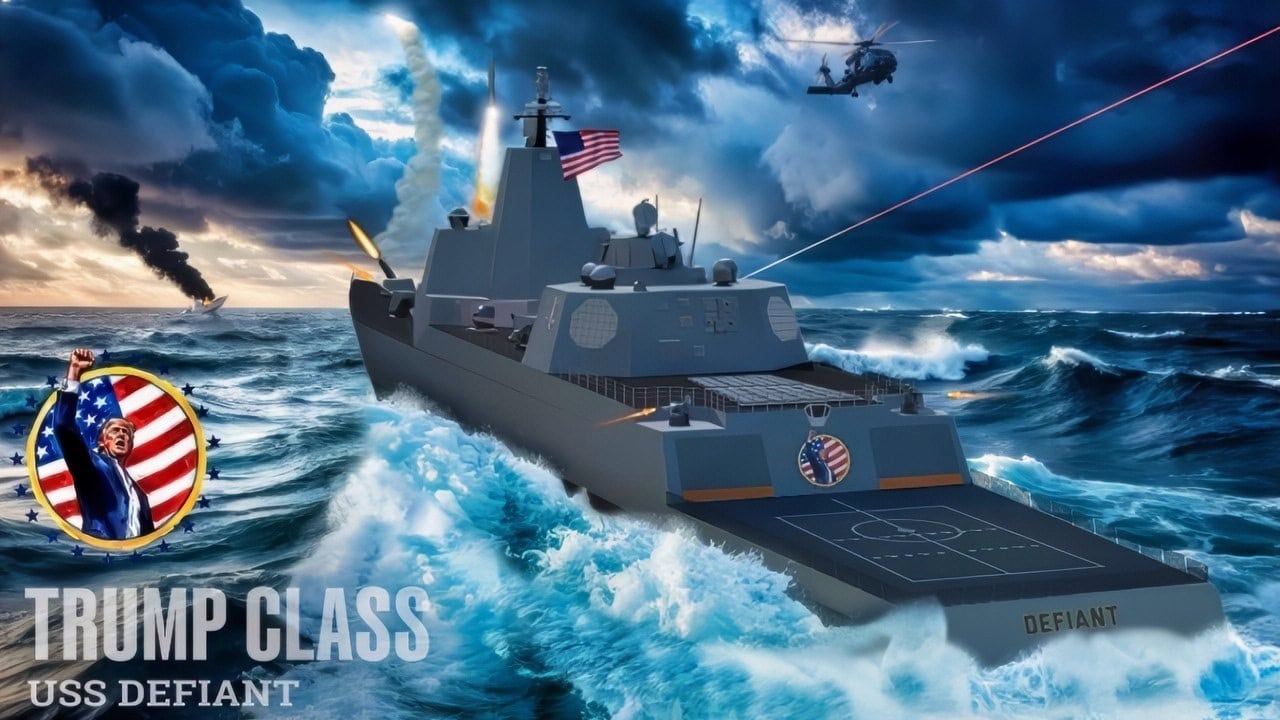
Trump-Class Battleship. Image Credit: Creative Commons/White House Photo.
The modifications would require a significant increase in armament. The V-shaped, ramped flight deck would be installed with the base of the V on the ship’s stern. Two elevators would bring Boeing AV-8B Harrier II jump-jets up from a new hangar to the flight deck. The battleships would support up to 12 Harriers.
Existing five-inch gun turrets would be removed and replaced with 155-mm howitzers for naval gunfire support.
In the space between the V would be a field of tactical missile silos, such as the MK 41. Up to 320 silos could fit in this space, supporting a mixture of land-attack missiles, anti-submarine rockets, and surface-to-air missiles.
This massive loadout would dwarf even the 154 Tomahawks found on today’s Ohio-class guided-missile submarines.
The hangar deck would accommodate 500 Marines who could be ferried to shore via helicopters and supported by Harriers, 155-mm howitzers, and the forward 16-inch guns. Unfortunately, this concept never materialized, and the Iowa-class battleships eventually were retired and repurposed as museum ships.
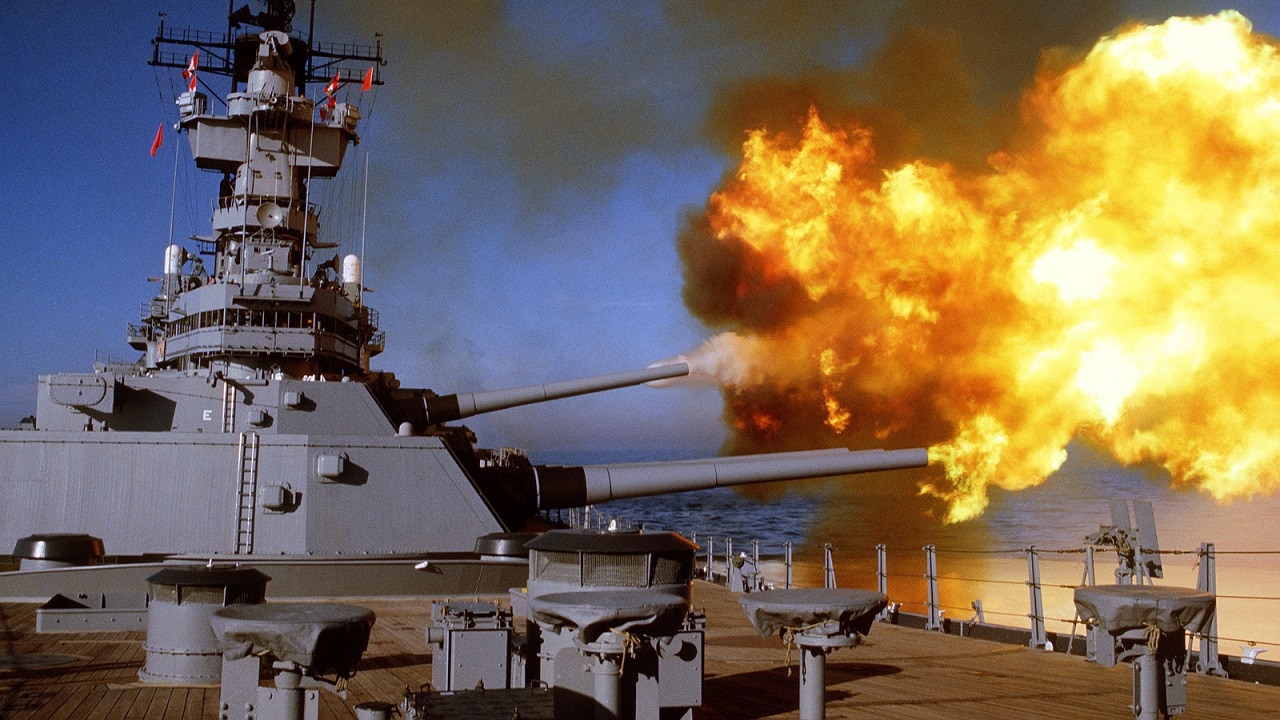
The Nos. 1 and 2 Mark 7 16-inch/50-caliber guns are fired to starboard during a main battery firing exercise aboard the battleship USS NEW JERSEY (BB-62).
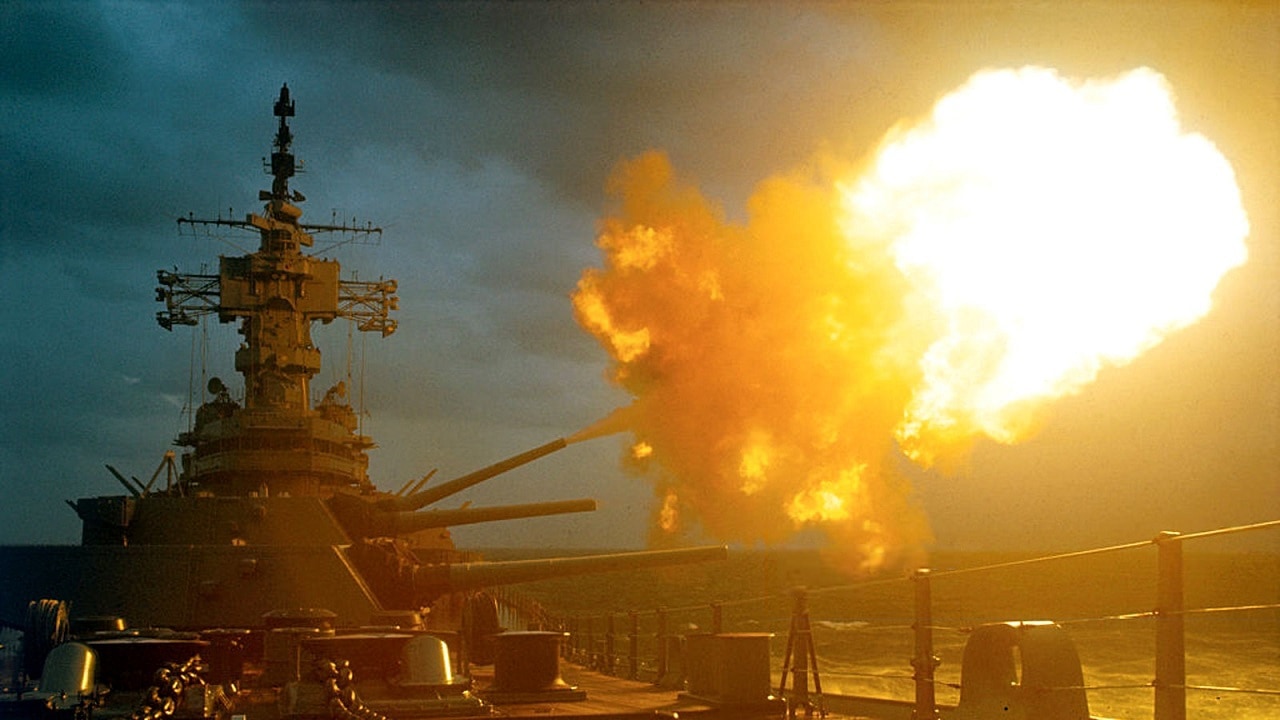
30 Sep 1968 — The battleship USS New Jersey fires its 16-inch guns into the demilitarized zone here 9/30. These were the first shells fired by the New Jersey in the Vietnamese war. The vessel is the only battleship on active duty in the U.S. Navy.
There is something nostalgic about the old battlewagons. We are enamored with those 16-inch guns, which evoke a feeling to which even the president isn’t immune.
“I look at those ships, they came with the destroyers alongside of them, and man, nothing was gonna stop them,” President Trump said. “Some people would say, ‘No, that’s old technology,’ I don’t know, I don’t think it’s old technology when you look at those guns.”
But those guns are from a bygone era. And the Trump-class battleship, like the battlecarrier, is a novel idea that should remain just that…and not be realized.
About the Author: Steve Balestrieri
Steve Balestrieri is a National Security Columnist. He served as a US Army Special Forces NCO and Warrant Officer. In addition to writing on defense, he covers the NFL for PatsFans.com and is a member of the Pro Football Writers of America (PFWA). His work was regularly featured in many military publications