
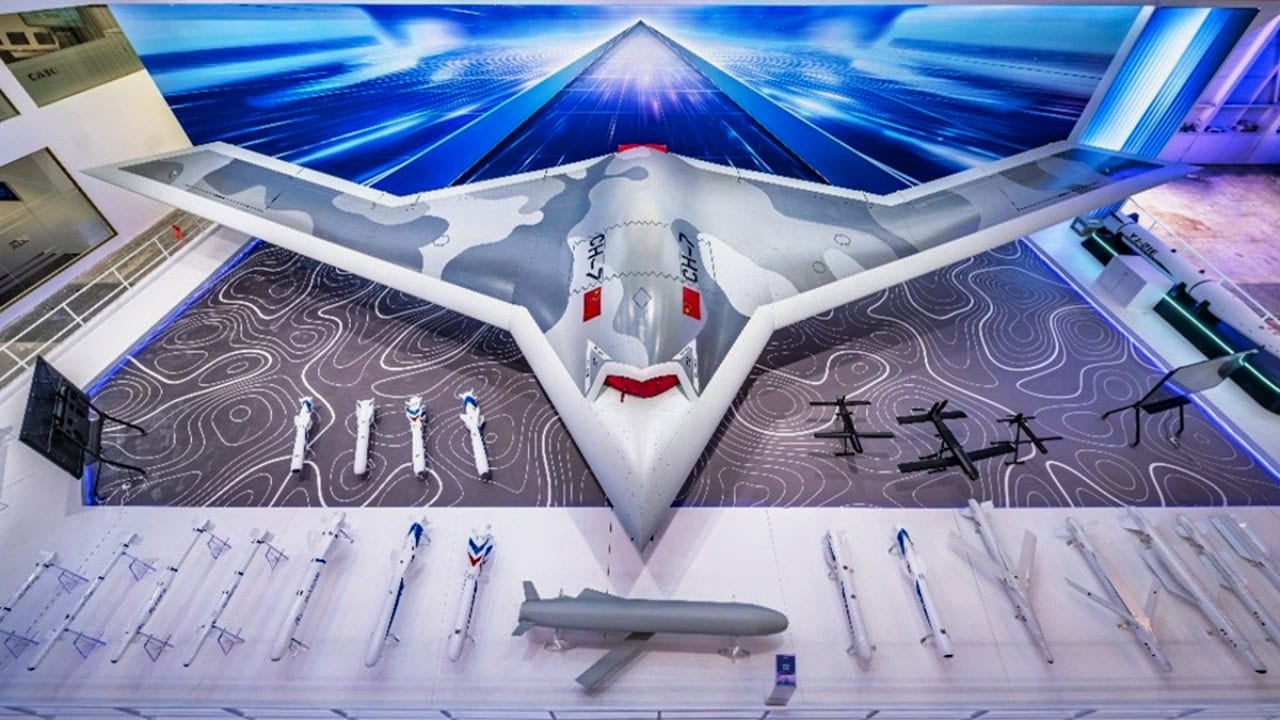
Summary and Key Points: China is building what amounts to an automated network of drones and sensors at industrial scale — outside what the U.S. has ever encountered.
-The Atlas Swarm-2, a truck-mounted launcher, can fire 48 drones in three-second intervals, creating a 96-drone swarm that communicates in real time with onboard AI handling terrain recognition and autonomous routing.
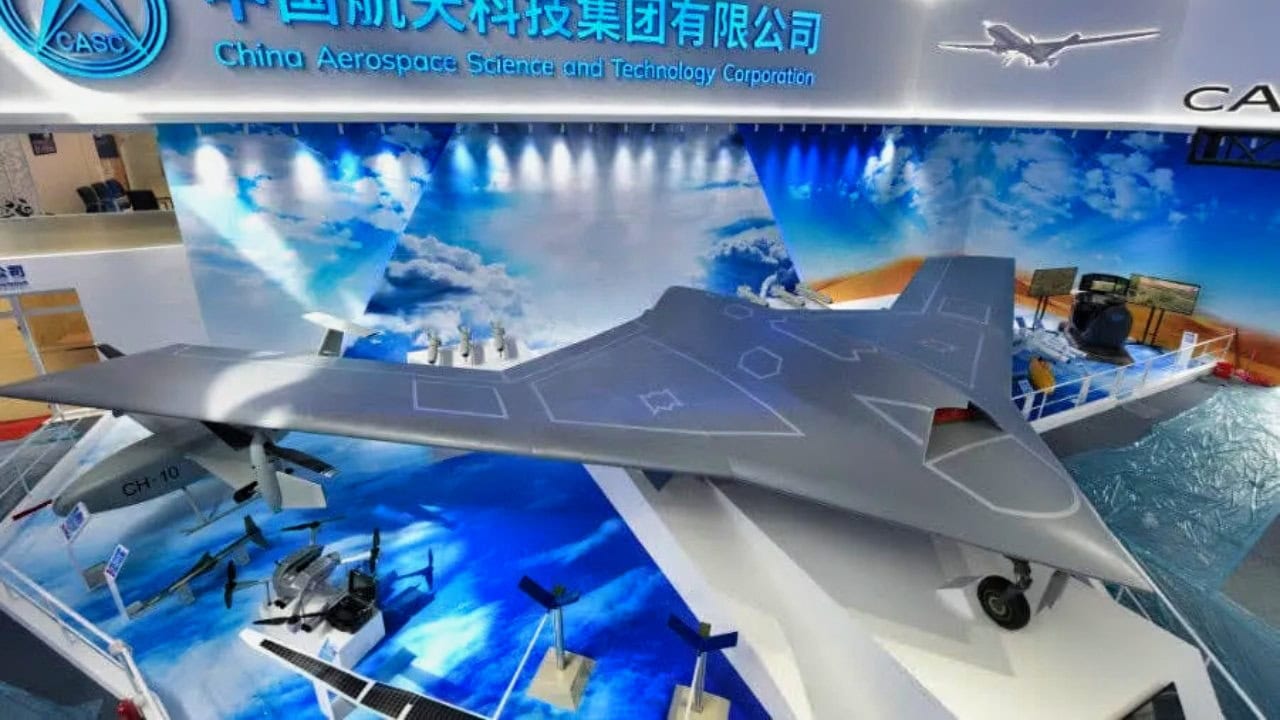
CH-7 Drone from China. Image Credit: X Screenshot.
-China’s Jiu Tian SS-UAV drone mothership has a 25-meter wingspan and carries 100 to 150 sub-drones. The WZ-8 Hypersonic Ghost reconnaissance drone is rocket-powered and reaches Mach 3 at 100,000 feet. The WZ-7 Soaring Dragon feeds targeting data to the DF-21D and DF-26 anti-ship missiles. An Arleigh Burke destroyer has only 90 to 96 vertical launch cells.
China: Drone Superpower?
The Chinese approach to warfare is increasingly focused on “intelligentized” warfare, algorithm-driven combat, autonomous networks, and industrial scale, which stands in stark contrast to the Western tradition of fielding expensive, concentrated platforms. In short, China is building an automated network of drones and sensors—an entire ecosystem consisting of quadcopters, loitering munitions, and drone motherships. The result is an automated system at a scale far beyond anything the US has ever encountered.
Intelligentized Warfare
The PLA is moving beyond simple information warfare towards something more thorough: AI-directed warfare. The goal is to make decisions at machine speed, using networked sensors and algorithm-assisted targeting.
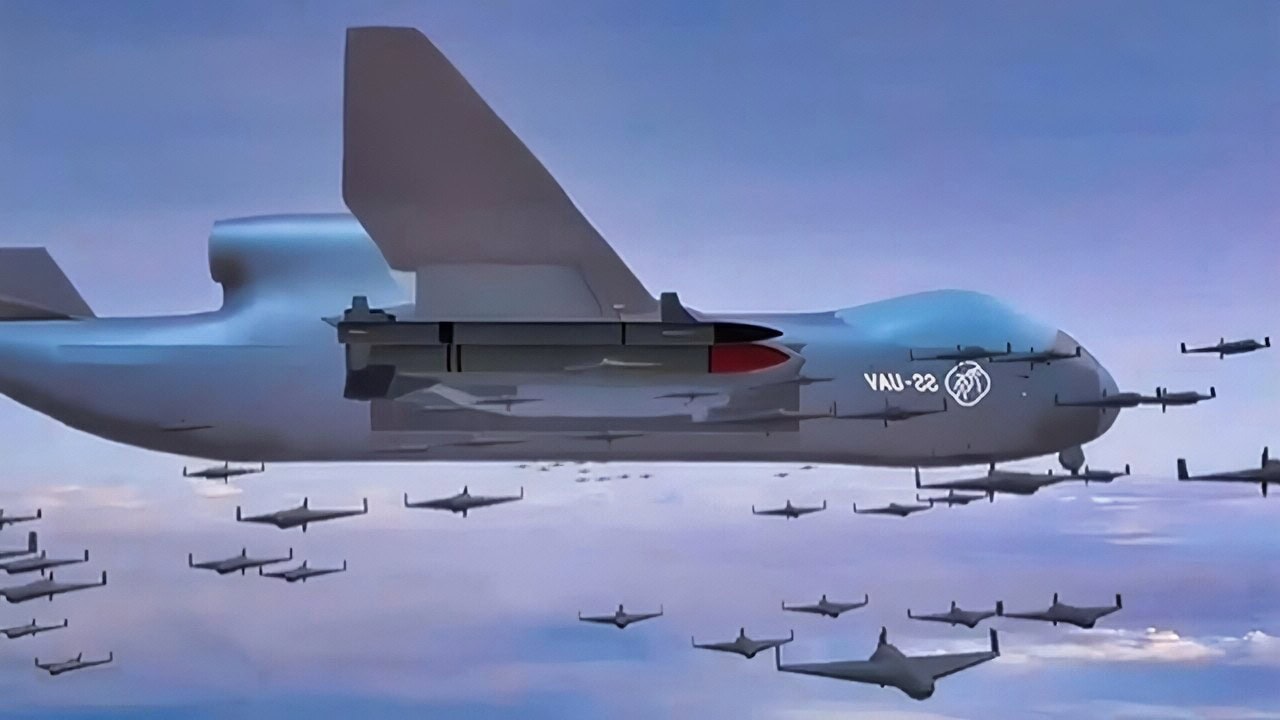
China Drone Aircraft Carrier. Image Credit: X Screenshot.
This has changed the role of the human in the system. Whereas before humans controlled every action, in the emerging Chinese model, humans establish the broader mission goals and allow AI to execute the mission details. For example, a human operator may direct the system to find and target naval targets; then, a drone swarm decides the routes, target allocation, attack sequencing, etc.—all the tactical stuff. Humans are increasingly being relegated to an oversight role, while software does the fighting.
Swarm Warfare
Validated in Ukraine, the Red Sea, and the Strait of Malacca, China is investing in swarm warfare. The Atlas Swarm-2 vehicle in particular is of concern. This truck-mounted launch system can launch 48 drones in three-second intervals, creating a swarm of up to 96 drones operating together.
This swarm can communicate in real time to identify targets and engage; each drone has onboard AI capable of terrain recognition and autonomous routing. These Atlas drones are far more advanced than traditional drones, which were essentially remote-controlled aircraft; the Atlas swarm is a distributed robotic team that operates as a single organism.
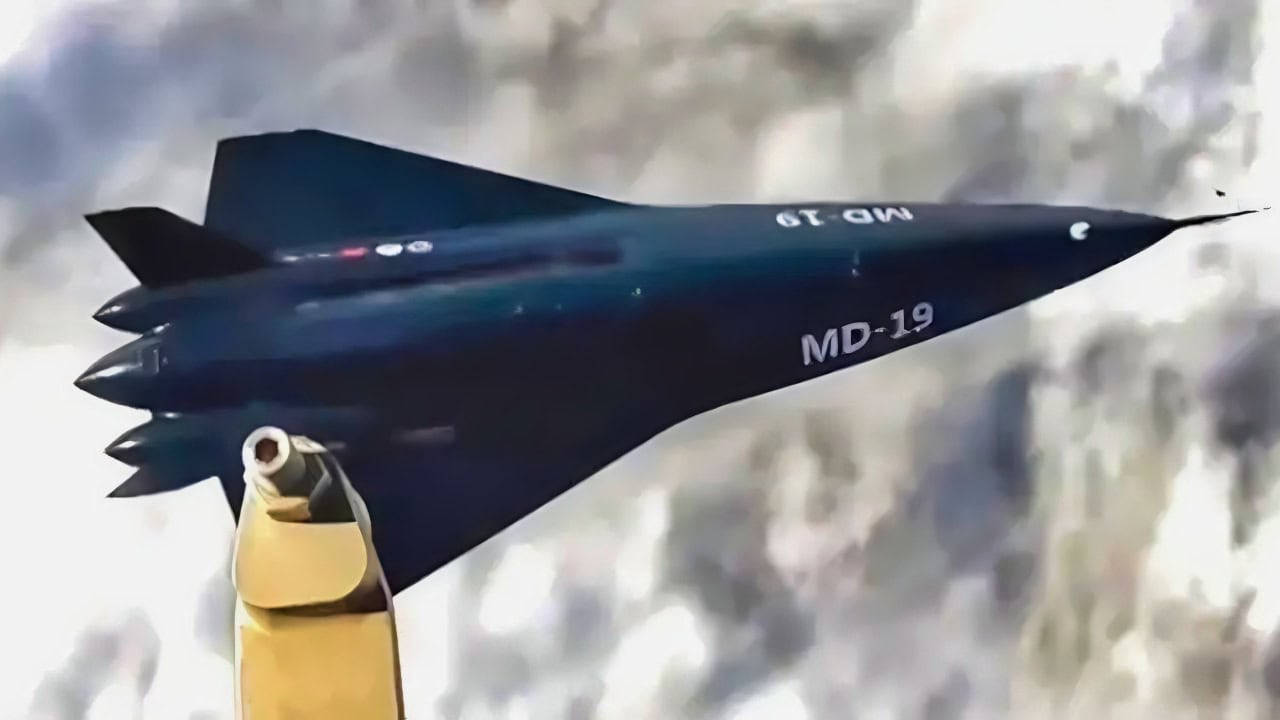
MD-19 Drone from China. Image Credit: Creative Commons.
The Mothership Concept
China has built a drone “mothership,” the Jiu Tian SS-UAV, with a 25-meter wingspan and an internal payload of 100–150 sub-drones.
Operating as a force multiplier, the Jiu Tian flies and releases its swarm package of sub-drones, which then self-organize into a swarming network and attack targets.
The sub-drones rely on an open architecture router that dynamically routes data between drones. So even if Chinese satellite links die, the drone network survives. This survivable system is functionally a flying aircraft carrier.
High-End Recon
China is fielding a variety of high-end reconnaissance drones. The WZ-8 “Hypersonic Ghost” is rocket-powered and capable of hitting Mach 3 and 100,000 feet of altitude. Operating at such extreme altitudes, the WZ-8 is difficult to intercept while performing reconnaissance and naval mapping.
Meanwhile, the WZ-7 Soaring Dragon is a HALE (High Altitude Long Endurance) platform featuring a joined-wing configuration. Responsible for maritime surveillance—specifically, tracking carrier strike groups—the WZ-7 feeds targeting data to Chinese anti-ship missiles like the DF-21D and DF-26. And lastly, the CH-7 stealth drone is a flying wing measuring 26 meters, built for deep penetration and long-endurance ISR. Each of these reconnaissance drones is a strategic system that supports China’s A2/AD architecture.
Industrial Scale
Arguably, China’s biggest advantage here is not the drones themselves, but the ability to manufacture them at scale. China has a robust manufacturing ecosystem with a massive civilian production base.
China also enjoys a coherent military-civil fusion whereby the military adapts civilian technology, which then enters mass production. China has both the ambition and the production base to produce millions of drones. China seems to believe, understandably, that future conflicts will be wars of scale and attrition, and that mass-producing $20K drones is sustainable and effective, and more cost-efficient than the sophisticated multi-million-dollar interceptor systems that will be fielded as a counter-effort. China’s factory system enables a highly asymmetrical advantage.
The US historical model, meanwhile, is to award civilian tech companies a government contract, which initiates years of testing and eventually production and fielding. The model is time-intensive and expensive.
Chinese industry also enjoys advantages in carbon fiber and battery construction. Commercial Chinese drone production has perfected carbon-fiber monocoque structures, which are lighter, stronger, and cheaper, and streamlined manufacturing in a way that reduces labor requirements.
In terms of batteries, China’s EV and civilian drone industries have spurred lithium-sulfur research and the development of high-energy-density batteries, enabling drone warfare; specifically, small tactical drones can fly longer, loiter longer, and carry larger payloads without increasing their size.
Complicating US Operations
The geography of the Indo-Pacific heavily favors China over the US; China would effectively be fighting in its backyard. The Taiwan Strait is only 100 miles wide, meaning China would not need strategic airlift, long supply chains, or extensive aerial refueling.
China could simply launch its drones from mainland bases, coastal facilities, or even civilian vessels. And China’s drone ecosystem would severely complicate the traditional US carrier strategy, where aircraft are launched to establish air superiority in the area.
The US will have to contend with Chinese surveillance drones, like the WZ-7, which can continuously patrol and scan the ocean surface, tracking naval movements and potentially hindering US access to the region. Historically, US carriers could disappear into the Pacific expanse. But increasingly, carriers are vulnerable to detection from persistent drone reconnaissance platforms, which then transmit coordinates to sophisticated missile systems.
The scale of Chinese drone systems also presents a problem.
Consider the Arleigh Burke destroyer, with roughly 90–96 VLS cells, carrying SM-2, SM-6, Tomahawks, etc. These cells are finite and cannot reload in combat at sea. So in a scenario where one hundred-plus drones approach, and the destroyer fires interceptors and exhausts its finite stores, the destroyer is rendered useless. And once that line of defense is compromised, China can launch a main attack, potentially including anti-ship missiles, ballistic missiles, or aircraft.
The Problem with Fixed Bases
To operate in the far-flung Indo-Pacific, the US is highly dependent on fixed bases like Guam and Okinawa. But because these bases are fixed, Chinese reconnaissance drones can identify aircraft concentrations, fuel farms, parked aircraft, etc., and then direct missile strikes with approximate intelligence. If these bases are compromised, it forces US aircraft such as the F-35 to operate from farther away, making them more dependent on tankers like the KC-46 and KC-135. These tankers then become absolutely critical.
But tankers are not stealthy; they’re slow, with a massive radar signature, and likely to be targeted.
And if US forces lose the ability to refuel, their sortie rates will collapse. The longstanding US assumption of fighting through technological superiority is being challenged by the Chinese approach of fielding scale and automation to absorb attrition and leverage favorable geography.
About the Author: Harrison Kass
Harrison Kass is a writer and attorney focused on national security, technology, and political culture. His work has appeared in City Journal, The Hill, Quillette, The Spectator, and The Cipher Brief. He holds a JD from the University of Oregon and a master’s in Global & Joint Program Studies from NYU. More at harrisonkass.com.