
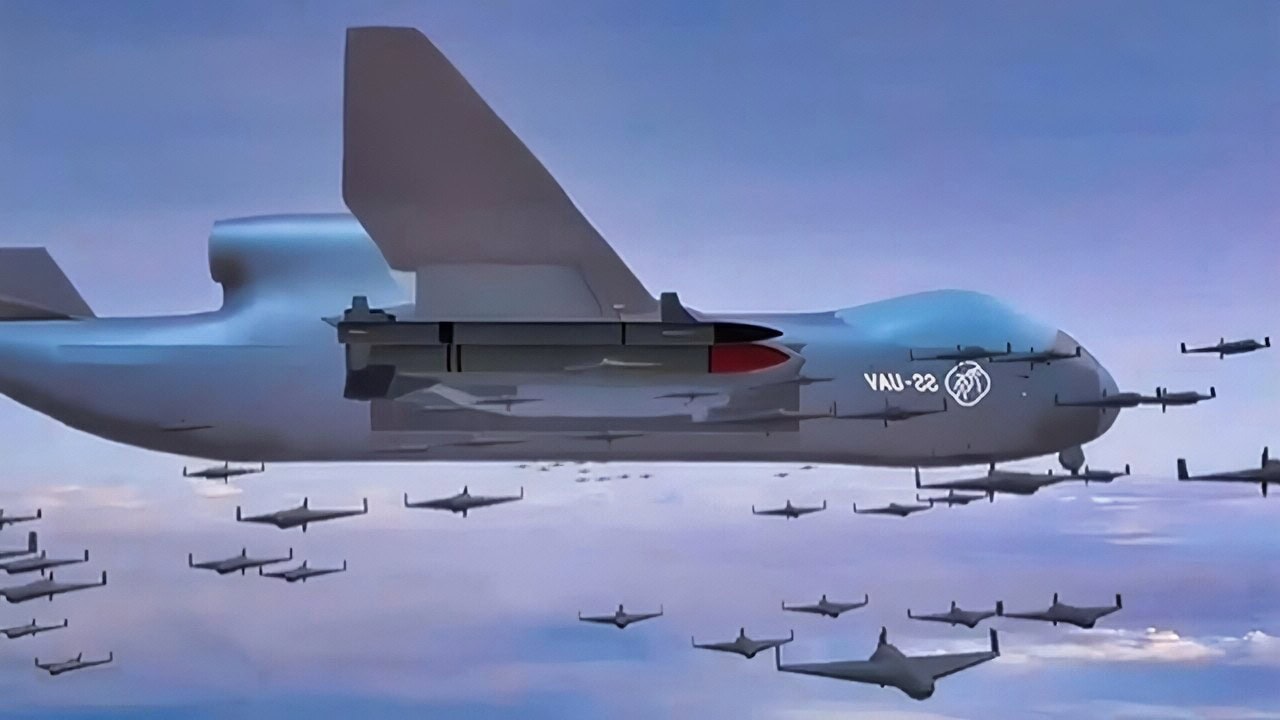
Key Points and Summary – China’s Jiutian “drone carrier” has completed its maiden flight, marking a new step in Beijing’s push toward swarming unmanned warfare.
-Official messaging frames Jiutian as a civil, modular workhorse, but the platform’s real significance is its potential to act as a mothership for smaller drones, sensors, and weapons.
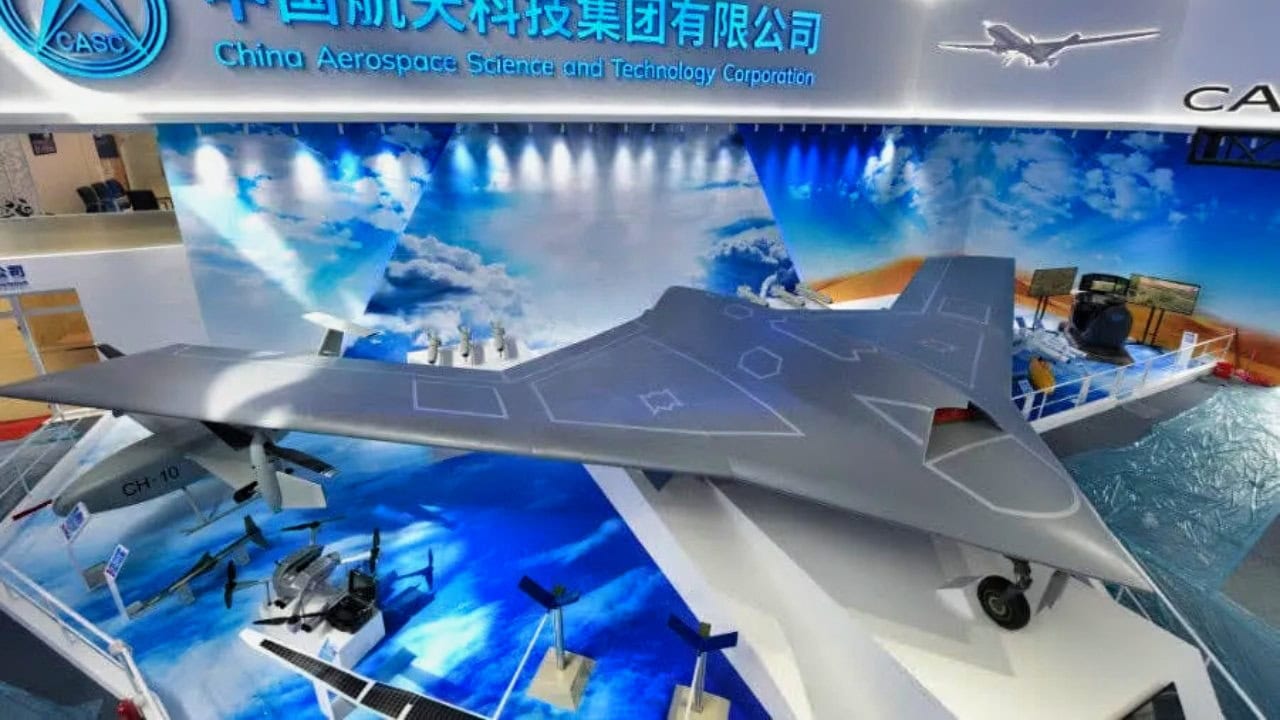
CH-7 Drone from China. Image Credit: X Screenshot.
-AVIC-reported figures describe a large jet UAV—16.35 meters long with a 25-meter wingspan—able to stay aloft up to 12 hours and ferry roughly 7,000 kilometers.
-With a 16-ton maximum takeoff weight and a 6,000-kilogram payload, it could support ISR, relay, logistics, or massed drone launches in the Western Pacific near Taiwan today.
China’s Jiutian “Drone Aircraft Carrier” Has a Message: The Swarm Era Is Here
As reported by Xinhua, Jiutian, a new Chinese platform described as “a large unmanned aerial vehicle (UAV),” made its maiden flight on Thursday. Xinhua attributed the news to the Aviation Industry Corporation of China.
The Jiutian (“Nine Heavens” or “High Sky”) is a large drone that can act as a carrier for smaller drones. It made its first appearance at the Zhuhai Airshow a little over a year ago.
Xinhua shared some details about the maiden flight.
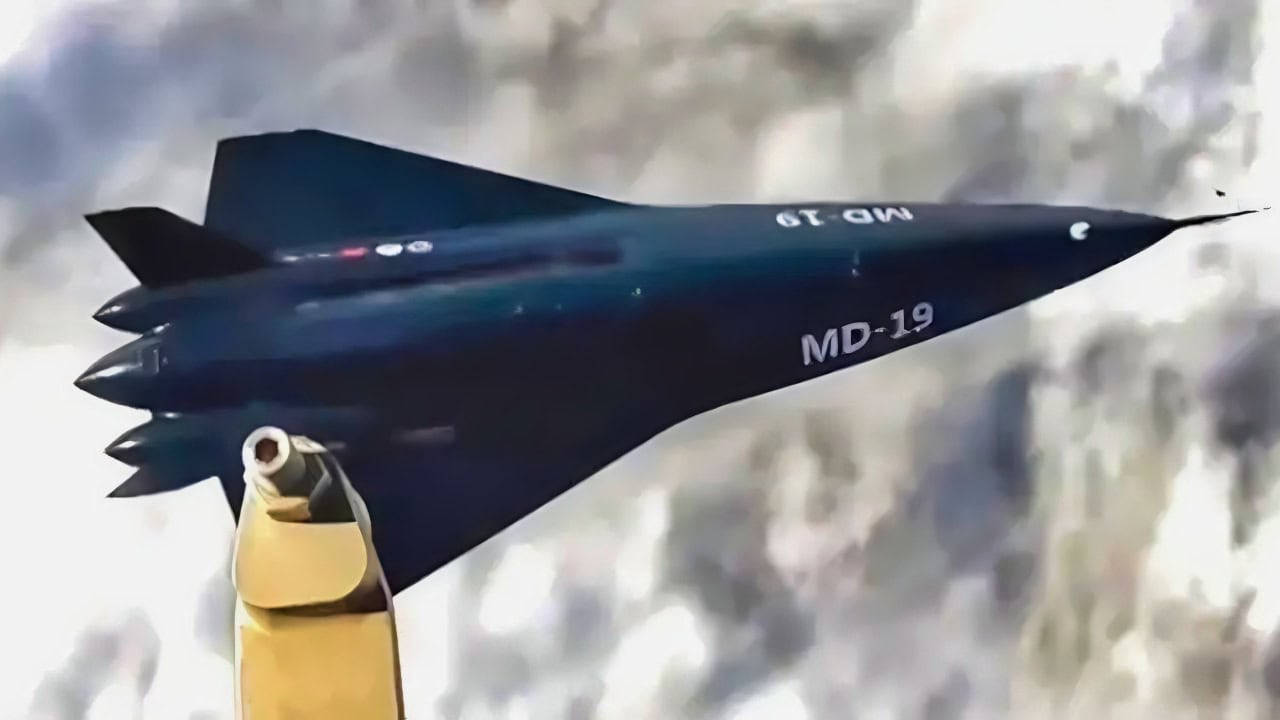
MD-19 Drone from China. Image Credit: Creative Commons.
“The domestically developed general-purpose drone, measuring 16.35 meters in length and 25 meters in wingspan, took to the skies in Pucheng, northwest China’s Shaanxi Province,” the news agency reported. “This aircraft boasts a maximum takeoff weight of 16 tonnes and a payload capacity of 6,000 kilograms. It can operate for up to 12 hours with a ferry range of 7,000 kilometers, according to the AVIC, its designer.”
The report emphasized the aircraft’s capabilities.
“Featuring a large payload, high operational ceiling, wide speed range, and short takeoff and landing capabilities, the UAV is designed for diverse civil missions,” Xinhua reported. “Its modular payload system enables roles ranging from precise deliveries of heavy cargo to remote regions, to emergency communication and disaster relief, to geographic surveying and resource mapping.”
Images surfaced on social media of Jiutian’s maiden flight.
The Swarm is Here
While the Chinese announcement emphasizes the civil aspects of the new aircraft, The War Zone points to the many potential military missions made possible by the Jiutian.
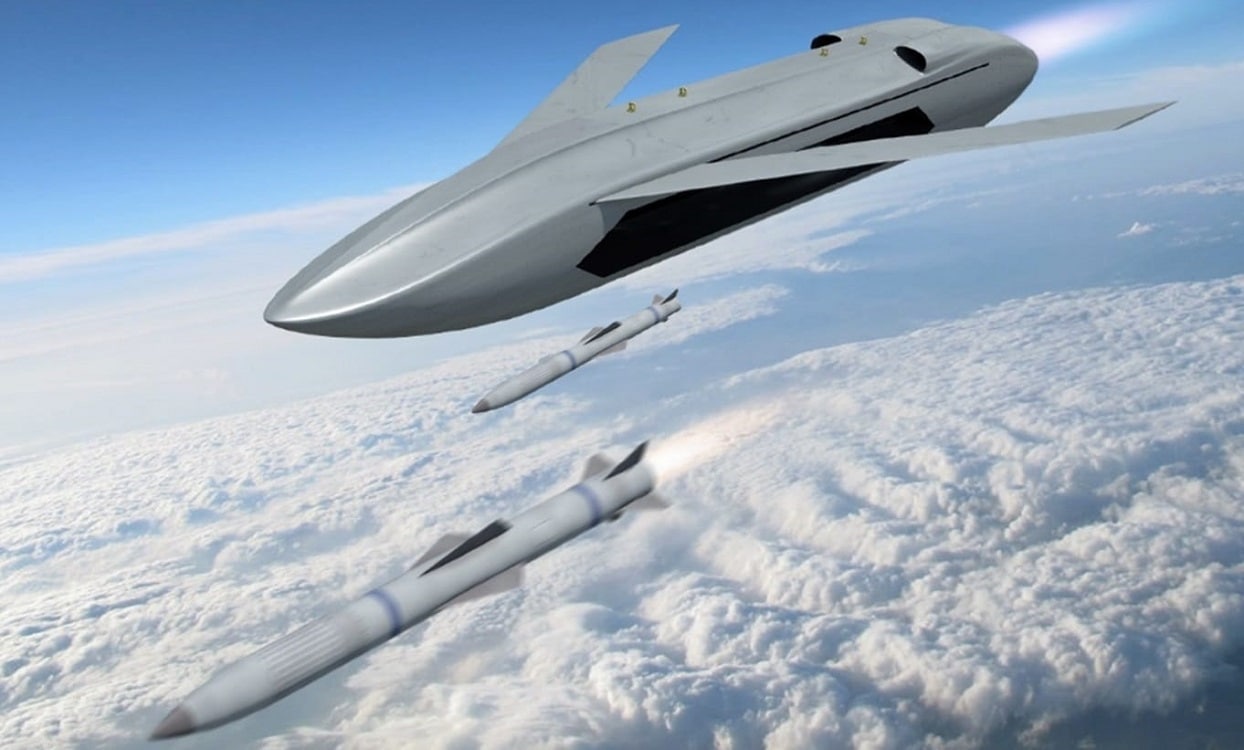
“A key mission for the design is expected to be acting as a mothership for swarms of smaller uncrewed aerial systems,” TWZ said of the aircraft. “It has also been shown previously armed with various air-to-surface and air-to-air munitions, and could perform a variety of other missions, including airborne signal relay and logistics.”
TWZ also looked at the aircraft’s design.
“In terms of its general configuration, Jiutian has a high-mounted wing with a very minimal sweep and small winglets at the tips, as well as an H-shaped tail,” the outlet said. “It has a single jet engine mounted in a nacelle on top of the rear fuselage. Its tricycle landing gear includes main units that retract into sponsons under the wings.”
When the Jiutian debuted at the airshow in November 2024, TWZ noted, it had a Chinese phrase inscribed on its side stating “ascension of the beehive mission module.”
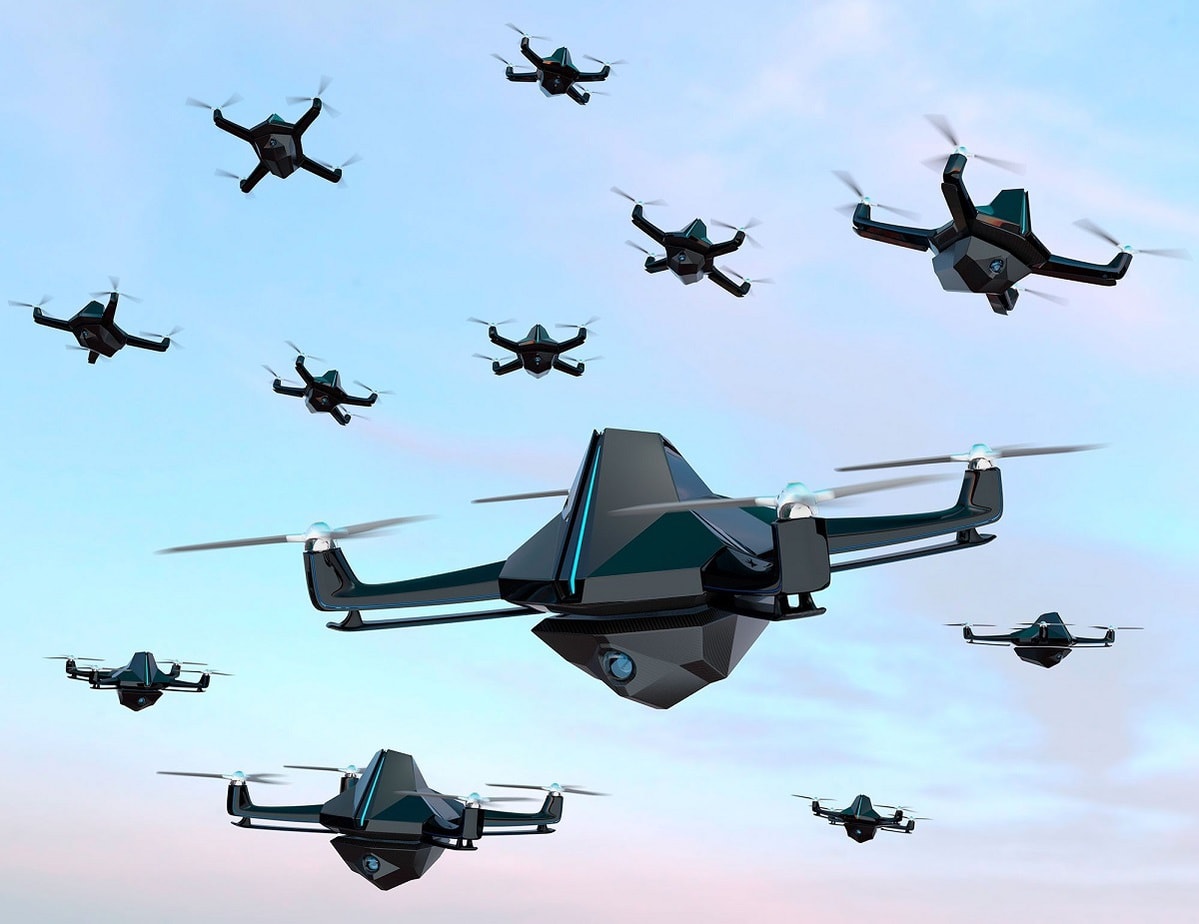
U.S. Army drone swarm. Image: Creative Commons.
Drone Swarm. Image: Creative Commons.
TWZ explained why China might want swarming capability.
“Having a platform capable of delivering a swarm of drones within hundreds of miles of a particular area would offer huge advantages, especially for attacking ships at sea, island outposts, and other distributed or dispersed target sets,” the outlet said. “Even the most modern warships in service in the United States and elsewhere today notably lack any real ability to defend against a high-volume attack of this kind.”
Civilian roles are also likely.
“It’s worth pointing out that AVIC’s heavy focus on non-military missions for Jiutian underscores the significant overlap between the military and commercial ends of China’s aerospace industry, as well as the role that ostensibly civilian research institutions often play,:” TWZ reported.
According to Aerospace Global News, Chinese state television had previously shown a rendering of the new aircraft “launching a swarm of drones,” in a way that resembles the ones Ukraine launched in Operation Spiderweb.
Bringing the Swarm to Taiwan?
The Center for Naval Analyses (CNA) analyzed the possibility of China using “UAV swarms” in future military conflict—particularly in a potential invasion of Taiwan.
“The PRC has been developing and testing uncrewed platforms since the 1960s but has largely lagged behind the world’s leading military powers technologically in uncrewed systems, particularly in autonomous and semi-autonomous drone swarm research,” according to CNA. “An examination and analysis of PRC writings from 2019 through 2024 indicates an intent to accelerate and advance the People’s Liberation Army’s (PLA’s) development, testing, and use of uncrewed systems, especially for drone swarm technology, in part because of the perceived threat from advancements in U.S. drone capabilities.”
And yes, Taiwan appears to be the impetus, along with the rising importance of drone warfare around the world:
“PRC writings from the past four years demonstrate that the PLA is exploring the use of uncrewed systems and testing drone swarm technology for use in a possible invasion of Taiwan. In addition, the PRC is examining militaries’ use of drones and drone swarms to develop its own counter–drone swarm methods and technologies.”
An Old Idea, Reimagined
According to Aerospace Global News, the “flying carrier” reimagines a very old idea.
“In the 1920s, it was unclear if aircraft carriers should be ships or aircraft,” AGN wrote. “The US Navy built two Akron-class airships (USS Akron and USS Macon) that carried five parasitic Curtiss F9C ‘Sparrowhawk biplanes. These airships were able to both launch and recover the aircraft.”
In the age of drones, the idea has been revived. And it’s not only China that is doing it. In a trial this fall, the United States launched a Switchblade 600 loitering munition from an MQ-9A Reaper, AGN reports. Carried out by the weapons’ manufacturers, General Atomics Aeronautical Systems and AeroVironment, the tests took place at the U.S. Army’s Yuma Proving Grounds in Arizona.
According to Army Recognition, “the test validates a new operational capability that transforms the MQ-9A from a traditional remotely piloted strike asset into a networked, long-range launch platform for precision loitering weapons. The demonstration marks a decisive step in the U.S. military’s shift toward modular, risk-tolerant, and distributed lethality across contested theaters.”
About the Author: Stephen Silver
Stephen Silver is an award-winning journalist, essayist, and film critic, and contributor to the Philadelphia Inquirer, the Jewish Telegraphic Agency, Broad Street Review, and Splice Today. The co-founder of the Philadelphia Film Critics Circle, Stephen lives in suburban Philadelphia with his wife and two sons. For over a decade, Stephen has authored thousands of articles that focus on politics, national security, technology, and the economy. Follow him on X (formerly Twitter) at @StephenSilver, and subscribe to his Substack newsletter.