According to estimates, the number of Chinese spies on Taiwan is about 5,000. But the island nation’s former Military Intelligence Bureau Director, Liu Te-liang, says that number is far too low. That earlier estimate, he told the China Times, came several years ago and is now outdated.
Liu’s assessment is that the intelligence services of the People’s Republic of China (PRC), most notably the Ministry of State Security (MSS), are increasingly active and aggressively expansionist, have more assets than in past years, and that the number of Chinese spies active in Taiwan is probably much higher.
The MSS is without equal in its size and invasiveness. Calder Walton, a prominent intelligence historian, describes the vast resources dedicated to China’s espionage activities by saying that today “China and its spies are like the Soviet Union on steroids,” and that Beijing’s activities abroad “make Soviet efforts during the Cold War look low-energy.”
Citing an anonymous official source from the FBI, among other specialists, Walder writes that the MSS today employs 800,000 personnel. This would compare with the approximately 480,000 officers who were used by the KGB at the height of its presence abroad during the Cold War.
The estimations thus show the MSS operating worldwide at a scale that has not been witnessed in decades.
The Life (and Work) of the Party
Another organization acts as an adjunct to the MSS and has its own role in China’s espionage activity.
Called the United Front Work Department of the Communist Party of China, this group is as much a growing concern for Western nations as is the increasing numbers of advanced weapons systems China manufactures.
The United Front was considered so vital to the life of the Chinese Communist Party that the founder of the nation, Mao Zedong, referred to it as a “magic weapon.” Audrye Wong, an assistant professor of politics at the University of Southern California, told the BBC in December 2024 that the “United Front work can include espionage but [it] is broader than espionage.”
Wong said that “beyond the act of acquiring covert information from a foreign government, United Front activities center on the broader mobilization of overseas Chinese.” She also observed that the PRC is “unique in the scale and scope” of providing state support and financing for such activity.
An Infiltration and Not Just Penetration
The deployment of so many United Front personnel abroad, including senior members of the organization who are given prestigious ambassadorial postings, prompted a BBC report to describe the department as a “well-documented arm of the Chinese Communist Party.”
That report adds that “investigators from the U.S. to Australia have cited the UFWD in multiple espionage cases, often accusing Beijing of using it for foreign interference.”
Liu explains that, with the current state of relations between Beijing and Taipei, he assesses the accurate number of infiltrated enemy agents is far higher than 5,000, as is commonly believed. If these spies “become embedded inside of ROC government agencies, the political parties, think-tanks, or major corporations” of the kind targeted by the MSS and United Front, this would represent an existential threat to Taipei.
Unlike their Chinese counterparts, in Taiwan law enforcement and counterintelligence agencies operate on the basis of rule of law. Because of these parameters, Liu told the ROC press outlet, it can require two to three years to gather sufficient evidence for an espionage case to go to trial.
Recent spy cases presented by Taiwan’s national security services are “a positive sign,” he said, indicating that national security agencies are still capable of the counterintelligence mission, but they require more personnel and a higher budget to accomplish their mission.
Third Nation Channels
That counterintelligence mission is more complicated than one might think.
It was former Deputy Minister of National Defense Lin Chong-pin who originally estimated that the number of Chinese spies in Taiwan likely exceeds 5,000. He supposed that number had already been reached during President Chen Shui-bian’s administration from 2000-2008.
But former National Security Bureau Secretary-General Wang Hsi-tien testified in a 2007 legislative hearing that the 5,000 figure were not all spies from the mainland, but included individuals who had illegally entered Taiwan over the years and were operating under the radar.
A retired senior intelligence official interviewed for the same China Times article said that one needs to distinguish between illegal immigrants and spies sent directly from the PRC, and claimed that the CCP rarely sends actual spies to Taiwan.
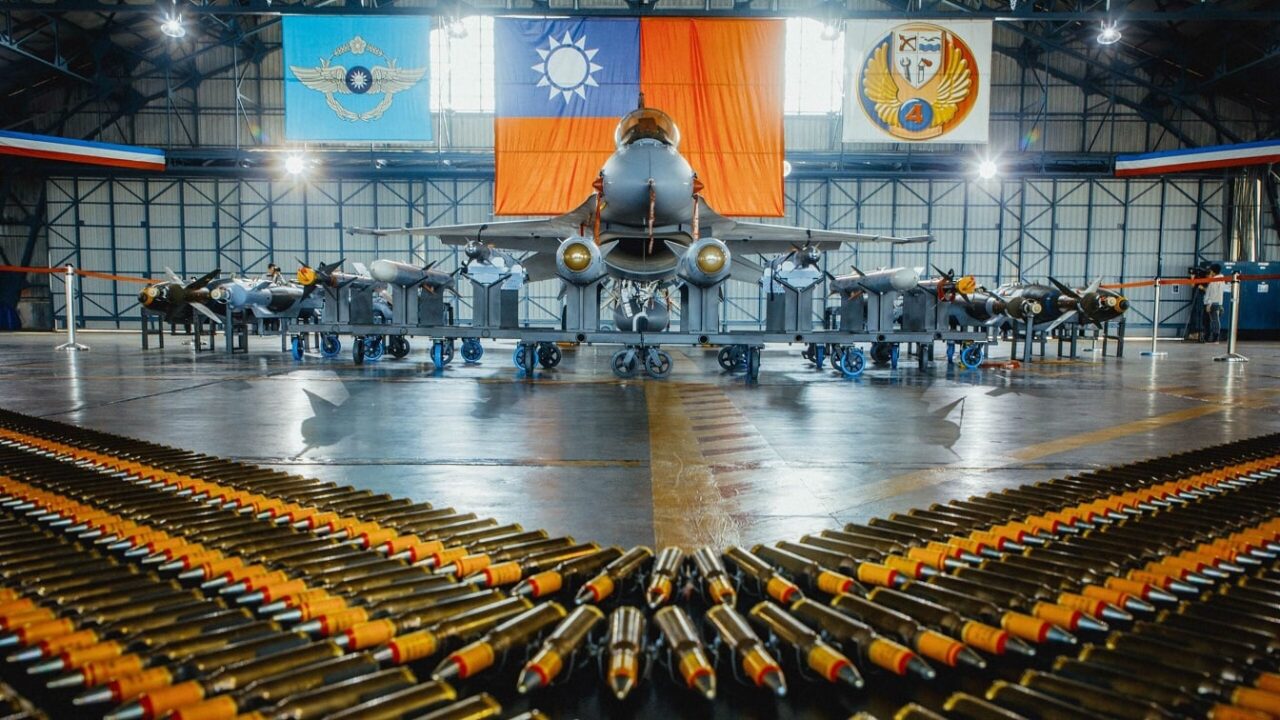
New Taiwan F-16V fighter jet. Image Credit: ROC government.
Instead, the source explained that Chinese spies in Taiwan usually operate from third countries, where they recruit agents for specific missions. He pointed to the espionage penetration involving former Army Major General Lo Hsien-che.
The investigation of this case revealed that all of Lo’s contacts with Chinese intelligence officers occurred in Thailand and elsewhere in Southeast Asia.
About the Author:
Reuben F. Johnson is a survivor of the February 2022 Russian invasion of Ukraine and is an Expert on Foreign Military Affairs with the Fundacja im. Kazimierza Pułaskiego in Warsaw. He has been a consultant to the Pentagon, several NATO governments and the Australian government in the fields of defense technology and weapon systems design. Over the past 30 years he has resided in and reported from Russia, Ukraine, Poland, Brazil, the People’s Republic of China and Australia.