
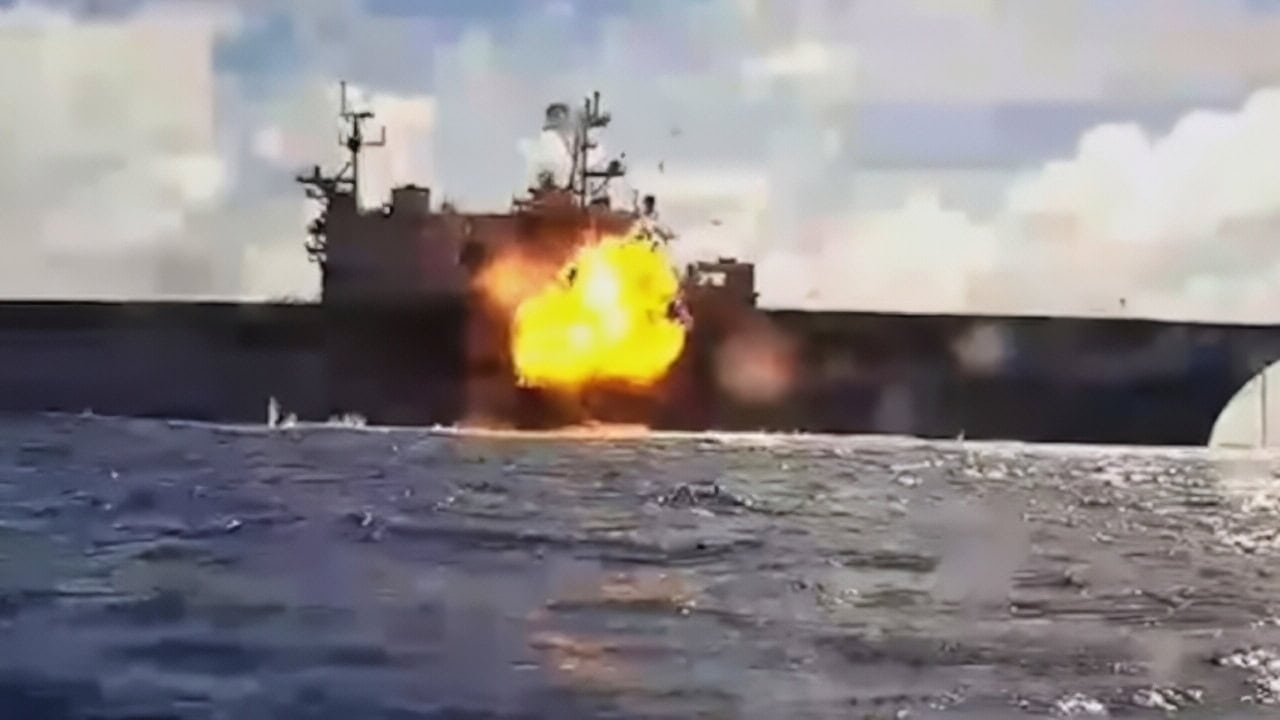
US Army Apaches and US Navy Uncrewed Boats Helped Sink Two Retired Warships at RIMPAC 2026 – RIMPAC 2026 used two retired U.S. Navy warships as full-size live-fire targets. The strike sequence against the decommissioned USS Mobile Bay began on July 11, and the Navy lists July 12 as the date the cruiser sank. Decommissioned USS Peleliu went down on July 17. Both now rest in 15,000 feet of water more than 50 nautical miles north of Kauai, according to the official exercise account.
How Two US Navy Warships Went Down in a Massive Drill Last Month
The targets did not leave Pearl Harbor in their former operating condition. Under Environmental Protection Agency requirements, qualified crews had to remove, to the maximum extent practicable, materials able to harm the marine environment.
Fuel tanks and lines were emptied and flushed, pollutants and detachable debris were removed, and older materials associated with PCBs received additional inspection and reporting.
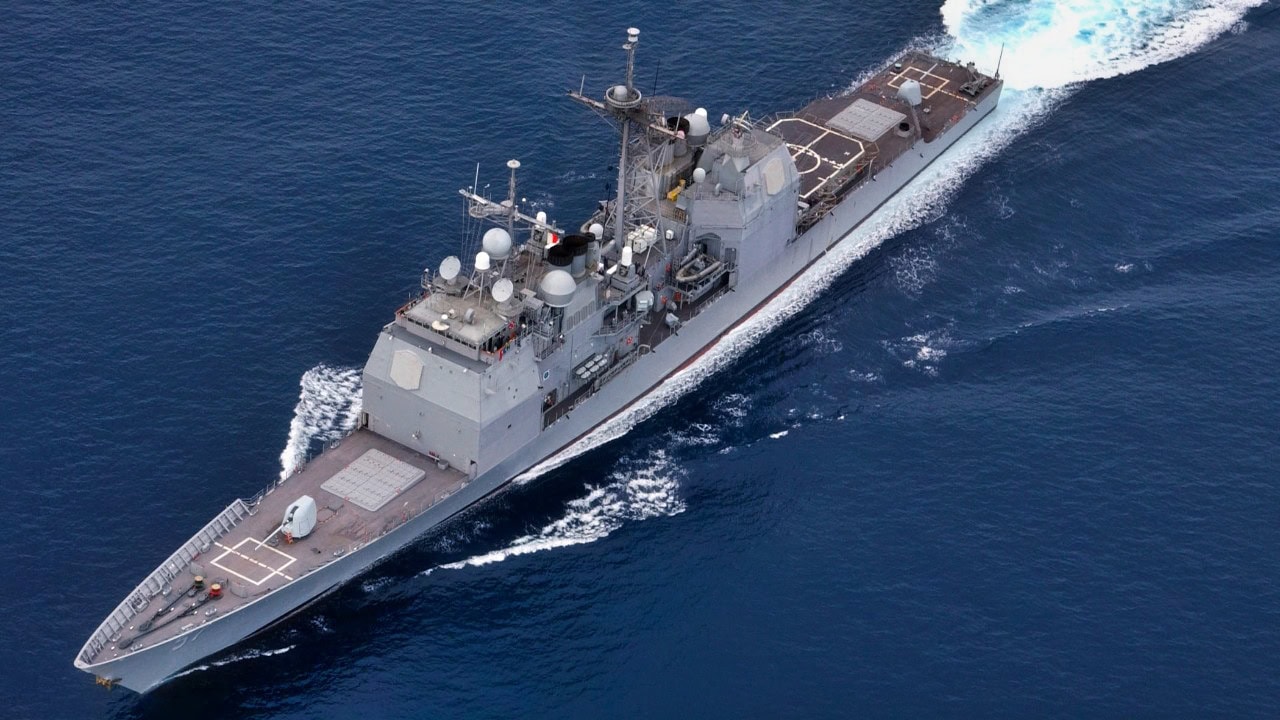
Ticonderoga-Class.
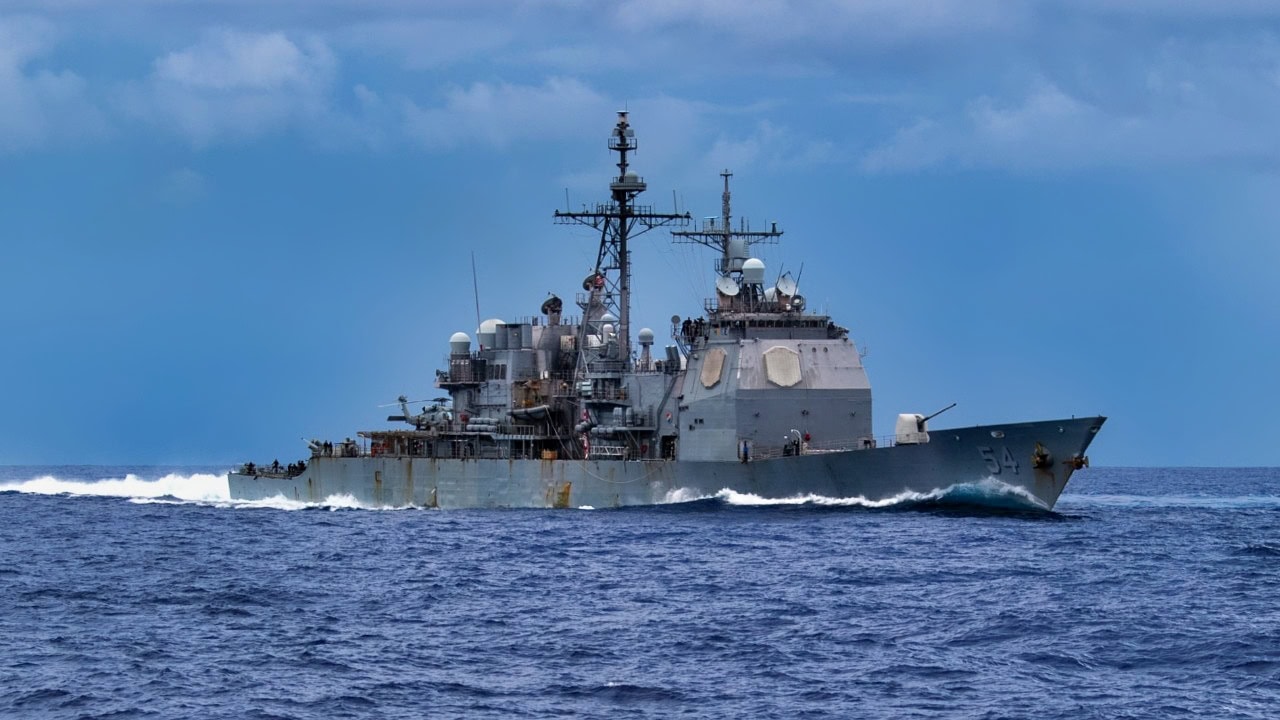
PACIFIC OCEAN (Sept. 14, 2020) The Ticonderoga-class guided-missile cruiser USS Antietam (CG 54) moves in formation during exercise Valiant Shield 2020. Valiant Shield is a U.S. only, biennial field training exercise (FTX) with a focus on integration of joint training in a blue-water environment among U.S. forces. This training enables real-world proficiency in sustaining joint forces through detecting, locating, tracking, and engaging units at sea, in the air, on land, and in cyberspace in response to a range of mission areas. (U.S. Navy photo by Mass Communication Specialist 2nd Class Nick Bauer)
Mobile Bay was the more unusual target. The Aegis cruiser, commissioned in 1987, served for more than 36 years and left active service only in August 2023. Peleliu was a nearly 40,000-ton amphibious assault ship decommissioned in 2015. The Ticonderoga class still has ships in frontline service, although the Navy is now in the final years of retiring the class.
RIMPAC, the largest recurring multinational maritime exercise, brought together 30 nations, 30 surface ships, five submarines, more than 190 aircraft and about 30,000 personnel. Aircraft have sunk warships for generations.
The change visible off Hawaii was the distribution of the attack across Army helicopters, land-based rocket and missile units, Navy aircraft, submarines, allied ships and expendable uncrewed surface craft.
Army Apaches and HIMARS Joined the Maritime Strike
On July 11, two Army AH-64 Apaches from the 16th Combat Aviation Brigade attacked Mobile Bay. One official image shows an Apache firing a Spike Non-Line of Sight missile over the Pacific. Soldiers from the Kentucky Army National Guard also launched rockets from an M142 HIMARS at Pacific Missile Range Facility Barking Sands.
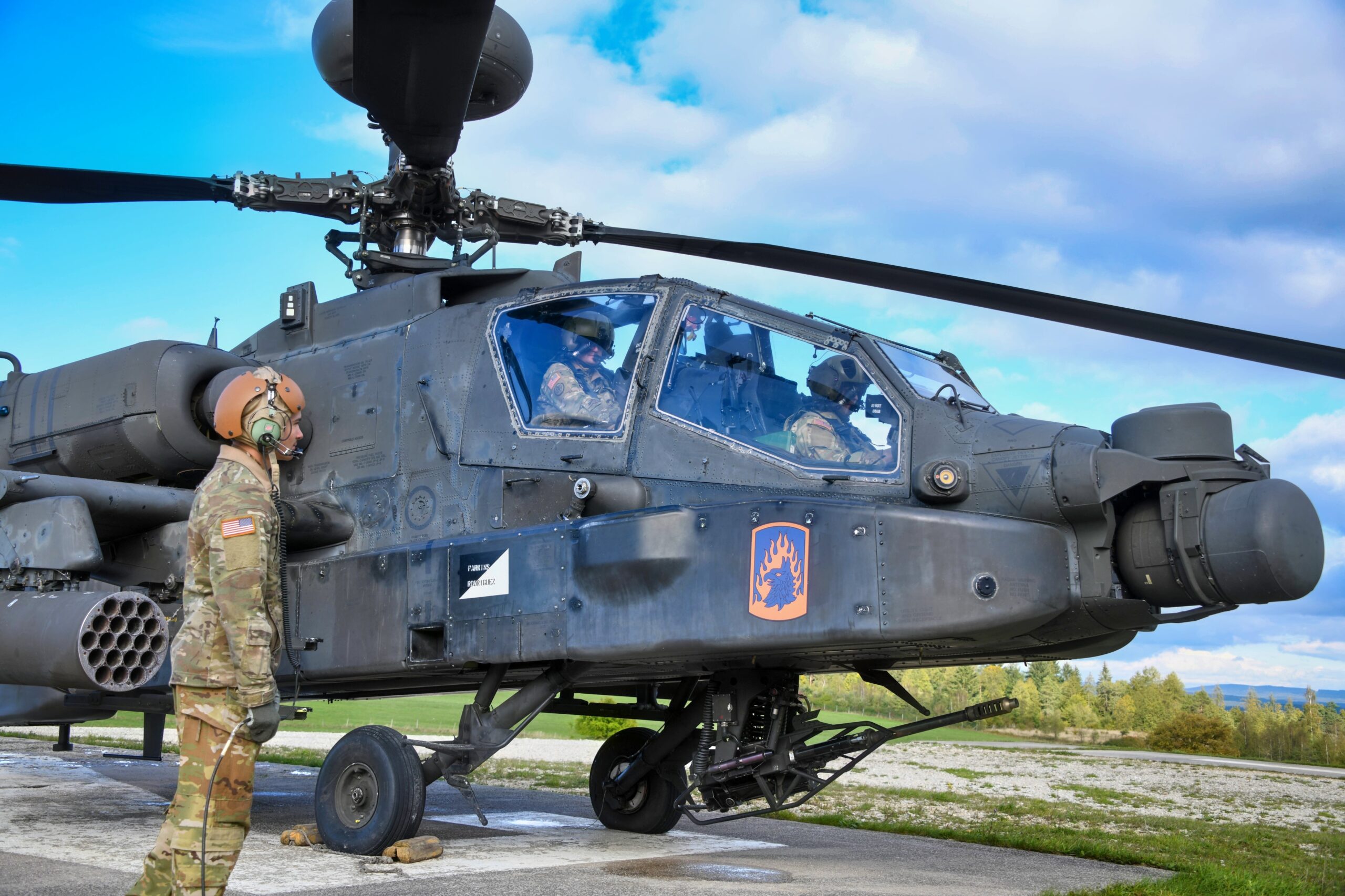
U.S. Soldiers assigned to 12th Combat Aviation Brigade conduct pre-flight checks on an AH-64D Apache longbow helicopter at the Grafenwoehr Training Area, Germany, Sept. 28, 2022. 12th CAB is among other units assigned to V Corps, America’s Forward Deployed Corps in Europe. They work alongside NATO Allies and regional security partners to provide combat-ready forces, execute joint and multinational training exercises, and retain command and control for all rotational and assigned units in the European Theater. (U.S. Army photo by Sgt. Randis Monroe)
Japan’s Ground Self-Defense Force contributed Type 12 anti-ship missiles, while a Navy F/A-18 carried an AGM-158C Long Range Anti-Ship Missile. RIMPAC 2024 had already used air-launched LRASM and other joint anti-ship weapons. The 2026 event placed those aircraft inside a wider land, air, surface and subsurface firing sequence.
The Army’s role matters in an island campaign. Mobile launchers and helicopters on dispersed islands create firing positions without another destroyer. Sensors elsewhere can locate and classify a ship, then pass the track to an Army unit able to attack. The Navy said participants practiced targeting, coordination and live fire against a surface vessel.
Navy GARC Boats Attacked Peleliu at the Waterline
The most novel public event came on July 17. Unmanned Surface Vessel Division 32 launched a Global Autonomous Reconnaissance Craft at sea. Operators at Barking Sands then assumed control, guided the craft beyond line of sight, identified Peleliu and completed the engagement, according to the Navy’s post-exercise account.
Despite the word “Autonomous” in the name, the published mission remained under human control. Operators used onboard sensors to navigate among maritime traffic and direct the attack. Video reviewed by Naval News showed two one-way craft detonating at the waterline after larger missiles had already struck the hull.
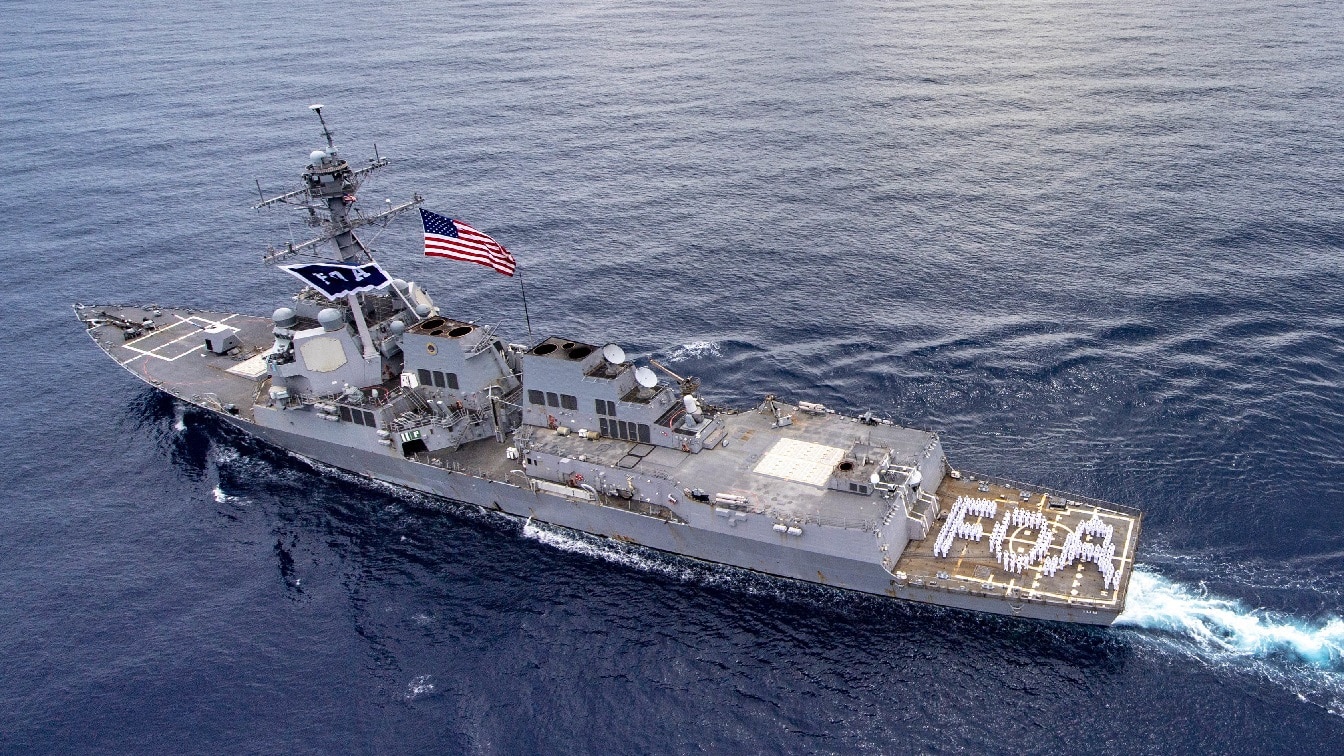
SOUTH CHINA SEA (Oct 2, 2019) The guided-missile destroyer USS Wayne E. Meyer (DDG 108) celebrates the 10th anniversary of the ship’s commissioning while transiting the South China Sea. Named after Rear Adm. Wayne E. Meyer, the Father of Aegis, (FOA), the crew stands in formation in his namesake. Wayne E. Meyer is deployed to the U.S. 7th Fleet area of operations to support regional stability, reassure partners and allies, and maintain a presence postured to respond to any crisis ranging from humanitarian assistance to contingency operations. (U.S. Navy photo by Mass Communication Specialist 2nd Class Rawad Madanat/Released)
The Navy is adapting a method demonstrated in the Black Sea, where uncrewed boats and missiles forced Russia’s fleet away from exposed bases. An explosive craft can approach from another bearing, draw defensive fire and place a warhead near the waterline. That threat now sits beside missiles and submarines in the debate over large-warship survival.
SINKEX Tested the Entire Kill Chain
The Maritime Administration describes a SINKEX target as a hardened, full-size platform for live ammunition, weapons testing and integration among air, surface and subsurface forces. A real hull gives engineers and crews effects that a small barge or computer simulation cannot reproduce. It also forces participants to coordinate range safety, target identification, firing windows and weapons arriving from several directions.
The exercise did not recreate a battle against an active cruiser. The hulks had no crews, radar, interceptors, electronic warfare or ability to maneuver. Fuel, ammunition and much equipment were gone. A hit proved a weapon reached and damaged a full-size hull; it did not show the same shot would defeat a defended ship.
That distinction separates RIMPAC from the Navy’s more controlled, heavily instrumented testing of the retired carrier USS America. The 2026 SINKEX primarily trained forces to assemble and execute a multinational attack while gathering valuable weapon-effects data.
Mobile Bay Made the Exercise More Relevant to Today’s Fleet
Mobile Bay represented an Aegis-era warship built around sensors, command spaces, and a large vertical-launch battery. It gave weapons teams a target closer to current surface combatants than an old transport. The exercise placed a recently retired member of the disappearing Ticonderoga force at the center of a modern joint strike.
The operational lesson runs in both directions. American forces now have more ways to attack a ship from land, air, beneath the surface, and on the water. U.S. warships must defend against the same mix, often at the same time.
The Navy has not released the complete firing order, damage attributed to each weapon, or the weapons-effects report for either target.
MORE – China Has 50 Frigates: The US Navy Has 2 on Order
About the Author: Harry J. Kazianis
Harry J. Kazianis (@Grecianformula) was the former Senior Director of National Security Affairs at the Center for the National Interest (CFTNI), a foreign policy think tank founded by Richard Nixon based in Washington, DC. Harry has over a decade of experience in think tanks and national security publishing. His ideas have been published in the NY Times, The Washington Post, The Wall Street Journal, CNN, and many other outlets worldwide. He has held positions at CSIS, the Heritage Foundation, the University of Nottingham, and several other institutions related to national security research and studies. He is the former Executive Editor of the National Interest and the Diplomat. He holds a Master’s degree focusing on international affairs from Harvard University.

