
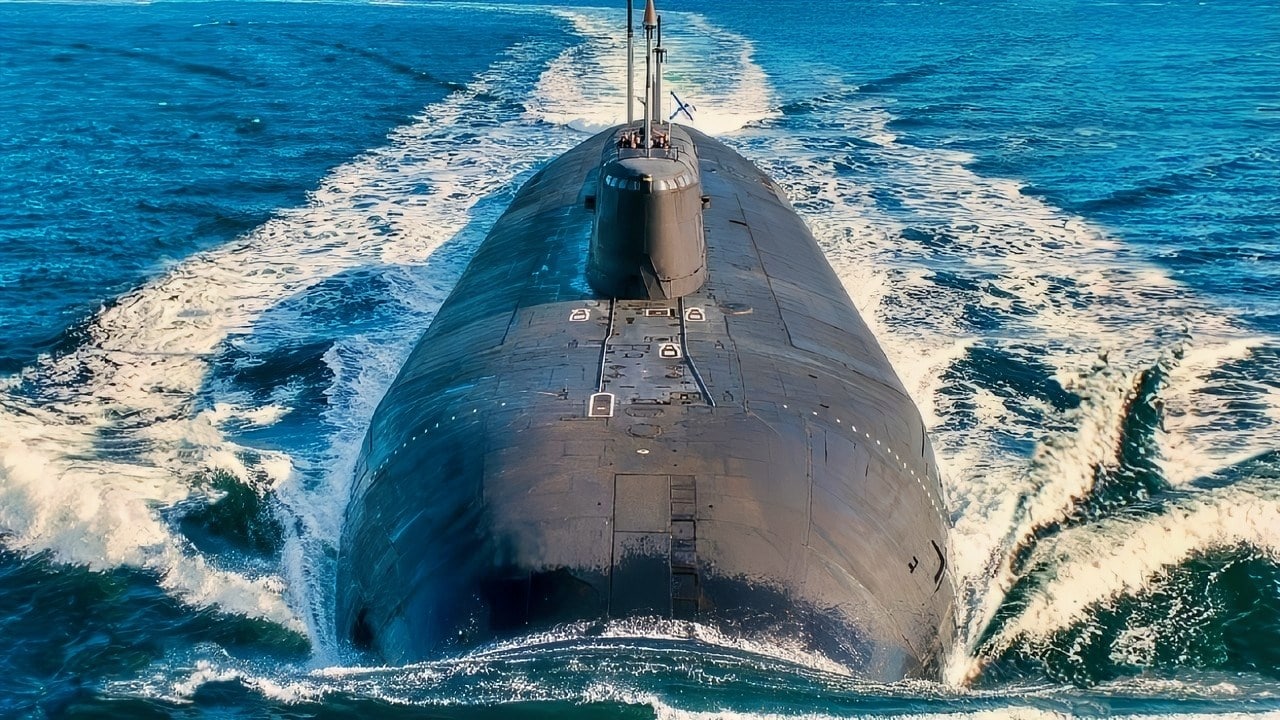
Oscar-Class by the Numbers: 24 Granit Missiles, Two Reactors and a 19,000-Ton Hull – The Soviet Union built Project 949 around 24 P-700 Granit missiles and one demanding mission: attacking American carrier battle groups before their aircraft reached Soviet naval forces and territory. Two Project 949 Granit submarines entered service, followed by 11 longer Project 949A Antey boats known to NATO as the Oscar I and Oscar II classes.
An Oscar II measured about 154 meters long and 18.2 meters across the beam. Open sources disagree on the exact displacement, but commonly used figures place the submarine near 14,000 tons surfaced and roughly 19,000 tons submerged. Two pressurized-water reactors supplied two steam turbines producing about 90,000 shaft horsepower, enough for approximately 32 knots underwater.
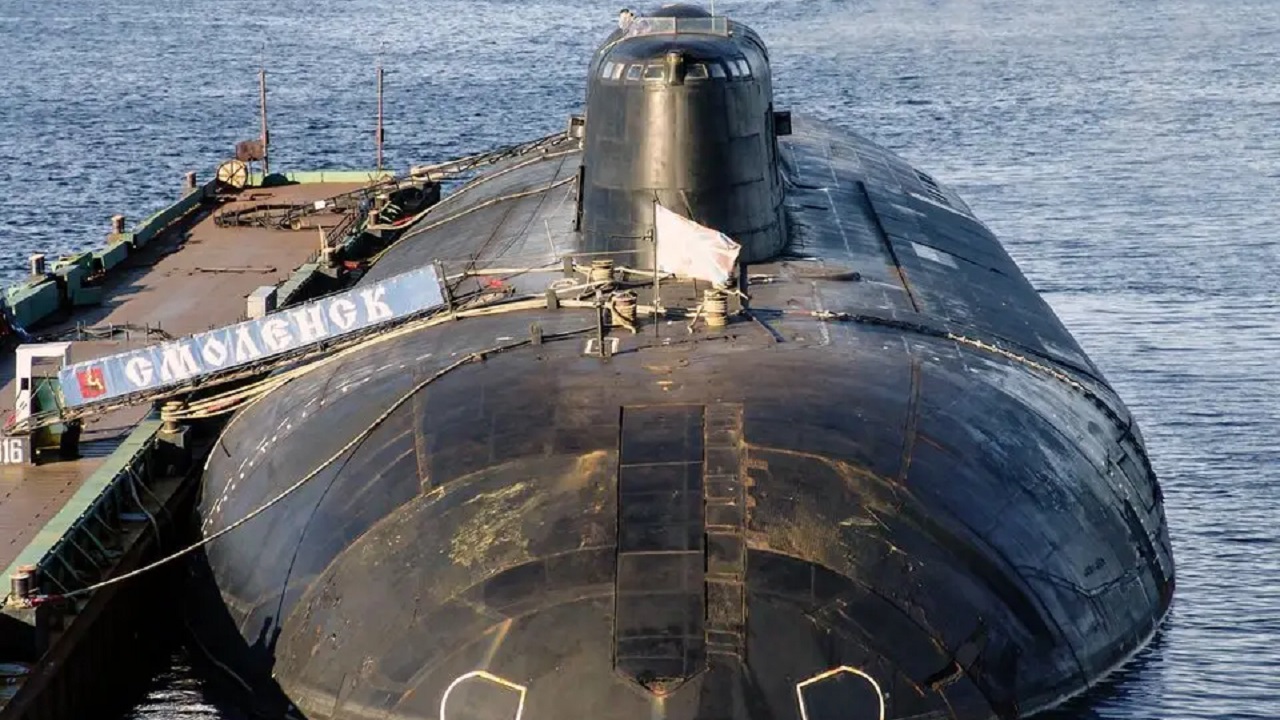
Oscar II Class Submarine. Image Credit: Creative Commons.
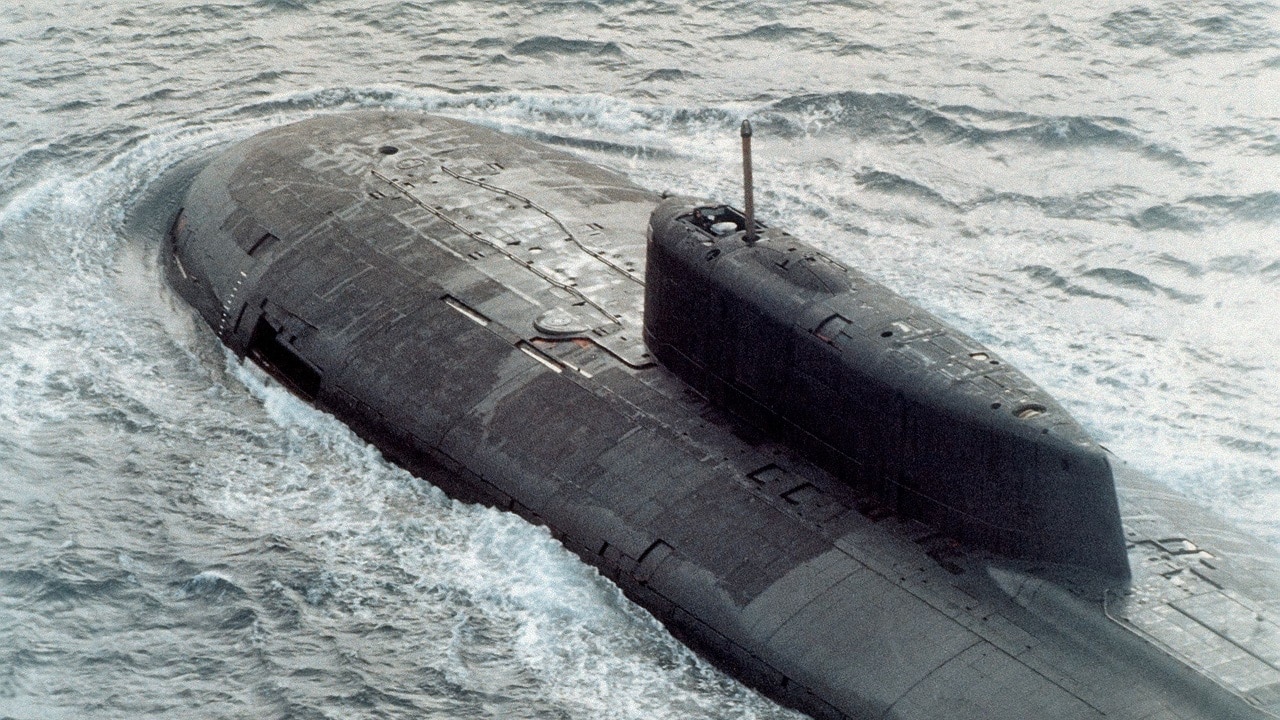
Oscar-class Submarine from Russia.
The defining weapons sat outside the pressure hull. Twelve angled launch tubes ran along each side of the submarine, carrying 24 Granit missiles. U.S. Army data place the missile’s speed between roughly Mach 1.6 and Mach 2.5 and its estimated range between 400 and 625 kilometers, depending on flight profile.
That firepower has outlived much of the Soviet system built to support it. Public fleet lists now conflict over how many Oscar IIs remain operational, under repair, or in reserve. Russia’s navy chief said in March 2026 that Project 949A and other third-generation nuclear submarines will be replaced by Yasen and Yasen-M boats during the next decade.
The Soviet Navy Built Project 949 Around the Carrier Problem
The Soviet Union could not match the United States carrier for carrier. Project 949 supplied an asymmetric answer. A submarine would approach from outside the immediate escort screen, receive targeting information from satellites, aircraft or other naval units, and release a massed missile salvo intended to overwhelm fighters and shipboard defenses.
The targeting network mattered as much as the submarine. A Granit traveling hundreds of kilometers still needed current coordinates for a formation moving at high speed. Project 949 therefore belonged to a wider reconnaissance-strike system rather than operating as a solitary hunter. No reliable public record provides a complete unit cost, and the price of the hull alone would exclude missiles, satellite surveillance and specialized bases.

Oscar II Class Submarine. Image Credit: Creative Commons.
Oscar I Became a Longer and Quieter Oscar II
The first two Project 949 boats entered service in 1980 and 1983. Both left the fleet in 1996. The improved Project 949A added roughly 11 meters of length, more buoyancy, revised electronics, and quieter machinery. Seven-bladed propellers replaced the earlier four-bladed design, while the familiar Soviet double hull provided reserve buoyancy and space for the large missile battery.
Sevmash completed 11 standard Oscar IIs between the mid-1980s and late 1990s. The class remained enormous, mechanically complicated and less acoustically discreet than later Russian attack submarines. Its value came from endurance and depth of magazine. It could patrol the Arctic, Atlantic or Pacific with enough weapons to force a carrier group to treat one contact as a fleet-level threat.
The Soviet and Russian navies never fired a Granit from an Oscar in combat. The boats instead trained for coordinated attacks, conducted missile exercises and deployed with the Northern and Pacific fleets. Their operational value rested partly on uncertainty: NATO commanders had to find the submarine before it received a usable firing solution.
Twenty-Four Granit Missiles Drove the Submarine’s Size
Each P-700 measured about 10 meters and weighed roughly seven metric tons. The missile carried a large conventional warhead, while Soviet planning also included a nuclear option. Public accounts often describe coordinated salvo behavior in which missiles exchanged targeting data and one climbed to search for the fleet. The detailed operating logic remains classified, so those descriptions should not be treated as a complete technical record.
The bow held four 533mm and two 650mm torpedo tubes for heavyweight torpedoes, anti-submarine missiles and mines. Those weapons gave the Oscar a way to fight submarines and nearby surface ships, but the carrier-killing mission controlled the design. Once the 24 Granits were fired, the main magazine could not be reloaded at sea.
Kursk Turned the Oscar II Into a National Disaster
K-141 Kursk entered service in 1994 and joined a major Northern Fleet exercise in the Barents Sea on August 12, 2000. Russia’s official investigation found that a 650mm 65-76A torpedo using high-test peroxide exploded in a forward tube. The initial blast started a fire, followed about two minutes later by the detonation of additional torpedo warheads.
The second explosion destroyed much of the bow and flooded the forward compartments. All 118 people aboard died. Evidence recovered from the wreck showed that 23 sailors survived the first blasts in the ninth compartment, although the record does not establish how long a successful rescue remained possible. Foreign assistance was accepted only after Russian rescue attempts failed.
The wreck was raised in October 2001 after contractors separated the damaged bow. Mammoet reported that the lift required 9,000 tons of traction to pull the hull from the seabed. Kursk was later dismantled, while the Navy withdrew the peroxide-fueled torpedo type implicated by the investigation.
Shipyard Fires Exposed the Burden of Aging Oscar IIs
Later accidents occurred during maintenance rather than patrols. K-150 Tomsk burned for more than five hours at the Zvezda shipyard in September 2013 after a welding safety violation, according to the Russian Defense Ministry. In April 2015, welding work ignited rubber-based insulation around K-266 Orel in dry dock at Severodvinsk. Officials reported no injuries and said fuel and weapons had been removed.
These fires did not repeat the Kursk disaster, but they exposed the industrial demands behind an aging double-hull nuclear submarine. Rubber coatings, inaccessible spaces, reactors, old cables and unique missile equipment complicate repair work. The class survived the Soviet collapse because its anti-carrier firepower remained valuable, yet every overhaul consumed shipyard capacity also needed for newer boats.
Project 949AM Promised a New Missile Magazine
Russia announced Project 949AM in 2011 as a way to replace the Granit battery with smaller Kalibr and Oniks weapons, later adding Zircon to the advertised package. Published load estimates range from 48 to 72 missiles because Russian accounts differ over launcher adapters and final configuration. Moscow has never publicly demonstrated a serving Oscar carrying the full advertised load.
K-132 Irkutsk became the leading test case after entering repair in 2001. Its overhaul expanded into a modernization that was repeatedly delayed. Reporting in December 2025 said Russia had decided to scrap the submarine after more than two decades in the yard. K-442 Chelyabinsk has also spent years assigned to modernization, one of the unresolved problems surrounding Russia’s aging nuclear-submarine force.
An unfinished Oscar II hull followed a different path. Russia lengthened and rebuilt Belgorod as Project 09852, a special-mission submarine delivered in 2022. It is designed to support deep-sea systems and carry the nuclear-powered Poseidon weapon. Belgorod is an Oscar descendant rather than a normal cruise-missile variant.
Yasen Will Replace the Oscar’s Single-Mission Design
Russia is moving toward smaller, quieter Yasen and Yasen-M submarines able to conduct anti-submarine warfare, attack ships and launch long-range weapons against land targets. Their universal launch systems support Kalibr, Oniks and Zircon without the Oscar’s 24 giant external Granit tubes.
The change trades one exceptional salvo for a more flexible submarine and a simpler fleet. It also reduces the maintenance burden created by separate reactor plants, combat systems and spare-parts chains across the Oscar, Akula and Sierra classes. The Russian Navy now says those third-generation boats should leave service by about 2035.
Moscow has not published a return-to-service date for Chelyabinsk or confirmed that any operational Oscar carries the full Project 949AM missile load.
About the Author: Harry J. Kazianis
Harry J. Kazianis (@Grecianformula) was the former Senior Director of National Security Affairs at the Center for the National Interest (CFTNI), a foreign policy think tank founded by Richard Nixon based in Washington, DC. Harry has over a decade of experience in think tanks and national security publishing. His ideas have been published in the NY Times, The Washington Post, The Wall Street Journal, CNN, and many other outlets worldwide. He has held positions at CSIS, the Heritage Foundation, the University of Nottingham, and several other institutions related to national security research and studies. He is the former Executive Editor of the National Interest and the Diplomat. He holds a Master’s degree focusing on international affairs from Harvard University.