
Key Points and Summary – Russia’s Yasen-class nuclear attack submarines are emerging as the sharpest edge of Vladimir Putin’s “blue water” navy.
-The latest boat, Perm, fields a quiet, long-endurance reactor, advanced sonar, and a heavy weapons load that includes Kalibr and Oniks missiles—and, crucially, Tsirkon hypersonic missiles.
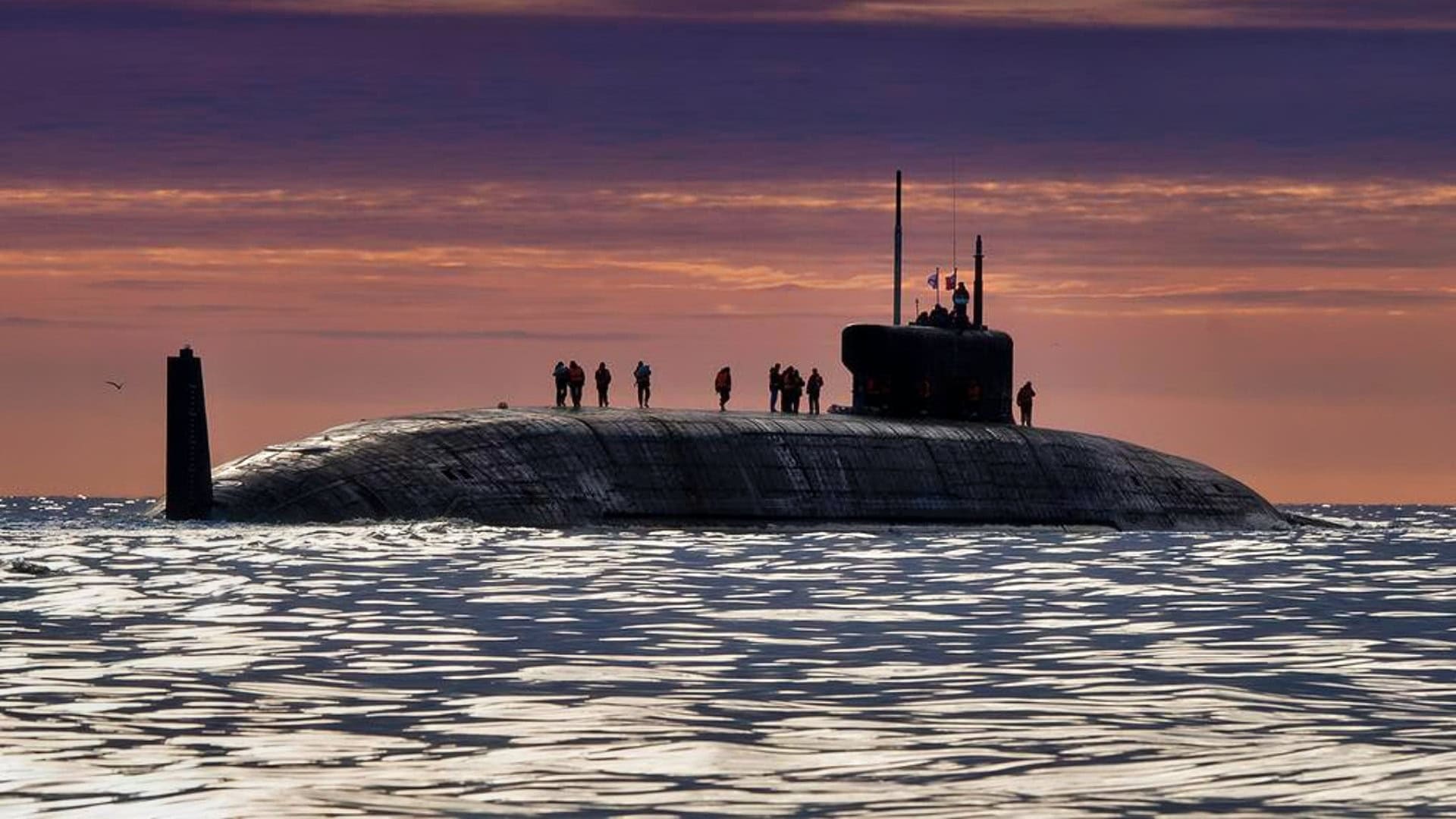
The Russian Navy is experiencing a resurgence, with new ships and submarines entering service despite ongoing challenges.
-A 2024 port call by sister boat Kazan in Havana showed how easily these subs can slip into America’s backyard, collect targeting data, and threaten U.S. carriers or bases from the Caribbean.
-For a stretched U.S. shipbuilding base, Yasen’s growing range and stealth are a pointed reminder that undersea deterrence is now a two-way street.
Russia’s New Yasen-Class Sub Just Put the U.S. Navy on Notice
It has been a big year for Russian submarine-building despite the crimping of military budgets caused by the war against Ukraine.
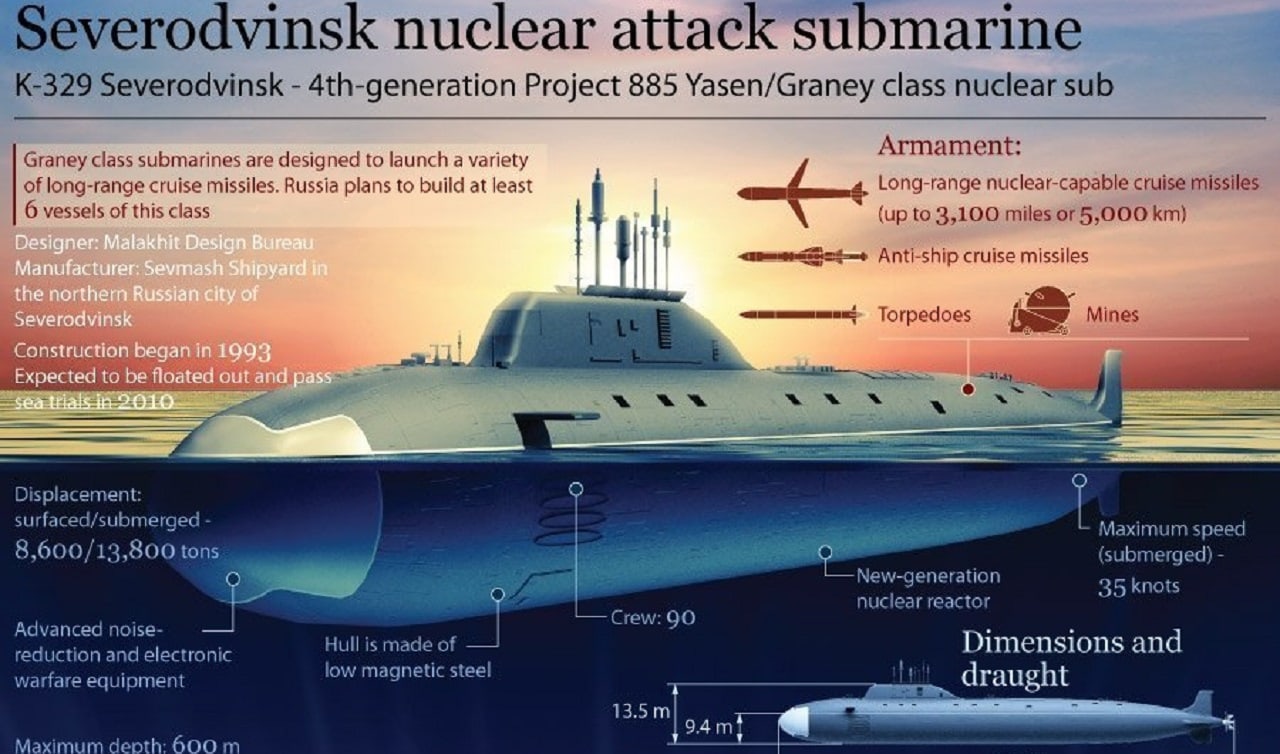
Earlier this year, the Russian navy officially introduced the nuclear-powered Yasen-class cruise missile submarine, the “Perm,” named for a city in Russia. The Perm and the Yasen-class are fourth-generation boats that will be a practical addition to Vladimir Putin’s silent service.
This is the sixth sub of the Yasen-class. The group features many features to reduce noise and increase stealth. The Yasen-class makes for a stalwart fleet of newly-fashioned hunter-killers.
This gives a badly needed boost to naval building efforts that have been so difficult in wartime due to the lack of resources and reduced shipbuilding manpower across the entire naval construction effort.
Look Out for Hypersonic Missile Deployment
The Perm and other Yasen-class boats are equipped with the hypersonic nuclear-capable missile called the Tsirkon. This MACH 9 weapon was effectively test-fired from a submarine in 2021. The Tsirkon has internal navigation for better accuracy. This replaces the aging P-700 Granit.
Their Perm was laid down in 2016 and should enter active duty early next year. The Perm, due to the evolution of the Yasen-class, is considered a Yasen-M designation made by the Malakhit Marine Engineering Bureau. The Yasen-M class has been specially integrated with the Tsirkon hypersonic weapon.
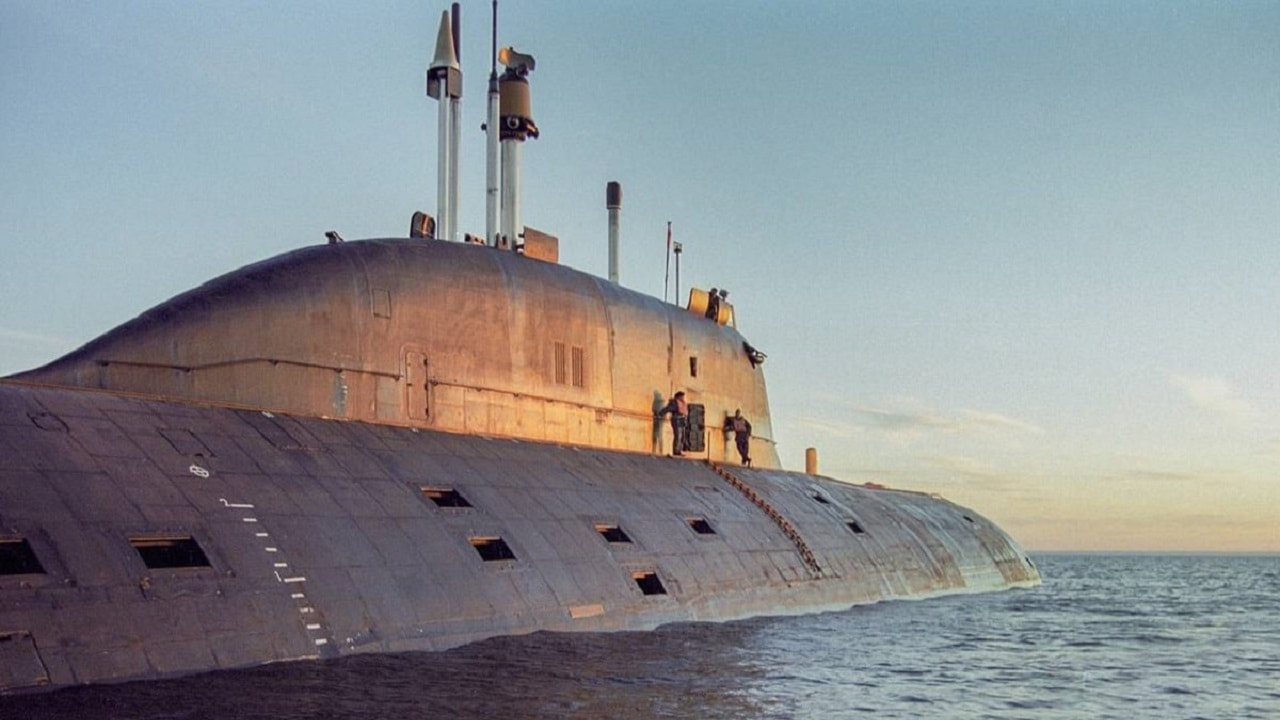
Yasen-Class. Image Credit: Creative Commons.
Yasen-M attack submarine. Image Credit: Russian Government.
Powerful Nuclear-Propulsion Is a Strong Feature
The Perm and future Yasen-class and Yasen-M boats are equipped with the KTP-6-185SP pressurized water-cooled nuclear reactor, which delivers more than 268,000 horsepower. This is one vigorous power plant. The reactor has a multi-decade service life and will not need a mid-life refueling. The “natural coolant circulation” of the reactor, according to ArmyRecognition.com, will make it more challenging to identify and track.
The Perm can also be submerged for more than three months. The displacement for the Perm is 13,800 tons underwater, and it is 426 feet long. There are 64 sailors on board.
The Weapons Load-out Is Impressive
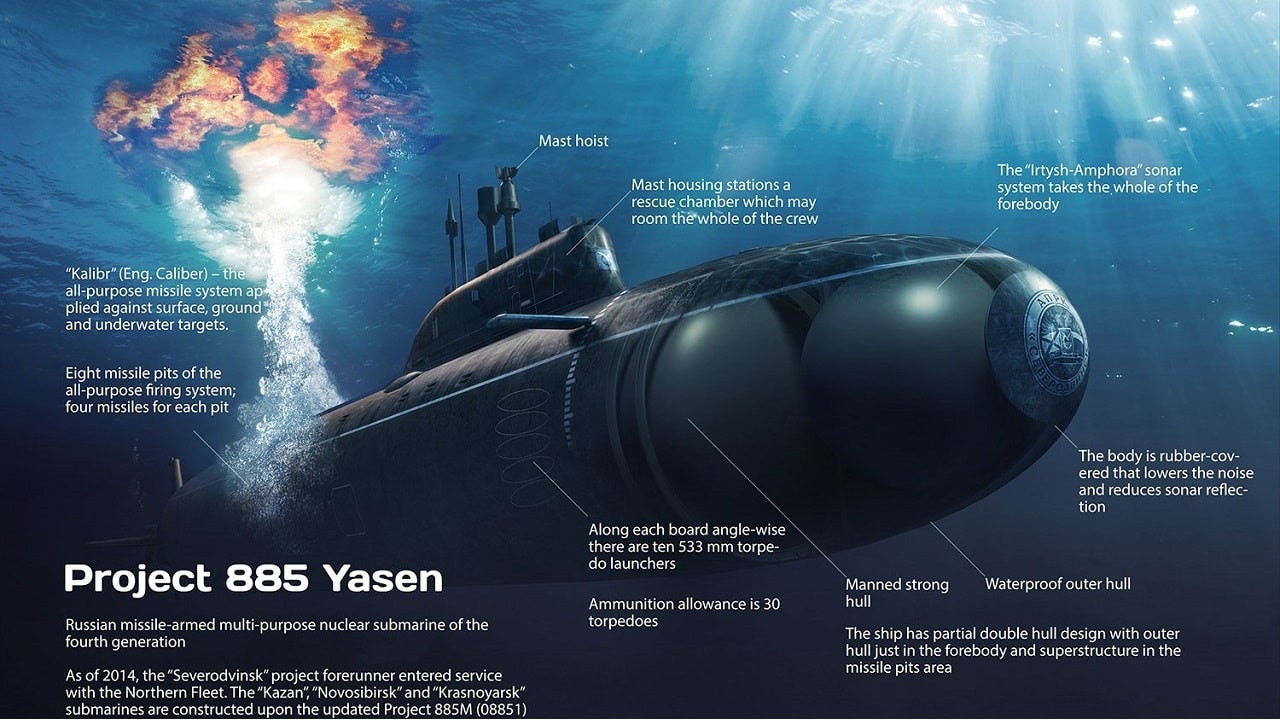
ArmyRecognition.com noted that the Perm has ten 533-meter torpedo tubes. There are three types of torpedoes, and the Yasen-class can also launch sea mines. Oniks anti-ship missiles and Kalibr missiles can be deployed by eight vertical launch tubes.
The Yasen-class is meant to replace the Akula and Oscar II-class boats that were prevalent during the Cold War. The first Yasen-class boat, “the Severodvinsk, was laid down in 1993, launched in 2010, and commissioned into the Northern Fleet on June 17, 2014,” ArmyRecognition.com wrote.
The Kazan also has a fourth-generation KTP-6 monoblock reactor, which is more stealthy than the previous boats’ reactors before the Yasen-M upgrade. This noise cancellation will give the Yasen-class even more ability to evade enemy efforts to find and destroy it.
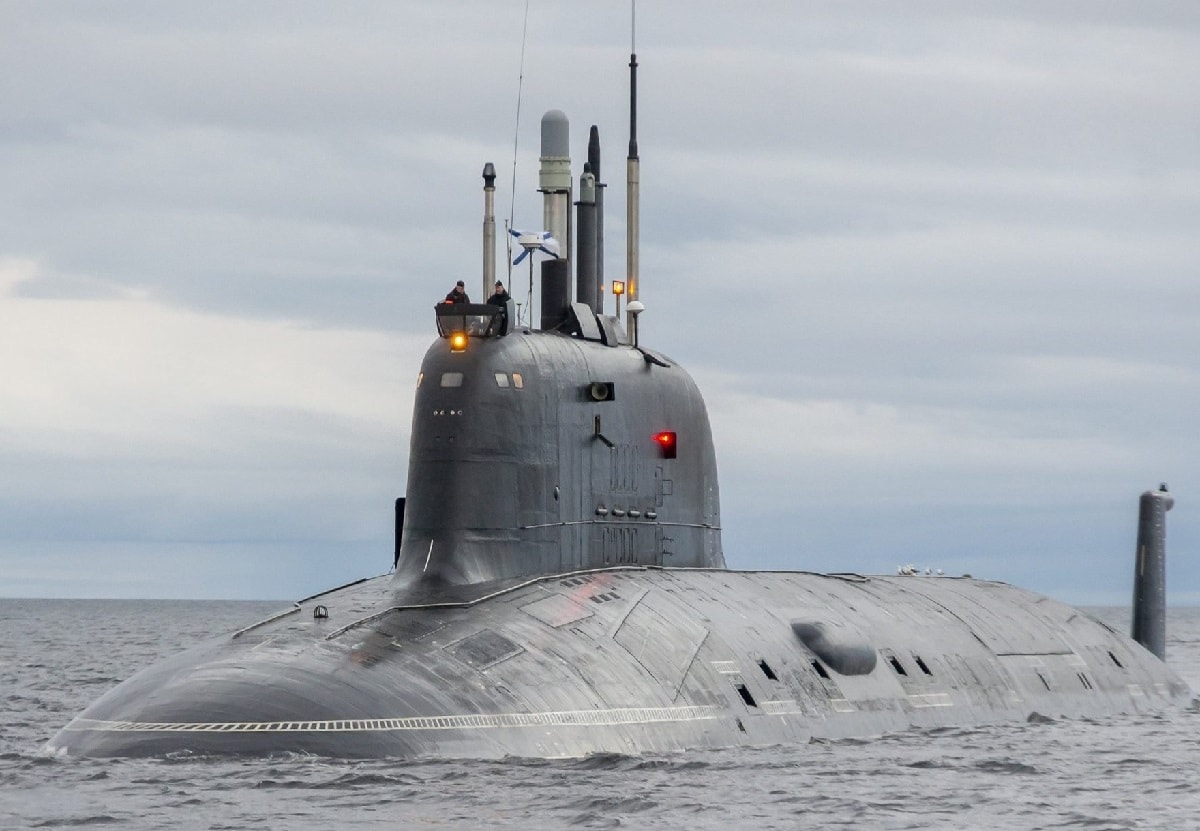
Yasen-Class Image: Russian Navy.
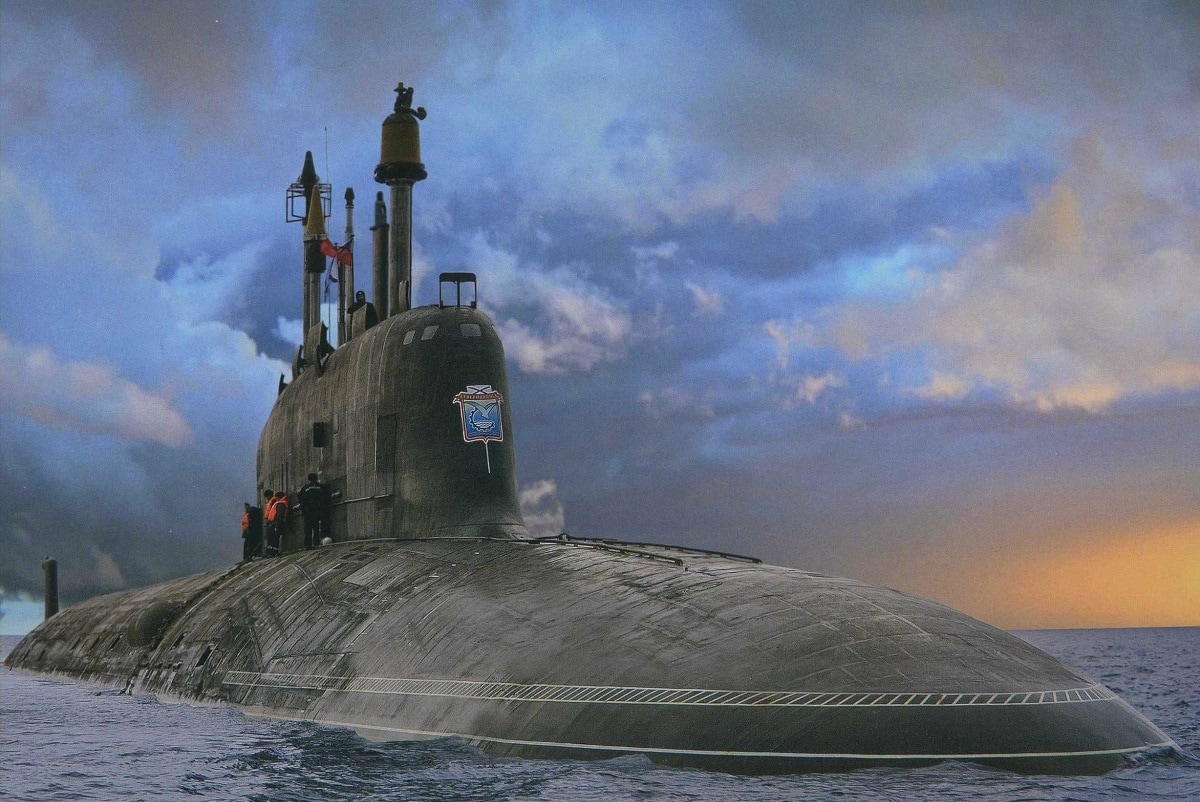
Image: Creative Commons.
The Perm has better sonar with its conformal array system, which is more advanced than that of earlier Yasen-class boats. This system is similar to the best sonars in most modern NATO subs.
The Yasen-class Submarines Close to Florida
In June 2024, the Yasen M-class Kazan appeared in Havana, Cuba. This showed the Blue Water reach of the Russian Navy. The Kazan had previously been relegated to hunter-killer roles closer to Russian shores. This deployment was considered an audacious move by Russia to display just how close Kazan could sneak to the United States.
The Russian navy feels like it can strike anywhere, anytime, with the Yasen M-class. The Kazan deployment was a wake-up call for the US Navy. Intelligence analysts may have been tracking it, but a docking so close to American shores was considered dangerous by the Navy. The Yasen-class showed off its impressive range during Kazan’s Caribbean deployment.
Are There Yasen-class Subs in the Caribbean Again?
Look for the Russians to deploy a Yasen-class or Yasen M-class near Cuba again if they haven’t already. Vladimir Putin’s submarine force is likely trying to collect intelligence on US Navy ship deployments near Venezuela. Yasen-class boats may already be deployed to the area of operations.
That’s why the Blue Water nature of Putin’s submarine fleet is crucial for projecting power and deterring adversaries near foreign shores. Russia supports Venezuela to counter US influence in the Western Hemisphere. Russia already offers military aid and advice to Venezuela. The Navy’s submarine may be collecting intelligence on the Gerald R. Ford carrier strike group and sharing it with the Venezuelans.
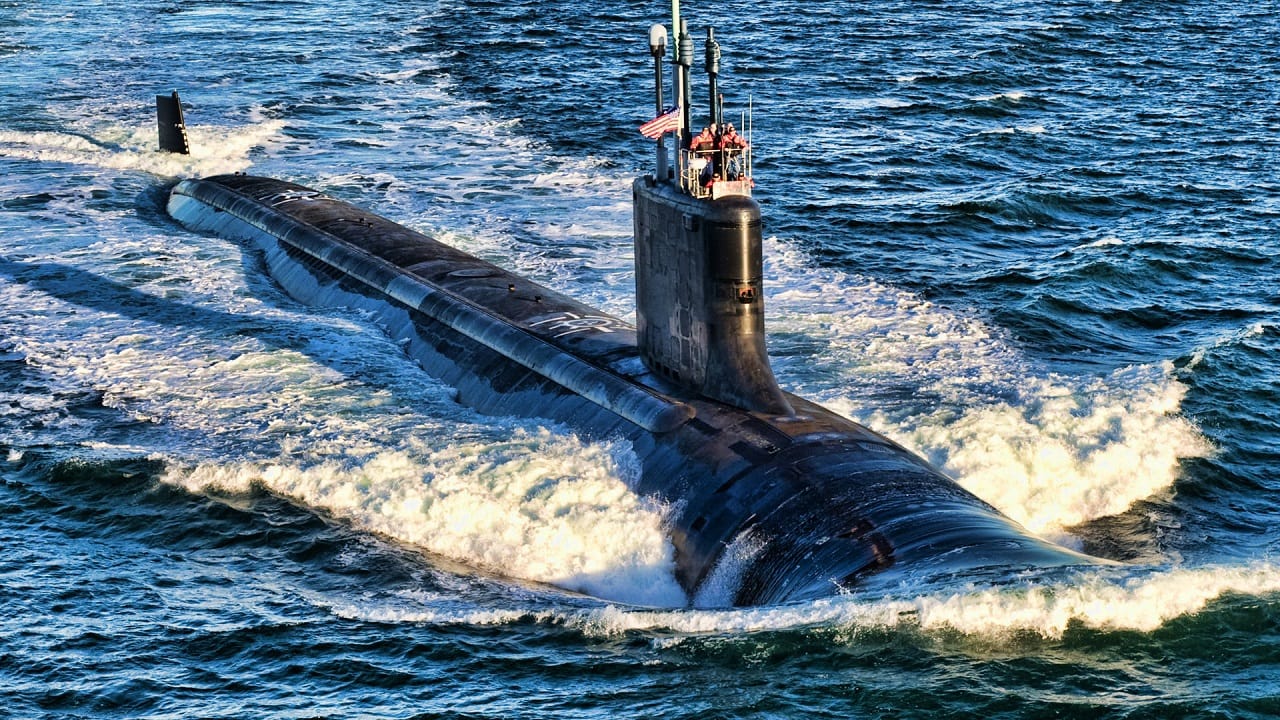
US Navy Attack Submarine. Image Credit: Creative Commons.
This makes the Yasen-class a presidential-level asset for Putin, allowing the Russians to diminish the effectiveness of the US Navy in its own backyard. The Yasen-class is a decent group of submarines that can sneak around the Caribbean under the US Southern Command. Its deployment of nuclear-capable hypersonic weapons so close to America is a problem for the Navy.
While Americans are likely aware that the Yasen-class can patrol the region, the 2024 deployment to Cuba likely stung. The Yasen-class is thus capable of challenging US interests in the area and could allow the Venezuelans more situational awareness of what the United States is now trying to accomplish in the Caribbean.
About the Author: Brent M. Eastwood
Author of now over 3,000 articles on defense issues, Brent M. Eastwood, PhD is the author of Don’t Turn Your Back On the World: a Conservative Foreign Policy and Humans, Machines, and Data: Future Trends in Warfare plus two other books. Brent was the founder and CEO of a tech firm that predicted world events using artificial intelligence. He served as a legislative fellow for US Senator Tim Scott and advised the senator on defense and foreign policy issues. He has taught at American University, George Washington University, and George Mason University. Brent is a former US Army Infantry officer. He can be followed on X @BMEastwood.