
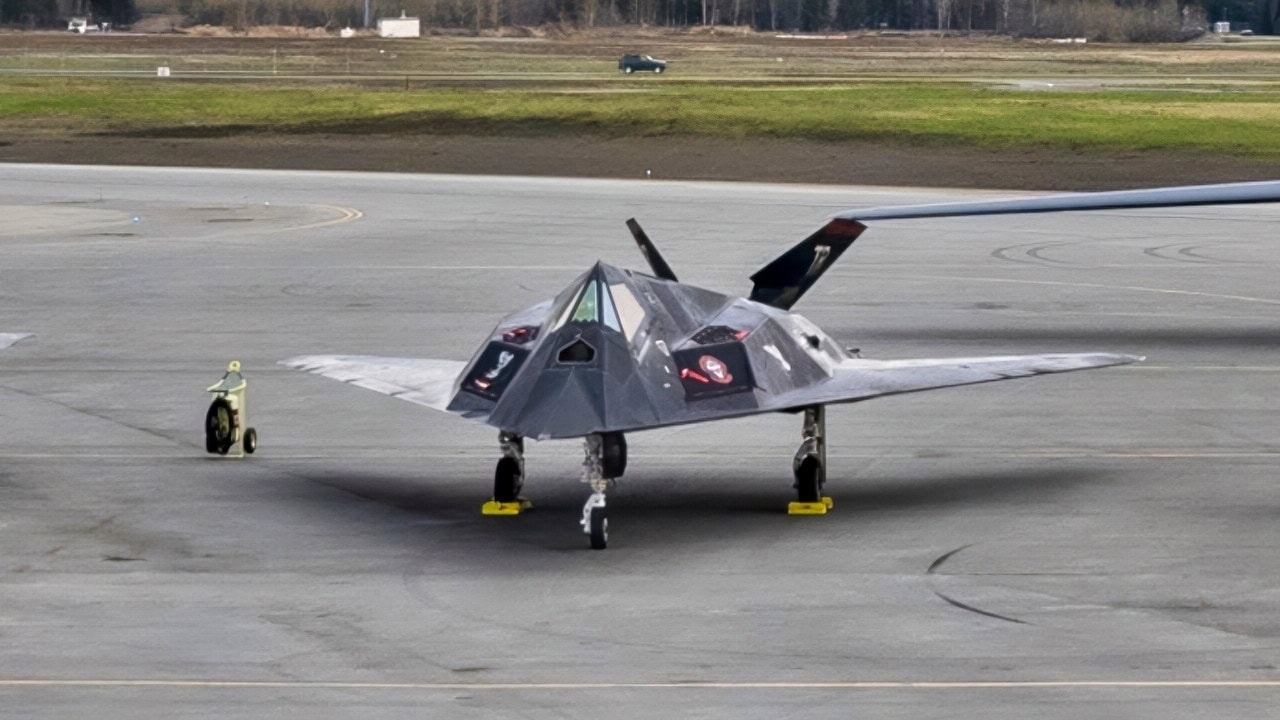
The F-117 Retired in 2008. The US Air Force Plans to Keep It Flying Through 2034 – The F-117 Nighthawk officially left frontline service in 2008, yet the U.S. Air Force plans to continue limited flying operations through 2034. That’s strange, since this author saw the F-117 at the US Air Force Museum in Dayton, Ohio, roughly a year ago. In fact, many of the photos in this article were taken during that visit.
A 2022 Air Force Test Center contracting document sought 10 years of maintenance and logistics support at the Tonopah Test Range, beginning in January 2024.
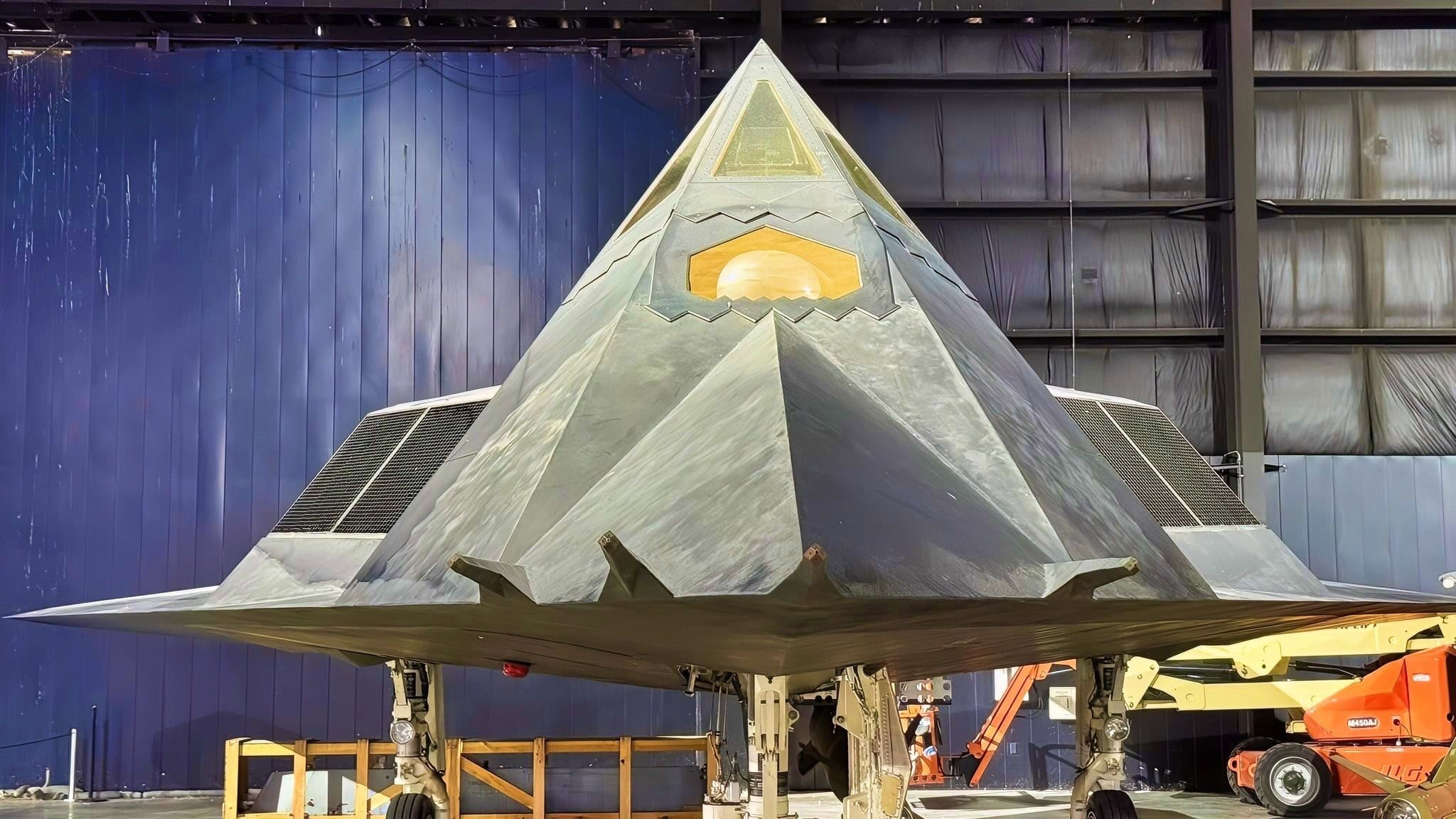
F-117 Nighthawk Stealth Fighter Harry Kazianis Photo from the U.S. Air Force Museum back in July of 2025.
The F-117 Nighthawk Comeback?
The 2008 retirement was real. The F-117 lost its operational squadrons and combat mission, and the Air Force said the B-2, F-22 and coming F-35 offered better capabilities. Its radar-absorbing exterior was also expensive and labor-intensive to maintain.
The remaining aircraft returned to secure storage at Tonopah, the Nevada base where the once-secret program had begun.
What survived was a small test and training force. The Air Force says selected aircraft fly for limited research and training, while other airframes are preserved, declassified for museums, or dismantled. The support requirement includes launch and recovery work, mission-planning equipment, and temporary modifications for developmental testing.
That second career explains why the F-117 is often described as a stand-in for China’s J-20 and Russia’s Su-57. The description needs a limit. The Nighthawk is a subsonic attack aircraft without radar, air-to-air missiles, supercruise, or the maneuverability of a modern fighter. It does not reproduce either foreign aircraft.
It gives American forces a live low-observable target whose signature and maintenance history are already well understood.
Retirement Left a Recallable Fleet at Tonopah
The Air Force built 59 production F-117As and lost seven aircraft before retirement, including one over Serbia in 1999.
The surviving jets did not follow ordinary retired aircraft to the open storage rows at Davis-Monthan Air Force Base. Most entered protective hangars at Tonopah with their wings and tails removed, while selected aircraft later returned to flying status.
Congress originally required the stored fleet to remain in a condition permitting recall. The fiscal 2017 defense law repealed that requirement, allowing the Air Force to transfer sanitized aircraft to museums or destroy airframes no longer needed.
The 2022 support request combined all three activities: preserving stored aircraft, operating a limited number, and demilitarizing aircraft judged excess.
The F-117 Gives Pilots a Stealth Target They Can Fly Against
Two F-117s were deployed to Fresno in September 2021 for dissimilar air combat training with F-15 pilots.
The 144th Fighter Wing said the aircraft created difficult, realistic problems for an integrated force. In May 2023, F-117s joined Northern Edge 23-1, an Indo-Pacific Command exercise involving more than 150 aircraft.
An official Northern Edge photograph placed an F-117 on the ramp with an F-35A, F-22, EA-18G, F-15EX and B-1B.
Public material does not disclose the engagement scripts, but the combination shows where the Nighthawk fits.
Fifth-generation pilots and the wider force must detect a low-observable aircraft, maintain a track, and share sufficient information to support an engagement.
The value lies in the radar and infrared problem rather than a one-on-one dogfight. A normal aggressor fighter is easier to find. The F-117 forces radars, passive sensors, airborne warning aircraft, and data links to work against a smaller return.
That makes the low-observable aggressor mission useful even though the aircraft does not imitate the J-20’s range or the Su-57’s kinematics.
The Nighthawk Also Tests Sensors and Cruise-Missile Defenses
The F-117 offers engineers a known low-observable baseline.

F-117 Nighthawk at National Museum of Air Force 19FortyFive Photo
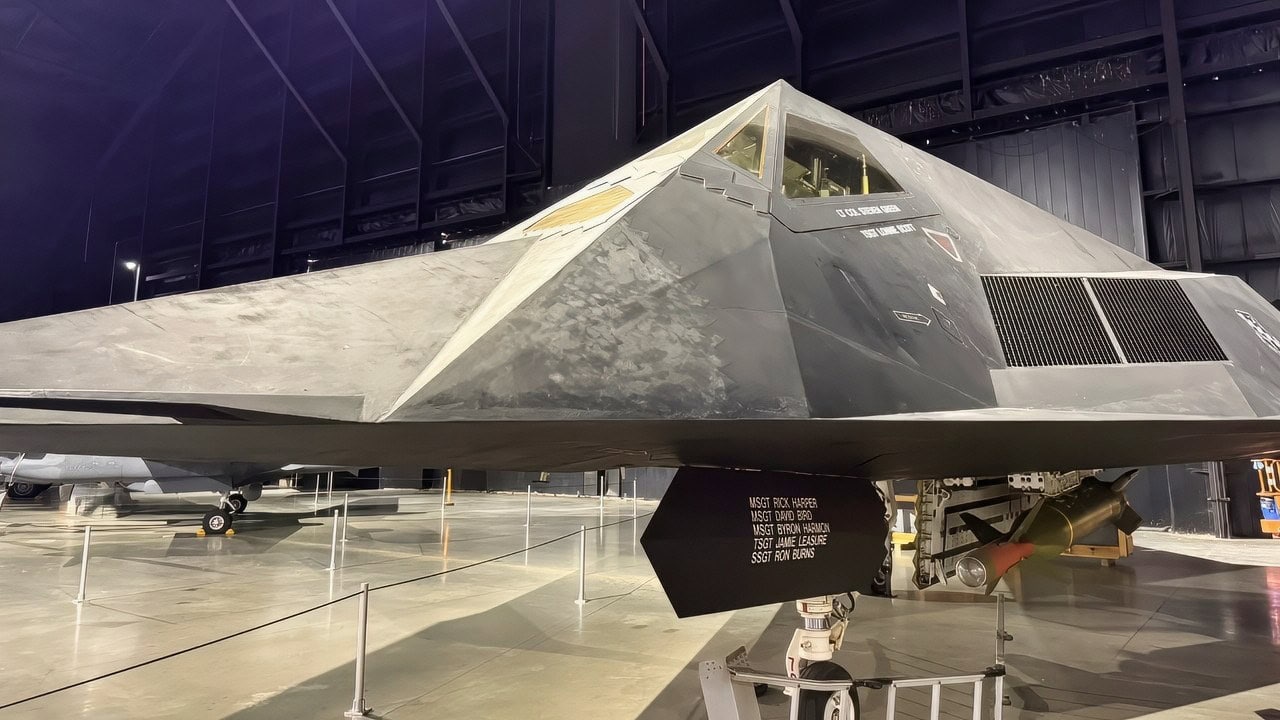
F-117A Nighthawk at USAF Museum. Image taken by 19FortyFive Owner, Harry J. Kazianis.
Engineers test new radars, infrared search-and-track systems, coatings, and electronic-support equipment against an aircraft whose signature has been studied for decades.
Using an older test asset also reduces the need to assign an operational F-22 or F-35 to every sensor experiment, one reason the Air Force still values the Nighthawk.
The aircraft has also served as a surrogate for a low-observable cruise missile. In 2021, Air National Guard director Lt. Gen. Michael Loh explained that the F-117 provides defenders with a stealthy airborne target for cruise-missile-defense exercises.
A crewed jet does not duplicate a missile’s size, route, or speed, but it lets operators practice finding and following a signature unlike ordinary training aircraft.
The work carries a caution. Serbian forces shot down an F-117 in 1999 after exploiting predictable routes, brief radar emissions and a well-positioned missile battery. That combat loss remains useful in training because low observability reduces detection and engagement ranges without making an aircraft invisible.
2034 Is the Support Horizon, Not a Return to Combat
In January 2023, an Air Force spokesperson said the service still possessed about 45 F-117s and had no requirement to preserve them for future combat. The number of still airworthy aircraft was not disclosed.
The service expected to demilitarize or declassify no more than two or three aircraft each year, with museum transfers absorbing some of the surviving fleet.
The Nighthawk’s extended service has been documented through its Northern Edge deployment, its work as a stealth surrogate, the debate over how well it represents the J-20 and Su-57 and the gap between museum retirement and active test flying.
The Air Force has not identified how many Nighthawks remain flyable in 2026 or which aircraft will make the final sortie.
Limited flights continue while the same fleet is dismantled a few airframes at a time toward the 2034 support horizon.
About the Author: Harry J. Kazianis
Harry J. Kazianis (@Grecianformula) was the former Senior Director of National Security Affairs at the Center for the National Interest (CFTNI), a foreign policy think tank founded by Richard Nixon based in Washington, DC. Harry has over a decade of experience in think tanks and national security publishing. His ideas have been published in the NY Times, The Washington Post, The Wall Street Journal, CNN, and many other outlets worldwide. He has held positions at CSIS, the Heritage Foundation, the University of Nottingham, and several other institutions related to national security research and studies. He is the former Executive Editor of the National Interest and the Diplomat. He holds a Master’s degree focusing on international affairs from Harvard University.