
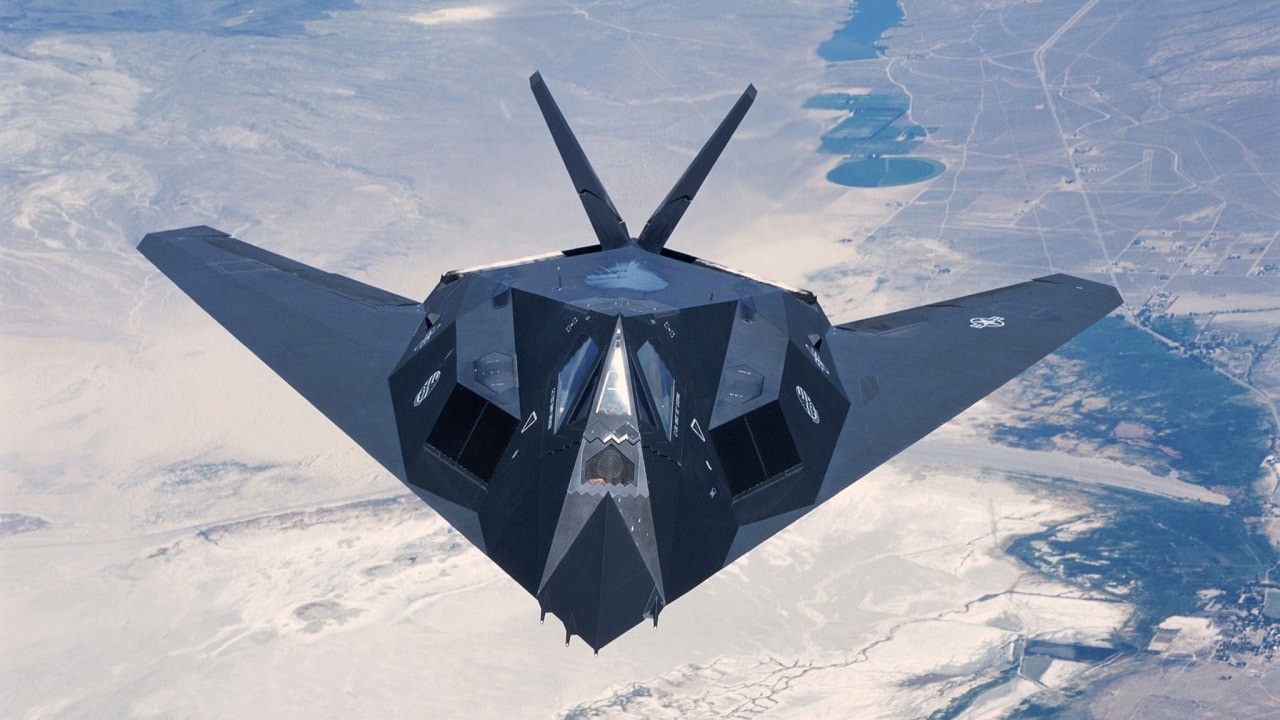
The F-117 Nighthawk is still flying in 2026 because the U.S. Air Force never actually let it go — it officially retired the world’s first stealth aircraft in 2008 and then quietly kept a portion of the fleet airworthy in the Nevada desert, where the “dead” jets fly classified test and training missions to this day. I learned how complete that gap is between the official story and the reality while standing in front of one of these aircraft at the National Museum of the U.S. Air Force in Dayton, Ohio, last July. The photo just below these words is literally what was in front of me, and what an amazing sight.
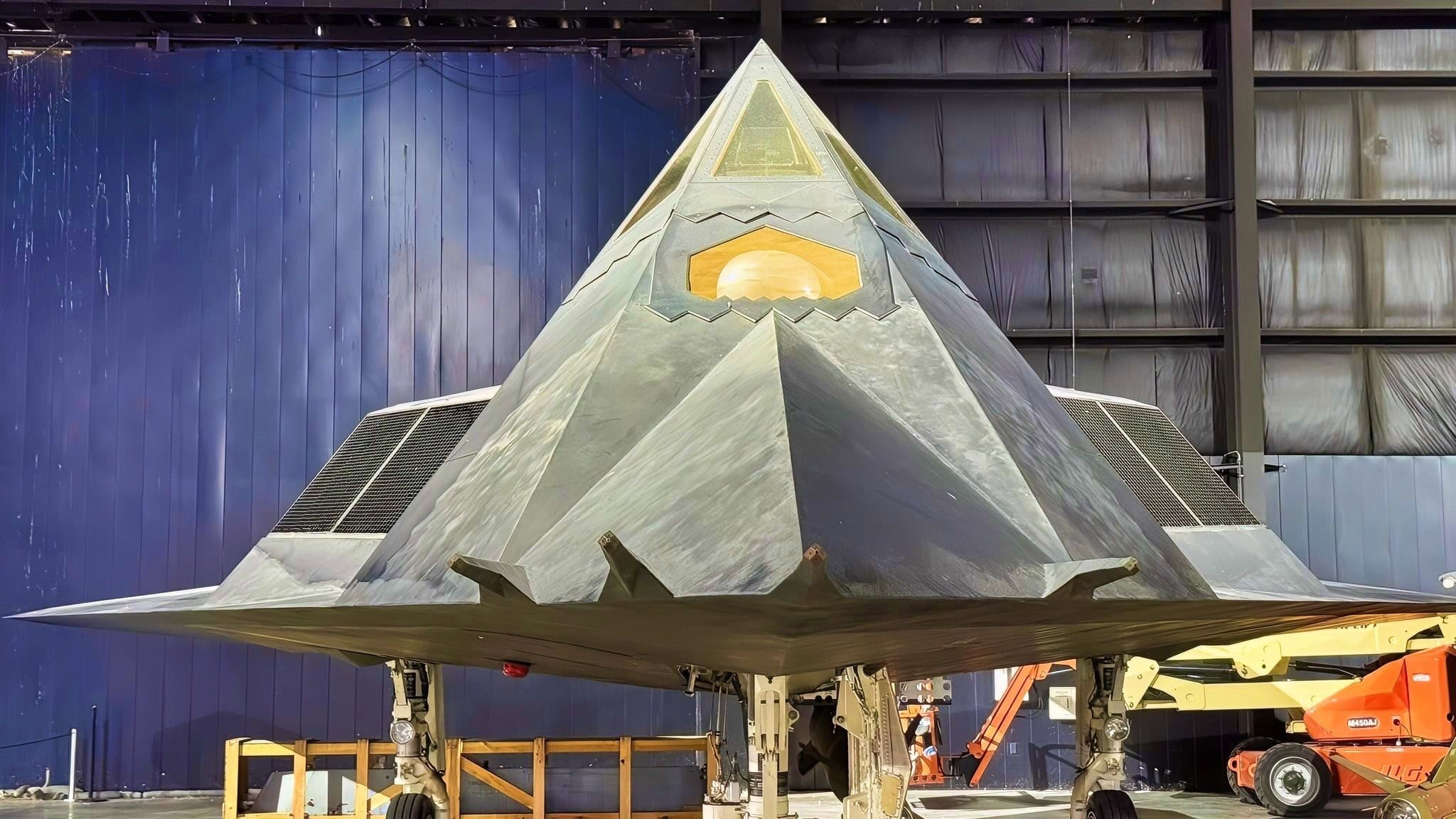
F-117 Nighthawk Stealth Fighter Harry Kazianis Photo from the U.S. Air Force Museum back in July of 2025.
The faceted black shape sits on the floor under the lights, the Cold War icon preserved behind a placard that records its service and its supposed retirement.
The jet in front of me was genuinely finished — demilitarized, drained, fixed to the floor.
But at that same moment, on the far side of the country, other F-117s were airborne, pretending to be the stealth fighters of China and Russia. The one I was looking at is the exception. The story of the ones that didn’t end up on a pedestal is the one the placard doesn’t tell.
F-117 Nighthawk: The Retirement That Wasn’t
The Nighthawk entered service in October 1983 as the first operational stealth aircraft ever fielded by any nation, a black project built by Lockheed’s Skunk Works around faceted shaping and radar-absorbent coatings to slip through air defenses and strike high-value targets.
It flew over Panama in 1989, struck a disproportionate share of strategic targets in the 1991 Gulf War, and served through the Balkans, Afghanistan, and Iraq before the Air Force decided its money was better spent on newer stealth. The service formally retired the type in April 2008.
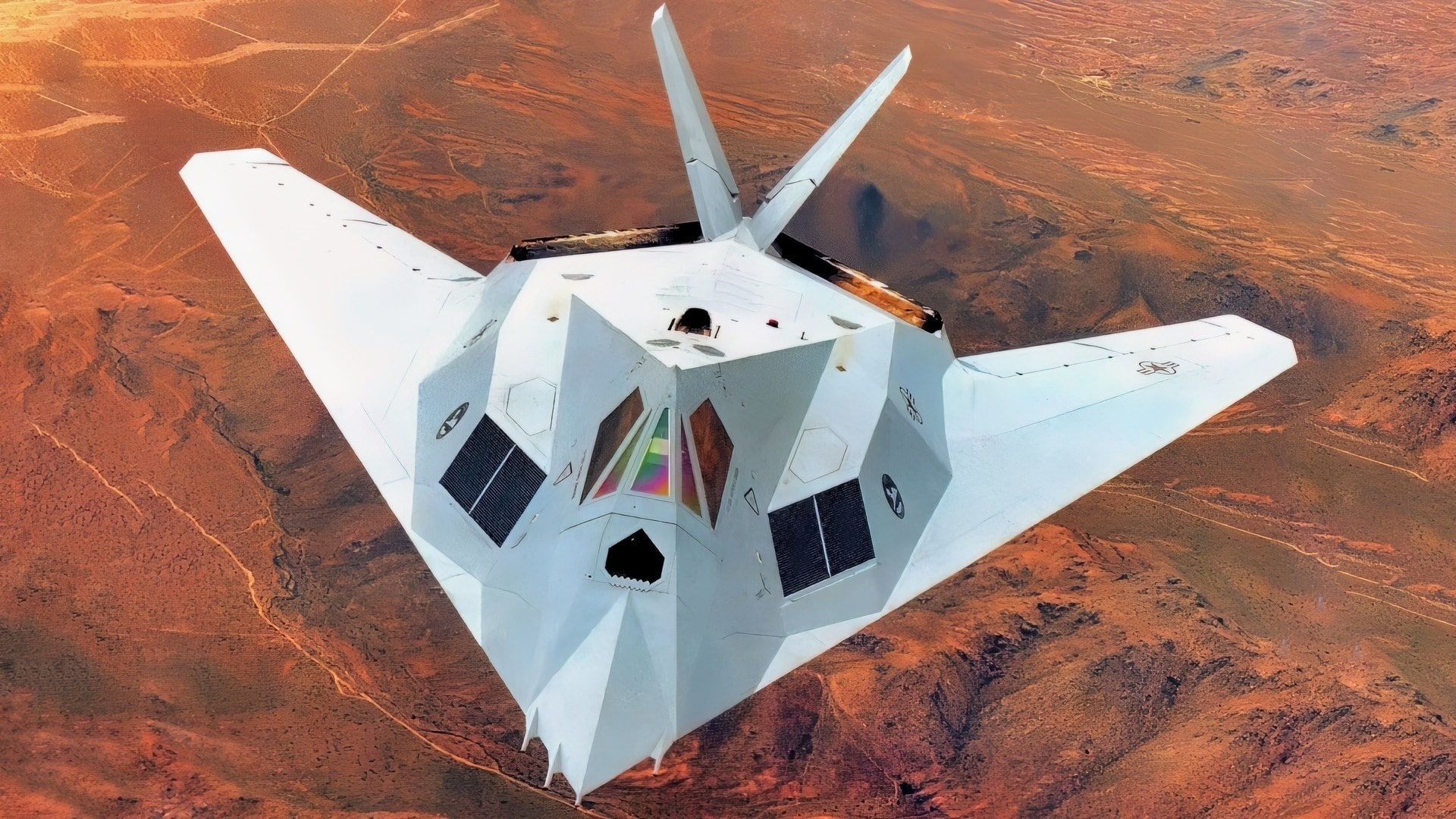
F-117 Nighthawk in White Config. Image Credit: Creative Commons.
It did not, however, send the jets to the boneyard to die. Instead, the Air Force moved most of the fleet into storage at the remote Tonopah Test Range Airport in Nevada, inside the larger Nevada Test and Training Range adjacent to Nellis Air Force Base — and crucially, it kept a portion of them flyable rather than fully demilitarizing them. For years, that was a closely held arrangement, the jets flying only at night or over restricted ranges where civilians could not see them. Then they started appearing in the open.
The first widely seen public sighting came in September 2021, when two Nighthawks landed at Fresno Yosemite International Airport in California to train with the local Air National Guard and the Air Force, in a notable break from decades of secrecy, and the Air Force released video of one coming in to land. A jet the public believed had been retired thirteen years earlier was demonstrably still flying.
The Fleet Math: A Shrinking Inventory Headed For The Pedestal
The numbers tell the story of an aircraft caught between two fates. Lockheed built 64 Nighthawks in total — five YF-117A development aircraft and 59 production jets. Six were lost over the years, and roughly thirteen have been handed to museums and display sites like the one in Dayton.
In 2023, an Air Force spokesperson stated the service had approximately 45 F-117s remaining, down from 51 acknowledged in 2019, and said that as the aircraft are demilitarized, they would be offered to museums or disposed of. Air & Space Forces Magazine’s accounting lists those 45 aircraft as remaining in flying or regeneratable stored condition, with roughly three airframes being demilitarized each year, all of them based at Tonopah.
That leaves a small active cadre doing the real work. Of the 45, only a handful — about five — appear to be flying at any given time, with the rest in storage that could, in theory, be regenerated.

An F-117 Nighthawk lands at the Fresno Yosemite International Airport, Sept. 15, 2021, after conducting a training mission with the local Air National Guard unit. Two F-117 Nighthawks are participating in dissimilar air combat training missions this week along with F-15 pilots from the 144th Fighter Wing in Fresno, Calif. (U.S. Air National Guard photo by Capt. Jason Sanchez)
The trajectory is unmistakable: the fleet is shrinking, three jets a year at a time, fed steadily into museums or scrapped. The aircraft I stood in front of in Dayton is not an anomaly; it is the destination. The Tonopah jets are the holdouts, and every year, a few more of them stop being holdouts and become exhibits.
Afterlife One: The Stealth Aggressor Flying “Red Air”
The most important job the retired Nighthawk does is pretend to be the enemy. In air combat training, “red air” is the force that serves as the adversary, and the F-117 flies as a threat-representative aggressor in large exercises, giving F-22 and F-35 pilots — along with the radar operators and air-defense crews who have to find them — live repetitions against an actual low-observable target that maneuvers unpredictably.
When the two Nighthawks deployed to Fresno in 2021, it was, as The Aviationist noted, the first time the Air Force openly acknowledged the type’s aggressor role and its involvement in dissimilar air combat training with other units. The jets have since appeared at larger events, including the Air National Guard’s Exercise Sentry Savannah in 2022.
The value here is specific, and it deserves an honest caveat. The F-117 is not a convincing stand-in for a J-20, a J-35, or a Su-57 in the literal sense — its 1970s faceted shaping produces a radar and infrared signature quite different from the rounded, blended edges of modern stealth designs, so it cannot truly mimic what those aircraft look like to a sensor.
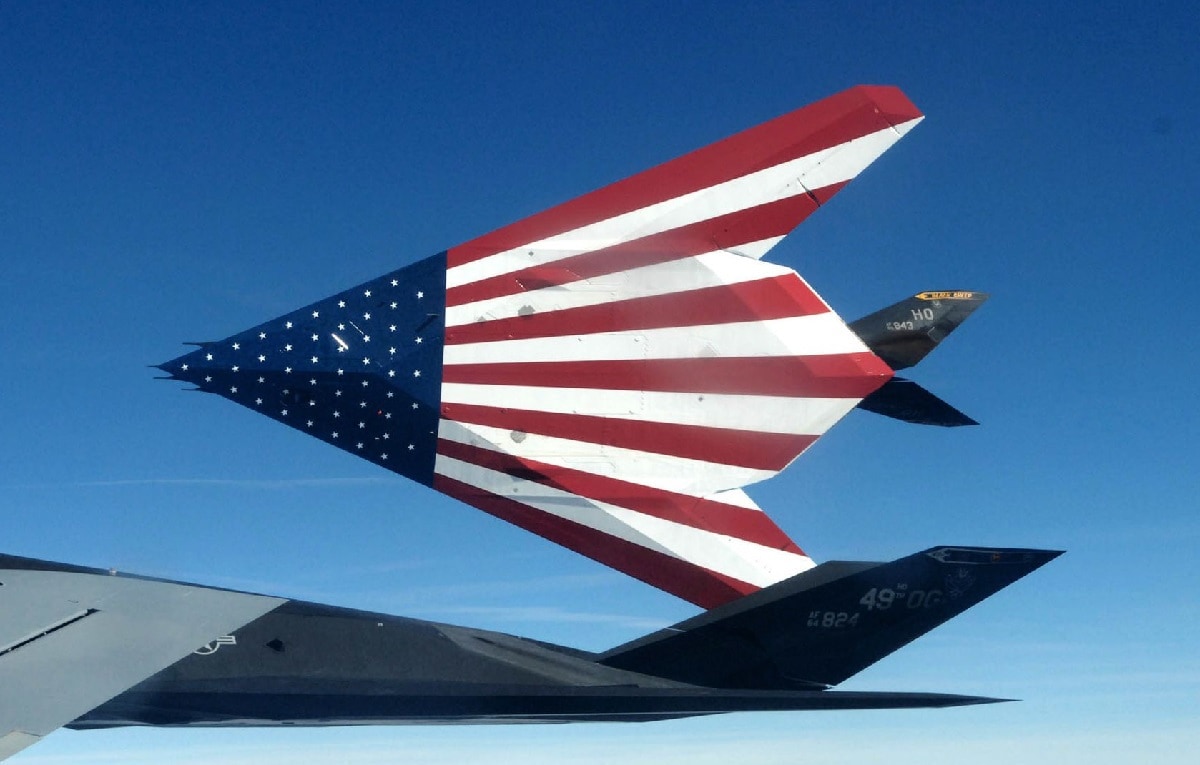
F-117 Stealth Fighter. Image: Creative Commons.
What it offers instead is the only real low-observable airframe the United States can put in the air to play the part at all. Against a backdrop where China has fielded the J-20 in numbers, is reportedly preparing to export the J-35, and Russia flies the Su-57, the Pentagon faces an urgent problem: how do you train against stealth you do not own?
The F-117 is the best available answer, an imperfect surrogate that still gives crews irreplaceable practice at the hard problem of detecting and engaging a stealthy target. Its signature, unlike anything pilots normally encounter, is, in this role, a feature.
Afterlife Two: The Cheap Stealth And Sensor Testbed
The second job is testing, where the Nighthawk’s age becomes an asset rather than a liability.
The Air Force uses the jets as a relatively cheap, low-risk platform to evaluate new radar and infrared search-and-track systems and stealth materials without tying up a frontline F-22, F-35, or B-21. Because the F-117’s signature profile is so different from that of current aircraft, it provides sensor developers with data on a wider range of low-observable characteristics than a modern jet alone would.
The evidence of this work appears in the details captured by plane spotters and reporters. One F-117 was photographed refueling in mid-2019 wearing an aggressor-style paint scheme, and in early 2022, another appeared with its leading edges, upper fuselage, and tails finished in a strange mirror-like coating — widely read as testing of radar-defeating materials, possibly tied to the Next Generation Air Dominance program.
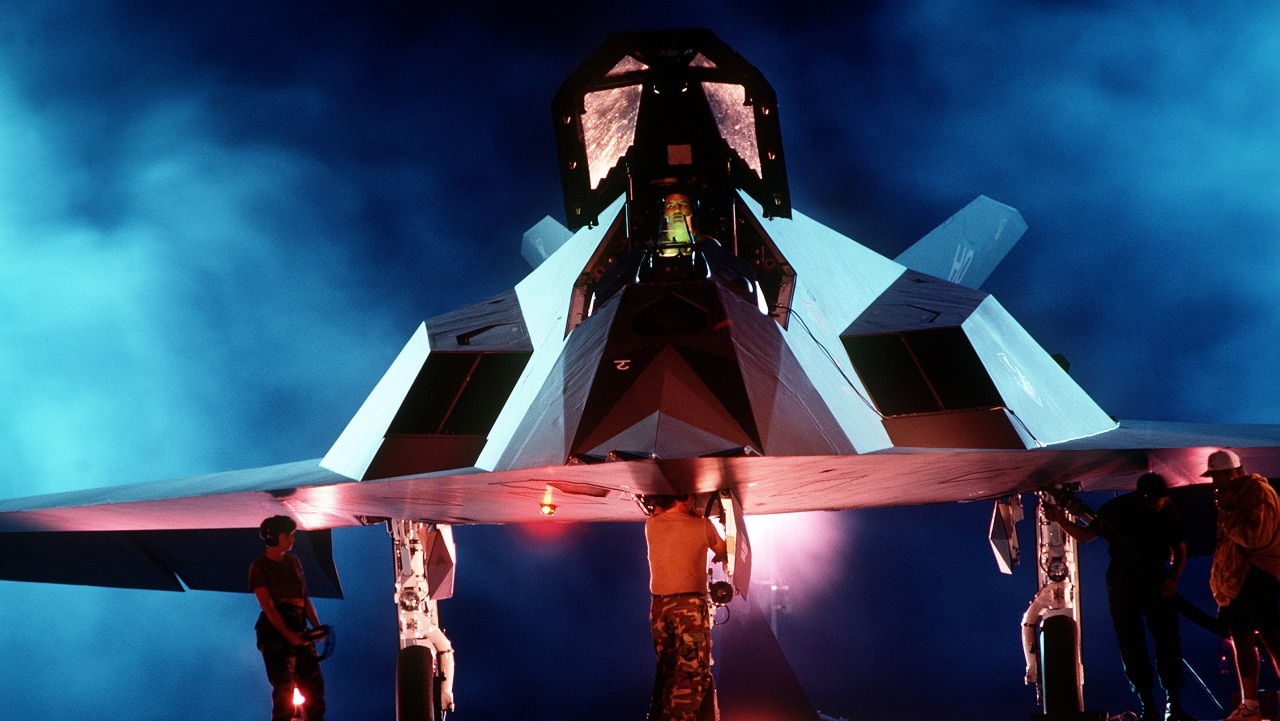
A back lit front view of a F-117A Stealth Fighter aircraft. From Airman Magazine’s February 1995 issue article “Streamlining Acquisition 101”.
Analysts who track the fleet judge that one major task has likely been helping calibrate the sensitive radar-cross-section measurement ranges at the Groom Lake test site, where aircraft signatures are measured under real-world conditions.
The Nighthawk, in other words, helps the Air Force measure and refine the stealth of the aircraft that replaced it.
Afterlife Three: The Stealthy Cruise-Missile Surrogate
The third role is narrower but real. In large-scale air-defense exercises, the F-117 has served as a surrogate for stealthy, subsonic cruise missiles, giving the crews who operate air-defense radars and the systems meant to catch such weapons a realistic, hard-to-see target to train against.
The Air Force’s own confirmation of the fleet’s continued use has grouped this in with the aggressor mission: the still-flying Nighthawks have been employed as stealthy aggressors and as stand-ins for cruise missiles for testing and training, where their unusual radar and infrared signatures make them useful precisely because they do not match what operators are used to seeing. It is the same logic as the red-air role applied to a different threat, and it stretches the value of a small fleet across more of the training problems the military actually needs to rehearse.

F-117 Nighthawk at National Museum of Air Force 19FortyFive Photo
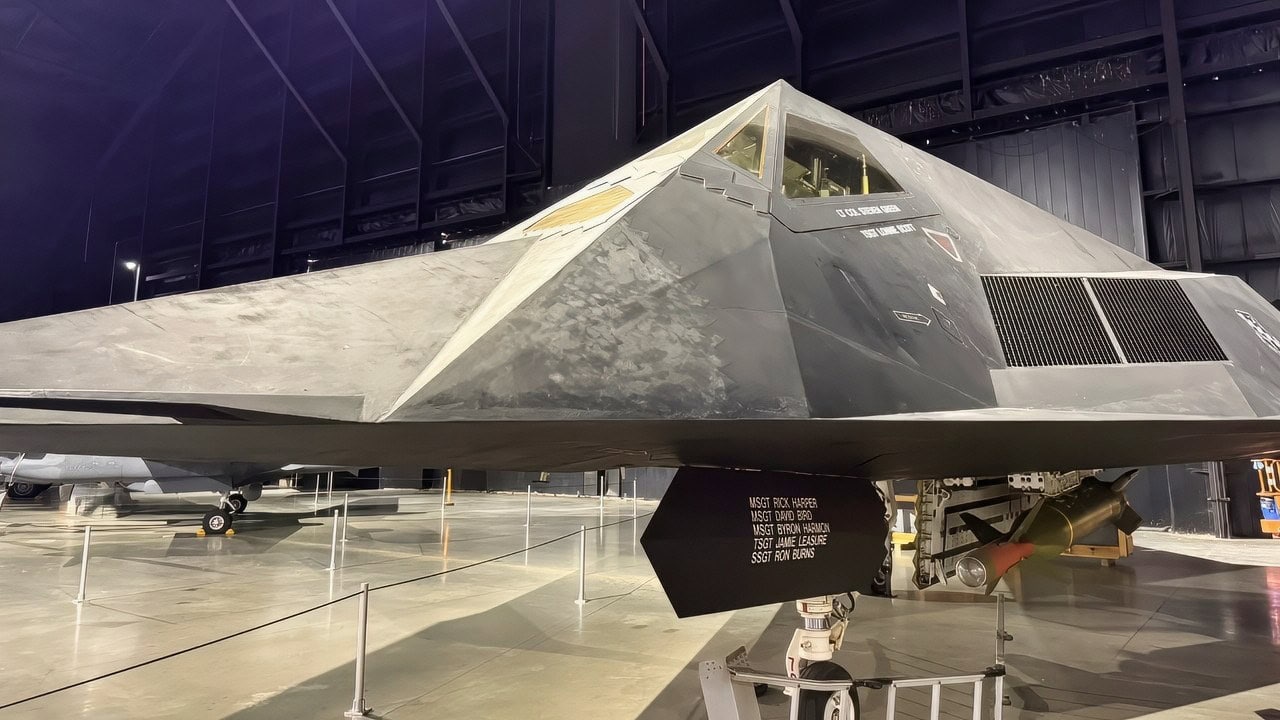
F-117A Nighthawk at USAF Museum. Image taken by 19FortyFive Owner, Harry J. Kazianis.
Afterlife Four: The Quiet Upgrades And The Tanker Connection
What is perhaps most remarkable about a jet the Air Force calls retired is that it has continued to receive attention and upgrades and has maintained its aerial-refueling capability. Nighthawks have been repeatedly photographed taking on fuel from tankers — most recently a pair seen over Los Angeles in 2025 refueling from a KC-135 Stratotanker, and earlier from an NKC-135 in 2019.
That retained capability is tied to the aircraft’s test and aggressor work rather than any plan to send it back into combat; refueling lets the jets range farther and stay airborne longer in support of exercises across the western United States.
Holding on to and using that capability, nearly two decades after retirement, is itself a sign that these are maintained, actively flown machines rather than mothballed relics waiting for the scrapheap. The Air Force has been clear that there is no requirement to preserve any of them for a return to combat — the upgrades serve the surrogate, not a war plan.
F-117: Why A 1983 Stealth Jet Still Flies In 2026
The reason all of this persists comes down to a convergence the Air Force could not ignore. Peer stealth has arrived: China’s J-20 is operational and being built in quantity; its J-35 is reportedly headed for export; and Russia’s Su-57 is flying, making the question of how American forces train against low-observable threats genuinely pressing.
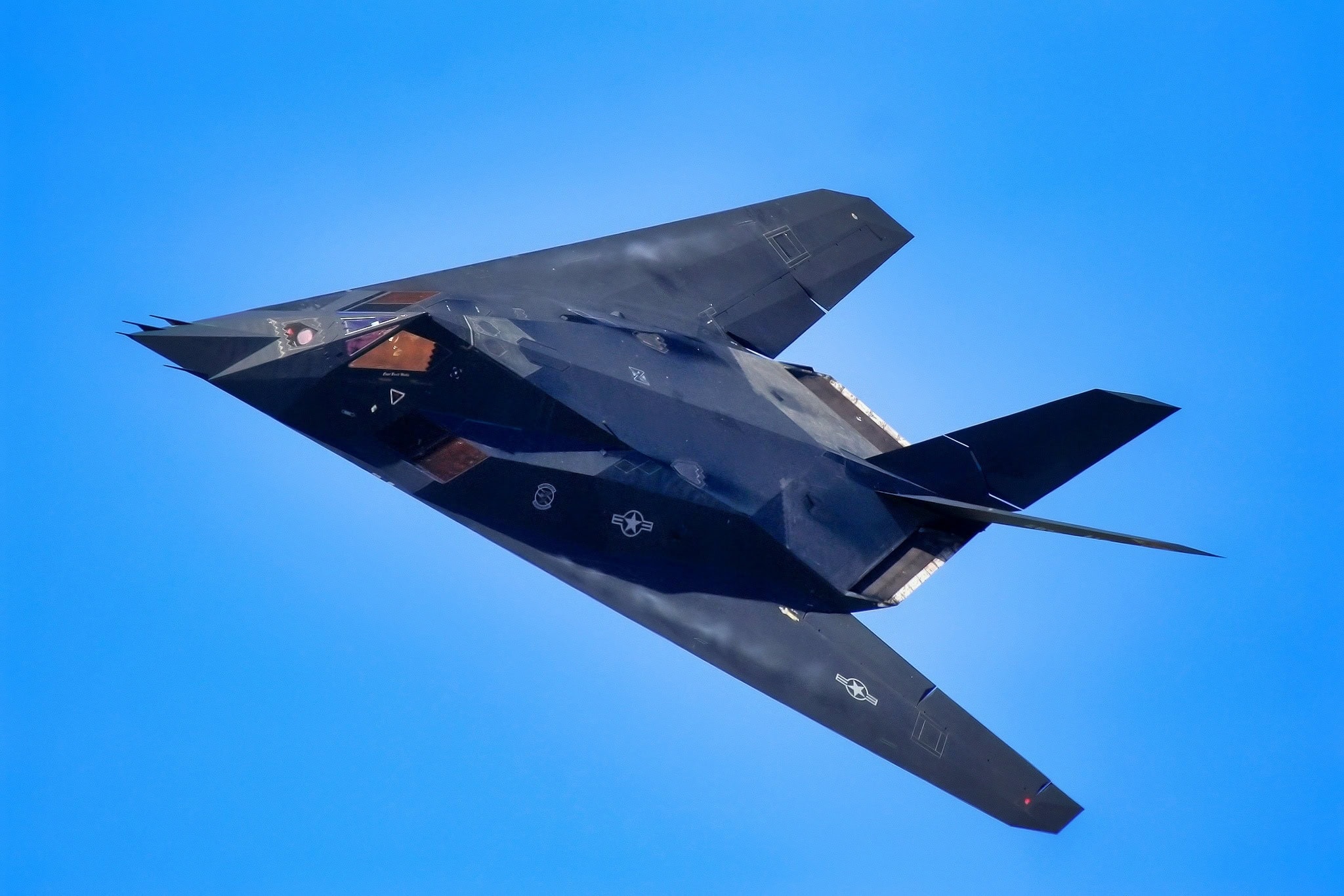
F-117. Image Credit: Creative Commons.
The Air Force has moved to address it on multiple fronts, including reactivating the 65th Aggressor Squadron at Nellis with early F-35As to play a fifth-generation adversary. But the F-117 remains the only purpose-built low-observable airframe cheap enough and expendable enough to fly the surrogate and testbed roles without pulling frontline jets off the line.
That logic is why the type received a remarkable reprieve. In response to questions from The War Zone, an Air Force spokesperson confirmed the service plans to keep at least some F-117As flying through 2034 and has contracted for the maintenance and logistics support to do so. Army Recognition, reporting the same extension, noted the jets will keep operating from Tonopah in their non-combat training, testing, and evaluation roles for years to come.
That figure is worth sitting with: the Air Force now intends to fly the F-117 until at least 2034 — twenty-six years after it officially retired the aircraft in 2008. A jet from 1983 will have a working career stretching past the half-century mark, most of it spent officially dead.
The Afterlife Is Finite
Standing in the museum in Dayton, it is easy to read the F-117 as a closed chapter — the silent black shape, the dim lighting, the placard fixing it in the past tense. What I understood by the end of looking into it is that the jet on the pedestal is the future of the fleet, not its past.
One airframe at a time, the Nighthawks at Tonopah are being demilitarized and sent to rooms like the one I was standing in, and the afterlife that has kept them flying for eighteen years is running out. When the last airworthy Nighthawk is too worn to fly, or when drones and purpose-built threat-representative aircraft can finally do the surrogate job better, the type will retire for real — quietly, the way it never quite did in 2008.
The aircraft that was in front of me back in July had a secret second career; its placard does not mention: a quarter-century as the enemy, as a test mule, as a stealthy ghost flown to teach the jets that replaced it how to find something they could not see. That career is the most interesting thing about the F-117 in 2026, and it is almost entirely invisible to the people who file past the museum exhibit. The Nighthawk launched the stealth age in 1983 and then, long after the world assumed it was gone, stayed in the air to help measure how far that age had moved beyond it. The ones still flying are not nostalgia.
They are the last of a kind doing a job nothing else can do yet — until, one by one, they come to rest on a floor like the ones in the phone just below.
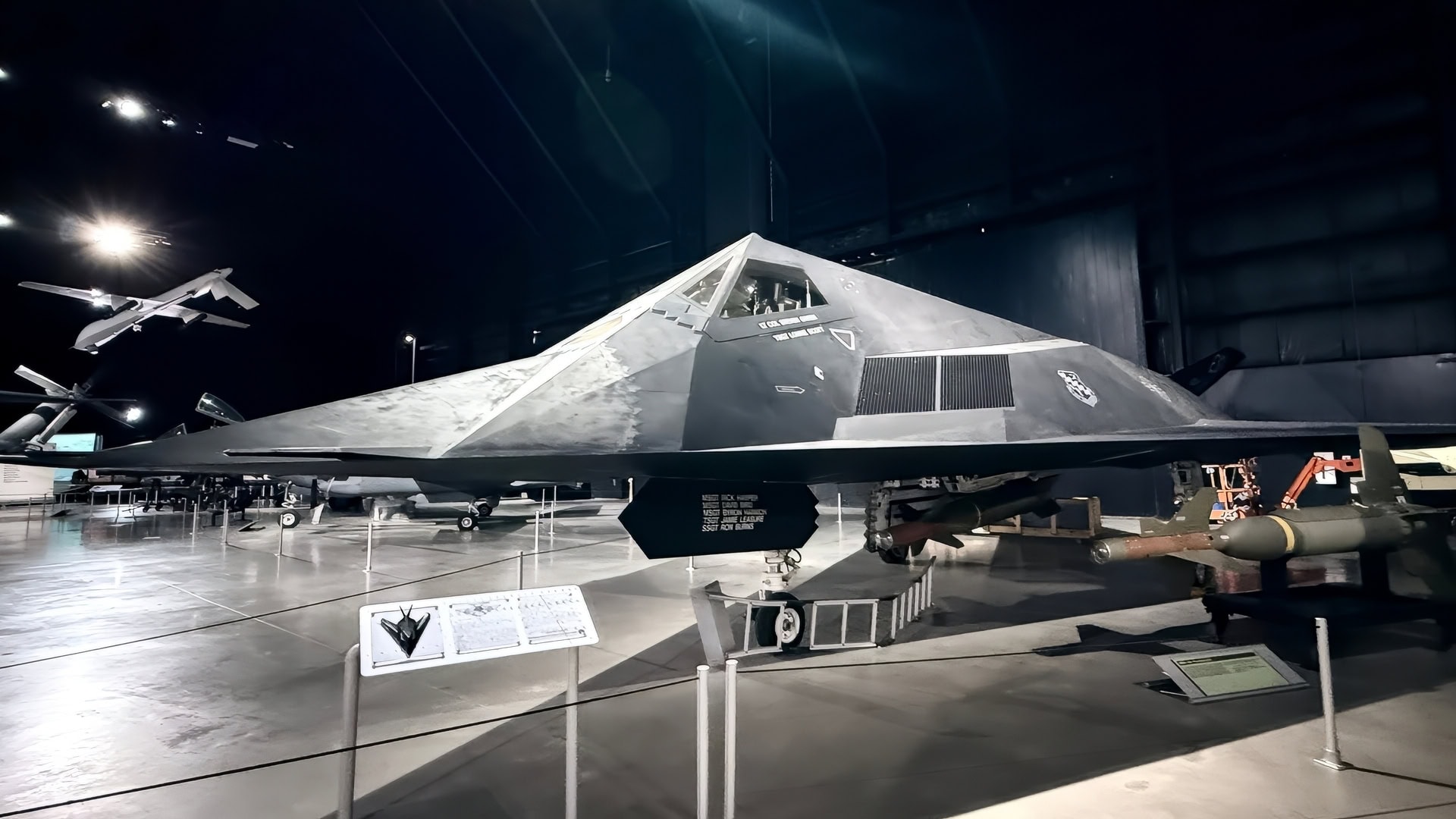
F-117A Nighthawk 19FortyFive.com Image. Taken on July 2025 at the National Museum of the U.S. Air Force by Harry J. Kazianis.
About the Author: Harry J. Kazianis
Harry J. Kazianis (@Grecianformula) was the former Senior Director of National Security Affairs at the Center for the National Interest (CFTNI), a foreign policy think tank founded by Richard Nixon based in Washington, DC. Harry has over a decade of experience in think tanks and national security publishing. His ideas have been published in the NY Times, The Washington Post, The Wall Street Journal, CNN, and many other outlets worldwide. He has held positions at CSIS, the Heritage Foundation, the University of Nottingham, and several other institutions related to national security research and studies. He is the former Executive Editor of the National Interest and the Diplomat. He holds a Master’s degree focusing on international affairs from Harvard University.

