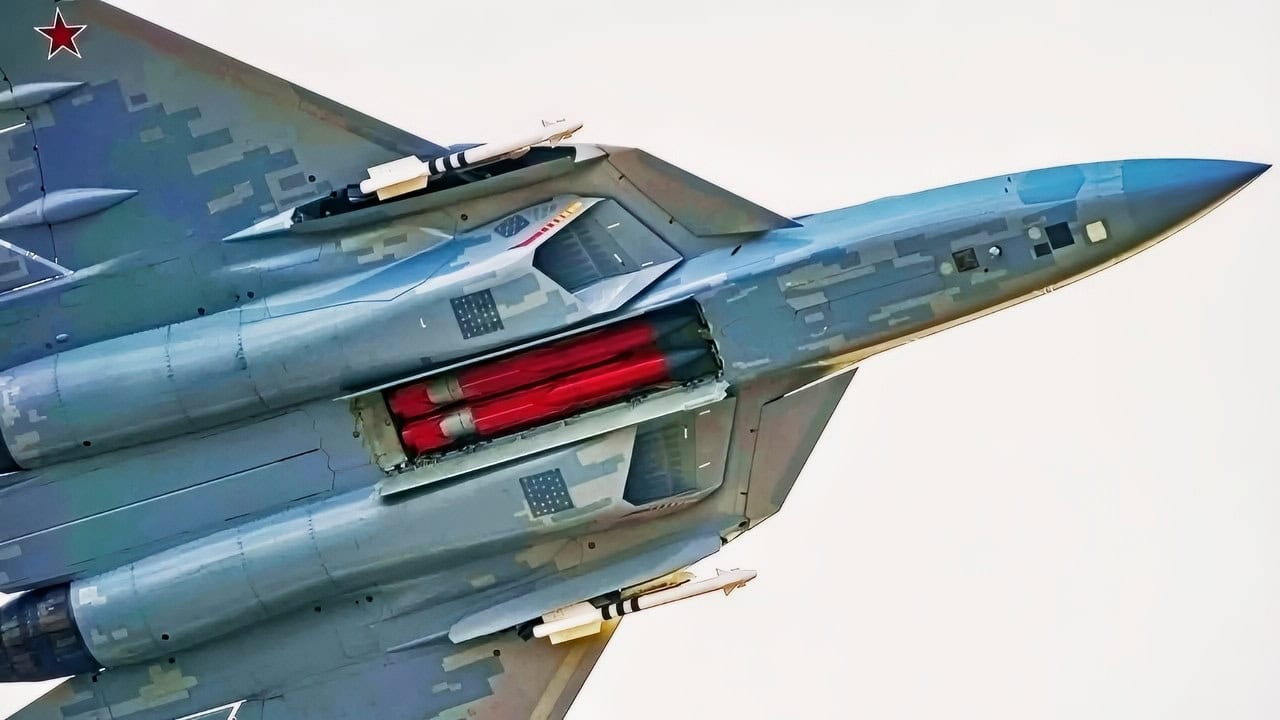
Russia’s Su-57 Felon Stealth Fighter Is No Joke and Has Capabilities
Mach 2 speeds, a stealthy configuration, and a range of more than 2,000 miles may lead some Pentagon observers to closely study and analyze Russia’s 5th-gen Su-57.
While the jet is known to suffer from a simple “numbers problem” compared with the F-35, meaning there are not very many of them, its actual capabilities remain a mystery to some extent.
Accordingly, it seems only a little is known about the extent of the threat Russia’s 5th-generation Su-57 Felon may pose to adversaries.
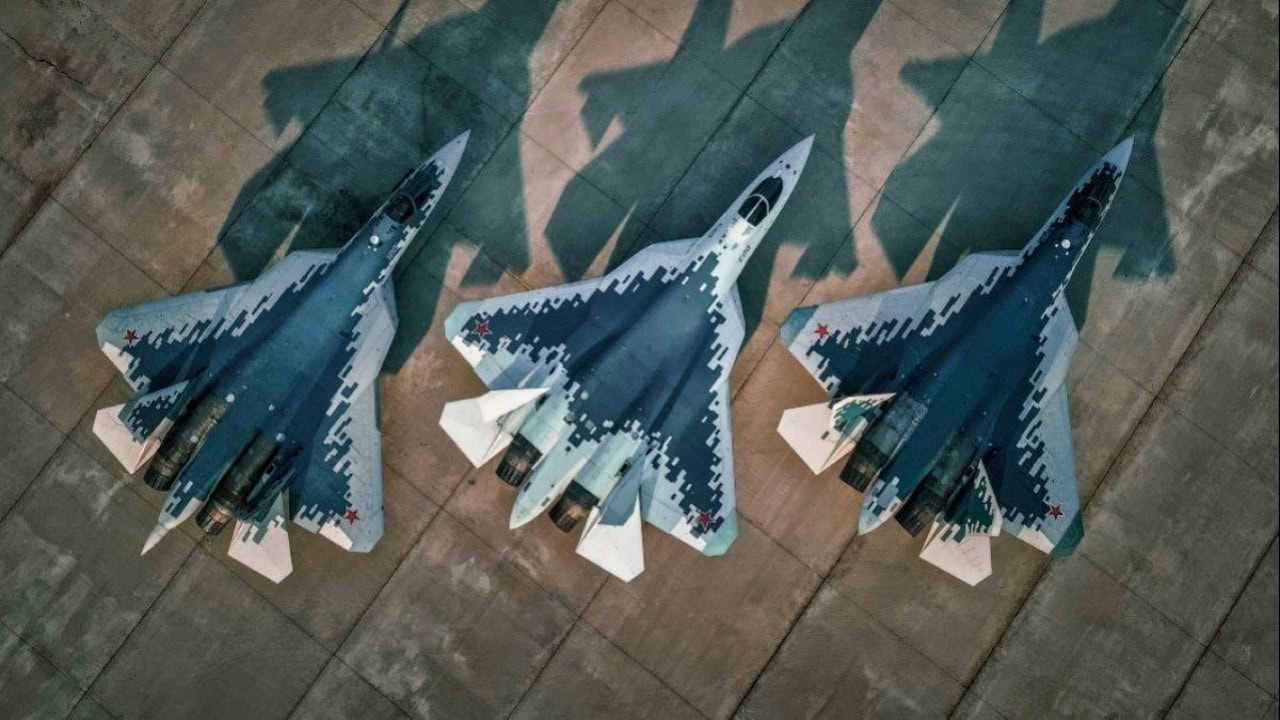
Su-57 Felon. Image Credit: Russian Government.
Russian media reports on many aspects of the airframe’s performance, and there are clear elements of a stealth configuration, yet little is known about its computing, weapons interfaces, sensing, and manned-unmanned teaming capabilities.
Certainly, looking at the airframe, the Su-57 does look stealthy with its blended-wing body and rounded fuselage.
Su-57 vs F-35
However, the operative question may be how it compares with the F-35 in sensing and high-speed, AI-enabled computing.
Is the Su-57 able to gather sensor data from disparate sources, perform immediate analysis and organization, and present integrated information to a pilot?
Additional specs on the Su-57 suggest it can reach Mach 2 and travel up to 2,200 miles.
This speed makes the jet slightly slower than an F-22, which reportedly reaches Mach 2.25.
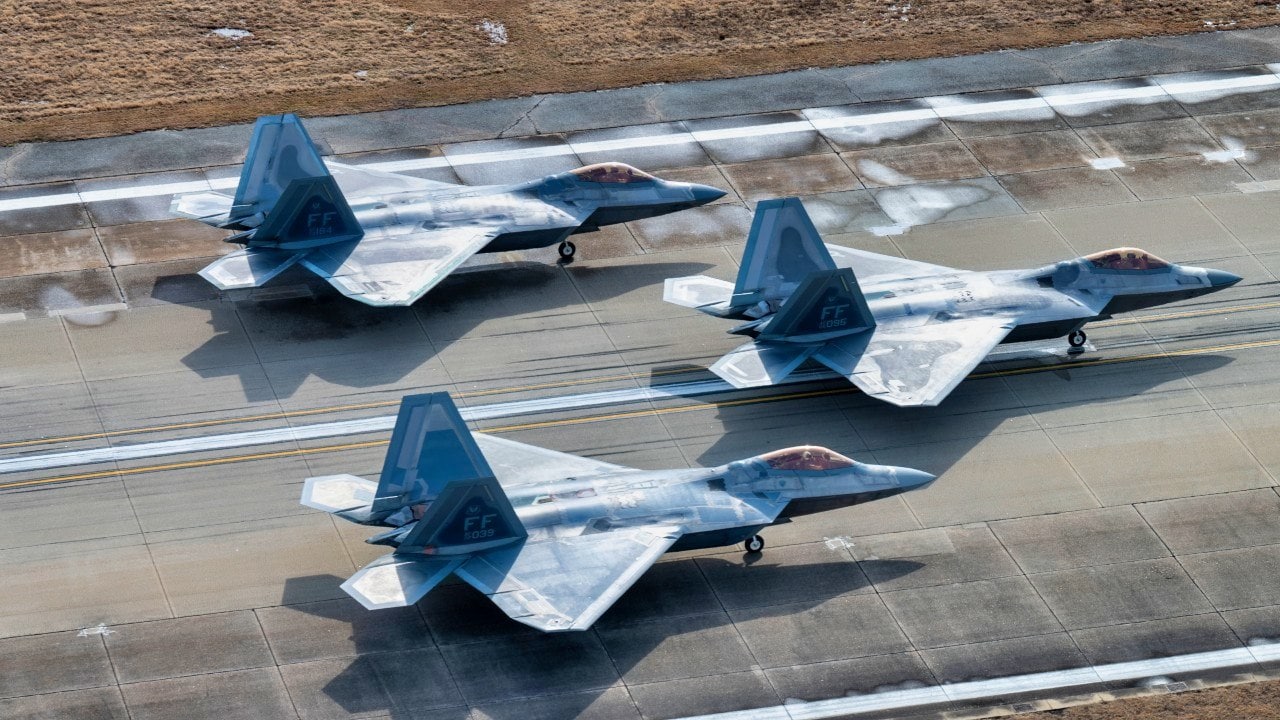
LANGLEY AIR FORCE BASE, Va. – F-22 Raptors from the 1st Fighter Wing sit in position on the runway during the Elephant Walk at Langley Air Force Base, Virginia, Jan. 31, 2025. The surge was designed to showcase the wing’s operational readiness and its ability to rapidly mobilize airpower. The 1st FW operates F-22 Raptors and T-38 Talons, maintaining combat capabilities that enable the U.S. Air Force to execute missions across the globe. With a focus on air superiority, the 1st FW plays a critical role in defending the nation’s interests. (U.S. Air Force photo by Tech Sgt. Matthew Coleman-Foster)
Also, the Su-57 may not have a thrust-to-weight ratio that rivals an F-22’s, making it less competitive as a true air-dominance platform.
It is reported that the Su-57 has an AESA (Active Electronically Scanned Array) radar and a phased-array radar, supported by extensive electronic countermeasures.
AESA radar is known for monitoring multiple targets simultaneously, yet its range can depend on the number of transmit/receive modules and “the packaging” technology.
Further details suggest the Su-57 uses an F/A-18-like Infrared Search and Track targeting technology, which, among other things, enables fighter jets to operate in a high-threat jamming environment.
Su-57 Loyal Wingman?
There is also the question of manned-unmanned teaming, as Russian media reports have mentioned efforts to connect drones with manned fighter jets using what the U.S. Air Force refers to as a “loyal wingman” scenario.
The U.S. Air Force, for instance, has demonstrated that its Valkyrie drone can share real-time data with an F-35, and it is not at all clear that Russia’s Su-57 is in any way capable of such technology.
Several years ago, Russia’s Izvestia news reported that the Su-57 has been working to network with Russia’s S-70 Okhotnik-B drone.
The extent of Russia’s progress on this may be unknown, particularly whether the Su-57 can control drones in real time.
It may not have evolved to the point where a single Su-57 can operate multiple drones from the cockpit, as an F-35 or F-22 can.
Still a Threat?
Nevertheless, the Su-57 may pose a significant threat to both Ukraine and the West, given its reported specifications, technologies, and stealthy configuration.
The aircraft certainly looks stealthy with its flat, rounded-wing, body-blended fuselage, has a reported range of up to 2,200 miles, and reaches speeds of Mach 2.
The quality of its computing, sensing, weapons, and targeting is likely more difficult to determine.
Yet, answers to those questions are likely to indicate whether the Su-57 can, in fact, rival an F-35.
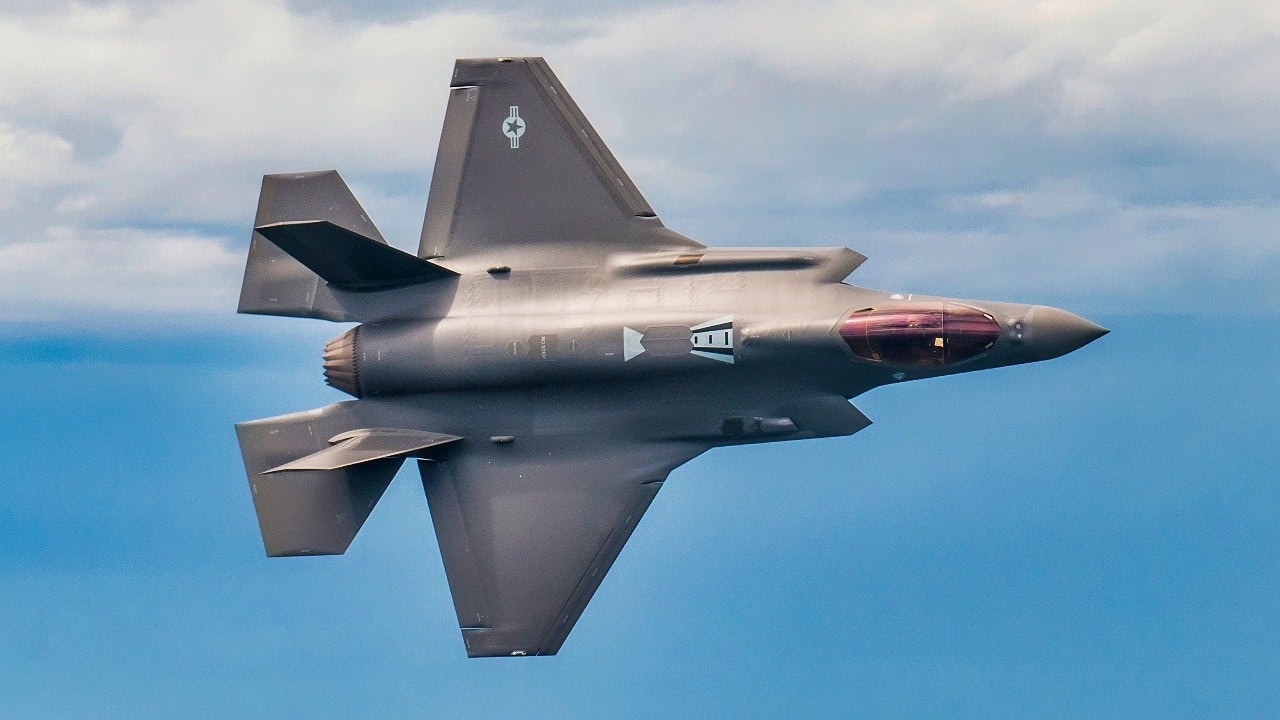
F-35 Fighter. Image Credit: Lockheed Martin.
What kind of range and resolution do the Su-57’s sensors have? What about mission systems, onboard computing, and weapons guidance?
The F-35 has, for instance, shown in wargames that its computing and long-range, high-fidelity sensors can detect and destroy large numbers of enemy fighters from stand-off ranges, where it remains undetected. How does the Su-57 compare in this respect?
MORE – China Will Be ‘Surrounded’ By A New Fleet of F-35A, F-35C, and New F-15EX Eagle II Fighters
MORE – The F-22 Raptor Mistake: 750 Ordered, 189 Built
About the Author: Kris Osborn
Kris Osborn is the President of Warrior Maven – Center for Military Modernization. Osborn previously served at the Pentagon as a highly qualified expert in the Office of the Assistant Secretary of the Army—Acquisition, Logistics & Technology. Osborn has also worked as an anchor and on-air military specialist at national TV networks. He has appeared as a guest military expert on Fox News, MSNBC, The Military Channel, and The History Channel. He also has a Master’s Degree in Comparative Literature from Columbia University.