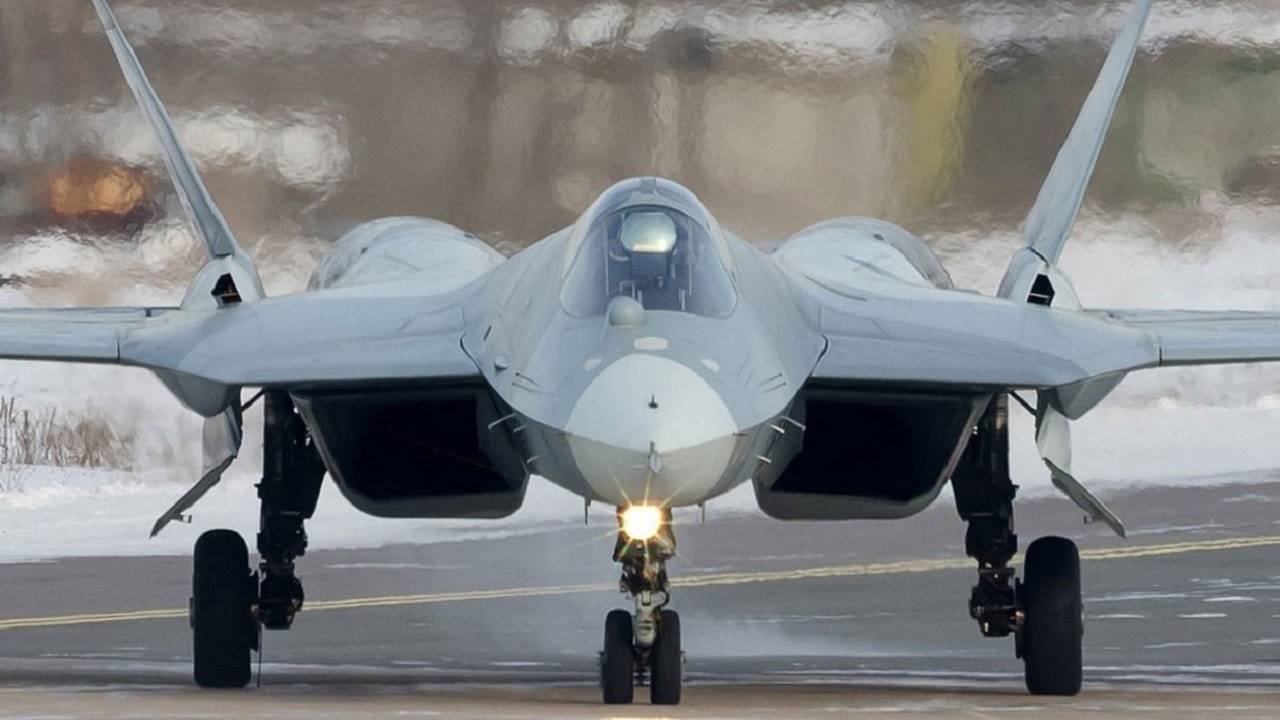
Key Points and Summary – Russia’s Su-57 is marketed as a premier stealth multirole fighter, but it falls short against its closest benchmark: the U.S. Air Force’s F-22 Raptor.
-The F-22’s purpose-built engines, thrust vectoring, and rear-aspect stealth shaping give it unmatched maneuverability and survivability in heavily defended airspace.
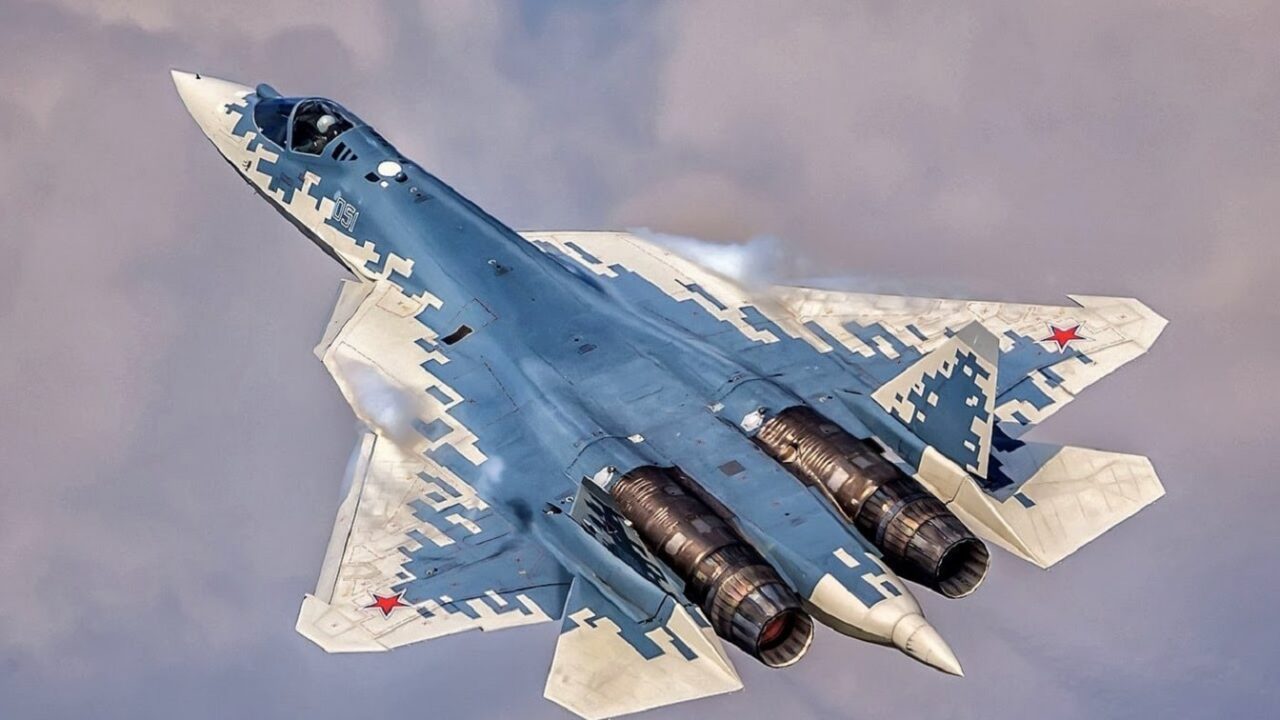
Russia’s Su-57 Felon Stealth Fighter. Image Credit: Creative Commons.
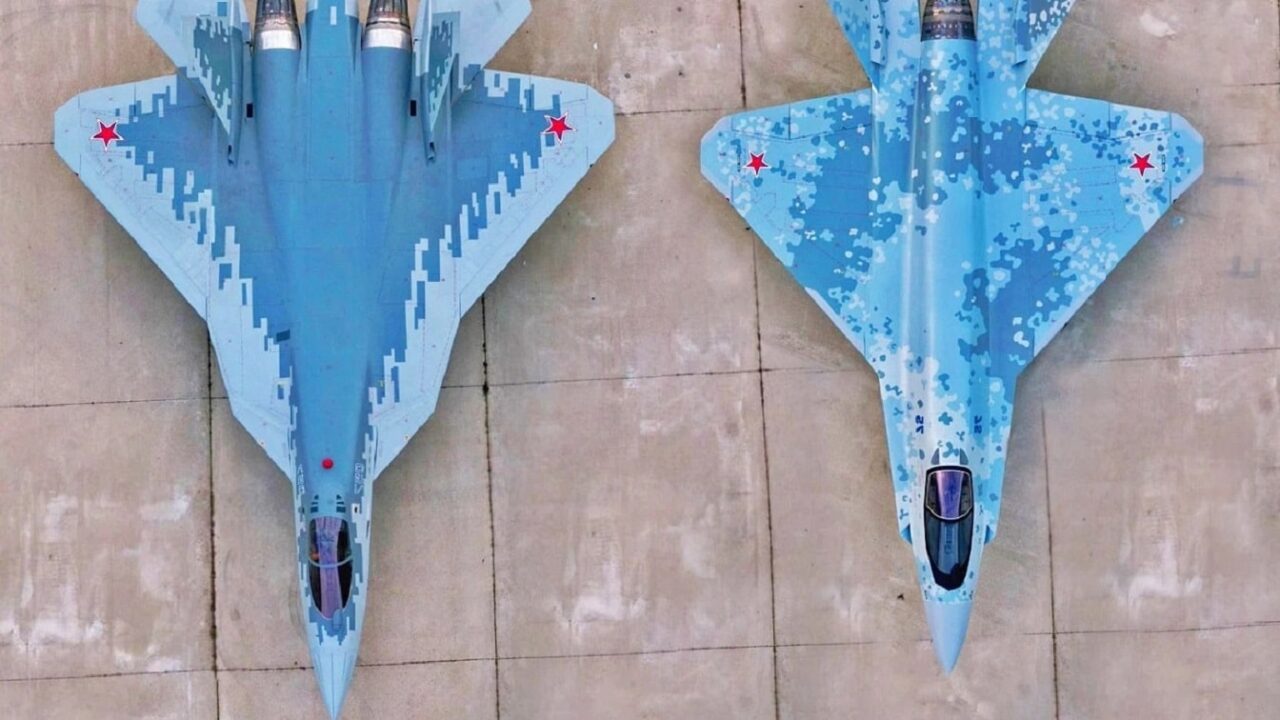
Russian Su-57 and Su-57 Stealth Fighters. Image Credit: Russian Government.
-By contrast, the Su-57’s propulsion and rear design appear to lack serious radar cross-section reduction, with some analysts arguing its signature is closer to a fourth-generation jet.
-The aircraft reflects Russia’s doctrinal preference for agility and close-in fights, but production is tiny—fewer than two dozen jets—constrained by war costs, sanctions, and limited industrial capacity.
Why Russia’s Su-57 Stealth Fighter Isn’t in the Same League as the F-22
It is touted domestically as one of the world’s preeminent stealth fighters, a large, multirole aircraft capable of performing multiple mission sets, such as Russia’s Su-57, which is notionally a stealth fighter.
However, compared to its perhaps most direct competitor, the U.S. Air Force’s F-22 Raptor air superiority fighter, the Russian Air Force’s Su-57 faces several acute shortcomings, both of which are thought to compromise the jet’s ability to perform its anticipated role for Moscow adequately.
The F-22 Raptor’s engines are Pratt & Whitney F119-PW-100 turbofans with afterburners and two-dimensional thrust-vectoring nozzles, purpose-built for the fighter.
While the engines are regarded for the amount of thrust they can generate — they clock in at 35,000 pounds of thrust, a figure that jumps with afterburner engaged — they are also notable for their exhaust nozzles.
Unlike in conventional fighter jet engines, the Raptor’s two edges are thrust-vectoring.
In other words, the aircraft’s engines do not simply compress hot air and squirt it out the back.
Instead, they can direct the thrust in multiple directions, giving the F-22 a degree of maneuverability that is almost unheard of in fighter jet design.
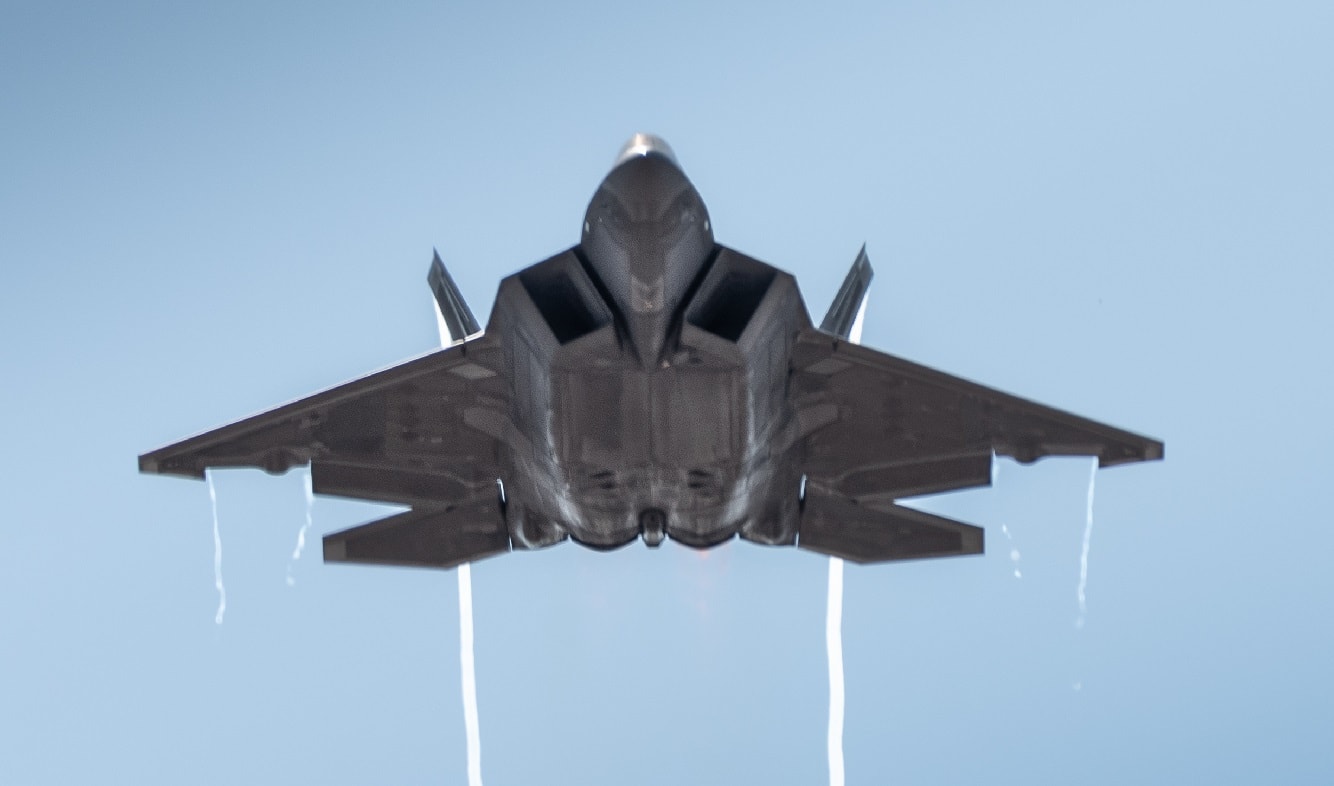
U.S. Air Force Maj. Paul Lopez, F-22 Demo Team commander, performs a high speed pass maneuver during the Fort Worth Alliance air show in Fort Worth, Texas, Oct. 19, 2019. Representing the U.S. Air Force and Air Combat Command, the F-22 Demo Team travels to 25 air shows a season to showcase the performance and capabilities of the world’s premier 5th-generation fighter. (U.S. Air Force photo by 2nd Lt. Sam Eckholm)
Like the F-22 Raptor, the Su-57 can vector its thrust in different directions and is considered a supermaneuverable fighter.
During the early stages of the Su-57’s design, before production, Sukhoi reportedly examined the Raptor as a potential starting point. However, both aircraft are employed in very different ways.
The F-22 is tailor-made for the air superiority mission and would be tasked with taking and holding airspace in combat, denying it to an adversary.
Even in the most highly contested, heavily defended airspace, the Raptor would not only survive, but thrive.
But Sukhoi took issue with the F-22’s more limited applicability as a multi-role fighter, a mission that it was never intended to fill. Consequently, the Raptor’s typical weapons load-out skews heavily toward air-to-air encounters, and as such lacks the robust air-to-ground capabilities of true multi-role aircraft.
But aside from thrust vectoring, the Su-57’s jet engines also lack another aspect that separates them from those of the Raptor: they do not appear to have incorporated any stealthy considerations into their design.
Compare the F-35 and the F-22 from their respective rear aspects. Though the Raptor has a pair of engines and the F-35 just one, both aircraft’s designs pay special attention to defeating adversary radar from the rear.
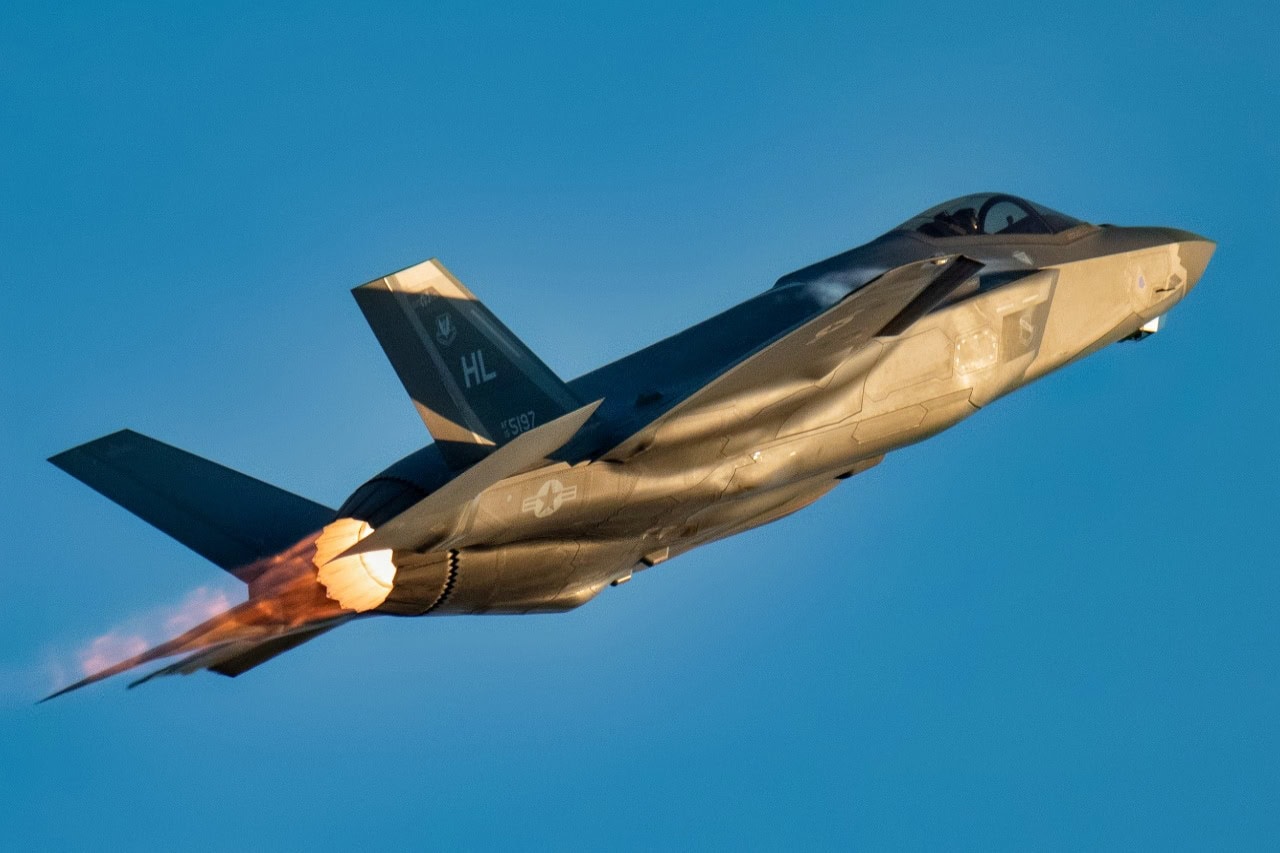
U.S. Air Force Major Kristin “BEO” Wolfe, F-35A Lightning ll Demonstration Team pilot and commander, flies during sunset over Mathers Airport, Calif., Sept. 24th, 2021, at the California Capital Airshow. The team consists of approximately 15 total Airmen to include the pilot and commander, pilot safety officers, superintendent, team chief, maintenance Airmen, aircrew flight equipment specialists, and public affairs personnel. (U.S. Air Force photo by Staff Sgt. Thomas Barley)
In the case of the F-35, its engine is not thrust-vectoring, but the serrated edges around the engine and the engine’s exhaust petals both help deflect and absorb radar. The F-22’s engines are also attuned to the jet’s radar cross-section from the rear aspect.
In sum, the Su-57 lacks both the thrust vectoring capabilities of the F-22 and does not fully embrace stealth technology, in particular related to the jet’s rear aspect and its propulsion.
While the jet does indeed seem to incorporate some features typically seen on stealth aircraft, like a canted V-tail, many other aspects of the design are thought to lag behind the Su-57’s more mature counterparts in the West.
How stealthy is the jet actually? It may be more limited than it seems. “Effective stealth design reduces an aircraft’s radar cross-section (RCS), allowing it to avoid detection and gain the upper hand in longer-range engagements,” the Center for European Policy Analysis, a think tank, explains. “However, the Felon [the Su-57] reportedly has a radar profile similar to that of fourth-generation non-stealth aircraft,” CEPA went so far as to call the Su-57 a “fraud” given its lack of decisively stealthy features.
Sukhoi’s jet is a reflection of the differing design philosophies that define combat aircraft in the United States, in the Soviet Union, and in today’s Russia.
Whereas Western air doctrine places a premium on dominating ranges beyond visual range, heightened situational awareness, and retraining movement and energy, Russian/Soviet aircraft have typically emphasized resilience, ruggedness, extreme maneuverability, and dominance in close-range combat and dogfighting.
Fifth-generation fighters are rapidly making inroads in air forces around the world. China’s growing crop of fifth- and sixth-generation fighters and bombers, as well as those of the United States, show that combat aviation is moving decisively towards a full embrace of stealth technology.
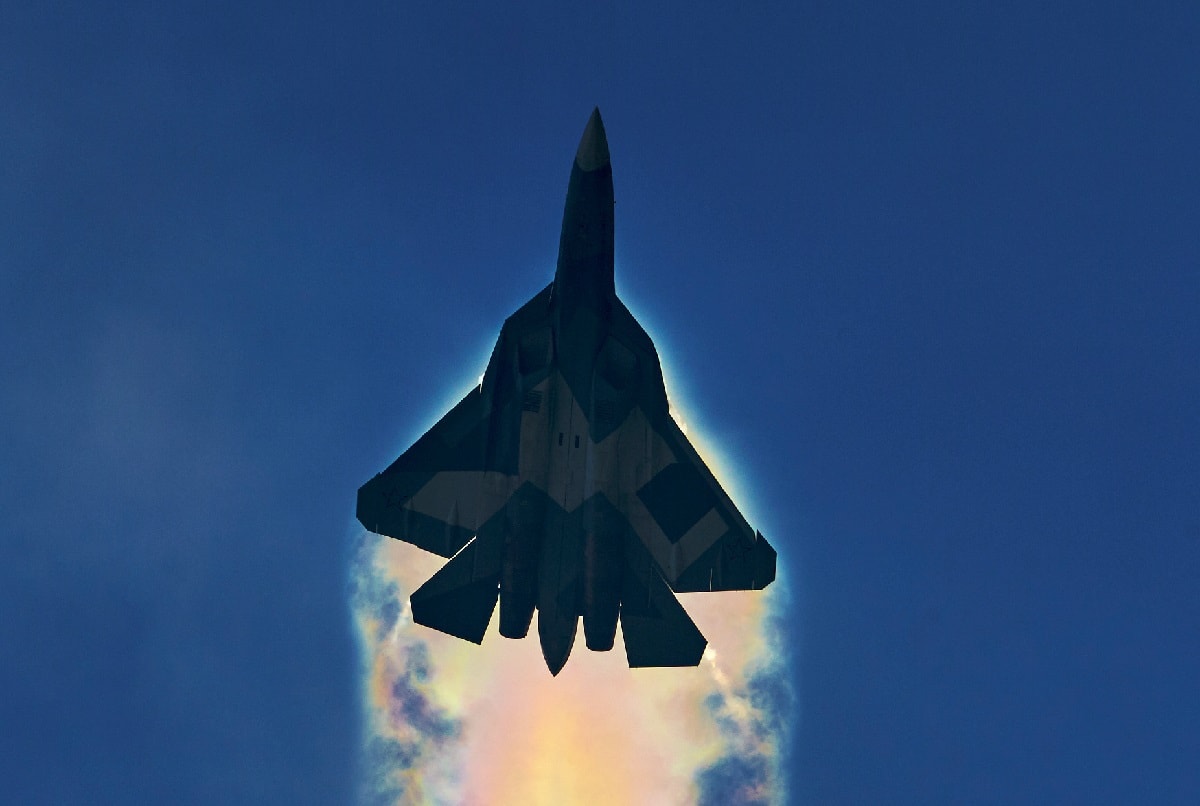
Image: Creative Commons.
Russia’s Su-57, in contrast, still prioritizes extreme maneuverability, but makes some effort to incorporate stealth technologies too.
Design is one question, production is a different question entirely.
Initially, the U.S. Air Force had intended to acquire 750 F-22 Raptors, a number severely curtailed by the collapse of the Soviet Union and the end of Cold War hostilities. But the project did move forward, albeit in an abbreviated form, with the Air Force acquiring fewer than 200 of the stealth fighters.
Russia, in contrast, has built precious few of its Su-57s. As of 2024, fewer than two dozen Su-57s had been constructed.
Those numbers are not expected to burgeon anytime soon. Bogged down by its grinding, land-centric war in Ukraine, Russia has precious few resources available for doubling down on what is thought to be a rather expensive aerospace project.
Combined with increasingly strict sanctions on Russian oil and U.S. President Donald Trump’s pressure campaign against Russia’s oil sector, rubles for aerospace will likely be in increasingly short supply.
About the Author: Caleb Larson
Caleb Larson is an American multiformat journalist based in Berlin, Germany. His work covers the intersection of conflict and society, focusing on American foreign policy and European security. He has reported from Germany, Russia, and the United States. Most recently, he covered the war in Ukraine, reporting extensively on the war’s shifting battle lines from Donbas and writing on the war’s civilian and humanitarian toll. Previously, he worked as a Defense Reporter for POLITICO Europe. You can follow his latest work on X.