
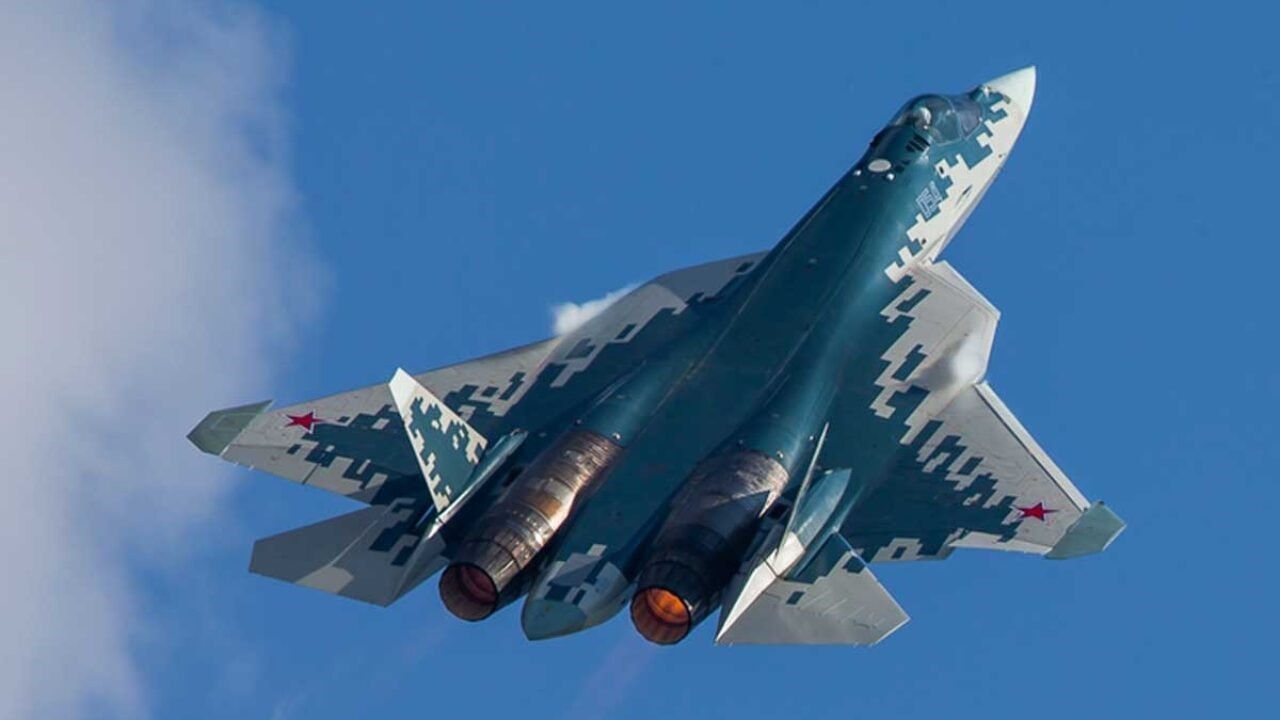
Key Points and Summary: A direct comparison between Russia’s Su-57 “Felon” and China’s new J-35A reveals a clash of philosophies: raw kinetic performance vs. modern stealth optimization.
-The Su-57 Advantage: Dominated by maneuverability (thrust vectoring), speed (Mach 2+), and sensor coverage (cheek/tail radars), making it a lethal dogfighter.
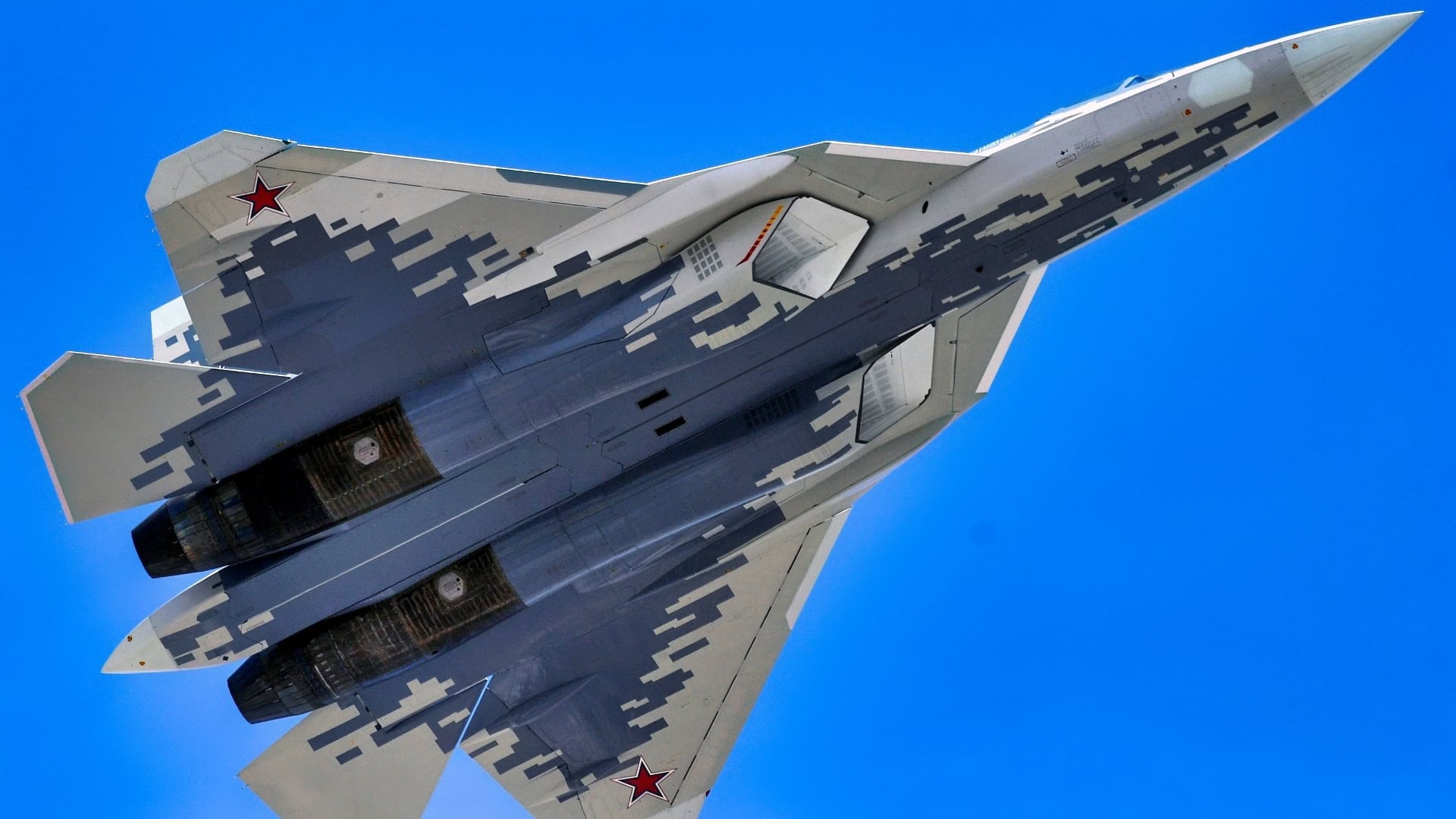
Su-57 Felon from Russia. Image Credit: Creative Commons.
-The J-35A Advantage: Prioritizes stealth with an RCS under 0.05 m², diverterless intakes, and advanced networking to win the “first look, first shot” battle.
-The Verdict: While the J-35A is the better stealth platform, the Su-57’s versatility, electronic warfare suite, and long-range R-37M missiles make it the “likelier victor” in a one-on-one engagement.
The J-35A Is Stealthier, But the Su-57 Has 1 Huge Advantage It Can’t Ignore
For decades, the United States held a monopoly on stealth aircraft. It lost that monopoly in recent years, as Russia and China fielded fifth-generation fighters of their own. Russia has its Su-57 fighter. China recently entered its newest J-35 into service, marking its second operational stealth fighter.
While much ink has been spilled comparing these fighters to their U.S. rivals, they are far less often compared against each other. Which country possesses the better fifth-generation fighter?
The Su-57 Felon vs. the J-35A
The Su-57 “Felon,” was developed by Russia under the PAK-FA program as a fifth-generation multi-role fighter. It is a large aircraft, measuring about 20 meters in length with a wingspan of 14 meters. It is powered by two AL-41F1 turbofan engines, with future variants expected to use the more advanced Izdeliye 30 engine.
The Su-57 can reach speeds exceeding Mach 2 and currently supercruises at about Mach 1.3, with projections of Mach 1.6–1.8 once the new engines are integrated. Its range is approximately 3,500 kilometers, making it suitable for long-range missions.
While stealth was a design consideration, the Su-57 does not achieve the same low radar cross-section as Western or Chinese counterparts.
In contrast, the Shenyang J-35A, which entered service with the Chinese People’s Liberation Army Air Force in 2025, is a smaller and lighter aircraft, measuring about 17 meters in length with a wingspan of 11.5 meters.
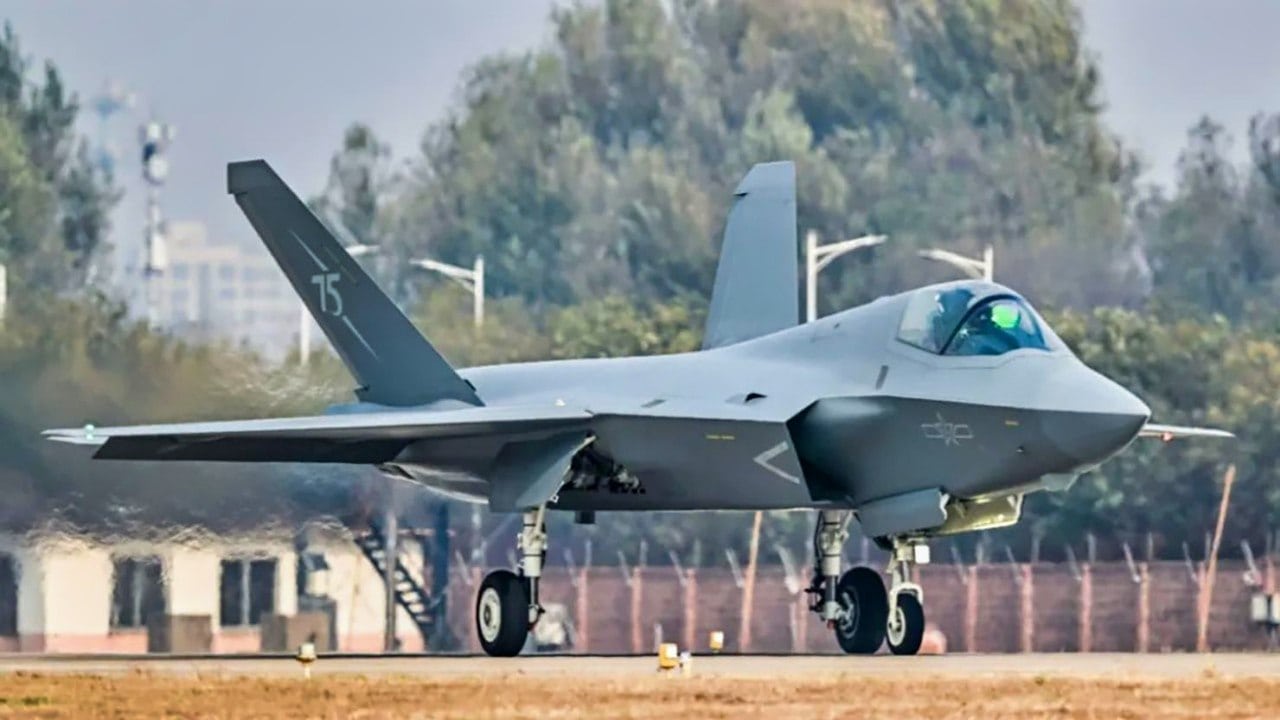
J-35A Fighter from China. Image Credit: Chinese Military
It is powered by twin WS-19 engines and can reach speeds of Mach 1.8, with a combat radius estimated between 1,200 and 1,500 kilometers. The J-35A emphasizes stealth far more than the Su-57, incorporating diverterless supersonic intakes and radar-absorbent materials in a design heavily influenced by the F-35.
Its radar cross-section (RCS) is believed to measure less than 0.05 square meters from the front aspect, making it significantly harder to detect than the Su-57.
Avionics and Engine Performance
The Su-57 is equipped with formidable avionics. Its N036 Byelka radar system uses multiple Active Electronically Scanned Arrays (AESA) positioned on the nose, cheeks, and tail, providing wide coverage, and even L-band capability for detecting stealth aircraft. Complementing this is the 101KS Atoll electro-optical targeting system and the L402 Himalayas Electronic Warfare (EW) suite, which enhances survivability and situational awareness.
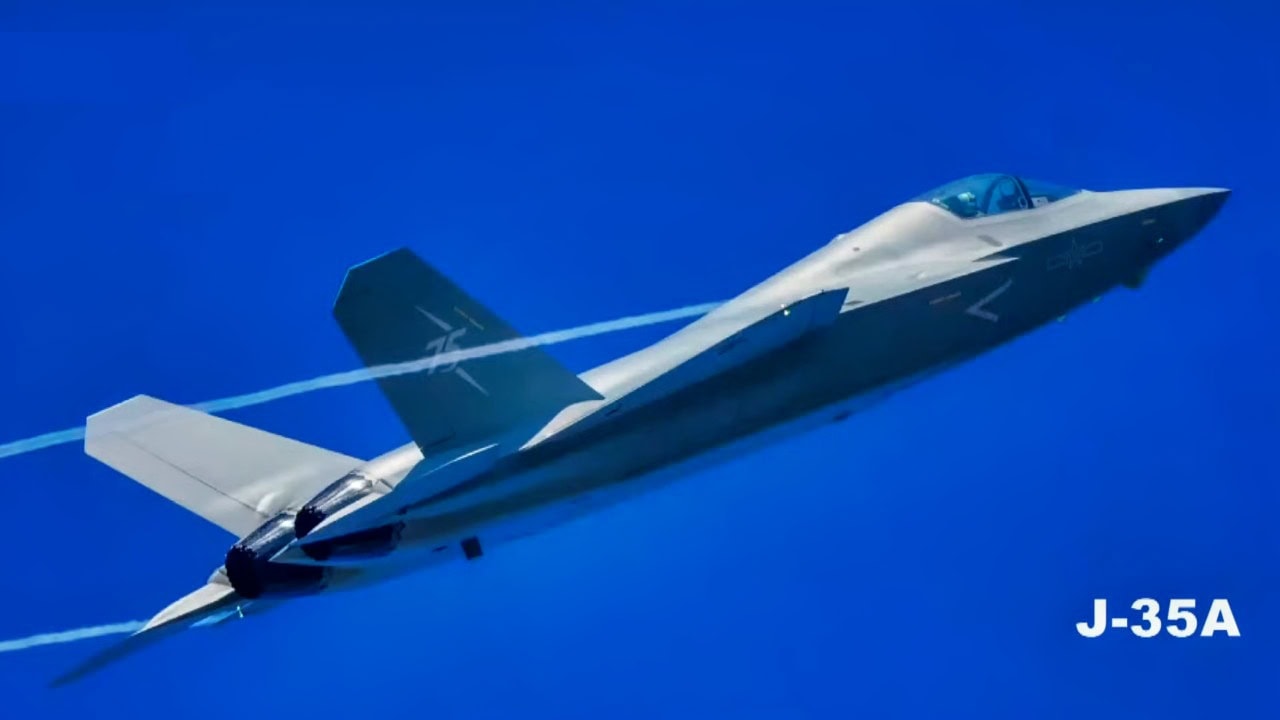
China J-35 Fighter. Image Credit: Creative Commons.
The J-35, according to some reports, is fitted with a KLJ-7A AESA radar, which has a range of about 150 kilometers when scanning for targets with a larger RCS. It also features a distributed aperture system, optical early-warning system, and an electro-optical targeting system.
The Su-57 is best known for its insane maneuverability, enabled by two-dimensional thrust vectoring (often mistaken for 3D thrust vectoring) and a high thrust-to-weight ratio, which makes it exceptionally capable in dogfights. Unlike the Su-57, the J-35A does not feature thrust vectoring and prioritizes stealth and electronic sophistication over raw maneuverability. Its design philosophy suggests that China expects these fighters to avoid close-in dogfights and instead rely on first-shot advantage and coordinated attacks within a broader networked system.
Stealth Features
The Su-57 carries its weapons internally to preserve stealth. The loadout includes up to six missiles such as the R-77M for beyond-visual-range engagements, and the R-74M2 for close combat. It can also deploy the R-37M, a long-range missile capable that can hit targets 300 to 400 kilometers away, giving it a unique advantage against high-value assets such as Airborne Early Warning aircraft.
The Su-57 is also equipped with a 30-mm cannon and can perform Suppression of Enemy Air Defenses using internally carried Kh-series missiles. The J-35A also carries its weapons internally, though it can use external hardpoints when stealth is not a priority. The J-35A’s weapons complement includes the PL-15, a long-range air-to-air missile with an estimated range of more than 200 kilometers, and the PL-10, a highly agile short-range missile with an imaging infrared seeker.
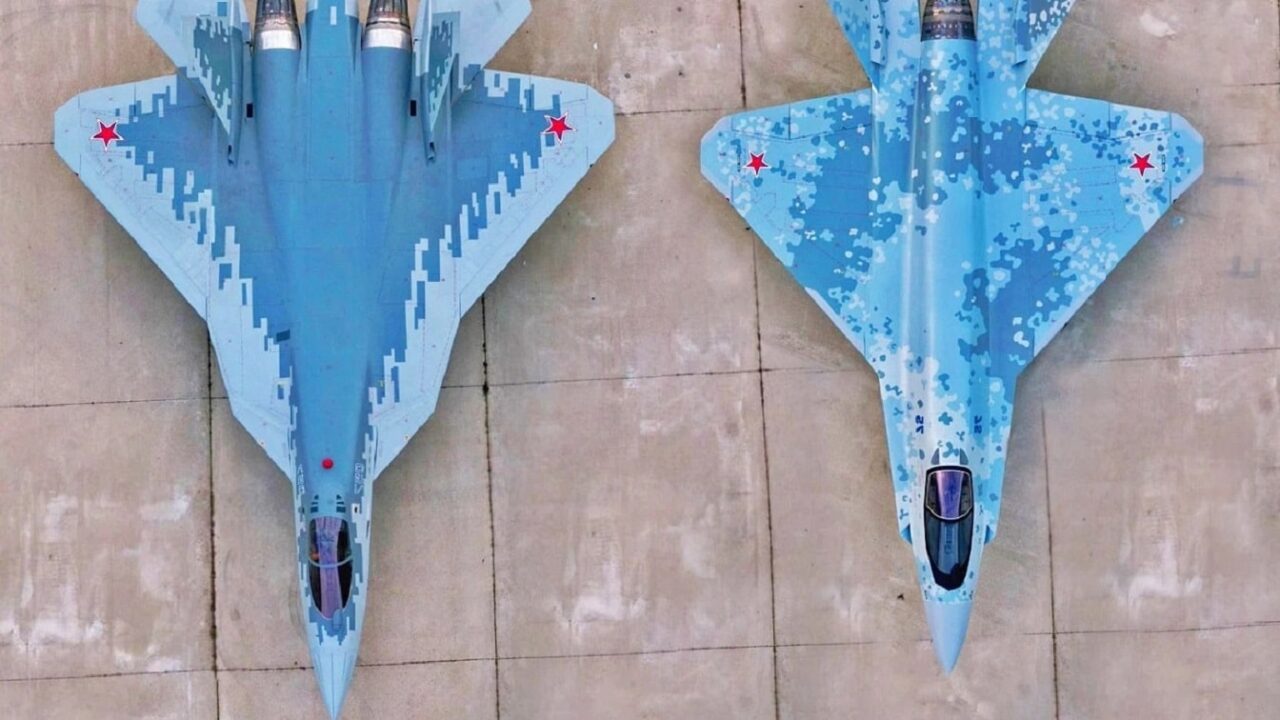
Russian Su-57 and Su-57 Stealth Fighters. Image Credit: Russian Government.
The Su-57’s stealth features are one of its greatest weaknesses. At the same time, this is one of the most widely misunderstood aspects of the aircraft. It is true that the Su-57 has a higher RCS than every other fifth-generation fighter, but many observers fail to identify why this is the case.
A major source of the Su-57’s high RCS is its engines. Even with RAM coatings on the engine fans, the Su-57’s engine intakes yield much greater radar returns than an S-shaped intake. The way the engines are integrated onto the airframe itself greatly enhances its signature.
Though later iterations will reduce the IR signature from the engines, their overall integration remains much less ideal than other stealth aircraft. While the Su-57 still has a lower RCS than any fourth-generation aircraft, it is far worse than the J-35.
Which Fighter Wins?
In a beyond-visual-range engagement, the outcome would hinge on detection and missile performance. The J-35A’s stealth advantage means it would likely detect the Su-57 earlier than vice versa, but the Su-57’s powerful radar and infrared sensors could still pick up the J-35A at long range.
If the Su-57 fired first with an R-37M, the J-35A would need to evade and close the distance quickly. If the fight moved within visual range, the Su-57’s supermaneuverability would be decisive.
Its thrust vectoring and aerodynamic design allow it to perform post-stall maneuvers that the J-35A cannot match, giving it a clear edge in dogfighting scenarios.
Ultimately, the winner in a one-on-one fight depends on the engagement conditions. If the battle remains at long range and the J-35A can exploit its stealth, it has a slight advantage. However, the Su-57’s combination of superior radar coverage, EW capabilities, and long-range missile armament gives it multiple paths to victory, even when detected.
In close combat, the Su-57 has the advantage due to its agility and thrust vectoring. Considering these factors, the Su-57 surprisingly emerges as the more versatile and likelier victor in a one-on-one engagement, despite its inferior stealth.
About the Author: Isaac Seitz
Isaac Seitz, a Defense Columnist, graduated from Patrick Henry College’s Strategic Intelligence and National Security program. He has also studied Russian at Middlebury Language Schools and has worked as an intelligence Analyst in the private sector.