
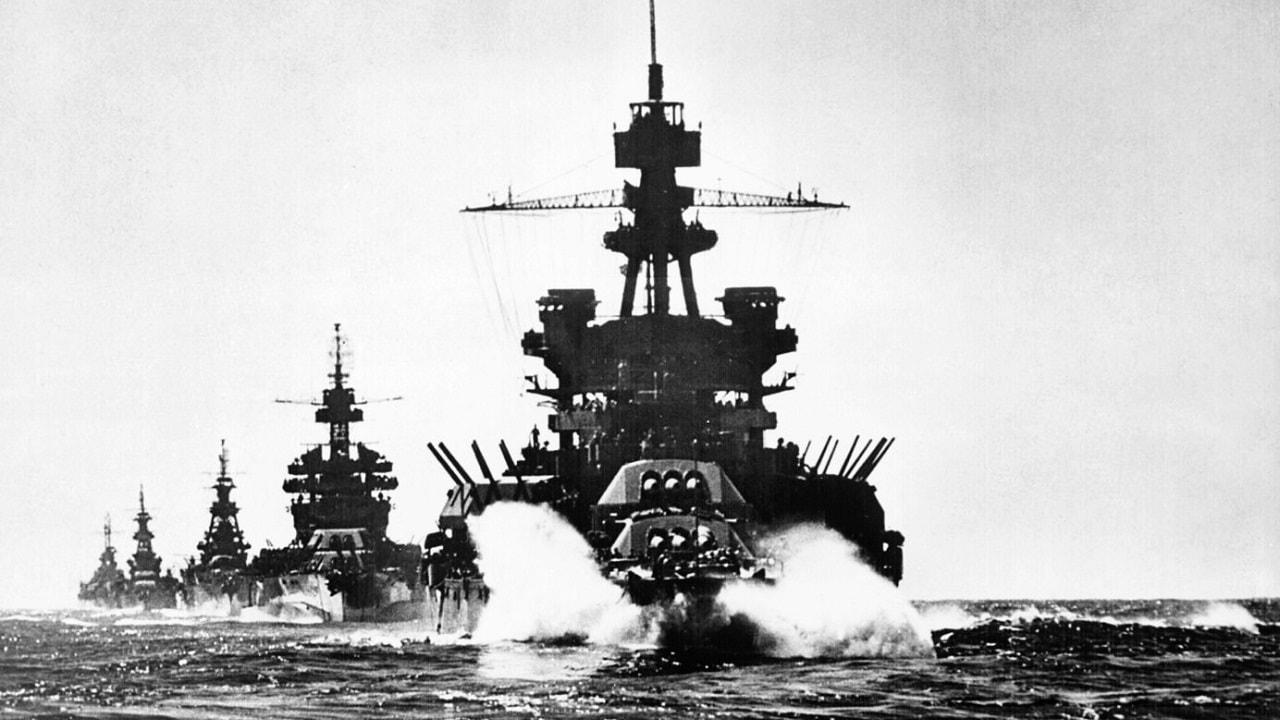
USS Pennsylvania by the Numbers: The $15 Million Battleship With Twelve 14-Inch Guns: Contemporary estimates placed the completed cost of USS Pennsylvania near $15 million, while official Navy ship data listed $7.26 million for the hull and machinery contract. Commissioned on June 12, 1916, the battleship remained in service for 30 years and survived Pearl Harbor, a Japanese aerial torpedo, and two atomic bomb tests.
Pennsylvania measured 608 feet long and displaced 31,917 long tons at deep load when built. Her 1929–1931 reconstruction widened the hull with anti-torpedo bulges and raised full-load displacement to roughly 39,224 long tons. Oil-fired boilers supplied four turbine sets and four propeller shafts with about 34,000 horsepower, enough for 21 knots.
Her main battery consisted of twelve 14-inch/45-caliber guns arranged in four triple turrets. After modernization, each gun fired a 1,500-pound armor-piercing projectile, producing an 18,000-pound broadside. The original battery also included twenty-two 5-inch guns, four 3-inch anti-aircraft guns,s and two submerged 21-inch torpedo tubes.
The original complement totaled 56 officers, 72 Marines, and 1,031 enlisted sailors. Later modifications expanded living and working spaces for more than 2,000 people. Pennsylvania eventually earned eight battle stars and the Navy Unit Commendation for World War II service stretching from Alaska to Okinawa.
$15 Million Bought a 31,917-Ton Fleet Flagship
Newport News Shipbuilding laid Pennsylvania’s keel on October 27, 1913, launched her on March 16, 1915, and delivered her the following year. She became the lead ship of a two-vessel class completed by USS Arizona. Both belonged to the Navy’s “standard-type” battleship family, designed with similar speed and handling so several classes could operate together in one battle line.
The machinery offered endurance rather than exceptional speed. Pennsylvania carried enough oil for an estimated range of 7,552 nautical miles at 12 knots. A 13.5-inch armored belt protected the machinery and magazine; turret faces reached 18 inches, and the conning tower carried 16 inches of armor. The combination made the Pennsylvania class one of the most heavily armed American designs of its generation.
Twelve 14-Inch Guns Fired an 18,000-Pound Broadside
Modernized 14-inch guns weighed about 62 tons apiece. A full propellant charge contained 425 pounds of powder and sent the 1,500-pound armor-piercing shell from the muzzle at about 2,600 feet per second. Maximum range reached approximately 34,300 yards, or 19.5 miles, after the turrets were modified for 30-degree elevation.
The guns were rated at roughly 1.5 to 1.75 rounds per minute, with 100 projectiles stowed for each barrel. Pennsylvania therefore carried room for about 1,200 main-battery shells. Her late-war secondary and anti-aircraft fit replaced the original casemate battery with sixteen 5-inch/38 dual-purpose guns, forty 40 mm Bofors barrels,s and about fifty-two 20 mm Oerlikons.
Pennsylvania Saw No Combat During World War I
The United States entered World War I less than ten months after Pennsylvania was commissioned. The British asked for American coal-burning battleships to reinforce the Grand Fleet because fuel oil was harder to supply in Britain. Pennsylvania burned oil, so she remained in American waters for exercises, gunnery work, and readiness duties instead of crossing the Atlantic for combat.
Her wartime service ended with a ceremonial mission. In December 1918, Pennsylvania joined the escort for the transport George Washington as President Woodrow Wilson sailed to Brest for the peace negotiations. The battleship then spent much of the interwar period as a fleet flagship, moving to the Pacific and participating in large exercises designed to refine American naval plans.
Pearl Harbor Sent Pennsylvania Into a Different War
On December 7, 1941, Pennsylvania sat in Pearl Harbor’s Dry Dock No. 1 with destroyers Cassin and Downes. The dry dock protected her from torpedoes but not bombs. Her antiaircraft crews opened fire within minutes, and one Japanese bomb passed through the boat deck before exploding in a 5-inch-gun casemate. The attack left 15 men dead, 14 missing and 38 wounded.
Pennsylvania received repairs and a stronger anti-aircraft battery, then returned to the Pacific alongside other restored Pearl Harbor veterans. Her subsequent service covered Attu, Kiska, Makin, Kwajalein, Eniwetok, Saipan, Guam, Tinian, Peleliu, and Angaur, giving the ship a far larger combat record than her quiet World War I service suggested.
Eight Battle Stars Came From Pacific Bombardment
Pennsylvania’s age and 21-knot speed kept her from operating with the fast carrier groups. Her strength lay in sustained naval gunfire. The battleship stood offshore and used her 14-inch and 5-inch batteries to break coastal defenses, strike troop concentrations and support Marines and soldiers moving inland.
She joined Rear Adm. Jesse Oldendorf’s force at Surigao Strait on October 25, 1944, when American battleships crossed the Japanese line of advance in history’s last battleship engagement. Pennsylvania did not fire; her Mark 3 fire-control radar never yielded a usable target solution before the action ended. She returned to bombardment work at Lingayen Gulf and Okinawa, where an April 1945 overhaul brought improved radar and replacement main guns.
At Buckner Bay on August 12, 1945, a Japanese torpedo bomber penetrated the anchorage and struck Pennsylvania’s stern. The explosion opened a hole about 30 feet across, killed 20 me,n and wounded 10, including Oldendorf. Flooding drove the stern deep into the water, and emergency repairs were needed before the ship could move under tow and then under her own reduced power.
Two Atomic Tests Preceded Pennsylvania’s Scuttling
Only temporary repairs were made before the Navy assigned the damaged battleship to Operation Crossroads. Pennsylvania survived the Able airburst on July 1, 1946, and the Baker underwater explosion on July 25. During Baker, she sat about 1,100 yards from ground zero. The blast caused limited structural damage, but radioactive water contaminated the hull and internal spaces.
The tests demonstrated why the target fleet became difficult to inspect and decontaminate. Pennsylvania was towed to Kwajalein and decommissioned there on August 29, 1946. After 18 months of radiological and structural study, the Navy scuttled her in deep water on February 10, 1948.
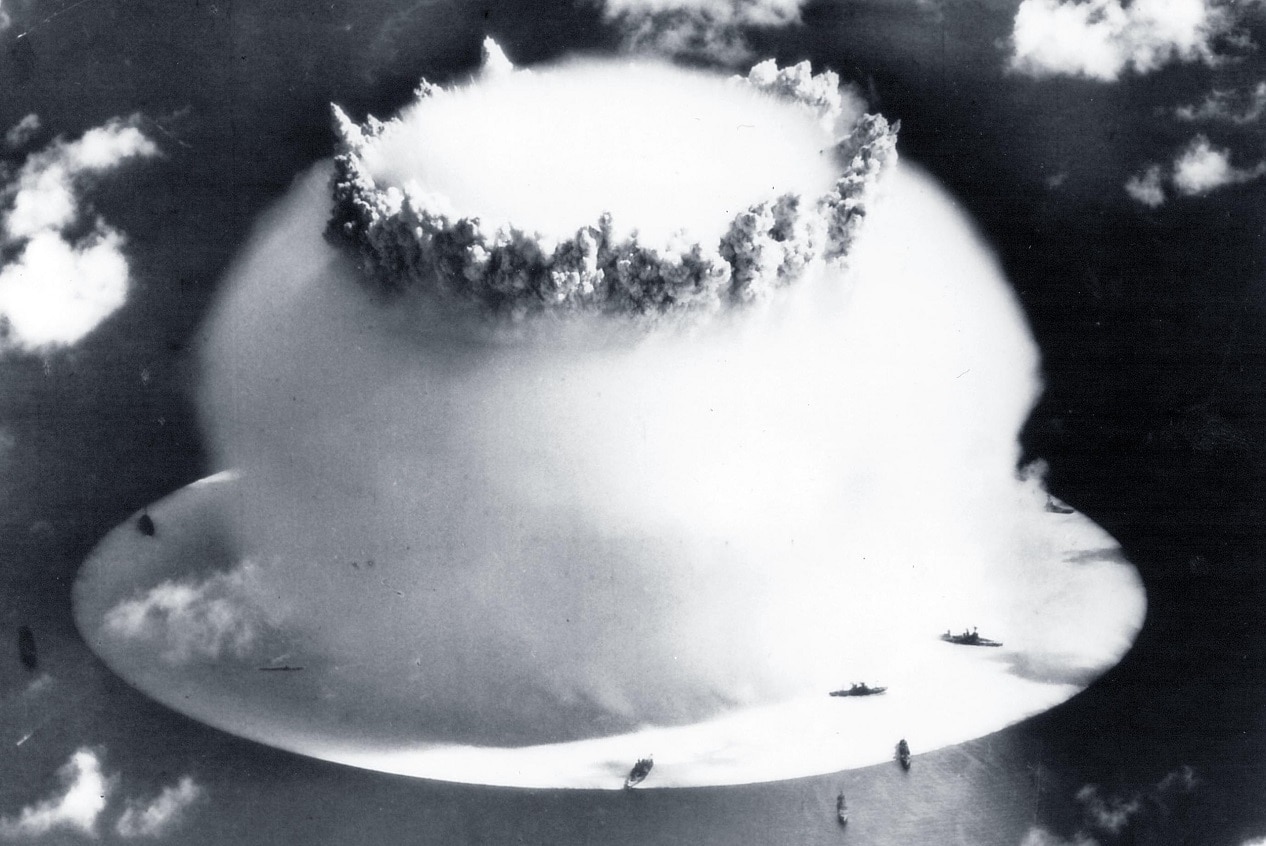
Operation Crossroads. Image Credit: Creative Commons.

The “Baker” explosion, part of Operation Crossroads, a nuclear weapon test by the United States military at Bikini Atoll, Micronesia, on 25 July 1946. The wider, exterior cloud is actually just a condensation cloud caused by the Wilson chamber effect, and was very brief.
About the Author: Harry J. Kazianis
Harry J. Kazianis (@Grecianformula) was the former Senior Director of National Security Affairs at the Center for the National Interest (CFTNI), a foreign policy think tank founded by Richard Nixon based in Washington, DC. Harry has over a decade of experience in think tanks and national security publishing. His ideas have been published in the NY Times, The Washington Post, The Wall Street Journal, CNN, and many other outlets worldwide. He has held positions at CSIS, the Heritage Foundation, the University of Nottingham, and several other institutions related to national security research and studies. He is the former Executive Editor of the National Interest and the Diplomat. He holds a Master’s degree focusing on international affairs from Harvard University.

