
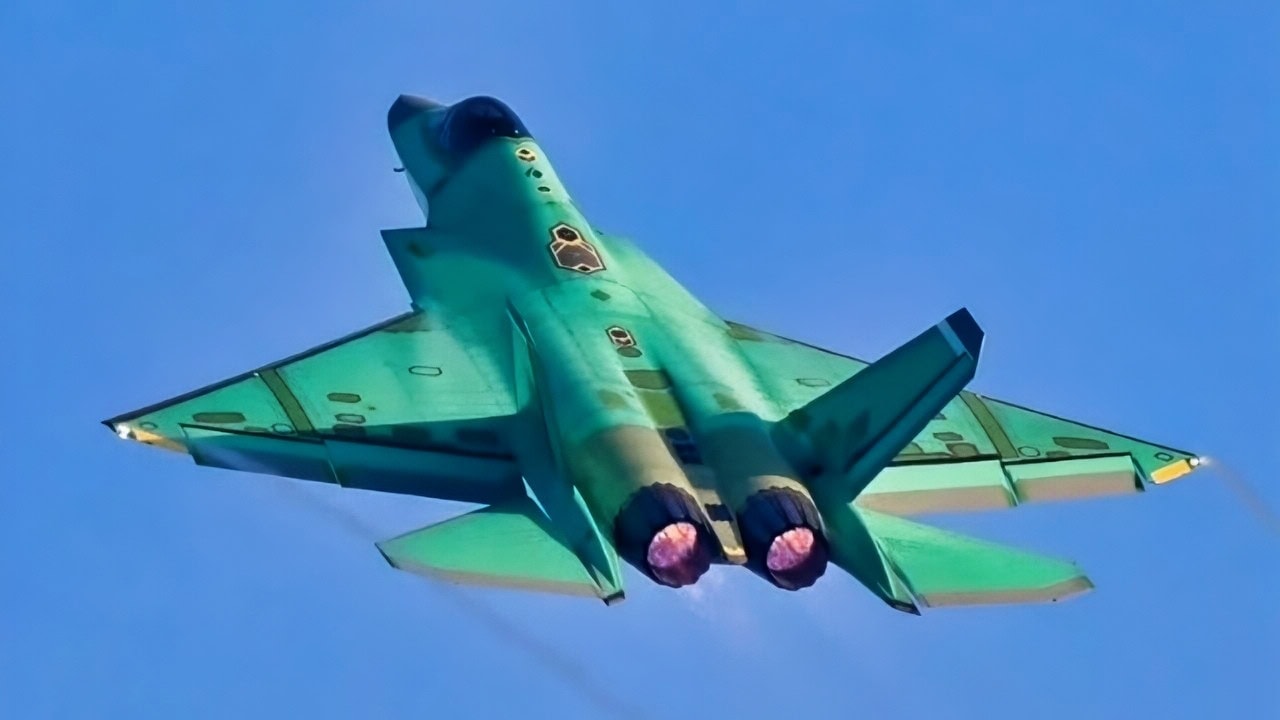
Chinese military analysts are increasingly convinced that the country’s new J-35 stealth fighter could eventually carry as many as four YJ-15 supersonic anti-ship missiles internally. The PLA has never confirmed the configuration; however, analysts studying the weapons bay dimensions believe that a four-missile loadout appears technically feasible. If the J-35 can indeed carry four YJ-15 missiles internally, it would mark a major evolution in China’s anti-access/area-denial strategy, complicating US carrier operations inside the First Island Chain.
What is the J-35
The J-35 is China’s next-generation carrier-based stealth fighter.
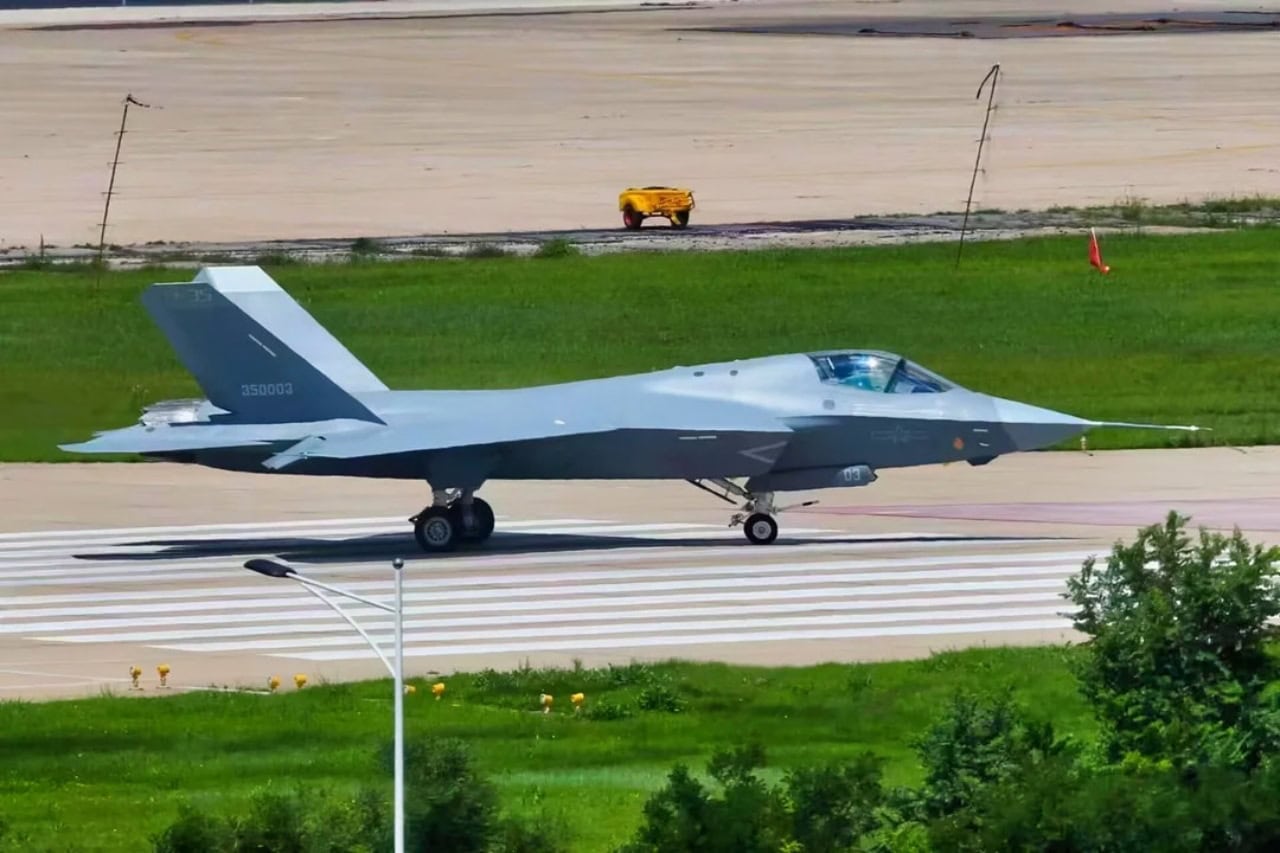
J-35 Fighter. Image Credit: Chinese Internet.
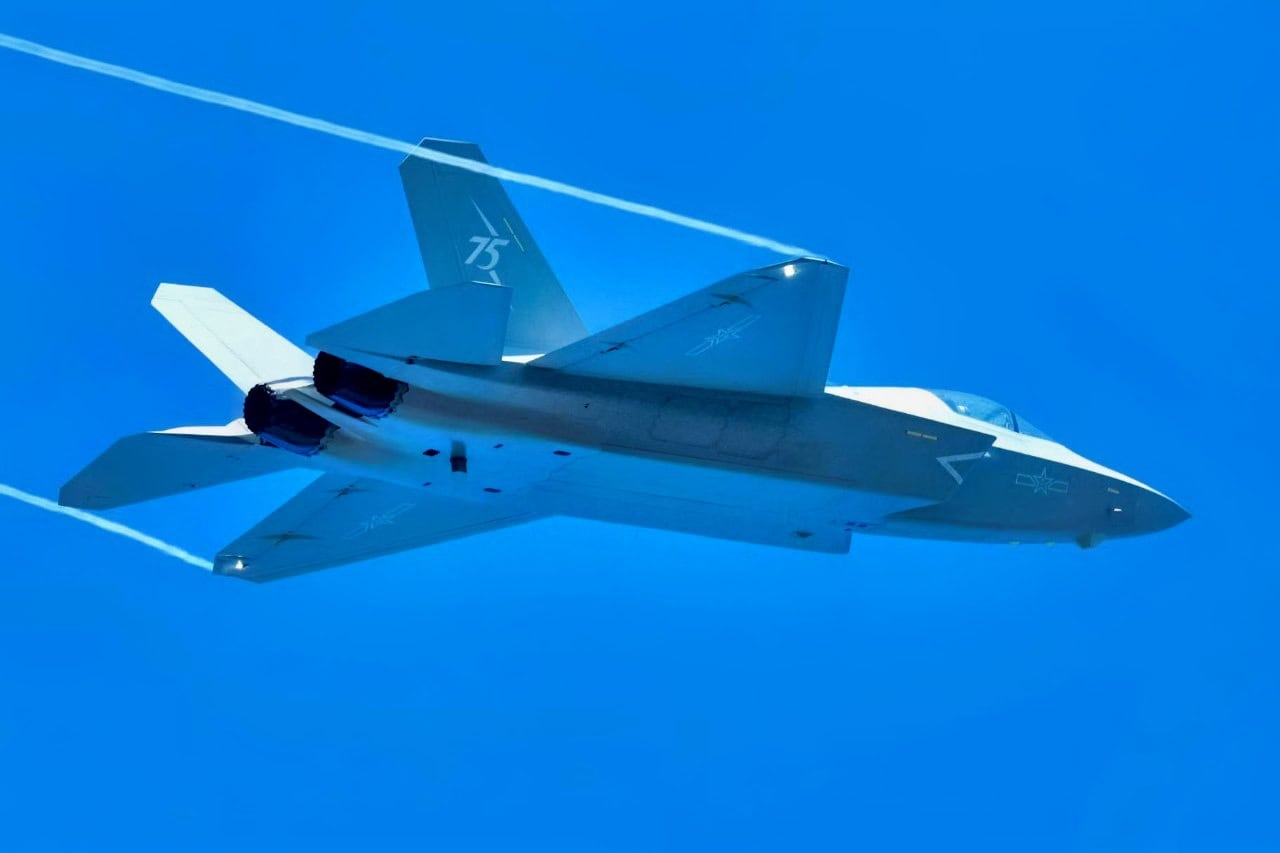
J-35 Fighter. Image Credit: Chinese State Media.
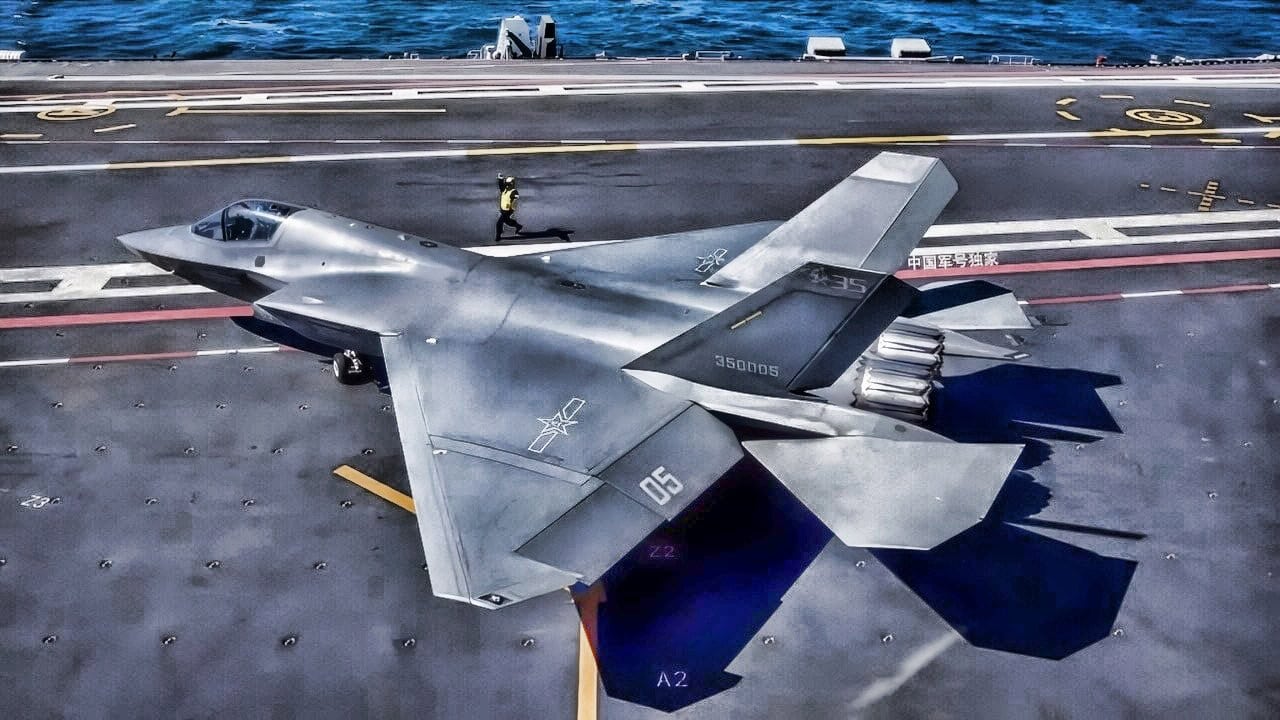
China J-35 Naval Stealth Fighter. Image Credit: PLAN.
Designed to complement and eventually reduce reliance on the existing J-15 Flying Shark, the J-35 features low observability, internal weapons bays, sensor fusion, and carrier compatibility. Generally, the J-35 is described as China’s rough equivalent to the F-35C, although the new Chinese fighter’s exact capabilities remain unclear.
Unlike the J-15, the J-35 is optimized for operating in heavily defended airspace where survivability matters as much as payload. In that respect, the J-35 has been calibrated toward modern air combat.
What is the YJ-15
The YJ-15 is a supersonic anti-ship cruise missile that made its public debut in September 2025 during the Victory Day parade. With an estimated range of roughly 500–600 kilometers (though some estimates extend farther depending on launch conditions), the YJ-15 reportedly cruises around Mach 3–4 and has a terminal sprint approaching Mach 5.
The missile flies a sea-skimming attack profile, roughly three meters above the ocean’s surface during final approach. This high speed plus low altitude combination dramatically reduces a defender’s reaction time, making the YJ-15 exceedingly difficult to intercept. The guidance system is unknown, but believed to combine satellite navigation, active radar homing, infrared imaging, and anti-jamming systems. If the specifications are as expected, the YJ-15 represents a legitimate threat to surface vessels.
The Importance of Internal Carriage
The fact that the J-35 can reportedly carry the YJ-15 is a key takeaway here. Traditional anti-ship fighter jets had to carry their weapons externally, which increased the aircraft’s radar signature.
Internal carriage, meanwhile, enables stealth preservation, meaning later or more difficult detection, allowing the aircraft to approach the ship more closely before launching its weapons.
If the aircraft can get significantly closer before defenders realize they are under threat, the defenders are at much higher risk. In short, a stealth fighter carrying four anti-ship missiles internally is much harder to counter than a conventional fighter carrying the same weapons externally.
From the Fujian
China’s newest carrier is relevant here: the Type 003 Fujian uses electromagnetic catapults, which enable heavier launch weights, allowing aircraft to launch with more fuel and more weapons.
Paired with the J-35, the Chinese may have a combination for their most capable carrier air wing ever. This could allow a shift in doctrine, from the older Chinese doctrine of fleet defense and presence missions to something focused on offensive sea denial and long-range strike. Indeed, the Fujian, loaded with YJ-15-equipped J-35s, could allow China to be more assertive.
The Bigger Picture
The J-35 does not operate in isolation; it fits into the broader Chinese maritime strike architecture—alongside missiles, submarines, bombers, destroyers, and sensor equipment. The J-35 is just one tool in the greater A2/AD system, which can launch attacks from multiple directions simultaneously, overwhelming defensive systems through saturation, confusion, and compressed reaction times.
So the J-35 is just part of the story, as the Chinese objective is not to launch one missile to sink one ship; rather, the J-35 will serve as one inbound threat among many, creating a saturation effect that defenders will struggle to sort.
For US carriers, which have long operated under the assumption that they can dominate regional seas, the Chinese scheme makes operating near Taiwan increasingly dangerous. If J-35s launch from carriers, the threat to US vessels could emerge from constantly changing locations.
This adds a new wrinkle: fixed missile sites can be tracked, but J-35s, operating from an aircraft carrier, can move. The result is greater uncertainty for US commanders, who may be forced to operate cautiously.
Much remains unknown, of course, as no official PLA imagery has confirmed a four-YJ-15 internal loadout. But the concept itself is concerning—and seems to suggest that analysts believe Chinese naval aviation is headed in a direction that could challenge US naval access in the Indo-Pacific.
About the Author: Harrison Kass
Harrison Kass is a writer and attorney focused on national security, technology, and political culture. His work has appeared in City Journal, The Hill, Quillette, The Spectator, and The Cipher Brief. He holds a JD from the University of Oregon and a master’s in Global & Joint Program Studies from NYU. More at harrisonkass.com.