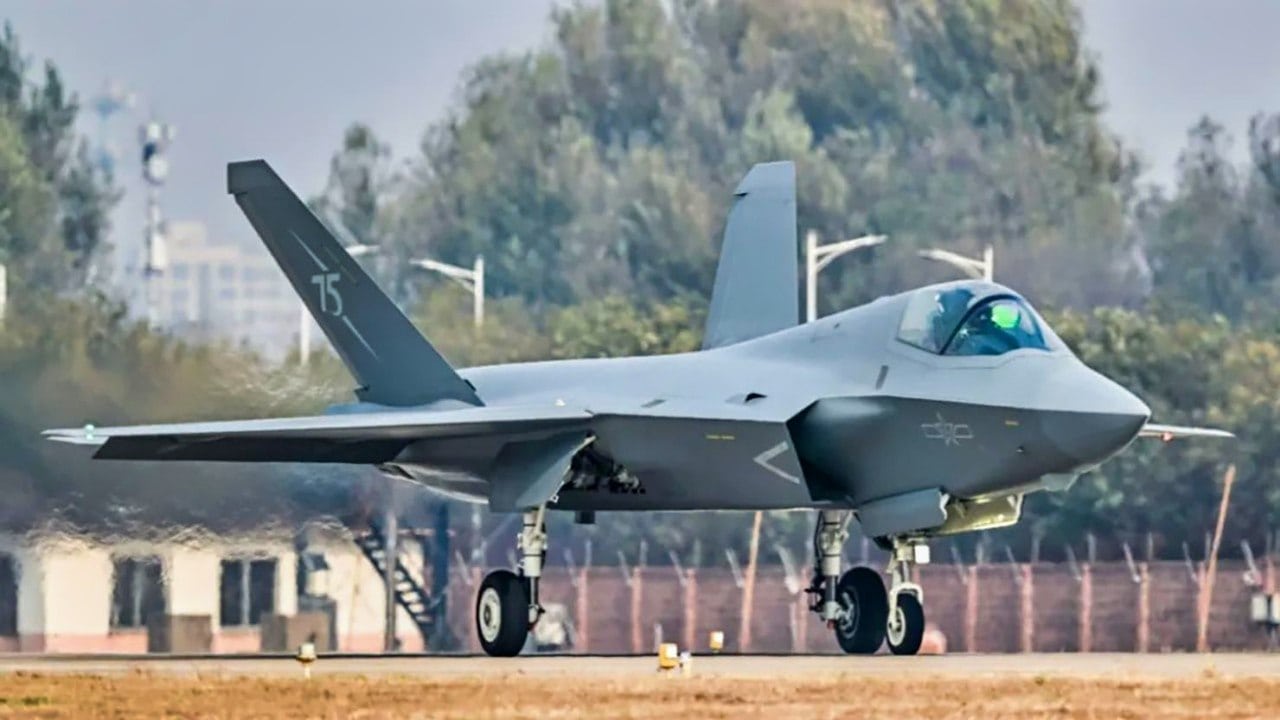
China’s J-35A: The Stealth Fighter Built to Break America’s Airpower Advantage – The J-35A is China’s second fifth-generation stealth warplane. This system, like the American F-35 Lightning II, is a multirole, medium-weight, twin-engine jet designed for use by both the People’s Liberation Army Air Force (PLAAF) and the People’s Liberation Army Navy (PLAN).
Although critics argue that the J-35 is merely a knockoff of the American F-35, and there are some similarities, the philosophies and doctrines undergirding China’s J-35 are fundamentally different from those of the American F-35.
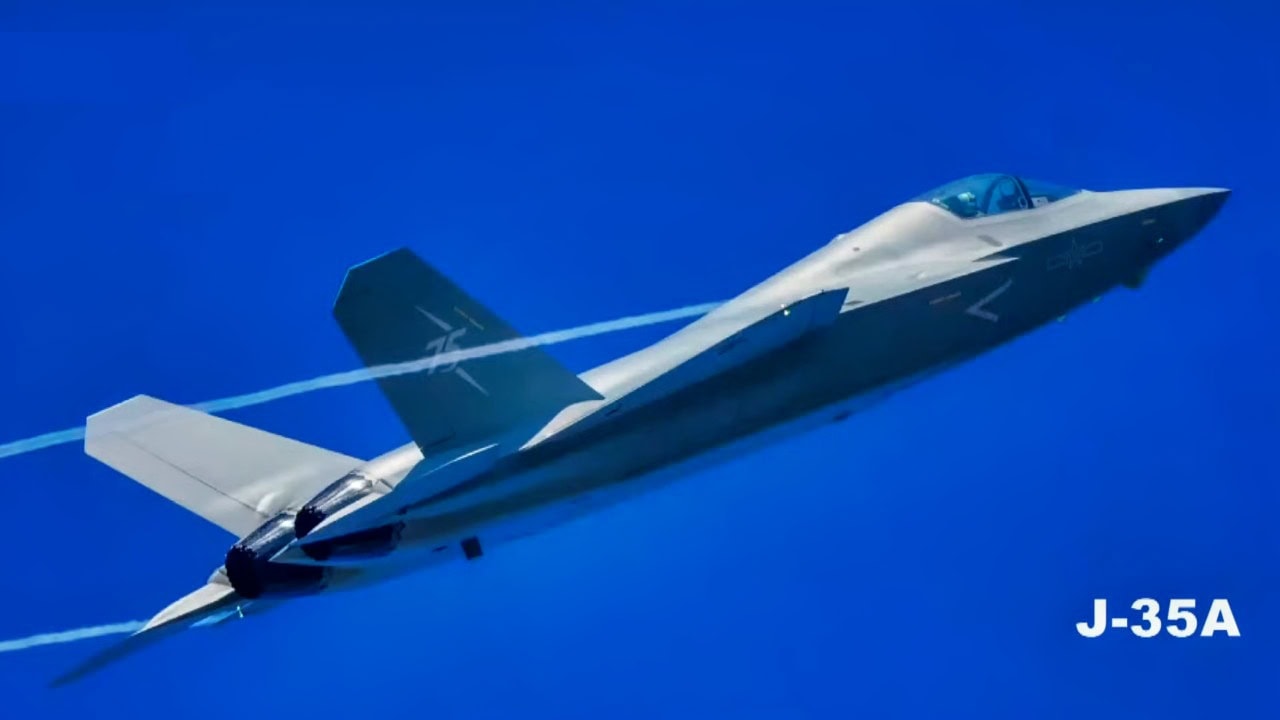
China J-35 Fighter. Image Credit: Creative Commons.
J-35 Built for Scale, Not Perfection
For starters, like everything that China creates, the J-35 is built for scale and mass production at a level that the American F-35 could only ever dream of. Yes, the United States has many F-35s today.
Yet its combat fleet of F-35s has a barely 50 percent readiness rating, and the program ran over budget and went way over schedule. Plus, all these planes require reliable access to rare earth minerals to build. China accounts for 90 percent of the world’s rare earth mineral resources.
Fighting Inside China’s Missile Umbrella
Anyway, the J-35 is designed to operate in networked warfare environments. More importantly, unlike the Americans, the J-35 is not designed to augment an expeditionary force.
Instead, China’s fifth-generation multirole warplane is designed to fight within the protective umbrella provided by China’s multilayered missile and sensor network arrayed across the First Island Chain (the region running from the Kamchatka Peninsula through Japan and Taiwan down to the Philippines).
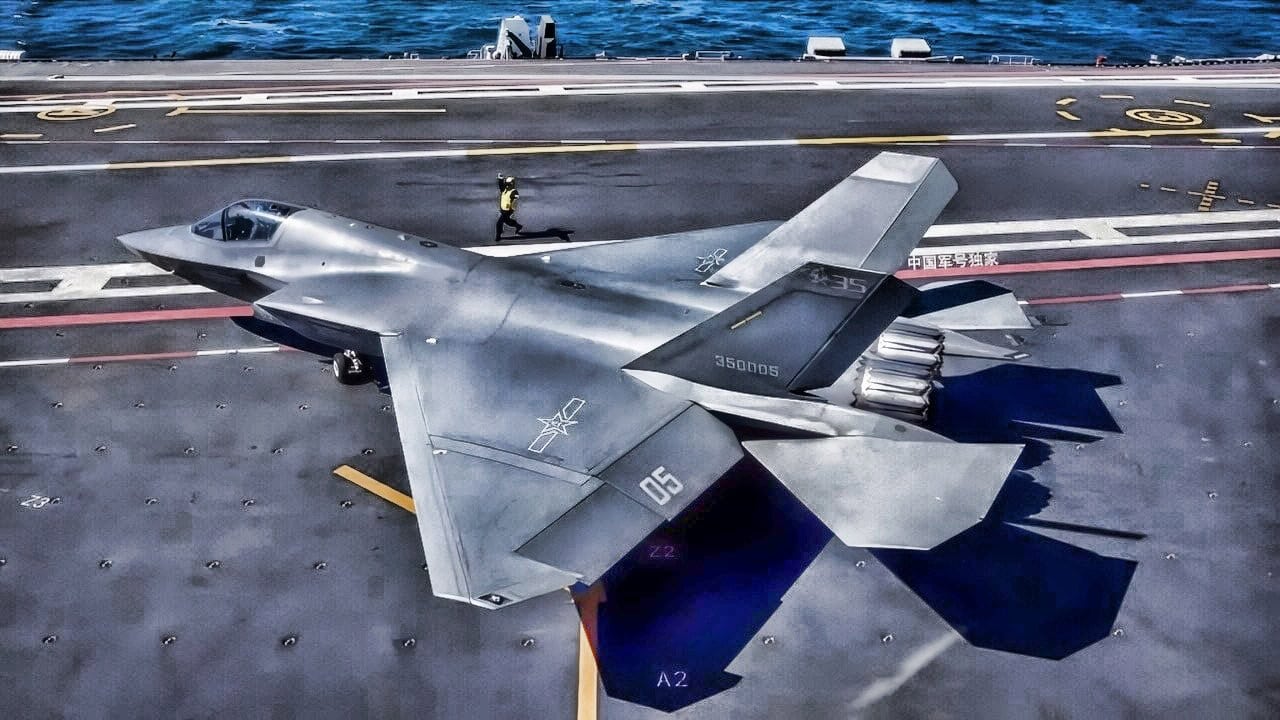
China J-35 Naval Stealth Fighter. Image Credit: PLAN.
The “Point Guard” of a Kill Chain War
More importantly, the J-35A is optimized to detect, track, and destroy high-end targets (especially other stealth aircraft). Business Insider correctly describes the plane as a “point guard” or “battle manager” for Chinese forces.
In essence, the J-35A feeds key real-time targeting data to the entire network (as the F-35 is meant to do). Rather than acting alone, the J-35A also supports the wider kill chain.
A Node, Not the Centerpiece
The J-35A is merely a node that plugs into a wider network forming the modern Chinese war machine. From here, we can see the origins of China’s “system of systems” philosophy for its purported sixth-generation warplanes.
Whereas the United States built the F-35 around sensor fusion and battlefield awareness, the Chinese J-35A shares its data with dozens of other Chinese military platforms. The J-35A, unlike the F-35, is merely a technological cog in China’s air war machine, whereas the US F-35 is the centerpiece of any air campaign in which it is involved.
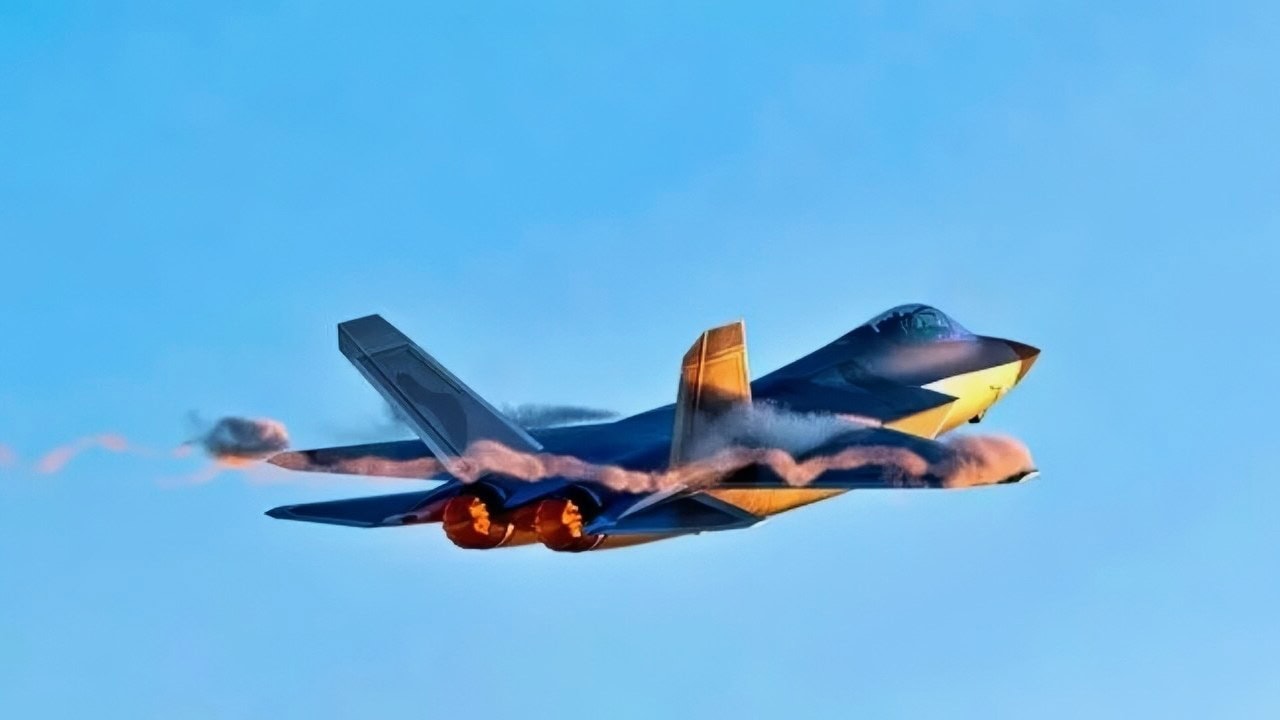
J-35A Fighter from China PLAAF. Image Credit: Creative Commons.
According to 19FortyFive’s military technology editor, Kris Osborn, this slight difference erodes the US’s qualitative advantages over the Chinese military.
Mass Production as a Strategic Weapon
The J-35A’s similarities to the US F-35 diverge further, thanks to China’s incredible advantages in mass production over the Americans. Yes, China (at times) is copying concepts and capabilities from the United States military. From there, however, Beijing’s engineers scale at a rate the Americans simply cannot match.
In this way, quantity alone provides a decisive advantage over the American F-35. Set aside the arguments between pro-China and pro-US military analysts about which system is superior. The F-35, if lost in combat, is much harder to replace than the Chinese J-35As.
The Real Threat: A2/AD + Networked Warfare
This fact alone means the J-35A and its sister fifth-generation air superiority fighter, the J-20, are real challengers to America’s dominance in fifth-generation warfare.
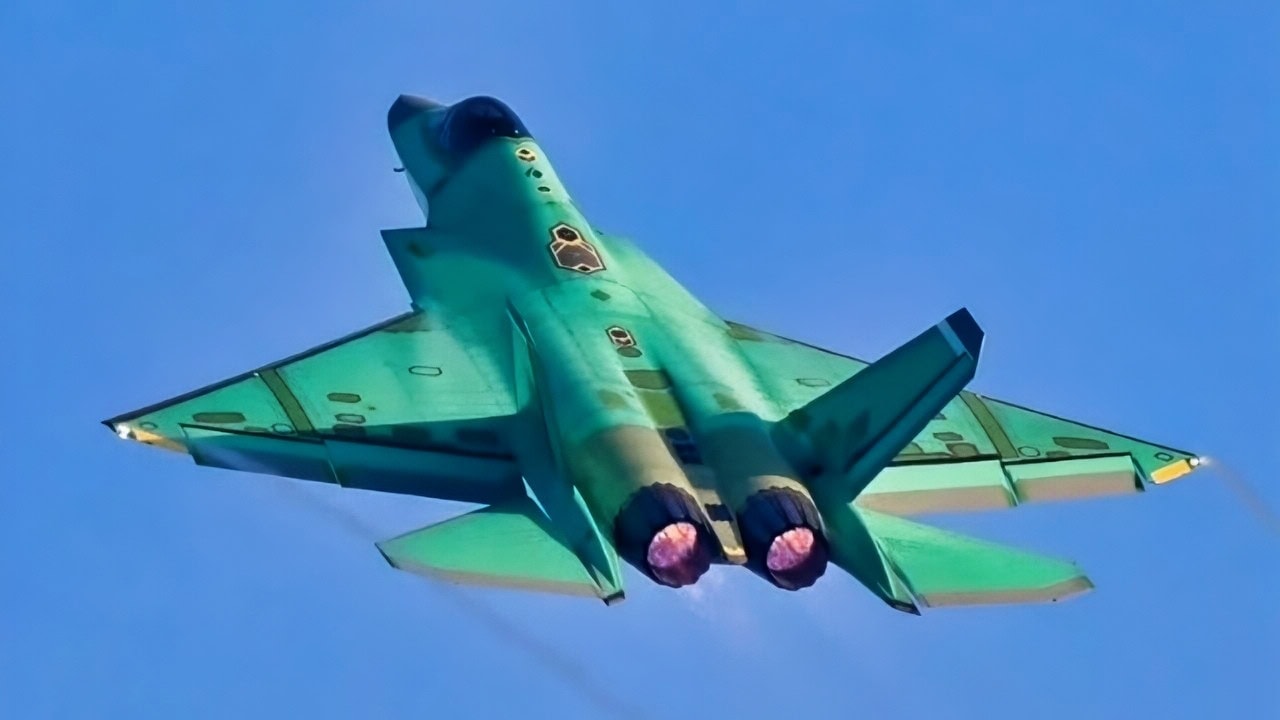
J-35A Stealth Fighter. Image Credit: Social Media Screenshot.
Now, combine that with China’s aforementioned anti-access/area-denial (A2/AD) capabilities in the First Island Chain, and you’ve got a serious threat from a J-35A that can detect approaching enemy (possibly stealth) planes, track them, relay that targeting data to other Chinese systems in the kill chain, and launch a missile (from anywhere).
And it isn’t only enemy stealth planes that could be targeted. It is tankers, AWACS planes, and potentially US aircraft carriers. Once those systems go down or are forced to hang back out of range for fear of being destroyed, US airpower collapses forward, leaving China a wide space in which to operate.
From Coastal Defense to Power Projection
Meanwhile, China is integrating the J-35 into its growing aircraft carrier fleet, which, unlike the US carrier force, is designed to be a forward-deployed expeditionary force, is—for now—intended to operate under that protective A2/AD umbrella as well.
Over time, though, adding the J-35s to China’s expanding carrier fleet will allow the PLAN to project significant combat power beyond the First Island Chain into the Second and, eventually, the Third Island Chains.
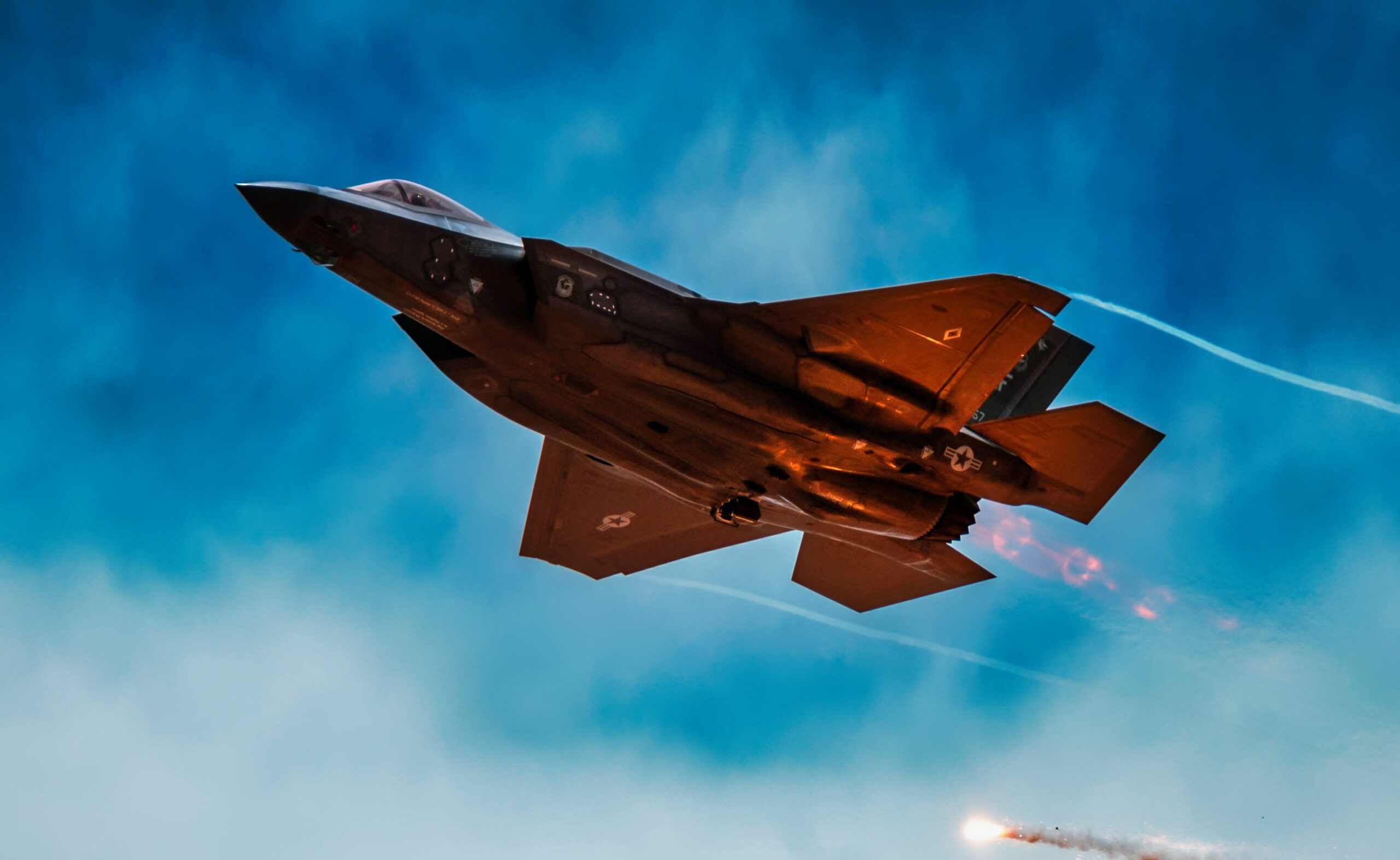
A U.S. Air Force F-35A Lightning II assigned to the 56th Fighter Wing, Luke Air Force Base, Arizona, performs a strafing run during Haboob Havoc, April 24, 2024, over Barry M. Goldwater Range, Arizona. Haboob Havoc is a total force exercise that provides a way for pilots from various bases to demonstrate their skills across a diverse range of aircraft, including F-35 Lightning IIs, F-16 Fighting Falcons, and A-10 Thunderbolt IIs, while also testing their abilities in different mission sets such as dogfighting and gun runs. (U.S. Air Force photo by Airman 1st Class Mason Hargrove)
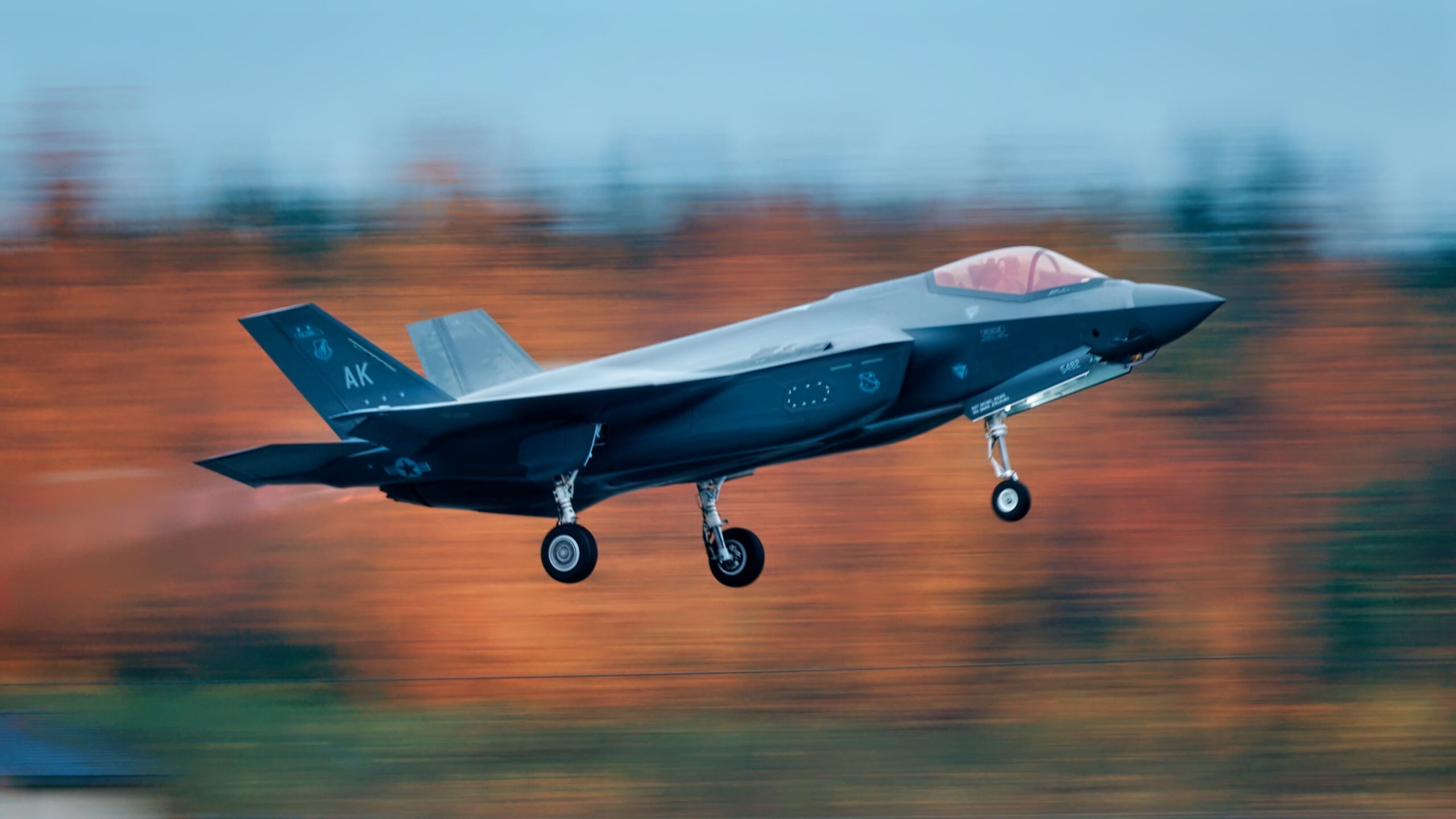
A F-35 Lightning lll assigned to the 354th Fighter Wing takes off from Eielson Air Force Base, Alaska September 19, 2024. The F-35 was participating in a multiple aircraft exercise for the 354th FW. (U.S. Air Force Photo by Senior Sean Lamb)
Plus, everything about the J-35A shows that the system is tailor-made for a fight over the First Island Chain, whether over Taiwan, the Philippines, or even Japan. Because the J-35A operates under dense Chinese surface-to-air missile (SAM) coverage, is integrated with long-range anti-ship and anti-air missiles, and is optimized for regional rather than global dominance (a key distinction from the US system), the J-35A gives the Chinese an asymmetrical advantage over the Americans.
The Weaknesses: Engines, Stealth, and Unknowns
Of course, the system is not without its complications. There have been persistent reports of engine and reliability issues. Historically, most Chinese jets have lagged in durability and performance (although Beijing insists this is changing).
Even analysts admit the aircraft’s stealth capabilities are relatively unknown, and some have suggested the J-35A might not match the US’s superior low-observable standards.
Then again, China’s stealth doesn’t have to be as good as that of America’s F-35. They just have to be good enough, and their scalability is an advantage the Americans otherwise lack.
J-35A System of Systems Stealth Fighter
Basically, the US F-35 would not be fighting just another advanced warplane in the J-35A.
Those American birds would be fighting an integrated sensor-shooter web of which the J-35A was a part.
And since the Americans must deploy over long distances to get close to fighting with China, and China has had time to develop integrated air and anti-ship defenses in its region, the fight would not be as easy for the F-35 as the US side believes.
About the Author: Brandon J. Weichert
Brandon J. Weichert is the Senior National Security Editor at 19FortyFive.com. Recently, Weichert became the editor of the “NatSec Guy” section at Emerald.TV. He was previously the senior national security editor at The National Interest. Weichert is the host of The National Security Hour on iHeartRadio, where he discusses national security policy every Wednesday at 8pm Eastern. He hosts a companion show on Rumble entitled “National Security Talk.” Weichert consults regularly with various government institutions and private organizations on geopolitical issues. His writings have appeared in numerous publications, among them Popular Mechanics, National Review, MSN, and The American Spectator. And his books include Winning Space: How America Remains a Superpower, Biohacked: China’s Race to Control Life, and The Shadow War: Iran’s Quest for Supremacy. Weichert’s newest book, A Disaster of Our Own Making: How the West Lost Ukraine, is available for purchase wherever books are sold. He can be followed via Twitter/X @WeTheBrandon.