
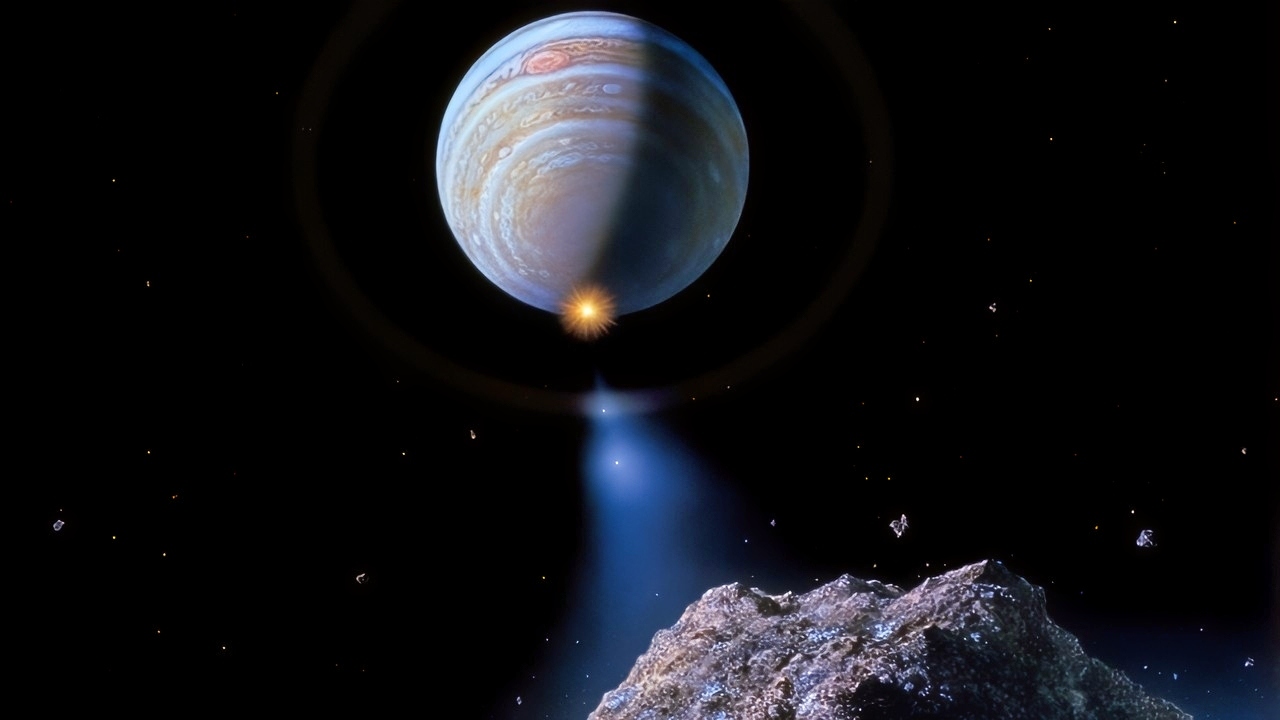
This week is the 57th anniversary of the Apollo 11 lunar mission, but there is another anniversary on this date that is notable and deserves its story to be told.
This was not a manned space exploration feat, but it was an awesome event that doesn’t happen often. The planet-shattering Comet Shoemaker-Levy 9 was discovered in 1994.
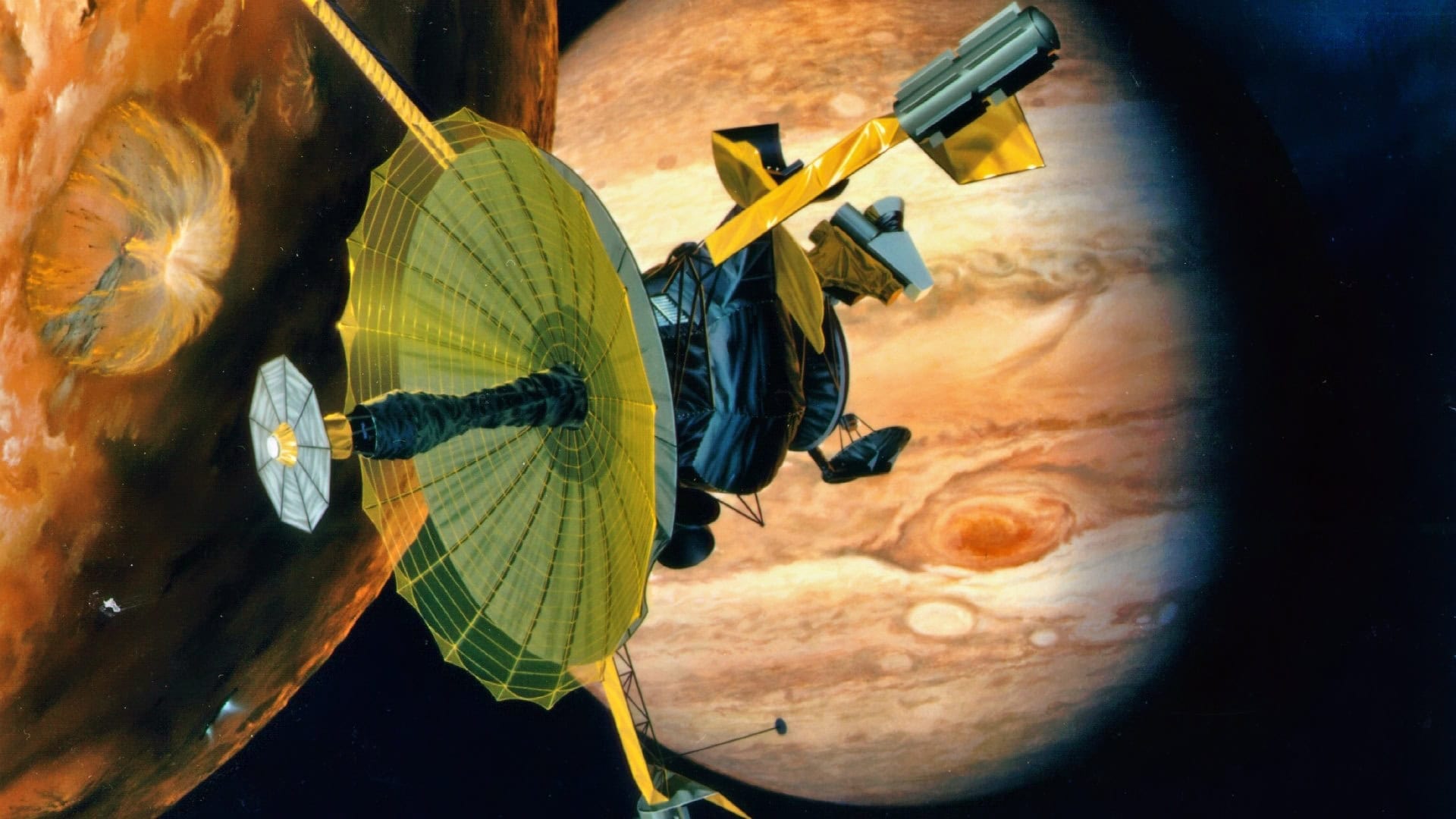
Artist’s rendering of NASA’s Galileo spacecraft flying past Jupiter’s moon Io. Galileo made multiple close approaches to the volcanically active moon during its time at Jupiter, including a first pass in Dec. 1995, during its arrival in the Jupiter system.
NASA Photo.
At the time, this was front-page news even though other events were stealing the spotlight. President Bill Clinton was in the White House, and the Cold War was over.
The Soviet Union was not the most prominent rival or enemy, and the U.S. space exploration program was looking for a lift.
Huge Impact Trail That Had Never Been Before
The comet was in Jupiter’s orbit, but it was coming apart into 20 pieces. What would happen if the chunks bashed into Jupiter in an explosion that would equal the force of 300 million atomic bombs?
This was a mystery that astrophysicists wondered about incessantly. Jupiter had a huge amount of gravitational pull that would break the comet’s body, but what would the pieces do to the planet?
Space Shuttle Discover. 19FortyFive Image Taken at the Smithsonian.
A photograph of the comet was taken in 1994 with the 0.4-meter Schmidt telescope at Mt. Palomar in San Diego County, California. Caltech ran the telescope, and it had delivered many images over the years that were extremely valuable to scientists.
A Fascinating and Unprecedented Event Viewed By Humans
The first images of the Jupiter comet were examined on July 16, 1994, at the Space Telescope Science Institute in Baltimore, Maryland. The institute displayed the photos on a monitor for all the observers to see.
This was not an everyday happening. Images from Jupiter were rare, and a comet was something that came around only once in a great while. A fragmented comet hitting Jupiter was a once-in-a-lifetime event.
Eagle-Eyed Probe Was in the Right Spot at the Right Time
Fortunately, NASA had an ace up its sleeve. The Galileo orbiter, an unmanned probe, was headed to Jupiter for an eight-year mission and had a ringside seat to observe the comet.
The fragments of the comet were labeled A through W, and they were on a collision course with Jupiter.
Space Shuttle Discover. 19FortyFive Image Taken at the Smithsonian.
This was going to be a crash that had not been witnessed by humans before. The parts of the comet were streaming through space at a frightful speed.
The fragments were glowing hot, and it was not known what would happen when they hit the planet. The impacts from the comet happened over six days, starting on July 16, 1994.
The ‘Freight Train’ Hit With a Mighty Force
“The ‘freight train’ of fragments smashed into Jupiter with the force of 300 million atomic bombs.
The fragments created huge plumes that were 1,200 to 1,900 miles high and heated the atmosphere to temperatures as hot as 53,000 to 71,000 degrees Fahrenheit. Shoemaker-Levy 9 left dark, ringed scars that were eventually erased by Jupiter’s winds,” according to NASA.
The Comet Would Have Literally Been Earth-Shattering
The comet was about a mile wide.
It’s a good thing it wasn’t headed to earth or we all would have been goners. The Hubble Space Telescope, Ulysses, and Voyager 2 also studied the impact and collected data on the collision while us earthlings could only imagine the damage that could be done with a similar event happening to our home planet.
“The impact might send dust and debris into the sky, creating a haze that would cool the atmosphere and absorb sunlight, enveloping the entire planet in darkness.
If the haze lasted long enough, plant life would die – along with the people and animals that depend on it to survive,” NASA explained.
What About the Name of the Comet
This was a day for geologists and planetary scientists Eugene and Carolyn Shoemaker and David Levy. They were watching the monitor at the Space Telescope Science Institute in Baltimore.
It was given the “9” designator since the scientists had previously viewed eight other comets. This was the ninth. In another footnote to history, Gene Shoemaker almost became a lunar astronaut.
Why the Anniversary of the Comet Discovery Should Be Observed
The anniversary is an important reminder that NASA needs all its unmanned spacecraft orbiting other planets to monitor such rare events.
The planet requires early warning and must prepare for the unlikely event that a comet or asteroid could crash into earth.
That sounds like a science fiction movie, but it is within the realm of possibility. This is something astrophysicists ponder, and unmanned probes are important for the survival of humans on earth.
Comet Shoemaker-Levy 9 is likely something we will never see again, so it needed to be documented and studied to see if other planets in the solar system could also be endangered by a comet collision.
The force of 300 million nuclear bombs going off is something that many worry about happening if a comet were to ever approach earth.
This could have created a global holocaust that would end life as we know it.
It’s a good thing that the Galileo orbiter was in the right place at the right time, giving NASA satisfaction that its strategy for unmanned space flight was a good one.
About the Author: Brent M. Eastwood, PhD
Author of now over 3,500 articles on defense issues, Brent M. Eastwood, PhD, is the author of Don’t Turn Your Back On the World: A Conservative Foreign Policy and Humans, Machines, and Data: Future Trends in Warfare, plus two other books. Brent was the founder and CEO of a tech firm that predicted world events using artificial intelligence. He served as a legislative fellow for US Senator Tim Scott and advised the senator on defense and foreign policy issues. He has taught at American University, George Washington University, and George Mason University. Brent is a former US Army Infantry officer. He can be followed on X @BMEastwood.