
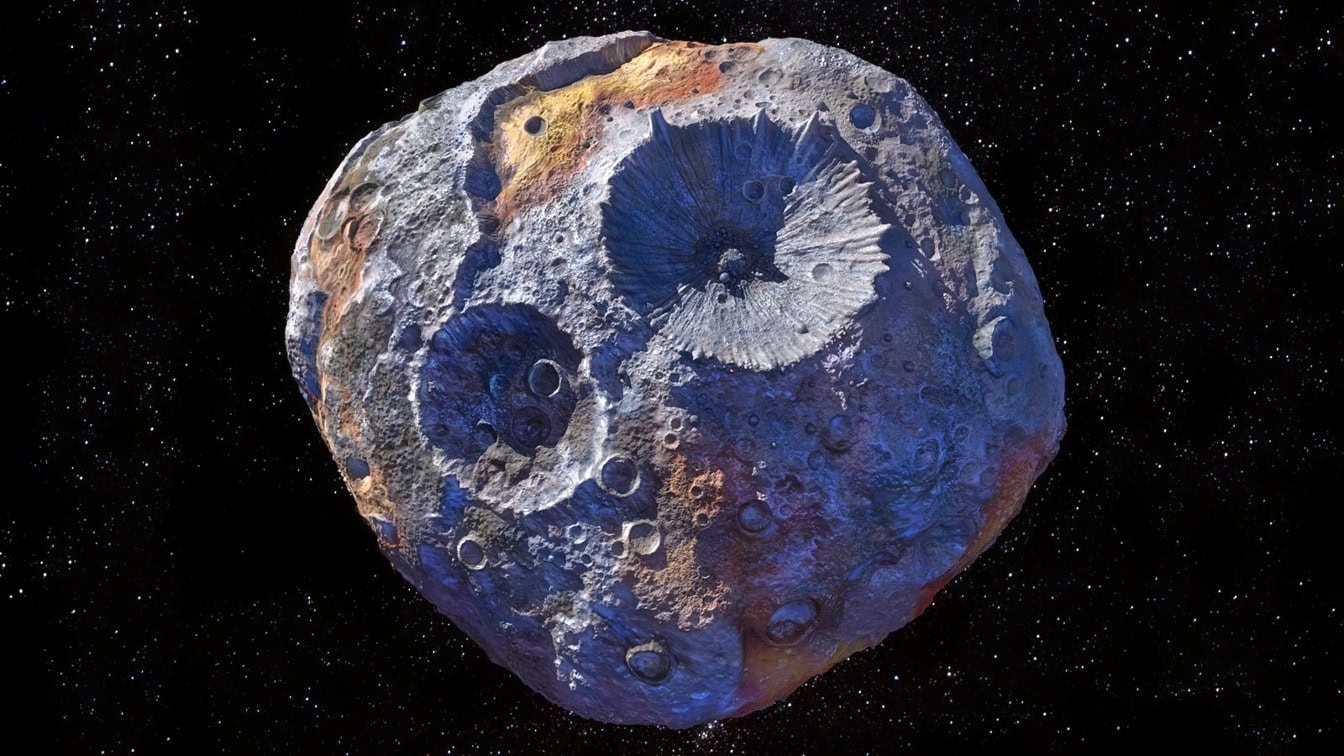
Summary and Key Points: On May 15, 2026, NASA’s Psyche spacecraft skimmed past Mars and came away a thousand miles per hour faster without burning a drop of its own fuel. The maneuver, a gravity assist, bent the spacecraft’s path and tilted its orbit by the one degree that matters, lining it up for an August 2029 arrival at 16 Psyche, a 173-mile-wide metal-rich asteroid that may be the exposed partial core of an early planetary building block. Behind the flyby sits a stranger story: a mission that nearly died before launch, engines that push with the force of three-quarters in your palm, a fuel-line failure survived on a backup valve, and a destination whose famous ten-quintillion-dollar price tag is the least interesting thing about it.
NASA’s Psyche Spacecraft Has Big Plans
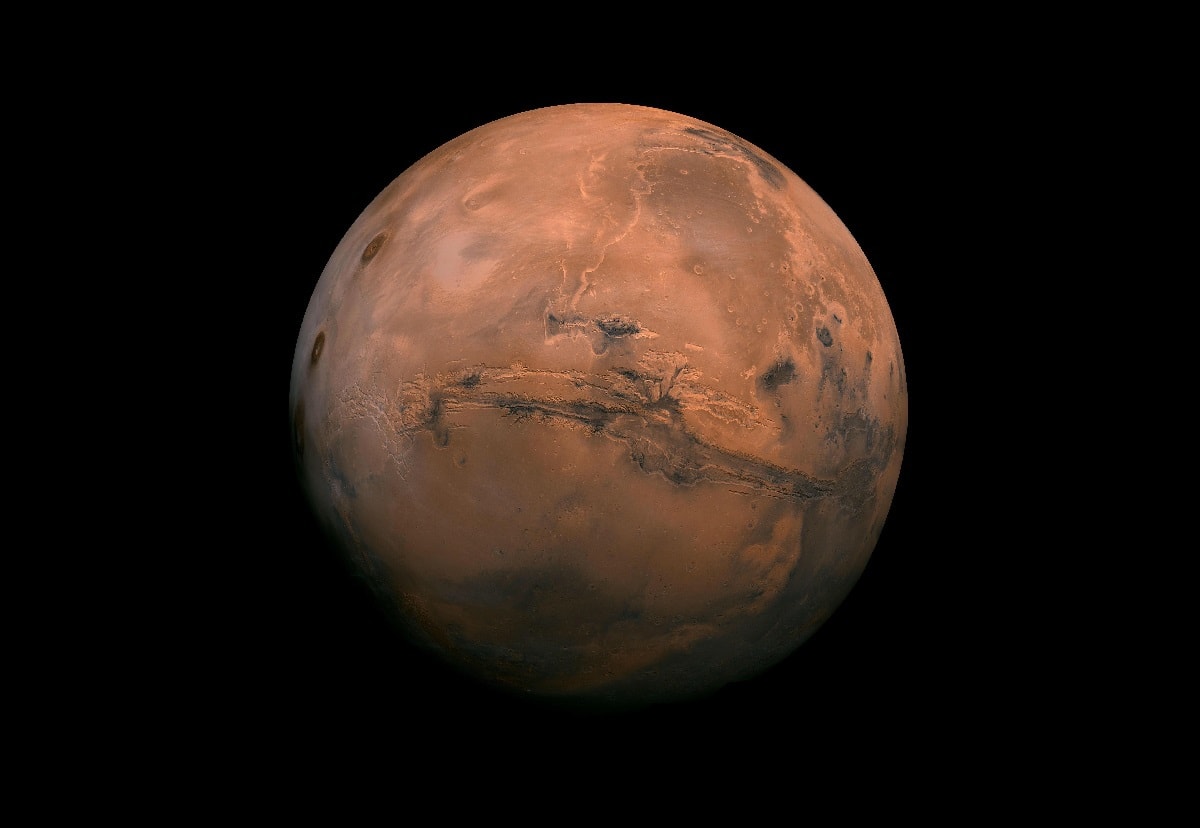
Mars. Creative Commons Image.
Spacecraft do not get free speed. Every mile per hour is normally paid for in propellant, hauled up from Earth at ruinous cost, which is why the best trick in spaceflight looks so much like cheating. On May 15, Psyche flew within 2,864 miles of the Martian surface, let the planet’s gravity grab it, and left the encounter measurably faster and pointed somewhere new, with its tanks untouched. Days later, after analyzing radio signals through the Deep Space Network, the navigation team made it official. “We’ve confirmed that Mars gave the spacecraft a 1,000 mile-per-hour boost,” said Don Han, Psyche’s navigation lead at NASA’s Jet Propulsion Laboratory, noting the flyby also shifted the spacecraft’s orbital plane by about one degree relative to the Sun.
How You Steal Speed From a Planet
A gravity assist can look like a violation of physics, energy from nowhere, but the books balance. As Space.com explained in its walkthrough of the maneuver, a spacecraft falling toward a planet speeds up and then slows by the same amount as it climbs away, and those gains would exactly cancel if the planet stood still. Mars does not stand still. It races around the Sun, carrying colossal orbital momentum, and by sweeping behind the moving planet, Psyche skimmed off a sliver of that momentum, the way a baseball leaves a bat, carrying the swing’s energy. Mars paid for the boost by slowing down, by an amount too small for any instrument ever built to measure. The technique has powered deep-space exploration’s greatest feats, including the once-in-176-years planetary lineup that flung Voyager 2 past all four giant planets.
The speed, though, was arguably the lesser prize. The flyby’s one-degree tilt of Psyche’s orbital plane aligned the spacecraft with the asteroid’s orbit, and plane changes are among the most propellant-expensive maneuvers in spaceflight. Mars performed one for free. The encounter doubled as a dress rehearsal, with every instrument powered up for calibration: the cameras captured a rare crescent Mars glowing through its dusty atmosphere, then a nearly full disk stretching from the south polar cap to terrain that includes the solar system’s grandest landmarks, while the magnetometers may even have detected Mars’s bow shock, where the solar wind piles up against the planet’s magnetic environment.
Space Shuttle Discovery at Smithsonian. 19FortyFive.com Original Image.
The Gentlest Engines in Deep Space
To understand why a free thousand miles per hour matters so much to this particular spacecraft, look at its engines. Psyche is the first interplanetary mission to fly on Hall-effect thrusters, four units that ionize xenon gas and expel it in a neon-blue stream. Their combined push is almost comically small. NASA has described it as “the same amount of pressure you’d feel holding three quarters in your hand,” which sounds absurd until you remember there is nothing in space to push back. Thrust that feeble, sustained for months in a vacuum, compounds into enormous velocity, a paradox that the fastest machines ever launched all share.
The efficiency is the point: Popular Science calculated the system gets roughly 10 million miles per gallon of xenon, hurling ions out at some 80,000 miles per hour, all powered by solar wings that span more than 80 feet. A chemical rocket delivering the same journey would need propellant by the ton. Psyche carries about 150 gallons, and that kind of solar-electric efficiency sits at the center of every serious plan for finally building something faster than the machines of the 1970s.
The gentle engines have also delivered the mission’s scariest moment. On April 1, 2025, sensors detected a pressure drop in the xenon feed line, from 36 pounds per square inch to 26, and the spacecraft automatically shut down its propulsion. Engineers traced the fault to a valve component that had stopped working as designed, and with a mid-June deadline before the stall would bend the trajectory, they switched to the backup fuel line and resumed thrusting. The mission’s flawless Mars encounter a year later happened on the spare plumbing, a quiet advertisement for redundancy.
The Long Way Around
There is an irony buried in the flyby’s timing. Psyche was supposed to launch in August 2022, and on that original trajectory, it would have swung past Mars in 2023 and arrived at its asteroid on the last day of January 2026, months before the real spacecraft ever reached the Red Planet. Flight-software testing problems scrubbed the 2022 window, an independent review uncovered institutional strain at JPL serious enough that NASA delayed its VERITAS Venus mission to free up staff, and the mission’s cost climbed from $1 billion to $1.2 billion.
The one-year slip stretched the cruise from 3.6 years to 5.7, because orbital mechanics offers no makeup exams, only longer routes. The spacecraft now flying is the survivor of a program that very nearly did not fly at all, which makes the precision of May 15 land differently: the team that almost lost the mission on the ground executed its hardest maneuver in space without a wobble.
The Metal World at the End of the Road
The destination justifies the patience. Asteroid 16 Psyche, orbiting in the main belt between Mars and Jupiter, is the largest metal-rich object known in the solar system, about 173 miles across at its widest, and the leading hypothesis holds that it may be the exposed partial core of a planetesimal, an early planetary building block whose rocky outer layers were stripped away by ancient collisions. If that is what it is, no mission has ever seen anything like it: a chance to study, in the open, the kind of iron-nickel interior that sits forever buried beneath thousands of miles of rock inside worlds like Earth and Venus.
The honest version is that nobody knows yet, and the uncertainty is the mission. NASA’s current best analysis puts the asteroid at 30 to 60 percent metal by volume, a mixture of metal and rock rather than a bare core, and density studies suggest it could be surprisingly porous, closer to a ball of steel wool than a solid ingot. Webb telescope data in 2024 even found hydrated minerals on its surface, something a naked metal core should not carry.
As for the famous price tag, the estimates themselves give the game away, ranging from ten quintillion dollars to seventy times that, depending on whose arithmetic you borrow, because the number is a thought experiment multiplying guessed metal content by today’s commodity prices, not a valuation. There are no plans and no technology to mine Psyche; the transport costs would erase the value, and flooding Earth’s markets with asteroid metal would crash the prices the estimate depends on. What the mission actually offers is worth more to science than the meme is to headlines: a direct answer to what this thing is.
That answer starts arriving in the summer of 2029, when the asteroid’s weak gravity captures the spacecraft in late July, and the mapping campaign begins in August, roughly two years of orbits stepping lower and lower over the metal world’s surface.
Space Shuttle Discovery at Smithsonian. 19FortyFive.com Original Image.
Mars has done its part; the backup fuel line is holding, and the gentlest engines in deep space are pushing again, three-quarters’ worth of force at a time, toward the only place in the solar system where a planet’s heart may lie in plain sight.
About the Author: Harry J. Kazianis
Harry J. Kazianis (@Grecianformula) was the former Senior Director of National Security Affairs at the Center for the National Interest (CFTNI), a foreign policy think tank founded by Richard Nixon based in Washington, DC. Harry has over a decade of experience in think tanks and national security publishing. His ideas have been published in the NY Times, The Washington Post, The Wall Street Journal, CNN, and many other outlets. He has held positions at CSIS, the Heritage Foundation, the University of Nottingham, and several other institutions related to national security research and studies. He is the former Executive Editor of the National Interest and the Diplomat. He holds a Master’s degree focusing on international affairs from Harvard University.

