
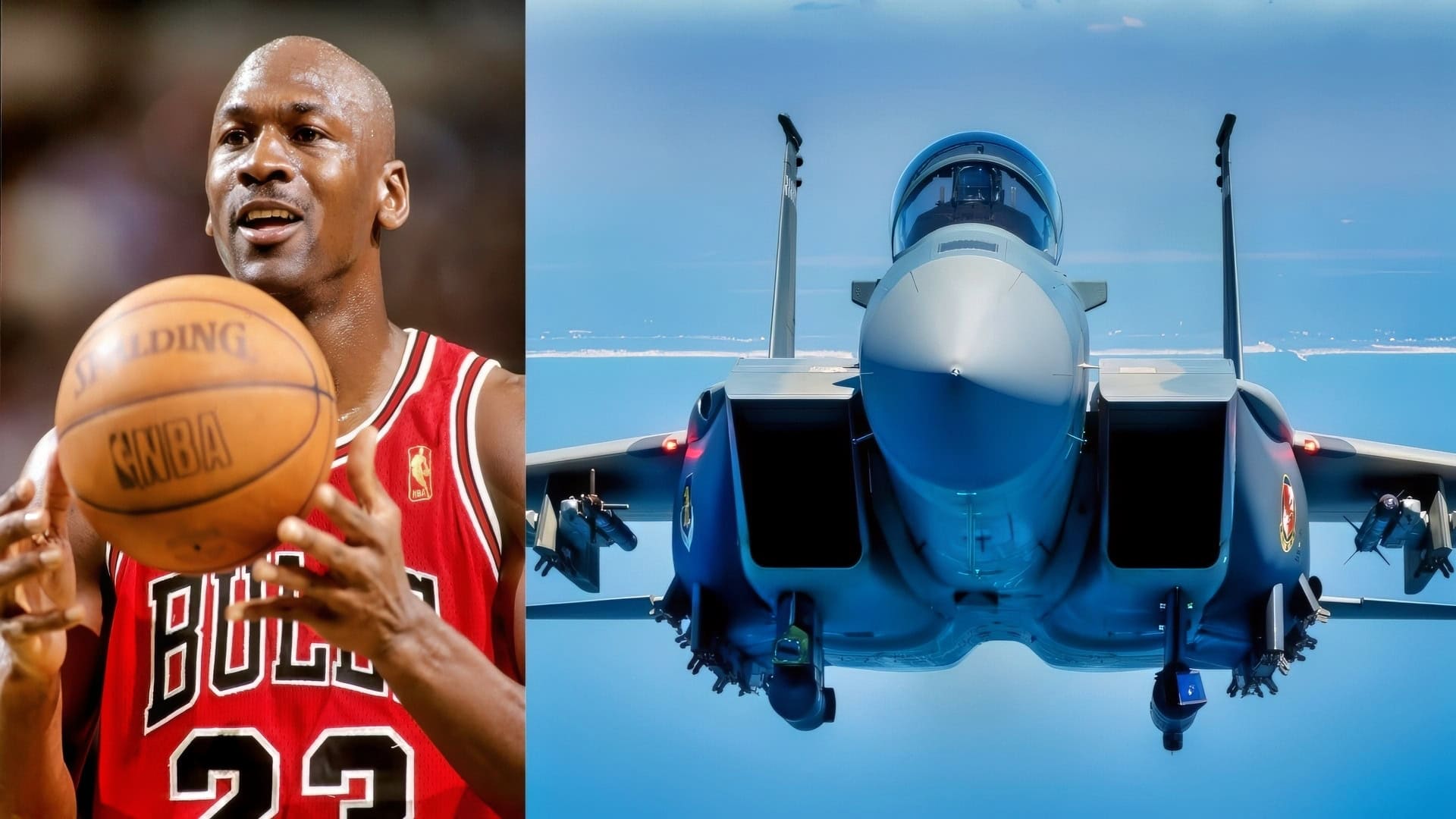
Summary and Key Points: Every debate about the greatest fighter of the modern era eventually becomes the Jordan-versus-LeBron argument, and this series has already made its LeBron case: the F-16, the do-everything franchise player still getting signed at 50. So who is Jordan? Jordan is the one with the record nobody can touch. Boeing and the U.S. Air Force count the F-15’s air-to-air ledger at 104 victories and zero defeats, a number independent tallies have since pushed to 106, and in fifty years, no air-superiority Eagle has ever been lost to enemy action of any kind. This year, in the skies of a real war, that legend finally took its hardest hits — and the record that matters came through intact. Even Jordan lost games. He never lost the Finals.
The F-15 and Michael Jordan – The Comparison We Need to Make
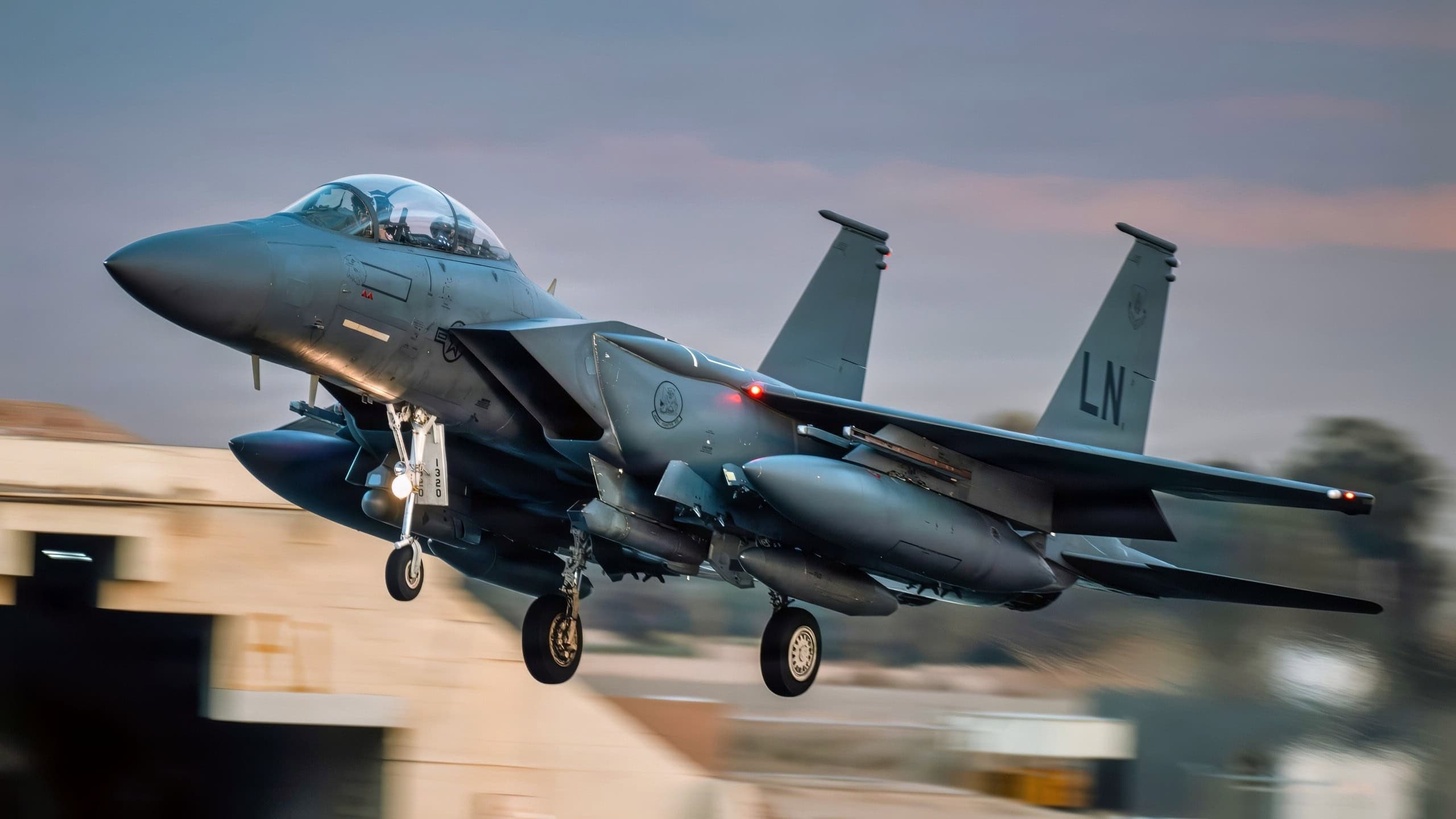
A U.S. Air Force F-15E Strike Eagle aircraft prepares to land at a base in the Middle East, Jan. 18, 2026. The U.S. maintains a highly agile fighting force, leveraging the most advanced capabilities to support the long-term security and stability of the region. (U.S. Air Force photo by Senior Airman Jonah Bliss)

A U.S. Air Force F-15E Strike Eagle performs a flare check over the U.S. Central Command area of responsibility, March 9, 2025. The F-15E is deployed within the CENTCOM AOR to help defend U.S. interests, promote regional security, and deter aggression in the region. (U.S. Air Force photo by Senior Airman Zachary Willis)
Comparisons are cheap until a number makes them expensive. Michael Jordan’s case rests on a fact with no answer: six trips to the Finals, six rings, zero losses when everything counted. The F-15 Eagle owns the aviation version of that fact, and it is the reason the comparison belongs to this jet and no other. Since 1972, across every operator and every war, the Eagle’s air-to-air record stands officially perfect. Rivals have claimed otherwise nearly a dozen times over five decades, and not one claim has ever produced a piece of wreckage.
That is not a reputation but a ledger, and ledgers are what separate the greatest of all time from the merely transcendent.
The Draft: Not a Pound for Anything Else
The Eagle was designed the way Jordan competed, with a monomania that unsettled everyone around it. In the late 1960s, stung by Vietnam’s dogfighting lessons and spooked by the Soviet MiG-25, the Air Force set out to buy a pure air-superiority machine, and the program absorbed fighter pilot John Boyd’s energy-maneuverability theory as its scouting report: the aircraft that keeps its energy wins the fight. The design mantra became famous — “not a pound for air-to-ground” — and McDonnell Douglas, selected in 1969, built exactly that. Twin engines pushing a thrust-to-weight ratio past one-to-one, meaning the Eagle could accelerate while climbing straight up. A wing so large that the jet could turn without losing speed. A radar that could look down into ground clutter and shoot what it found there, paired with a single-piece canopy that gave the pilot the whole sky. It first flew on July 27, 1972, entered service in January 1976, and carried out no mission except the one it was born for. Scouts said the same thing about a guard from North Carolina: the skill set was narrow and the will behind it was bottomless.
The Record: Six Rings’ Worth of Perfect
First blood came in 1979, when Israeli pilot Moshe Melnik downed a Syrian MiG-21, opening a ledger Israel would come to dominate — more than half of all Eagle kills belong to Israeli pilots. The championship run came over Lebanon’s Bekaa Valley in June 1982, during one of the largest jet-versus-jet battles ever fought, in which Israeli Eagles cut through Syrian MiGs without losing a single aircraft. Nine years later came the American version: in Desert Storm, F-15s accounted for 36 of the U.S. Air Force’s 39 air-to-air victories against Iraqi fighters, including MiG-29s and MiG-25s, flying the air-superiority mission the type owned without a single air-to-air loss. The Eagle even scored from beyond the arc of the atmosphere: in 1985, an F-15 climbing at the edge of space launched an anti-satellite missile and killed an orbiting satellite, the only fighter kill ever recorded above the sky itself.
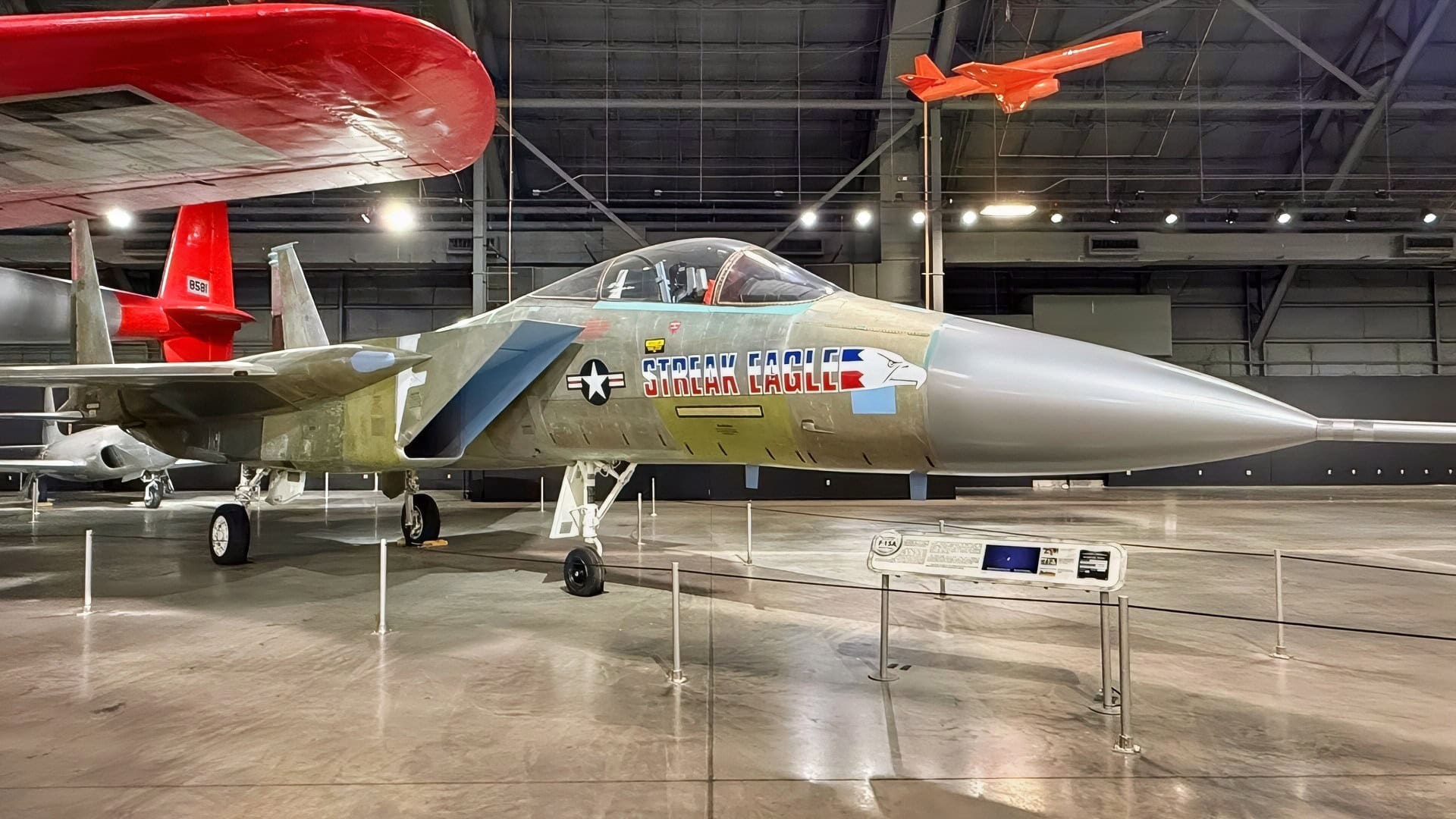
F-15A Fighter. Image Credit: 19FortyFive.com Original Image.
And like every untouchable record, this one has its conspiracy file, which is where it gets stronger, not weaker. Opposing air forces have claimed downed Eagles nearly a dozen times — Iraqi fighters over H-3, Syrian missiles off Tyre — and no claimant has ever produced evidence. The closest anyone came was the Bekaa itself, when a Syrian R-60 missile struck an F-15D mid-battle. The Eagle flew home wounded, was repaired, and returned to service. Played hurt. Finished the game.
Why Not the F-22 or F-35?
The obvious objection deserves a straight answer: if we’re handing out the Jordan title, why not the sexier stealth jets?
Because Jordan is not a talent grade but a completed record, and the stealth fighters do not have one. The F-22 Raptor is the most physically gifted air-superiority machine ever built, and its career was cut short at 187 aircraft when the production line closed in 2011: the transcendent draft pick who never got his full run, whose entire air-to-air combat ledger, five decades of American investment later, consists of one Chinese spy balloon. The F-35 is the opposite problem: a magnificent system player, more than 1,100 built, the aircraft that makes everything around it better — which is exactly why this series already cast it as the young LeBron, a decade into a career whose defining wins haven’t happened yet.
And there is a deeper reason the title can’t go to either. Stealth doctrine wins by refusing the contest: see first, shoot first, never merge. It may be the smartest way ever devised to fight, but it means the stealth era’s greatness is, so far, a projection, an undefeated prospect who hasn’t taken a title fight. The Eagle took the fight 104 times, on camera, against every MiG its era could send, and won every one.
Even Jordan Lost Games
An honest version of this piece has to go where 2026 went, because the Eagle just had its hardest season in fifty years, and pretending otherwise would insult the reader.
In early March, during the war with Iran, three U.S. F-15E Strike Eagles were downed over Kuwait by friendly fire from Kuwaiti air defenses, with all six crew members ejecting safely; speculation pointed to a Kuwaiti F/A-18. Within the same two days, by Doha’s account, a Qatari F-15EX shot down two Iranian Su-24s that failed to answer warnings while closing on Al Udeid Air Base: even in the war’s chaos, the family was still scoring.
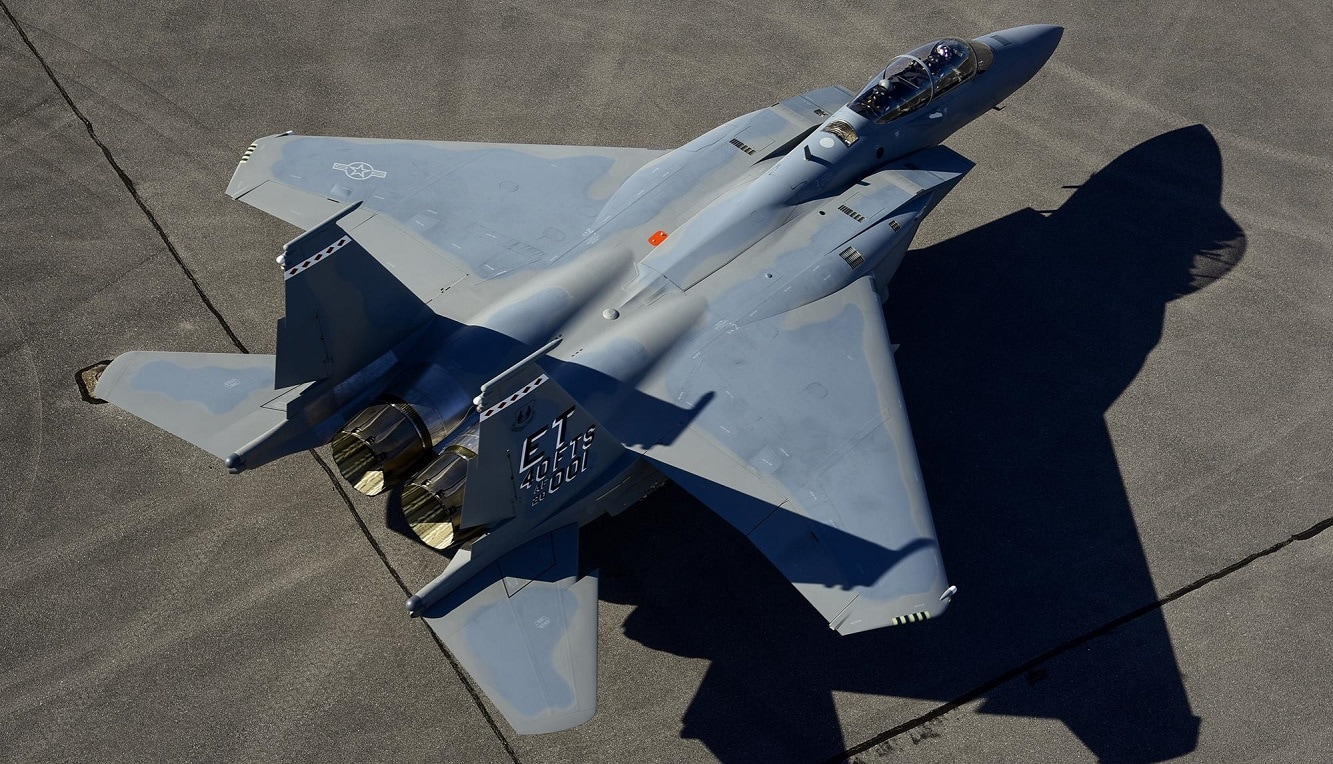
F-15EX. Image Credit: Creative Commons.
Then came April 3. An F-15E, call sign DUDE 44, was brought down over southern Iran: the first American aircraft downed by enemy fire since 2003. What killed it depends on who is talking, and all three versions deserve their attribution. By the White House’s official telling, U.S. forces had suppressed the area’s air defenses and a lone Iranian scored a lucky hit with a shoulder-fired heat-seeking missile drawn into an engine; Tehran credits an advanced new air-defense system it says survived the campaign; and the pilot, in a debriefing first reported by CNN, described a swarm of Iranian drones hovering in a jellyfish-like formation before the shootdown, a claim U.S. intelligence is still arguing about. What is not disputed is what happened next. Both crews ejected safely. The pilot was pulled out within seven hours under fire, the rescue helicopter, in the Joint Chiefs chairman’s words, “engaged by every single person in Iran who had a small arms weapon.” The weapons systems officer, a badly injured colonel, climbed 7,000 feet up a Zagros ridgeline armed with a handgun and evaded a bounty-fueled manhunt for more than a day before American forces brought him home. Tehran, for its part, initially claimed it had shot down an F-35, until the tail stripe identified a Lakenheath Strike Eagle.
Now the scorekeeping is stated precisely. The jet lost in April was a Strike Eagle downed by ground fire, the same category as the only two combat losses in the Eagle’s history, both Strike Eagles lost to Iraqi air defenses in January 1991, one of whose crews gave their lives. No Eagle of any model has ever been lost to an enemy aircraft in air-to-air combat, and the March losses to a friendly Hornet, whatever their sting, sit outside any combat ledger ever kept.
So the record that defines this airplane, the Finals record, remains perfect, and the aura of untouchability does not, which is precisely the Jordan shape of it. He lost regular-season games, took hard fouls, and had the flu game. The banner count never changed.
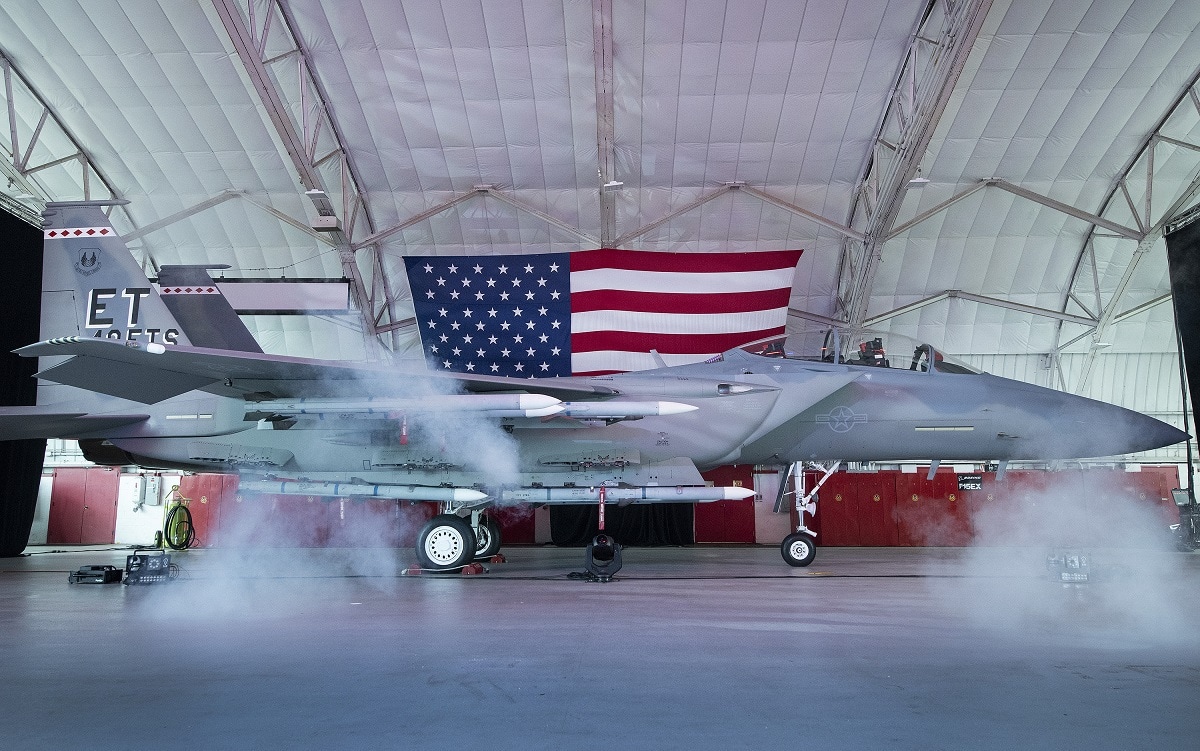
The Air Force’s newest fighter, the F-15EX Eagle II, was revealed and named during a ceremony, April 7, 2021, at Eglin Air Force Base, Fla. The aircraft will be the first Air Force aircraft to be tested and fielded from beginning to end, through combined developmental and operational tests. (U.S. Air Force photo by Samuel King Jr.)
The Comeback Contract
Jordan retired twice and came back twice, and the Eagle is deep into its own second act. A program the Air Force nearly killed at 80 aircraft has swelled to a planned 267 F-15EX Eagle IIs, the fastest-growing fighter buy in the inventory. The new jet wears the 1972 silhouette over an almost entirely new aircraft, hauling more weapons than any fighter in American service on an airframe built to fly past 2040. Only about 27 had been delivered when the Iran war began, which is why the newest Eagle sat this one out while its combat-proven older siblings carried the load. The rookie doesn’t start the playoffs. Israel has been cleared for its own new-build fleet.
We Need To Be Honest
The honest ledger, because the record deserves scrutiny rather than incense. A share of the 104 came against helicopters and against air forces flying a generation behind, and padding is real in every era’s stats — the answer is Jordan’s answer: you can only beat who shows up, and the Eagle beat everyone who ever did. Peacetime attrition tells its own story: well over a hundred Air Force Eagles have been destroyed in accidents across fifty years, because flying a 9g fighter is dangerous even when nobody is shooting.
The claims file exists and is linked above rather than hidden. And the analogy has one limit worth saying out loud: Jordan’s knees eventually voted, and he stayed retired. The Eagle’s airframe is rebuilt, re-winged, and re-ordered, which is why its comeback has a production line rather than a farewell tour.
Fifty-four years after the first flight, the scoreboard reads like nothing else in aviation: 104 official wins and counting, zero air-to-air defeats, a satellite among the victims, a war this spring that bent the legend without breaking the record, and 267 new jerseys on order. Somewhere in a museum sits a gray F-15C with green kill stars under its canopy rail; somewhere in the Zagros Mountains, a colonel with a handgun proved the fraternity still comes home; and somewhere in St. Louis, the line is building Eagles for the 2040s.
The greatest of all time is a title you have to defend every night for decades. The Eagle still hasn’t lost the one that counts.
MORE – The F-16 Is the LeBron James of Fighter Planes
About the Author: Harry J. Kazianis
Harry J. Kazianis (@Grecianformula) was the former Senior Director of National Security Affairs at the Center for the National Interest (CFTNI), a foreign policy think tank founded by Richard Nixon based in Washington, DC. Harry has over a decade of experience in think tanks and national security publishing. His ideas have been published in the NY Times, The Washington Post, The Wall Street Journal, CNN, and many other outlets worldwide. He has held positions at CSIS, the Heritage Foundation, the University of Nottingham, and several other institutions related to national security research and studies. He is the former Executive Editor of the National Interest and the Diplomat. He holds a Master’s degree focusing on international affairs from Harvard University.

