
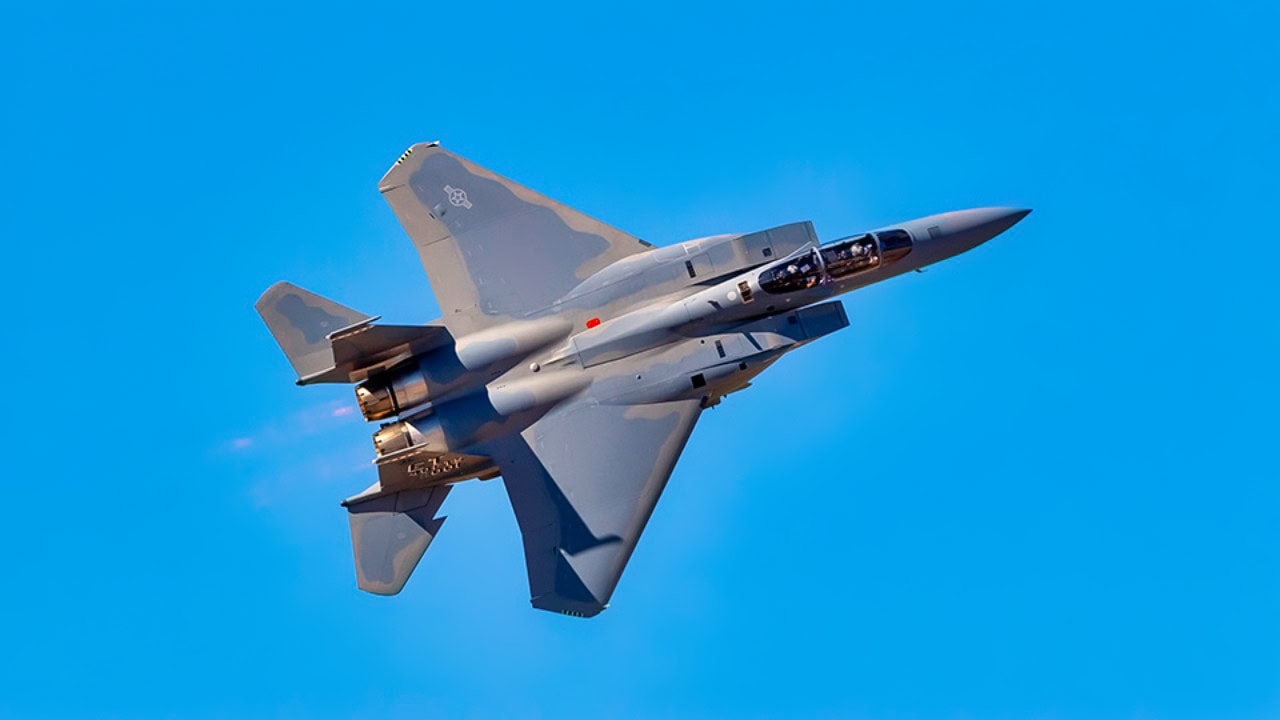
I’ve been pestering Boeing for a few months now to get inside their F-15EX Eagle II factory and give you, our loyal readers, a tour of what is most likely an amazing facility that builds a fighter that many have had a lot of negative things to say about. That isn’t the case anymore.
The reason why comes down to math: The United States Air Force plans to buy 267 F-15EX Eagle II fighters. Three years ago, the program had been cut to 80 and was widely treated as a placeholder, a small consolation buy to keep Guard squadrons flying until something stealthier arrived.
Today, it is the fastest-growing fighter program in the American inventory, with the planned fleet more than doubled in a single budget cycle and the production line in St. Louis now expected to run years longer than anyone projected.
The full history of this airplane explains how that reversal happened, and it says as much about what the Air Force has learned since 2019 as it does about the jet itself.
The F-15C/D Crisis That Forced The 2019 Decision
The Eagle II exists because the Air Force ran out of road on a problem it had deferred for two decades. The F-15C/D fleet that carried out the air-superiority mission since the 1980s was supposed to be replaced by the F-22, and when Raptor production was capped at 187 aircraft, the old Eagles simply kept flying.
By the late 2010s, they had been pushed years beyond their designed service life, to the point that the structural condition of the airframes had become a safety question in its own right, and the homeland-defense and Guard squadrons flying them needed replacements on a timeline the F-35 production system could not meet.
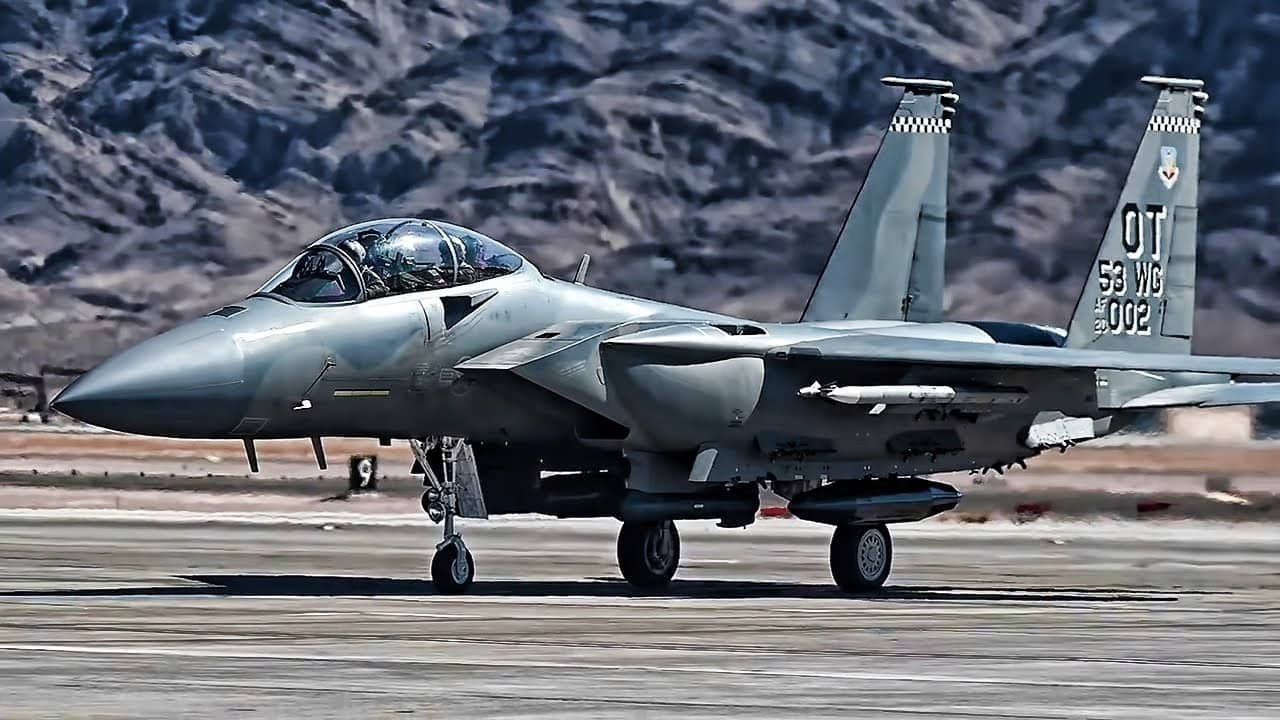
F-15EX Eagle II. Image Credit: Creative Commons.
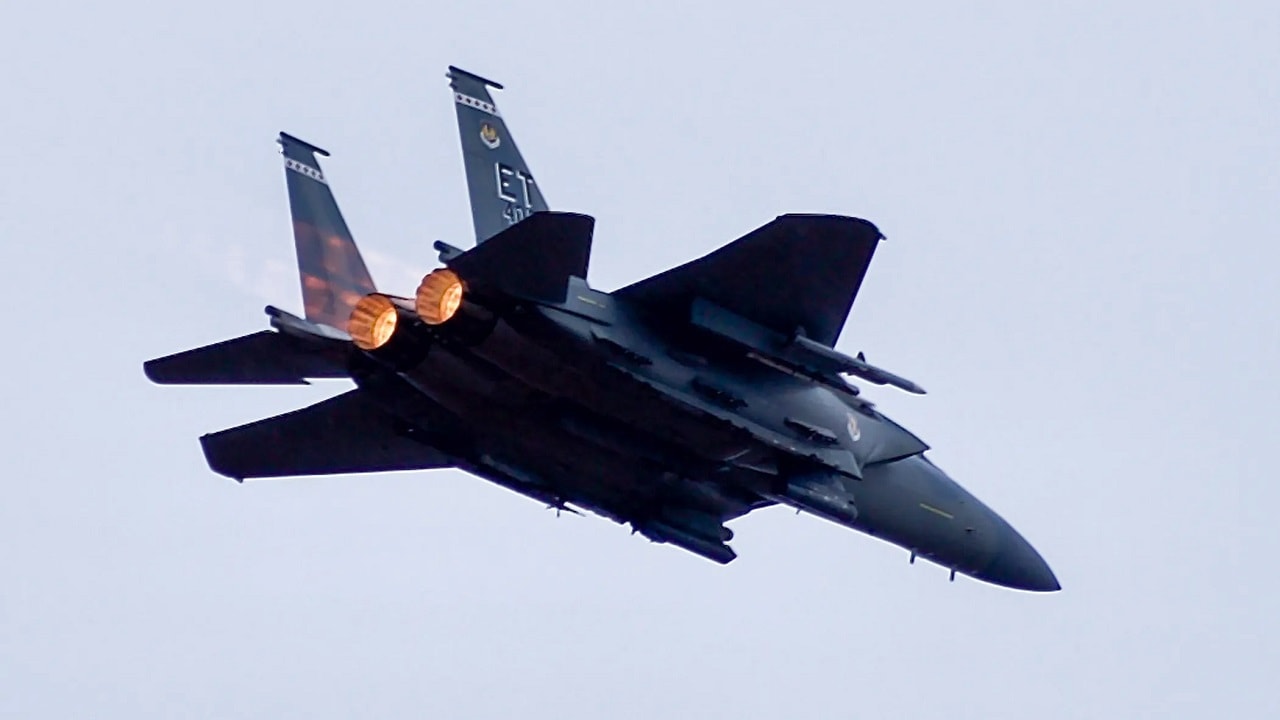
F-15EX Eagle II. Image Credit: Creative Commons.
The 2019 decision to solve that problem with new-build F-15s was genuinely controversial. The Air Force had not ordered a fourth-generation fighter since the early 2000s, and for a decade the service’s messaging had been that stealth was the price of admission to modern air combat. Critics argued every dollar spent on a non-stealthy Eagle was a dollar taken from the F-35.
The counterargument that won was practical: the missions these jets would fly — defending North American airspace, standing alert, hauling large weapons loads in places where stealth was unnecessary — did not require a penetrating strike fighter, and a new F-15 could slot into existing squadrons using existing infrastructure, simulators, tankers, and maintenance culture with almost no transition cost.
Born On Qatar’s Production Line: The F-15SA, F-15QA, And The 2018 Contract
The reason a new F-15 was even possible in 2019 traces to two Gulf monarchies. Boeing’s St. Louis line had stayed warm, building the most advanced Eagles ever made for export: the F-15SA for Saudi Arabia and then the F-15QA for Qatar, each adding fly-by-wire flight controls, modern cockpits, and strengthened airframes to the basic Strike Eagle design.
When the Pentagon awarded Boeing the development contract in 2018, the program drew directly on the F-15SA and F-15QA work, and the active export line cut development costs and compressed the delivery timeline in ways no clean-sheet program could match.
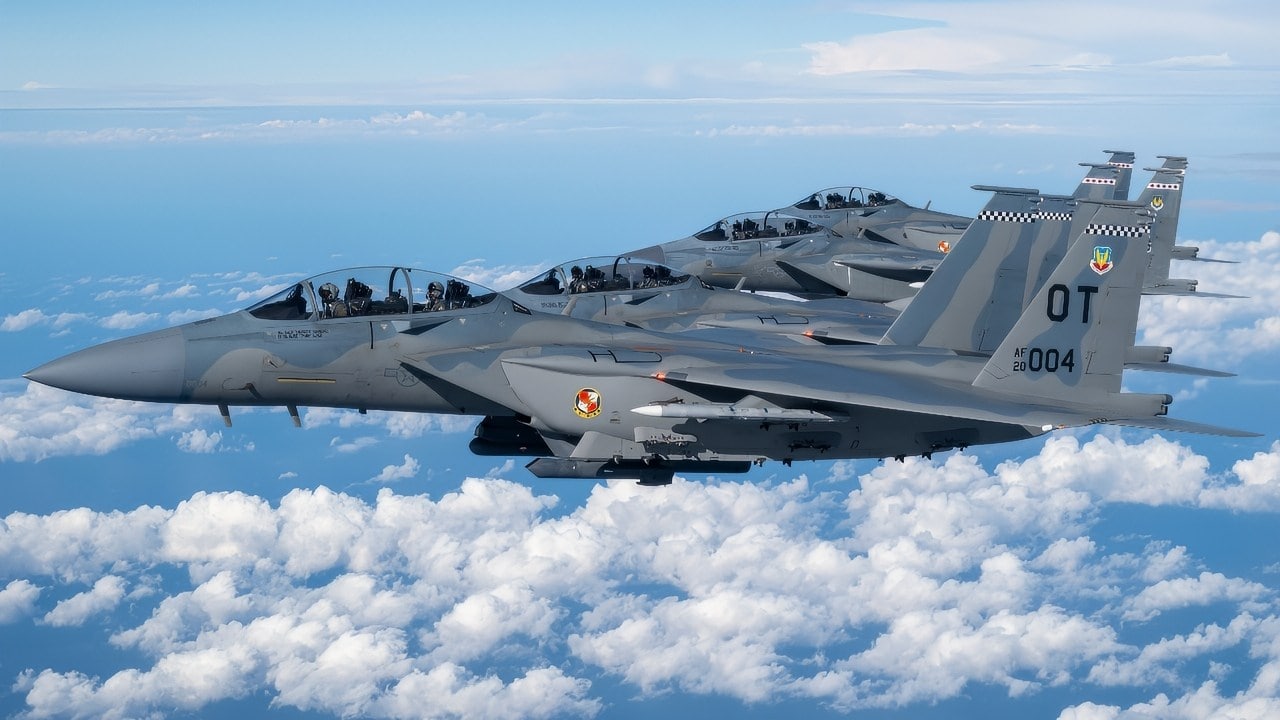
A formation of four U.S. Air Force F-15EX Eagle II fighter jets, assigned to Eglin Air Force Base, Florida, fly over the Gulf of America, Nov. 21, 2025. Secretary of the Air Force Troy Meink flew in the backseat of the lead jet as part of his visit to Eglin AFB. The flight oriented Meink to F-15EX tactics, techniques and procedures being developed and advanced by the 53d Wing to include weapons capacity, next-gen survivability, and next-generation radars, sensors and networking capabilities. (U.S. Air Force photo by Staff Sgt. Blake Wiles)
The F-15EX is, in effect, the Qatari jet adapted for American requirements. That origin gave the program its central selling point: this was the rare fighter purchase with almost no development risk, because the hard engineering had already been paid for by foreign customers and proven on a running production line. The Air Force was buying the newest version of an aircraft it had operated for nearly half a century.
First Flight In February 2021, Eglin A Month Later
The program moved at a pace that has become almost unheard of in American fighter procurement. The first F-15EX flew in February 2021, and the Air Force accepted the aircraft the following month, flying it from Boeing’s St. Louis plant to Eglin Air Force Base in Florida to begin combined developmental and operational testing under a plan that then called for 144 aircraft. The service formally named it the Eagle II that April.
At Eglin, the jet went into an integrated test program designed to wring out problems before full-rate production, participating in major exercises within months of delivery.
The testing record built steadily from there, and it would later matter a great deal: when the Pentagon’s independent Office of the Director, Operational Test and Evaluation published its 2025 annual report, the assessment found the F-15EX operationally effective across all air superiority roles, including defensive and offensive counter-air missions flown against surrogate fifth-generation adversary aircraft. For a jet whose critics had spent years calling it obsolete on arrival, that finding was a quiet vindication.
What The Eagle II Actually Is: EPAWSS, The APG-82, And A 29,500-Pound Payload
Underneath the familiar silhouette, the F-15EX is the most capable Eagle ever built. It is the first US Air Force F-15 designed from the outset with digital fly-by-wire controls, a large-area touch-screen glass cockpit, the APG-82 active electronically scanned array radar, the Joint Helmet Mounted Cueing System, and the BAE Systems EPAWSS electronic-warfare suite, a self-protection capability no earlier American Eagle carried.
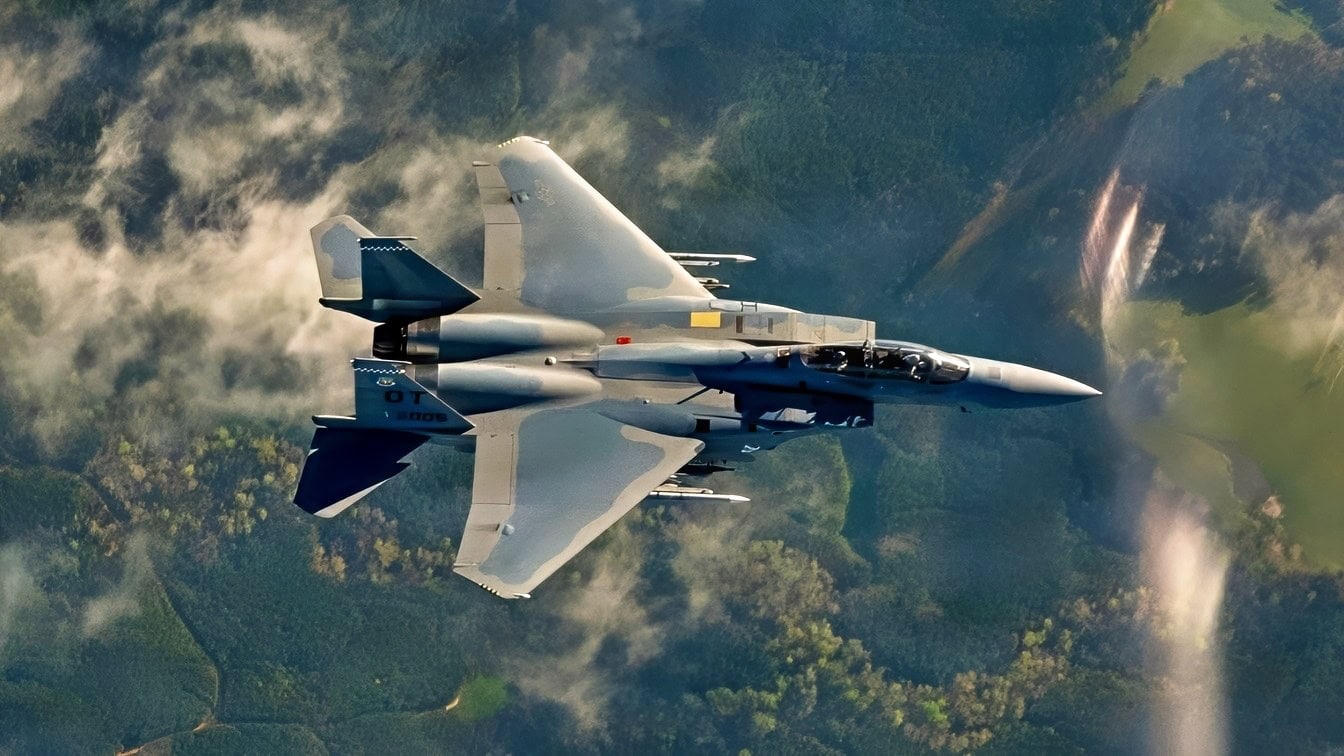
A U.S. Air Force F-15EX Eagle II assigned to Eglin Air Force Base, Florida, flies a training mission over southeast United States, March 23, 2026. The 96th Test Wing and 53rd Wing perform developmental and operational test series on the platform including next-generation survivability, radars, sensors and networking capabilities. (U.S. Air Force photo by Staff Sgt. Blake Wiles)
Its open mission systems architecture allows software and capability upgrades at a pace legacy jets cannot match, and its performance figures remain startling for any generation: Mach 2.5 speed, a 60,000-foot ceiling, and a payload of 29,500 pounds across two additional weapon stations, with the ability to carry up to a dozen air-to-air missiles and the longest standoff air-to-air engagement range of any fighter in the inventory.
The two-seat cockpit and the payload define the jet’s modern roles. As a missile truck, the EX can stand off outside the densest threats and add magazine depth to a package led by F-22s and F-35s, launching weapons against targets the stealth jets find.
It is one of the few fighters sized to carry outsized hypersonic weapons externally. And the second seat, the digital backbone, and the jet’s endurance have made it a leading candidate for controlling collaborative combat aircraft, the unmanned wingmen the Air Force is funding in parallel, which would turn the Eagle II into a battle-management node as much as a shooter.
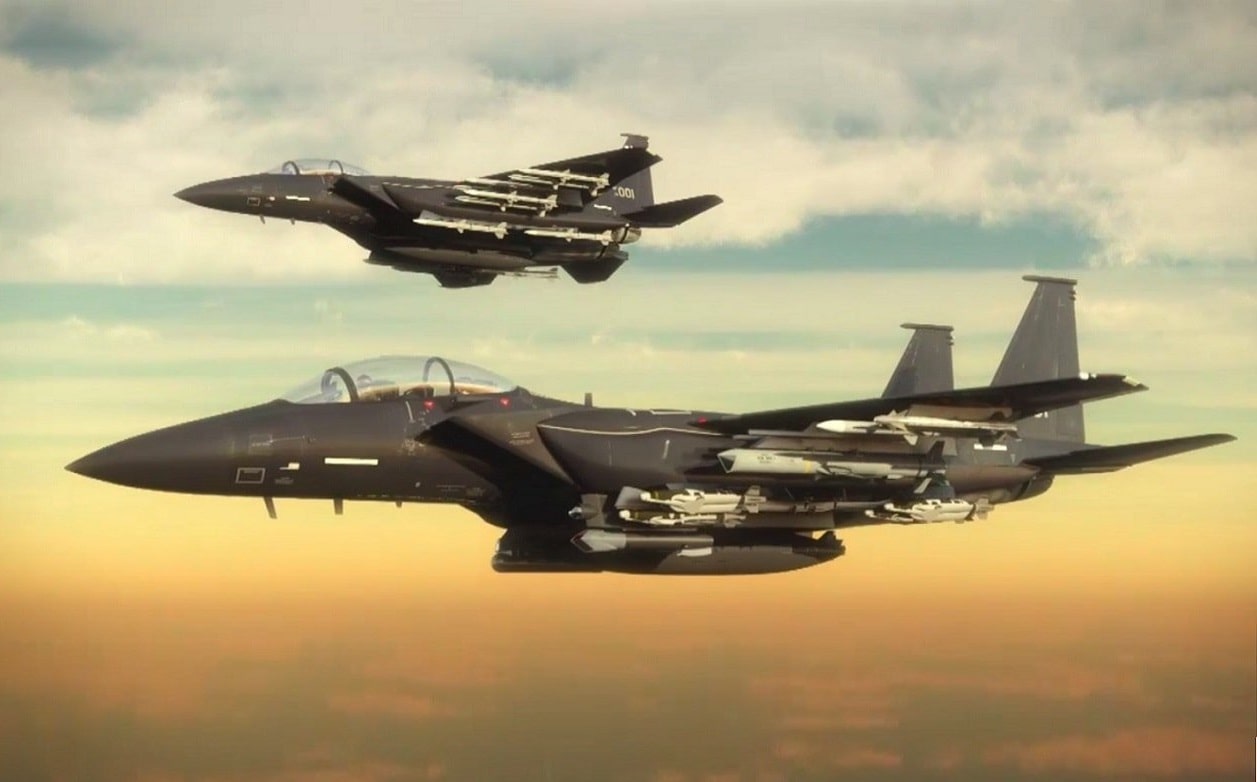
F-15EX Eagle II. Image Credit: Boeing.
The Lean Years: 144 Becomes 80
None of that protected the program when the budget knives came out. By 2022 and 2023, with the Air Force squeezed between the F-35, the B-21, the Sentinel ICBM, and the Next Generation Air Dominance program, the F-15EX buy was slashed to a low of just 80 aircraft. The official logic held that every available dollar belonged in fifth- and sixth-generation programs, and the EX settled into the role its critics had always assigned it: a small, transitional buy for the Air National Guard, useful for homeland defense and little else, destined to end production quietly.
The 80-jet floor created problems the Air Force understood even as it imposed the cut. The number was too small to recapitalize the Guard’s F-15C/D squadrons, let alone touch the larger and equally aging F-15E Strike Eagle fleet, and it threatened to close a production line the United States might want later.
The program survived those years on the strength of its delivery record and its low risk, while the assumptions that had shrunk it were quietly collapsing in the real world.
The Climb Back: 98, 129, And The Selfridge Surprise
The rebound came in stages. The buy recovered to 98, and then the fiscal 2026 budget proposal lifted it to 129 aircraft, backed by roughly $3 billion for 21 jets with funding for more in the reconciliation bill. The proximate trigger was political and specific: President Trump’s surprise announcement that the Michigan Air National Guard’s 127th Wing at Selfridge, losing its A-10 Warthogs to retirement, would be re-equipped with the F-15EX.
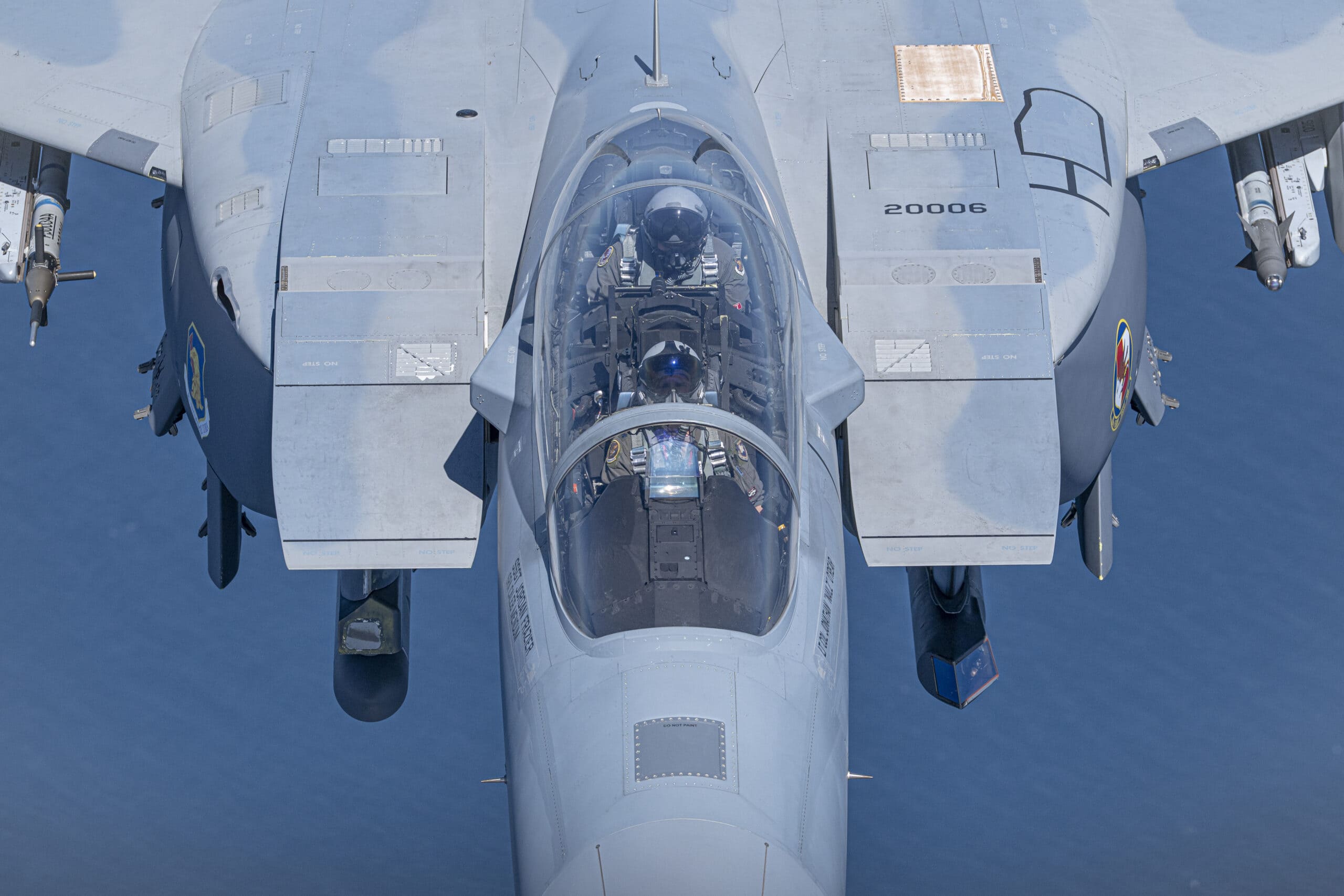
A U.S. Air Force F-15EX Eagle II flies over the Gulf of America, September 16, 2025. The F-15EX, from the 40th Flight Test Squadron at Eglin Air Force Base, Florida, is one of the first F-15EXs in the Air Force, and is going through developmental and operational test series at Eglin to confirm its operational capabilities before it is delivered to the combat Air Force. (U.S. Air Force photo by Tech Sgt. Jacob Stephens)
The arithmetic behind the 129 number showed how tight the program had become. The planned beddown already included Portland, Fresno, New Orleans, and two squadrons at Kadena Air Base in Okinawa, a plan requiring roughly 90 of the original 98 jets.
Adding Michigan’s squadron pushed the requirement to about 126, which would have left three aircraft in the entire program for testing, evaluation, and training. The 129 figure was less an expansion than an admission that the existing commitments had already outgrown the fleet.
Kadena deserves its own note in that list: basing two F-15EX squadrons at the most important fighter base in the Western Pacific put the Eagle II at the leading edge of the China problem rather than in a rear-area homeland role.
Fiscal 2027: The Buy Doubles To 267
Then came the jump that reframed the entire program. With the fiscal 2027 budget request this spring, the Air Force more than doubled the planned F-15EX fleet from 129 to 267 aircraft, seeking 24 additional jets for roughly $3 billion in the first installment, at a moment when only about 25 EXs had actually been delivered.
The new number transformed the jet’s purpose: the expanded fleet signals a clear intent to recapitalize the F-15E Strike Eagle force, the aging two-seat fleet that has carried decades of continuous combat deployments, with the 20 oldest jets slated to begin retiring in fiscal 2027. The production line, once expected to wind down, will now run long enough that the Air Force plans to operate three fighter lines simultaneously.
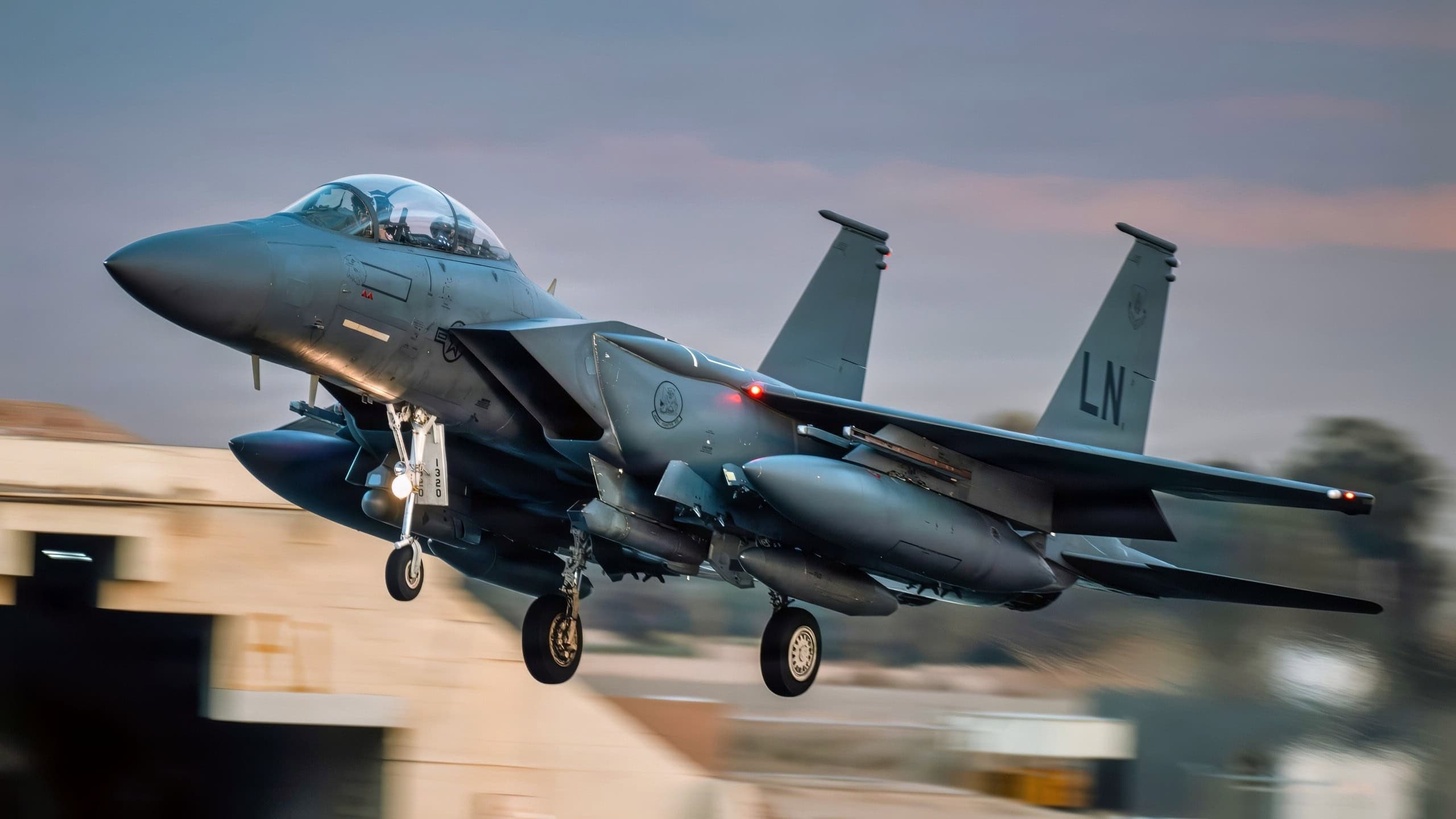
A U.S. Air Force F-15E Strike Eagle aircraft prepares to land at a base in the Middle East, Jan. 18, 2026. The U.S. maintains a highly agile fighting force, leveraging the most advanced capabilities to support the long-term security and stability of the region. (U.S. Air Force photo by Senior Airman Jonah Bliss)

An F-15E Strike Eagle, deployed to the 332d Air Expeditionary Wing, prepares for takeoff just as the sun sets at in undisclosed location in Southwest Asia. The 332 AEW works around the clock to support Operation Inherent Resolve. (Air National Guard photo by Master Sgt. Jonathan Young)
The reasons stack up quickly when laid side by side. A sharply larger Air Force budget made room for mass that previous years could not fund. Delays to the F-35’s Block 4 upgrade left newly delivered jets short of their full combat capability, strengthening the case for a fighter that arrives ready. The DOT&E report certified the EX’s effectiveness in writing.
The shift from Guard stopgap to Strike Eagle recapitalization gave the program a mission measured in decades. And behind all of it sits the lesson of the past year’s wars, the one this column has tracked since the first munitions-depletion figures emerged from the Iran campaign: stealth can open a fight, but mass, payload, endurance, and magazine depth decide how long it can be sustained. A fighter that can haul a dozen AMRAAMs or a heavyweight standoff load suddenly looked less like nostalgia and more like the answer to the arithmetic of a long war.
What 267 Eagles Says About American Air Power
The honest limits belong in any full history. The F-15EX is not survivable inside a modern integrated air defense system the way an F-35 or B-21 is, and nobody in the Air Force plans to send it downtown against China on the first night.
The doubled buy does not repudiate stealth; the same budgets pour money into the F-47, the B-21, and collaborative combat aircraft. What the 267 number repudiates is the idea, dominant for two decades, that a fighter without stealth has no future worth funding.
About the Author: Harry J. Kazianis
Harry J. Kazianis (@Grecianformula) was the former Senior Director of National Security Affairs at the Center for the National Interest (CFTNI), a foreign policy think tank founded by Richard Nixon based in Washington, DC. Harry has over a decade of experience in think tanks and national security publishing. His ideas have been published in the NY Times, The Washington Post, The Wall Street Journal, CNN, and many other outlets worldwide. He has held positions at CSIS, the Heritage Foundation, the University of Nottingham, and several other institutions related to national security research and studies. He is the former Executive Editor of the National Interest and the Diplomat. He holds a Master’s degree focusing on international affairs from Harvard University.

