
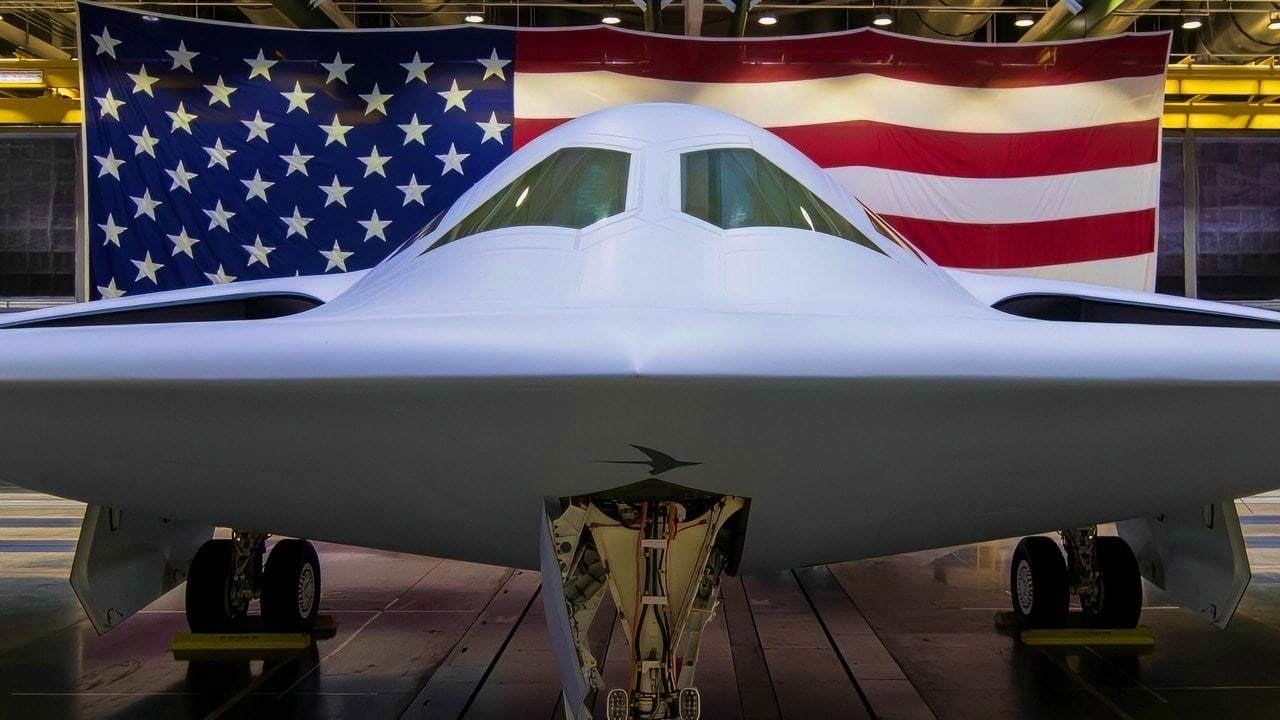
For years, analysts and even Air Force officials have argued that plans to procure 100 B-21 Raiders are insufficient, and that a fleet of 200 or more would be a safer bet as the United States prepares for future wars. Those calls now appear to be being taken seriously by the Pentagon, with reports now describing how the U.S. Air Force is preparing to formally revise the planned size of its B-21 Raider stealth bomber fleet. Senior officials are now openly acknowledging that the current minimum goal of 100 aircraft is unlikely to be sufficient for future wars against major adversaries like China.
The B-21 Raider Stealth Bomber Numbers Question
The revised procurement target is expected to be included in the Air Force’s FY2028 budget request due in spring 2027, according to testimony delivered May 13 before the House Armed Services Committee’s seaport and projection forces subcommittee.
Air Force Deputy Chief of Staff for Plans and Programs Lt. Gen. David H. Tabor told lawmakers the service is now actively determining what the revised “program of record” should become as Pentagon support for a larger bomber fleet rapidly grows. The comments come only weeks after Defense Secretary Pete Hegseth publicly stated that the United States would need “a lot more” than 100 B-21s in the future.
The push for additional bombers has been ongoing for some time, but has accelerated following recent U.S. operations against Iran, growing concern over China’s expanding military capabilities, and increasing recognition inside the Pentagon that America’s stealth bomber inventory remains extremely small relative to the demands of even current warfare.
Air Force Signals Major Shift In Bomber Planning
The Air Force has technically maintained for years that it intended to acquire “a minimum” of 100 B-21 Raiders, but Tabor’s recent testimony is the clearest indication yet that the service now expects to move substantially beyond that figure.
“We’re in the process of sharpening our pencils, really getting down to exactly what that [revised program of record] is,” Tabor explained to lawmakers while discussing a revised procurement target. He added that by the FY2028 budget cycle, the Air Force expects to present a far more precise force structure plan.
“I think here in the next year, by the time we get to the ’28 budget, we’ll be able to give you a better answer, much more precise answer, and show you our homework.”
Rep. Rob Wittman argued during the hearing that the original bomber requirement was established under a completely different strategic environment and questioned whether the rise of China’s military power now demands significantly larger numbers of stealth bombers – a case that has been made by analysts for years.
The B-21 Raider is intended to eventually replace both the aging B-1B Lancer and B-2 Spirit fleets while also forming part of the wider modernization of America’s nuclear triad alongside the Sentinel intercontinental ballistic missile and Columbia-class ballistic missile submarine programs.
Unlike tactical fighters, bombers like the Raider provide long-range strike capability across enormous distances while carrying large payloads of precision weapons. Pentagon planners now increasingly see that capability as essential for any future conflict in the Indo-Pacific, where Chinese missiles already threaten forward U.S. airbases and tanker aircraft.
Iran Operations and China Are Driving Demand
There should be little doubt that recent U.S. combat operations against Iran have significantly strengthened internal Pentagon arguments for expanding the B-21 Raider fleet beyond its long-standing 100-aircraft minimum.
During Operation Midnight Hammer and Operation Epic Fury, the Air Force relied heavily on its small fleet of B-2 Spirit stealth bombers to conduct long-range penetrating strikes against Iranian nuclear infrastructure, missile facilities, and hardened military targets protected by layered air defenses.
The operations required sustained bomber sorties from Whiteman Air Force Base in Missouri and forward-deployed support assets spread across Europe and the Middle East, placing enormous operational demand on one of the smallest stealth bomber fleets in modern military history.
The missions also seemed to reinforce an existing Pentagon concern that the United States lacks sufficient numbers of penetrating aircraft for a prolonged high-intensity conflict.
The Air Force currently operates only 20 B-2 bombers, and due to maintenance requirements and readiness limitations, only a fraction of those aircraft are typically available for combat operations at any given time.
Meanwhile, the B-2 fleet’s mission-capable rate stood at roughly 55 percent during fiscal year 2024, meaning barely half the fleet was mission-ready on average.
In February, the Air Force announced a $4.5 billion agreement with Northrop Grumman to increase B-21 production capacity by roughly 25 percent.
The move was officially presented as a way to accelerate delivery timelines while preserving cost and performance targets – but in hindsight, it looks as though the move could have been directly tied to plans to increase procurement.
Recent comments from Hegseth and STRATCOM now suggest that the groundwork for substantially higher B-21 procurement numbers may have been underway for some time.
About the Author: Jack Buckby
Jack Buckby is a British researcher and analyst specializing in defense and national security, based in New York. His work focuses on military capability, procurement, and strategic competition, producing and editing analysis for policy and defense audiences. He brings extensive editorial experience, with a career output spanning over 1,000 articles at 19FortyFive and National Security Journal, and has previously authored books and papers on extremism and deradicalization.