
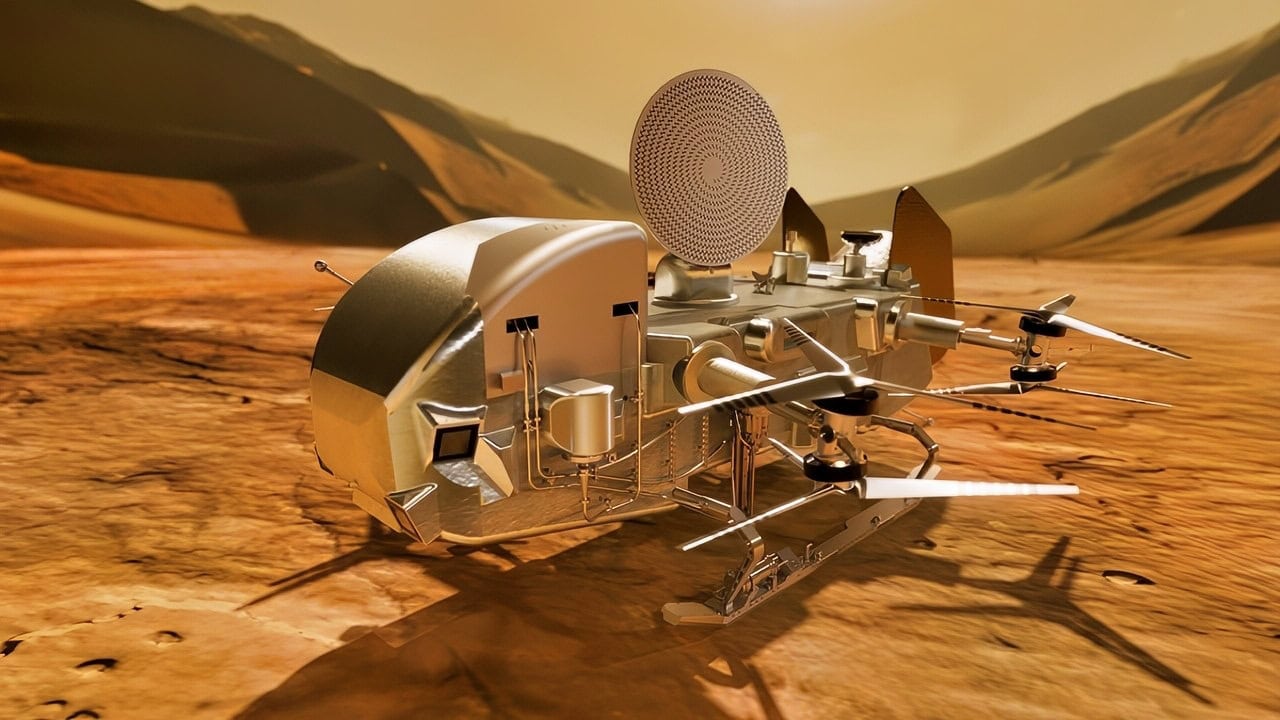
The upcoming Dragonfly mission is unlike any planetary mission NASA has ever attempted. Instead of another slow-moving rover, like Curiosity or Perseverance, Dragonfly is a car-sized nuclear-powered drone designed to fly across the surface of Saturn’s moon Titan.
The mission, recently cleared by NASA and confirmed with a July 2028 launch, will cost roughly $3.35 billion and reflects a major shift in planetary exploration methods.
Why Titan?
Titan is Saturn’s largest moon and one of the most fascinating worlds in the Solar System. Titan is the only moon with a thick atmosphere, weather, clouds, rain, rivers, and lakes.
But unlike Earth, Titan’s rivers and lakes are liquid methane and ethane instead of water. Beneath the icy crust, scientists believe a global liquid-water ocean may exist.
Rich in carbon-based organic molecules, the building blocks of life, scientists often describe Titan as a frozen version of early Earth, the planet that existed before life developed.
Titan is also perfect for a flying mission. The atmosphere is roughly four times denser than Earth’s, though gravity is only one-seventh that of Earth’s.
Dense air generates tremendous lift and low gravity means much less energy required to stay airborne—a combination of factors that bodes well for flying.
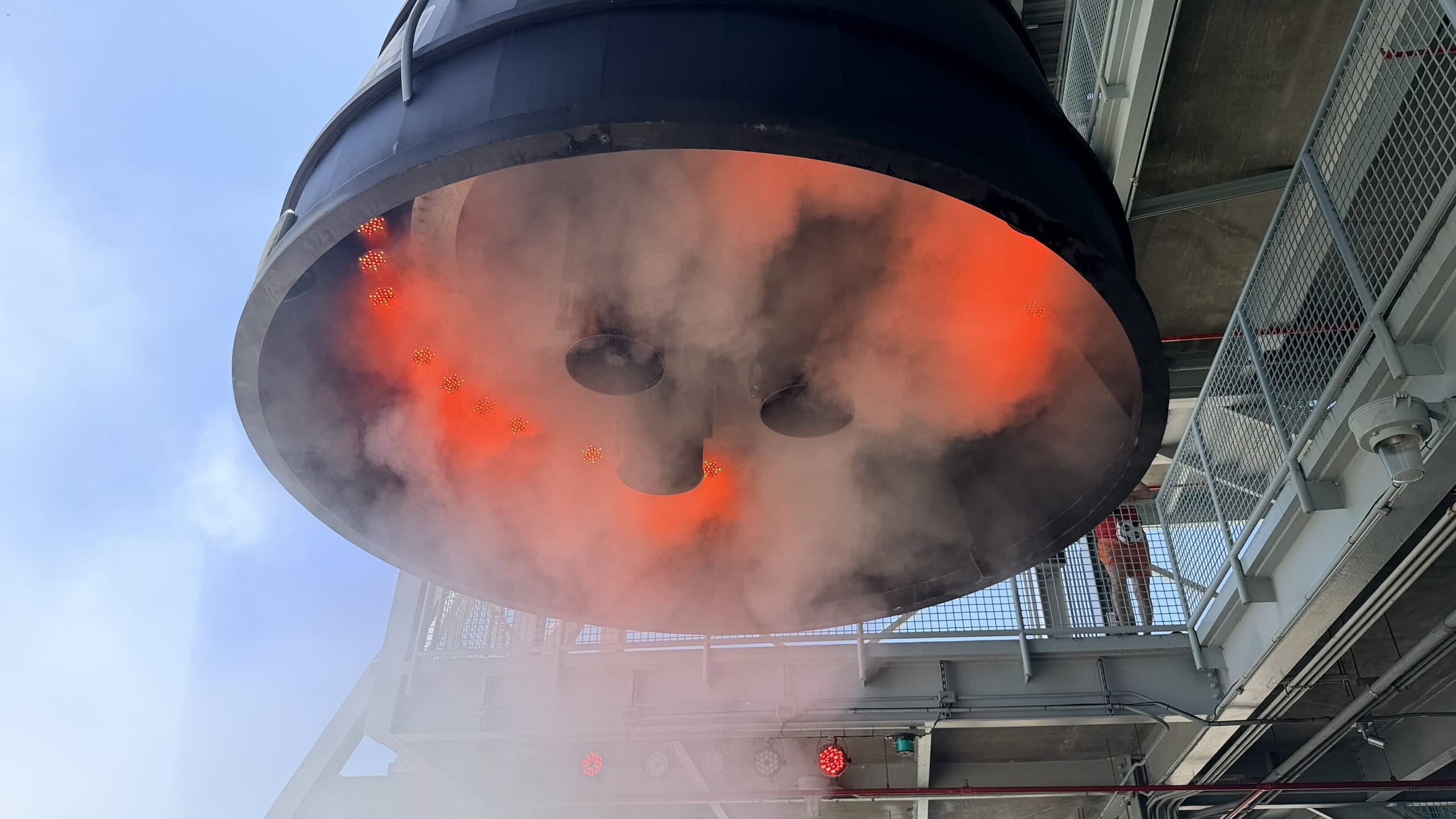
Mock Engine Test at NASA Kennedy Space Center on 6/28/2026.

NASA logo. 19FortyFive image.
NASA engineers have even noted that a human wearing artificial wings could theoretically fly on Titan.
Indeed, Titan will be easier to fly on than Mars, where the atmosphere is extremely thin and where helicopters would need their rotors to spin extremely fast just to stay airborne.
Meet Dragonfly
Weighing roughly 1,000 pounds, Dragonfly is about the size of a small car. The first rotorcraft designed to carry a full scientific laboratory across another world, Dragonfly uses eight rotors, four arms, and coaxial counter-rotating rotor pairs.
Multiple rotors provide redundancy; if one rotor or motor has problems, others can compensate to maintain controlled flight.
Dragonfly will be powered by plutonium—not sunlight.
This is necessary because Titan lies nearly 900 million miles from the Sun, so sunlight is weak to begin with and is further weakened after being filtered through a thick atmospheric haze.
Solar panels on Dragonfly would generate very little electricity. Instead, Dragonfly uses an MMRTG (Multi-Mission Radioisotope Thermoelectric Generator).
The heat from naturally decaying plutonium-238 generates electricity continuously, while the MMRTG slowly charges onboard lithium-ion batteries, which then provide a large burst of power needed during flight.
Waste heat also keeps the electronics warm, again a necessity—Titan’s temperature is nearly 300 degrees below zero.
Exploring Titan
Most of the Dragonfly mission will actually be spent sitting still. The vehicle will land, and its batteries will spend days recharging using the MMRTG.
Then, Dragonfly will lift off, fly for roughly 30 minutes, travel several kilometers, and land again.
Through that rhythm, Dragonfly will explore the surface of Titan, traveling at speeds of roughly 22 mph, in increments of flight distances that would take a rover months to cover.
Notably, the mission will be autonomous. Radio signals between Earth and Titan would take well over an hour one way, so it would be impossible to fly with a joystick from Earth.
Instead, Dragonfly must navigate itself, avoid hazards, choose safe landing sites, and manage its own flight independently.
Toward this end, Dragonfly uses cameras, LiDAR, onboard navigation software, and terrain mapping—representing one of NASA’s most autonomous spacecraft ever built.
The scientific priorities of the mission include determining whether Titan possesses the chemical ingredients that could eventually lead to life.
Accordingly, Dragonfly carries several sophisticated instruments: DraMS, a mass spectrometer that analyzes complex organic molecules and searches for prebiotic chemistry; DraGNS, a gamma-ray/neutron spectrometer that maps chemical composition beneath the surface without extensive digging; DragonCam, a panoramic and microscopic camera studying Titan’s landscape; and DraGMet, a weather station and geophysics package measuring winds, atmospheric conditions, and possible “Titanquakes.”
Dragonfly could redefine planetary exploration, demonstrating that aircraft—not just wheeled rovers—may become standard tools on worlds with atmospheres.
This mission provides a blueprint for future exploration of Titan and other planetary bodies. And if Dragonfly discovers increasingly complex organic chemistry, it could reshape scientists’ understanding of how the ingredients of life emerge across the Solar System.
About the Author: Harrison Kass
Harrison Kass is a writer and attorney focused on national security, technology, and political culture. His work has appeared in Tablet, City Journal, The Hill, The Spectator, and The Cipher Brief. He holds a JD from the University of Oregon and a master’s in Global & Joint Program Studies from NYU. More at harrisonkass.com.