
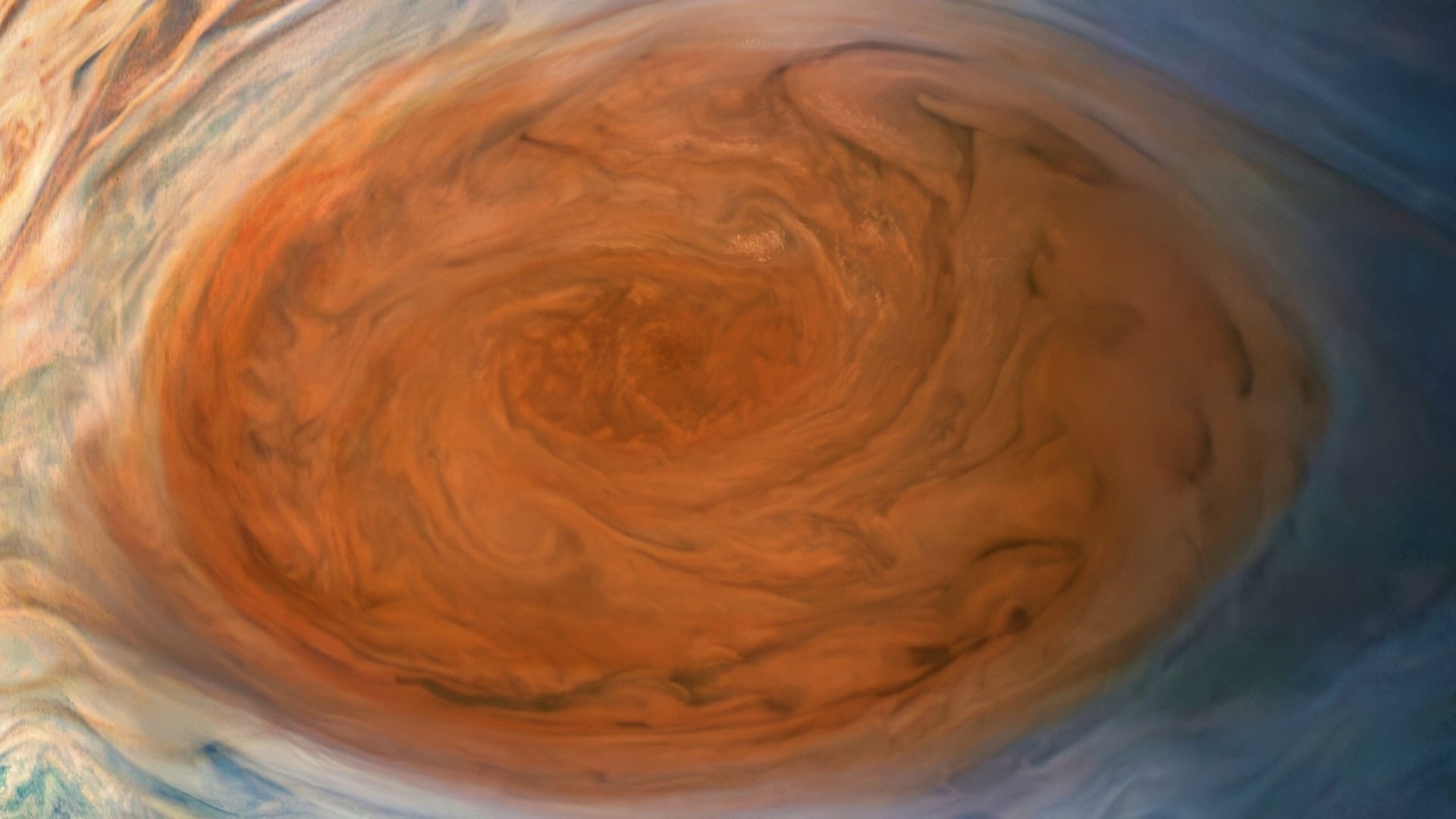
Summary and Key Points: The winds circling Jupiter’s Great Red Spot blow at more than 400 miles per hour, roughly double the speed of the fiercest hurricane ever recorded on Earth. The storm is wider than our entire planet, has raged without pause for at least 190 years, and is driven by forces no earthly hurricane can tap. Here is why the largest storm in the solar system makes a Category 5 look mild.
Jupiter and the Giant Red Spot Mystery
The most powerful hurricane ever reliably measured on Earth carried winds of roughly 200 miles per hour, an almost unimaginable force that levels buildings and reshapes coastlines. Now picture a storm whose winds blow at more than twice that, that is wider than the entire planet Earth, and that has been raging without a break for at least 190 years. It is real, and on a clear night, a backyard telescope can find it: Jupiter’s Great Red Spot, the largest and most violent storm in the solar system, so far beyond any weather Earth can produce that the comparison almost breaks down.
The Numbers
Start with the benchmark. On Earth, a Category 5 hurricane, the top of the scale, begins at sustained winds of 157 miles per hour, and the strongest storms ever recorded, like 1969’s Hurricane Camille and 2015’s Hurricane Patricia, topped out around 200 mph. Those are the fiercest winds our planet has ever managed.
Jupiter operates on another scale entirely. A ring of high-speed winds circulates around the outer edge of the Great Red Spot, and NASA measurements show those winds exceed 400 miles per hour, roughly 640 kilometers per hour. NASA itself has framed the gap in plain terms: the winds in Jupiter’s giant anticyclonic storms blow at almost twice the speed of the strongest hurricane on Earth. Put another way, the Great Red Spot’s winds are more than two and a half times the threshold of a Category 5, and roughly double the worst storm our planet has ever thrown.
A Different Kind of Storm
The comparison to a hurricane is useful but not quite right, because the Great Red Spot is not a hurricane at all. A hurricane is a low-pressure system, with air spiraling inward and upward, fueled by warm ocean water. The Great Red Spot is the opposite: an anticyclone, a colossal high-pressure system that rotates counterclockwise in Jupiter’s southern hemisphere, with no ocean and no solid surface beneath it.
It is also almost incomprehensibly large. Even after shrinking for over a century, the Spot is still about 10,000 miles across, wide enough to swallow the entire Earth. And it reaches deep: data from NASA’s Juno spacecraft show the storm extends some 300 miles below the visible cloud tops, its roots plunging far beneath the surface layer. Most striking of all is its age. A hurricane lasts days; the Great Red Spot has been observed continuously since at least 1831, and possibly far longer, a single storm that has outlived every human who ever watched it.
Why Earth Can’t Make One
Two things let Jupiter sustain winds Earth never could. The first is the absence of a surface. A hurricane weakens and dies when it moves over land, because friction with the ground and the loss of warm-water fuel drain its energy. The Great Red Spot floats in a bottomless atmosphere of hydrogen with no ground to rub against, so nothing slows its circulating winds, and its swirling eddies simply persist, which is how one storm endures for centuries.
The second is raw power. Jupiter is enormous and spins fast, completing a full day in under ten hours, and the storm taps heat rising from the planet’s hot interior rather than depending on a warm ocean the way Earth’s storms do. Freed from the limits that cap terrestrial hurricanes, ocean temperature, landfall, and our planet’s smaller size, the Spot can spin far faster and far longer than anything in our own skies.
A Storm in Flux
For all its permanence, the Great Red Spot is not static. It has been shrinking for more than a century, from perhaps 25,000 miles across in the late 1800s to less than half that today, narrowing fastest at its waist and growing more circular.
Its winds are changing too: Hubble found the outer ring sped up roughly 8 percent between 2009 and 2020. And in 2024, astronomers watched it jiggle like gelatin, oscillating in size and shape, while the James Webb Space Telescope found its center surprisingly cold. Why it is shrinking, why its winds are quickening, and even why it is red all remain unanswered. The most closely studied storm beyond Earth is still, after nearly two centuries, mostly a mystery, and the calm-looking red oval in a telescope’s eyepiece remains the most violent weather in the solar system.
About the Author: Harry J. Kazianis
Harry J. Kazianis (@Grecianformula) was the former Senior Director of National Security Affairs at the Center for the National Interest (CFTNI), a foreign policy think tank founded by Richard Nixon based in Washington, DC. Harry has over a decade of experience in think tanks and national security publishing. His ideas have been published in the NY Times, The Washington Post, The Wall Street Journal, CNN, and many other outlets worldwide. He has held positions at CSIS, the Heritage Foundation, the University of Nottingham, and several other institutions related to national security research and studies. He is the former Executive Editor of the National Interest and the Diplomat. He holds a Master’s degree focusing on international affairs from Harvard University.