
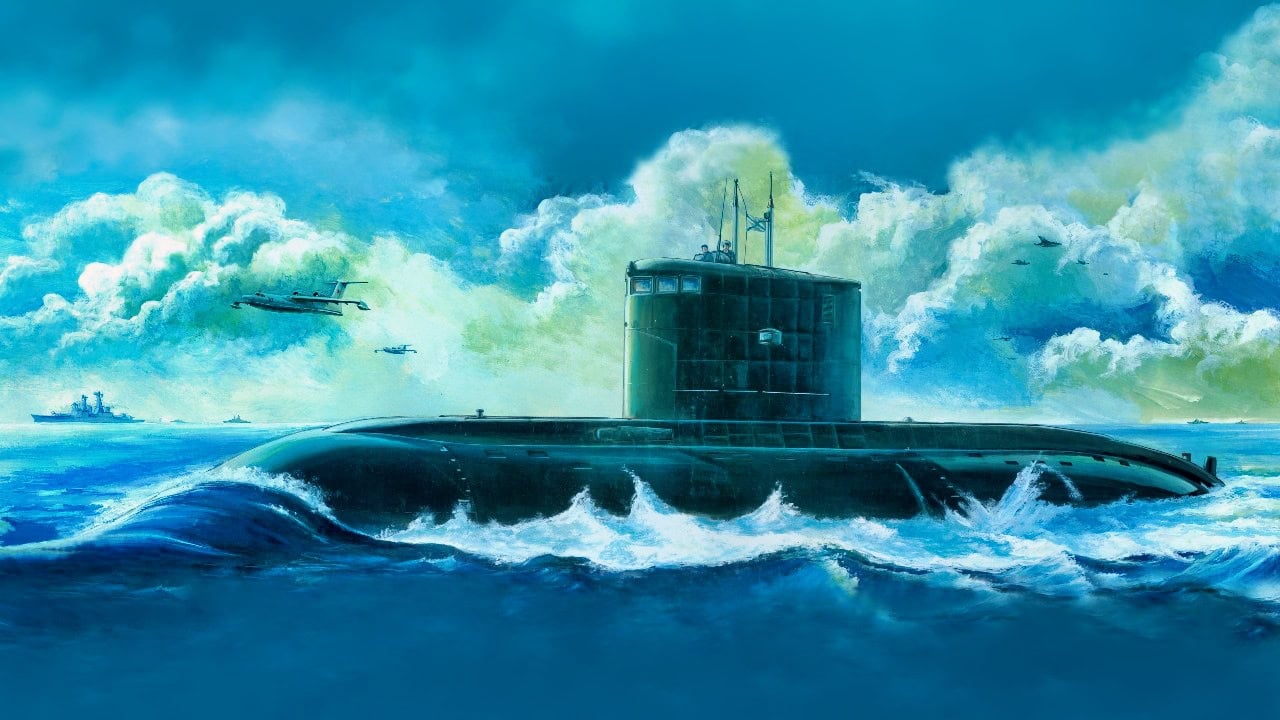
This summer, satellite photographs showed Russia bolting lattice cages over the conning towers of its Black Sea submarines, hiding their masts and hatches from Ukrainian drones inside its own port. Ukraine began this war with a single warship, which it scuttled in the first days to keep it from the enemy. It has since sunk or wrecked roughly a third of one of the world’s great fleets, driven the survivors from Crimea to a port they can no longer defend, and rewritten what a warship is worth, using boats that cost less than the torpedoes once fired at them. The world’s navies are watching because the lesson is coming for all of them.
On July 3, the British Ministry of Defence confirmed what satellite imagery from early June had revealed: Russia’s Black Sea Fleet has begun fitting counter-drone cages over the sails of its Kilo-class submarines at Novorossiysk, with three of its four operational boats already modified. The lattice canopies are meant to shield periscopes, communication masts, and hatches from Ukrainian attack drones without touching the boats’ underwater stealth. It is a small, improvised, revealing measure: one of the world’s most storied navies, reduced to welding cages onto its submarines to keep them alive at the pier. And it is the latest sign of something much larger than one fleet’s misfortune.
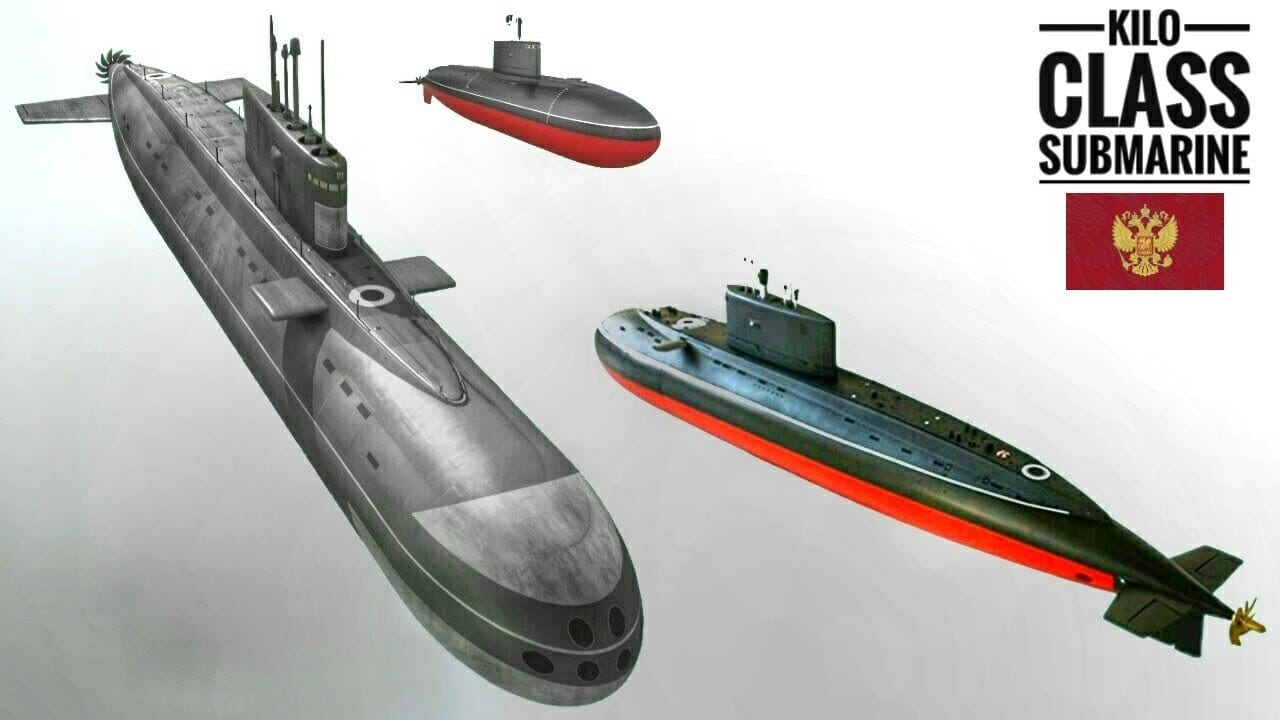
Kilo-class Submarine. Image Credit: Creative Commons.
The scale of what Ukraine has done at sea has no real precedent. By its Defense Ministry’s accounting, roughly a third of Russia’s Black Sea Fleet has been destroyed or seriously damaged, and the British defense ministry judged the fleet “functionally inactive” as far back as March 2024. Forced out of its historic home port at Sevastopol in October 2023, the fleet retreated more than 200 miles east to Novorossiysk, and the story of this year is that Novorossiysk stopped being safe too. A March strike involving more than 200 drones reportedly sank a minesweeper and damaged two anti-submarine ships; April strikes hit the frigates Admiral Essen and Admiral Makarov, the largest warships Russia has left in the Black Sea since the cruiser Moskva was sunk in 2022. In December, a Ukrainian underwater drone struck a submarine at its berth, assessed as the first time an uncrewed underwater vehicle has mission-killed a submarine in port. Ukrainian sea drones have even shot down aircraft: Magura boats downed two Russian helicopters, then two Su-30 fighter jets, with missiles fired from the water, firsts in the history of naval warfare. All of it was accomplished by a country whose entire prewar navy amounted to a single frigate.
What makes this a revolution rather than a run of bad luck for Moscow is the arithmetic. A Ukrainian naval drone costs a few hundred thousand dollars, less than a single modern torpedo, and yet these boats have sunk warships worth tens of millions and chased a fleet built over generations into hiding. For four centuries, sea power has meant expensive ships crewed by hundreds of sailors, and the whole logic of that investment assumed no cheap weapon could threaten it at scale. Ukraine has broken that assumption in full view. It has achieved sea denial, the ability to make a body of water too dangerous for an enemy fleet to use, without a fleet of its own, using expendable machines it can build in secret workshops faster than Russia can sink them.
This is why the world’s naval powers are studying the Black Sea with unusual intensity. The Pentagon, shifting its focus toward a possible war with China, plans to field thousands of small uncrewed surface vessels across the Indo-Pacific by the end of the decade, and in June, U.S. special forces sank a target ship with a Ukrainian-built Magura at an exercise off the Philippines, the first use of the technology in the Pacific. The lesson cuts directly at the most expensive assets afloat: if a few hundred thousand dollars of boat can threaten a frigate, the same math haunts a ten-billion-dollar aircraft carrier. It sharpens every warning about the thinness of American shipbuilding and the vulnerability of fixed bases and big platforms in the Pacific, the same anxieties that run through wargames of a fight over Taiwan. NATO has already trained against Ukrainian tactics, and Ukraine’s own drone crews beat an alliance force in every scenario at a naval exercise in Portugal last year. The country with no navy has become the teacher.
None of which means the story is finished, or as one-sided as the highlight reel suggests. Russia is adapting, and seriously. The British defense ministry assesses that the Russian navy is building both its own attack drones and counter-drone defenses to close the gap with Ukraine; it has hardened its harbors, and it now uses helicopters to hunt Ukrainian sea drones with airborne FPVs — the cope cages are only the most visible piece. The pace of this contest is brutal: analysts describe an innovation cycle measured in months, in which a weapon that dominates today can be countered within a season, meaning Ukraine’s edge is a lead to be defended, not a permanent law. The drones have real limits, too: they can be jammed, they struggle in heavy weather, and many are simply shot down before reaching their targets. A fleet that is alert, dispersed, and defended is a far harder target than the anchored, complacent one Ukraine surprised in 2023. And the whole Ukrainian achievement rests on Western technology: when Russia tried to build a naval drone campaign of its own, it reportedly stalled after SpaceX cut off its access to Starlink, a reminder of how much of this revolution depends on a satellite network that a single company controls.
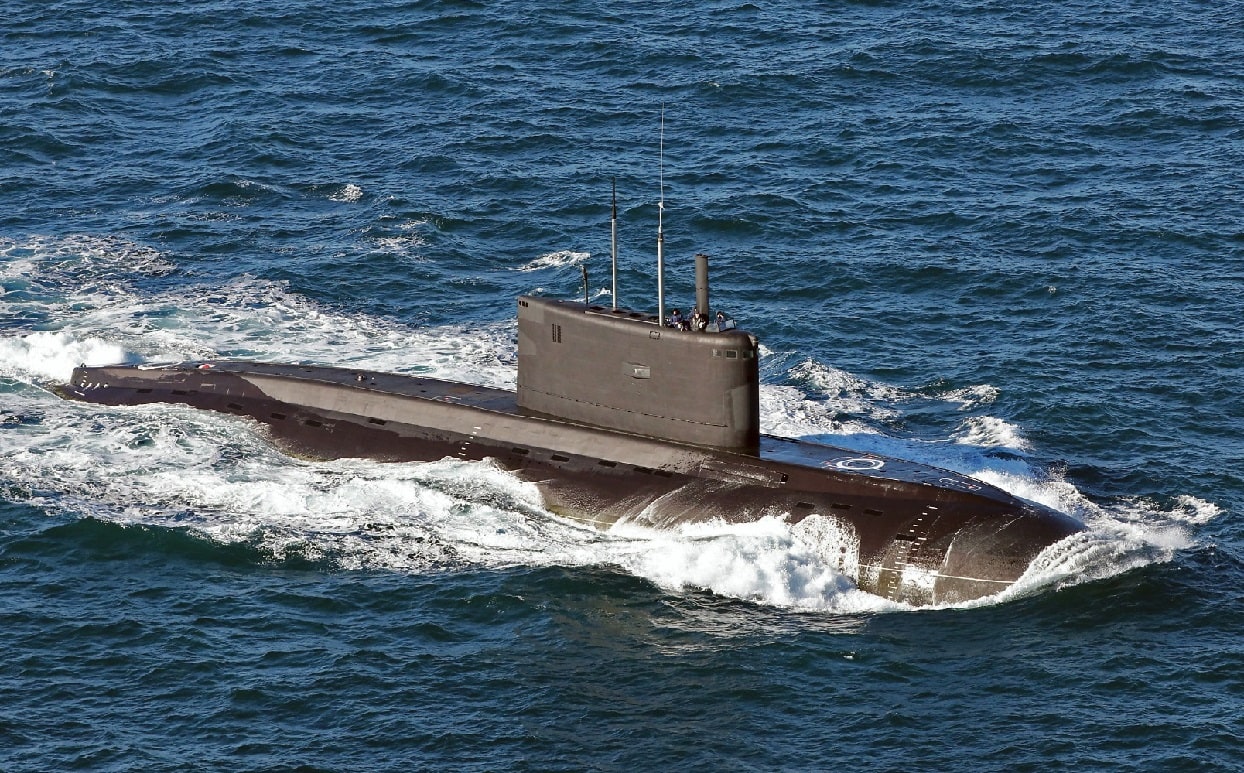
Kilo-class Submarine. Image Credit: Creative Commons.
But adaptation is not the same as escape, and the direction of travel is unmistakable. Every fix Russia has reached for — the retreat east, the hardened harbors, the helicopters, the cages on the submarines — is a concession that the cheap machine has changed the rules, forcing a great-power navy to spend its time and money defending against boats costing a fraction of its ships. That is the image worth holding onto: not Ukrainian triumph exactly, but a Russian admiral in Novorossiysk deciding which of his submarines to cage first. Every navy that still counts its strength in large, expensive hulls is now quietly running the same arithmetic and hoping the answer comes out differently for them than it has for Russia.
About the Author: Harry J. Kazianis
Harry J. Kazianis (@Grecianformula) was the former Senior Director of National Security Affairs at the Center for the National Interest (CFTNI), a foreign policy think tank founded by Richard Nixon based in Washington, DC. Harry has over a decade of experience in think tanks and national security publishing. His ideas have been published in the NY Times, The Washington Post, The Wall Street Journal, CNN, and many other outlets worldwide. He has held positions at CSIS, the Heritage Foundation, the University of Nottingham, and several other institutions related to national security research and studies. He is the former Executive Editor of the National Interest and the Diplomat. He holds a Master’s degree focusing on international affairs from Harvard University.

