The China Missile Threat to U.S. Bases in the Indo-Pacific Must Now Be Taken Seriously
To quote a RAND report on the subject: “China’s missile program is arguably the most active in the world and has provided the PLA with the ability to launch hundreds of ballistic and cruise missiles at air bases and other critical targets in Taiwan, Japan, or the Philippines. The PLA is also able to strike targets as distant as Guam with air-launched cruise missiles. In a conflict, these capabilities would challenge the U.S. ability to operate safely or efficiently from forward air bases and would have major spillover effects on other parts of the battle.
“To mitigate this threat, the United States should pursue a combination of measures to improve operational resilience, including dispersed basing, base hardening, missile defenses, and new operating techniques that limit the impact of attacks on flight operations.”
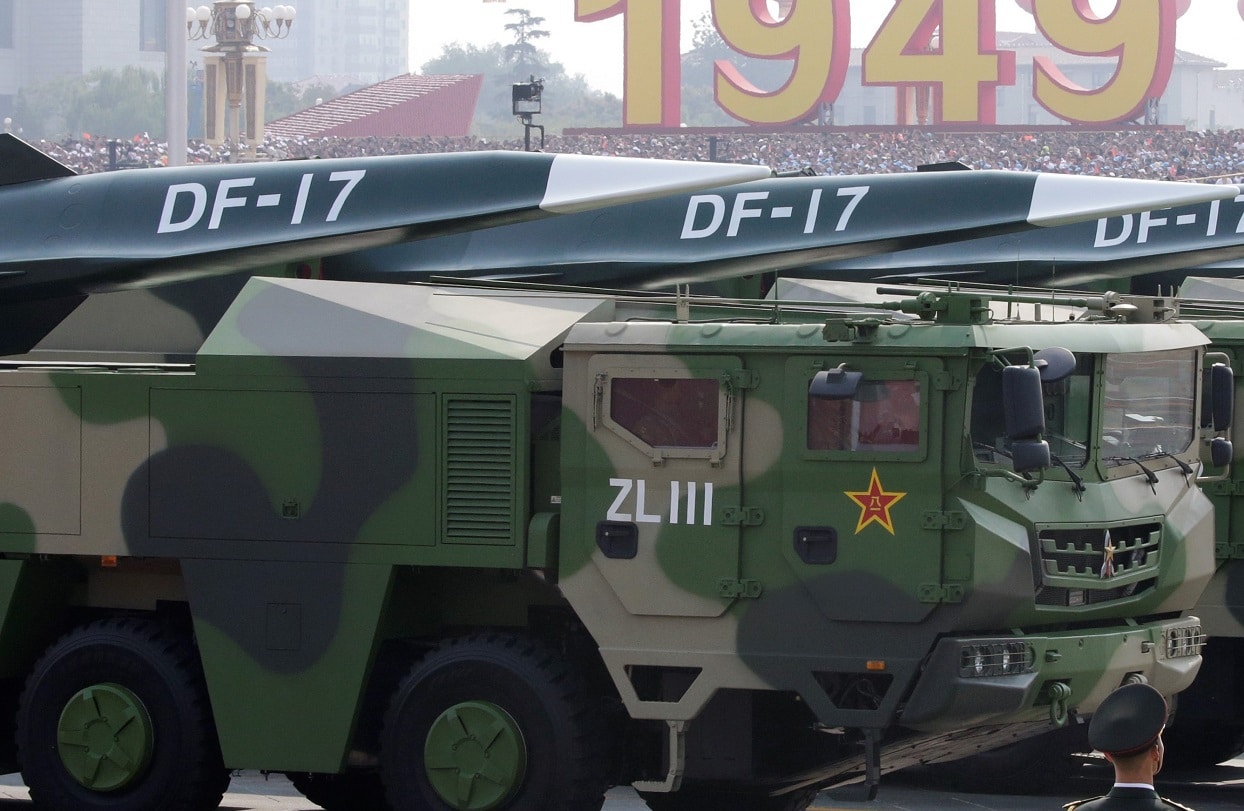
Image of DF-17 missile. Image: Creative Commons.
The quote is from a report generated by the RAND Corporation, the U.S. Air Force’s (USAF) owned-and-operated Federally Funded Research and Development Center (FFRDC). No one would argue with the report’s assertions, said more than one expert on the People’s Liberation Army (PLA) who spoke to NSJ. The only problem with these conclusions is that the report is more than 10 years old.
“You can only imagine how much greater peril our soldiers, sailors, and air crew based in the region are today,” said one long-time PLA analyst who is retired from a NATO member state’s military. “The PLA capabilities with these kinds of missile systems have grown by leaps and bounds in the intervening years and we have not kept pace in the deployment of suitable defensive countermeasures.”
China Missile Forces Today: 1,700 Missiles Ready to Strike
Given the current disposition of the People’s Republic of China’s (PRC’s) missile programs, Beijing can now target major US installations in the region.
Given that the PLA currently has over 1,300 intermediate-range ballistic missiles (IRBMs) and 400 ground-launched cruise missiles (GLCMs), it can overwhelm the U.S. missile defenses available today.
Recent analysis shows that PLA missile attacks could also overwhelm U.S. Patriot missile batteries and other anti-ballistic missile assets.
Reports from recent years on the PLA’s likely battle plan indicate that it would conduct an overwhelming series of first strikes to degrade and — if possible — make U.S. bases in the region largely unusable.
The same reports looking at the issue underline that the PLA will be aiming to hit and destroy U.S. aircraft and other assets while they are still on the ground. PLA missile strikes will also be targeted to destroy runways and wipe out fuel and ammunition depots.
In general, by the time these attacks are over, the ability of U.S. forces to maintain enough of an op-tempo to be effective.
Most worrying has been the PRC’s recent development of extremely high-speed, nearly impossible-to-intercept hypersonic missiles. These missiles threaten not only high-value targets in the Indo-Pacific but can even potentially reach installations as far off as Hawaii or even the U.S. mainland.
The PRC has become a global leader in the design of this class of weapons and is actively developing and deploying these advanced, highly maneuverable missiles. These missiles are also configured to evade existing U.S. missile defense systems.
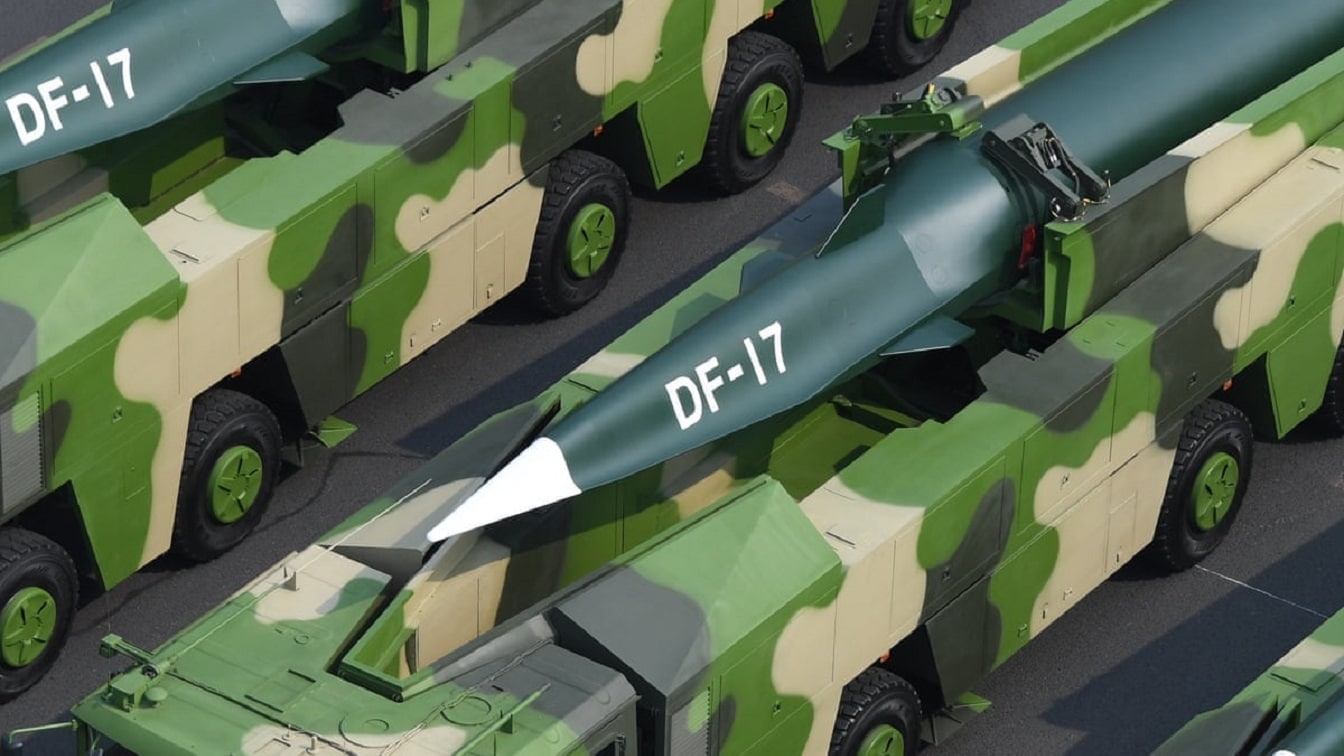
Key PLA operational systems include the DF-17 glide vehicle, DF-ZF, and YJ-21 anti-ship missiles, which travel at speeds over Mach 5 to strike regional targets. These weapons are not only operating at unheard-of speeds but are also produced at comparatively low cost in some models.
Are We Paying Enough Attention to the Missile Threat?
Should a shooting war with the Chinese break out tomorrow, their missile attacks would likely close down the runways and taxiways at U.S. forward air bases in Japan, Guam, and other Pacific locations.

DF-17. Image Credit: Creative Commons.
Air operations would be shut down in the first critical days — and even weeks — of a war between the United States and the PRC.
At present, there is no combination of U.S. countermeasures, including the greater dispersal of aircraft to secondary airstrips, improved techniques, and more assets for runway repair, and more missile defenses, that would be sufficient preparations to solve the problem.
There is a growing danger that Beijing could keep American airpower so tangled up that a series of quick attacks could accomplish a quick victory before the U.S. has time to re-group and recover from these initial attacks.
The Experts Are Worried
One of the longest and most experienced observers of the PLA’s operations in the region is retired U.S. Navy Captain James Fanell, who was formerly the head of intelligence for the Indo-Pacific Command in Hawaii and is now a fellow at the Geneva Centre for Security Policy.
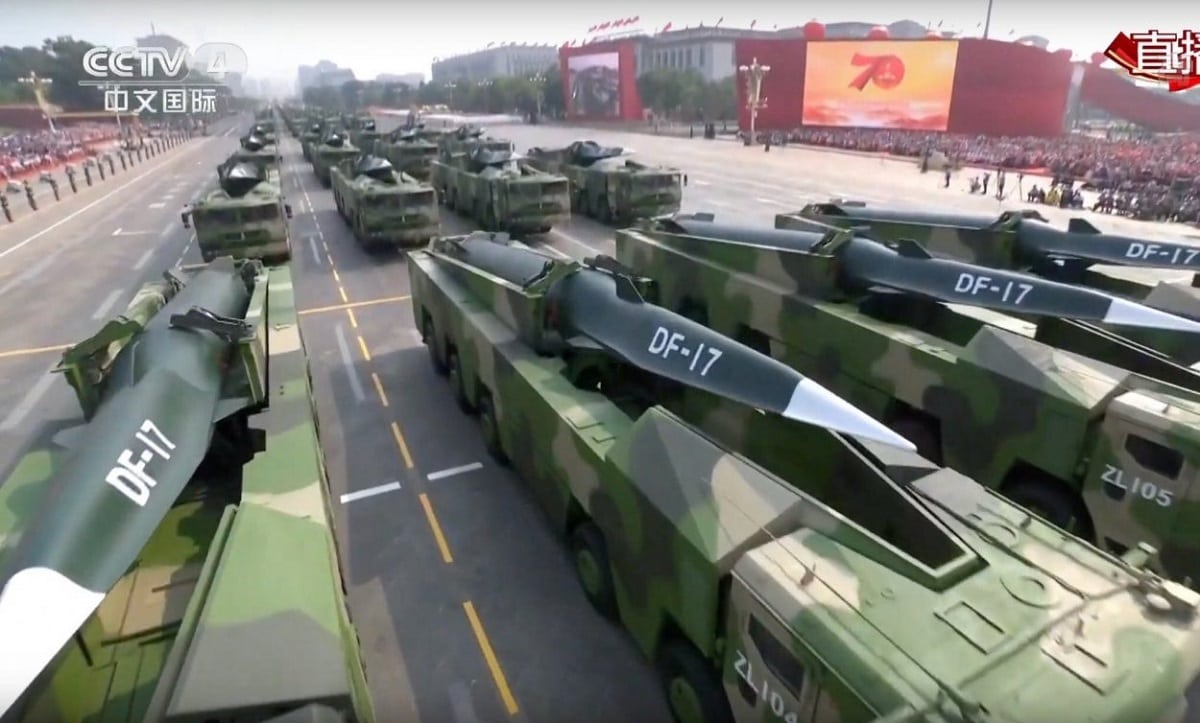
DF-17 Missiles
“What we are seeing with these attacks by Iran on our bases in the Gulf – and with far less capable missiles than what the Chinese have in hand today — ought to be a wake-up call,” he said, speaking to 19FortyFive. “If our planners in the Indo-Pacific do not realize what has happened to some of our aircraft parked on the ground in Saudi Arabia and other neighboring states and do not understand the implications for the Pacific theater, then they have not been paying enough attention.”
About the Author: Reuben F. Johnson
Reuben F. Johnson has thirty-six years of experience analyzing and reporting on foreign weapons systems, defense technologies, and international arms export policy. Johnson is the Director of Research at the Casimir Pulaski Foundation. He is also a survivor of the Russian invasion of Ukraine in February 2022. He worked for years in the American defense industry as a foreign technology analyst and later as a consultant for the U.S. Department of Defense, the Departments of the Navy and Air Force, and the governments of the United Kingdom and Australia. In 2022-2023, he won two awards in a row for his defense reporting. He holds a bachelor’s degree from DePauw University and a master’s degree from Miami University in Ohio, specializing in Soviet and Russian studies. He lives in Warsaw.