
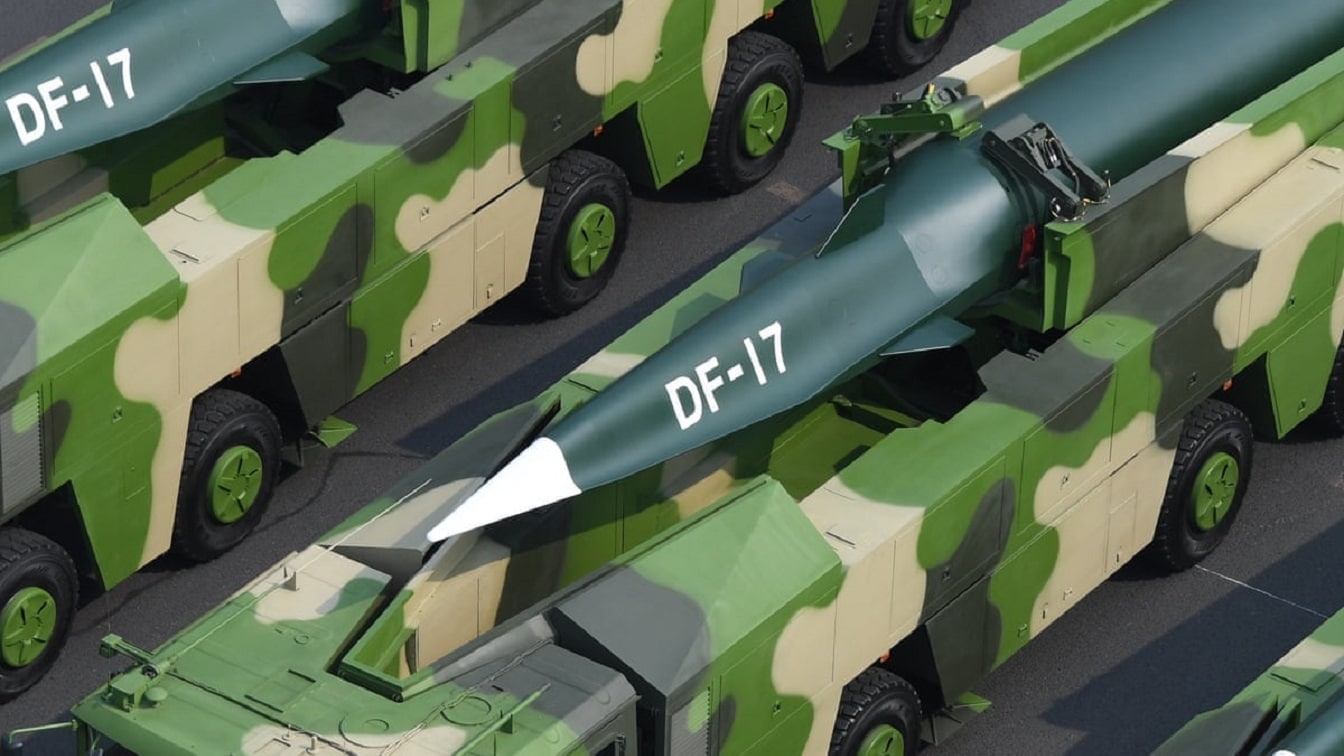
Key Points and Summary – China’s DF-17 hypersonic missile sits at the heart of Beijing’s “Assassin’s Mace” strategy to keep U.S. carrier strike groups at bay in the Indo-Pacific.
-Mated to the DF-ZF hypersonic glide vehicle, the solid-fueled DF-17 can maneuver at Mach 5–10, skim the atmosphere, and threaten ships or land targets out past 1,000 miles, potentially with either conventional or nuclear warheads.
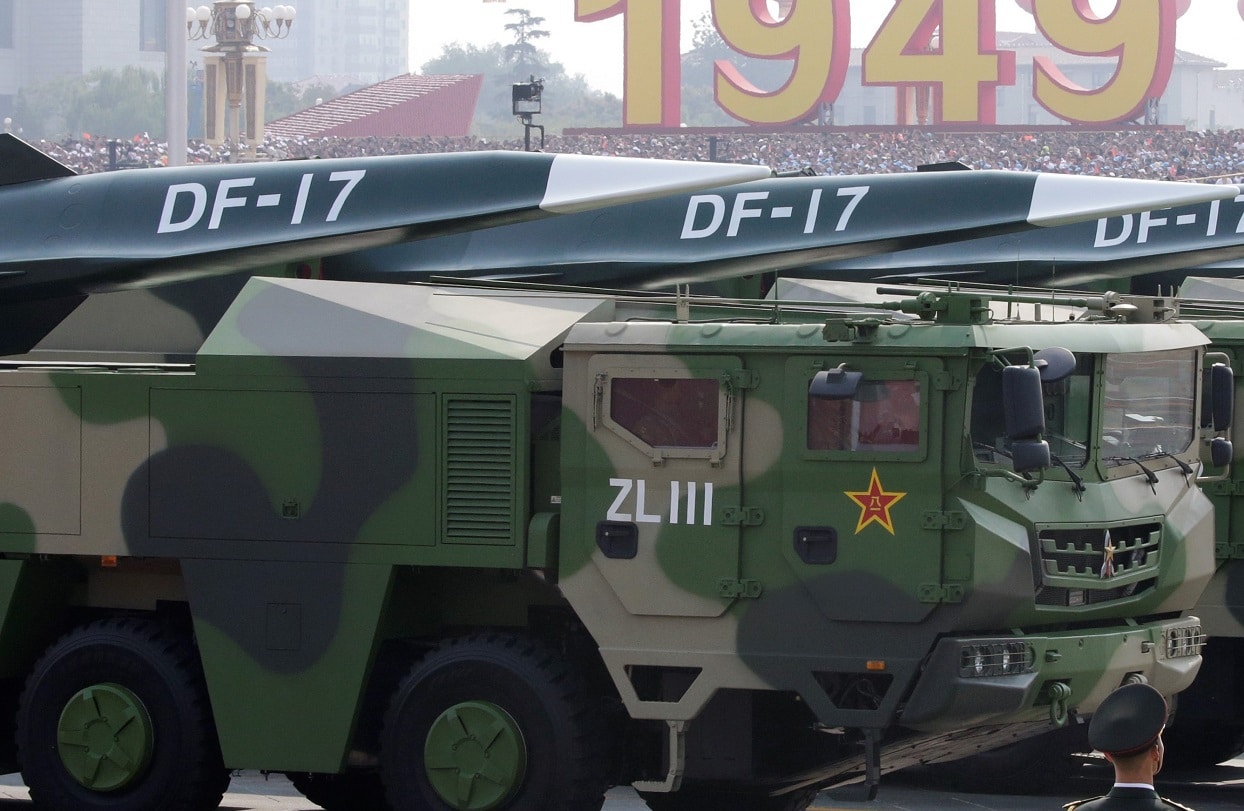
Image of DF-17 missile. Image: Creative Commons.
-Designed to underpin China’s broader A2/AD posture, the system forces the U.S. Navy to rethink carrier operations, invest in extended-range airpower like the MQ-25 Stingray, and fast-track new defenses—including directed-energy systems—for a coming “kinetic missile fight.”
DF-17: Chinese Use Hypersonic Missiles as an ‘Assassin’s Mace’
What is the best way that China can stymie the U.S. Navy in the Indo-Pacific? How about using a carrier-killing hypersonic missile?
The Chinese have leapt ahead of the Americans in hypersonic weapons development.
Their Dongfeng DF-17 missile can reach speeds above MACH 5 and be maneuverable in flight with a hypersonic glide vehicle. This has U.S. Navy admirals standing up and taking notice and wondering how a carrier strike group would respond to a DF-17 launch.
The Chinese want to make sure the Navy has no time to react to a DF-17 speeding toward enemy ships.
Hypersonic glide vehicles can be controlled in flight and cruise at ultra-high speeds to skim the waves at low altitude before hitting paydirt. The flight path is unpredictable.
Quick History of the DF-17
The DF-17 was developed by the Near Space Flight Vehicle Research Institute, according to CSIS.
The first test launch was in 2014, which shows just how much of a head start China has enjoyed over the last 11 years.
State-run media in the early days identified the hypersonic glide vehicle as the DF-ZF. By 2017, the engineers from the research institute had tested what would become the DF-17 nine times, CSIS wrote in a profile.
The DF-17 is solid-fueled, making it faster and easier to launch from a mobile launcher than a liquid-fueled missile, which requires more specialized storage.
The missile is about 36 feet long and 33,000 pounds.
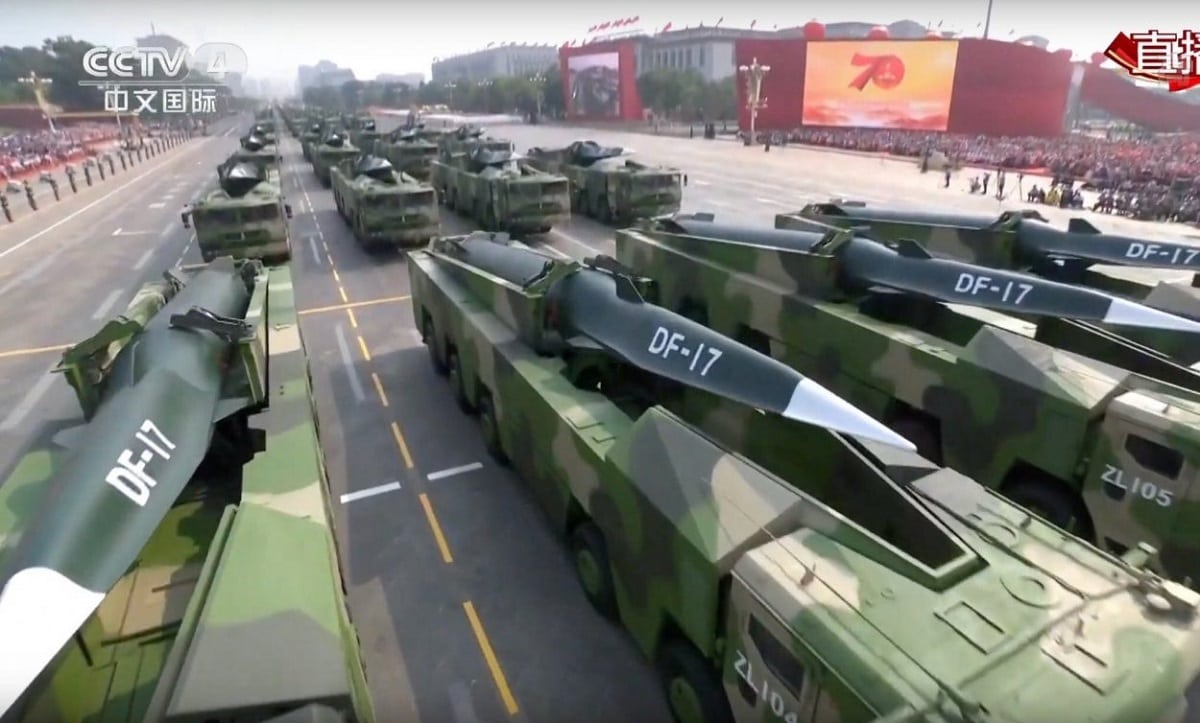
DF-17 Missiles
It has been tested successfully over the years at Taiyuan Satellite Launch Centre in Shanxi Province.
The Chinese people first glimpsed the DF-17 and its mobile launcher at a military parade in 2019. At the time, it was the world’s first road-mobile hypersonic missile system.
Can This Missile Strike Accurately?
The hypersonic glide vehicle is highly accurate and can come “within meters” of its intended target, according to the Diplomat.
The vehicle can reach from MACH 5 to MACH 10 in its glide phase.
The range exceeds 1,118 miles. In 2019, the Chinese began work on the DF-17 anti-ship variant.
The DF-17 with the DF-ZF glide vehicle is concerning because it can launch a nuclear warhead. This is one of the deadliest aspects of the system.
The dual-use capability is noteworthy since the Chinese have around 600 nuclear warheads with many able to mate to conventional mobile launch systems like the DF-17.

DF-17. Image Credit: Creative Commons.
How Does the Hypersonic Work?
The launch sequence works as follows. “The hypersonic glide vehicle [HGV] is mounted on top of the launch vehicle, which is used to boost the HGV along the initial part of its trajectory, before performing a maneuver that will then enable the HGV to begin the glide phase of its trajectory, occurring in the upper atmosphere,” according to ArmyRecognition.com.
The DF-17 missile is deployed on a 10×10 military truck chassis.
This vehicle can travel at 43 miles per hour and has a range of 403 miles. The truck features a Transporter Erector Launcher that sends the missiles into the air.
The DF-17 unit needs little assistance from other missile-launch infrastructure. All launch activities can be executed by the truck.
Two Chinese figures closely related to the DF-17 are Major General Zhang Jianqiang and Major General Wang Xinguo.
These individuals were present at the 2019 military parade and oversaw the unveiling of the system in front of Tiananmen Square. Currently, the DF-17 is deployed by two rocket brigades.
What Is the Strategy Behind the DF-17?
China has a doctrine called “Assassin’s Mace.” This strategic gambit is focused on asymmetric weapons that can keep the Americans from accessing certain geographical areas that lead to anti-access/ area denial (A2/AD) operations and tactics.
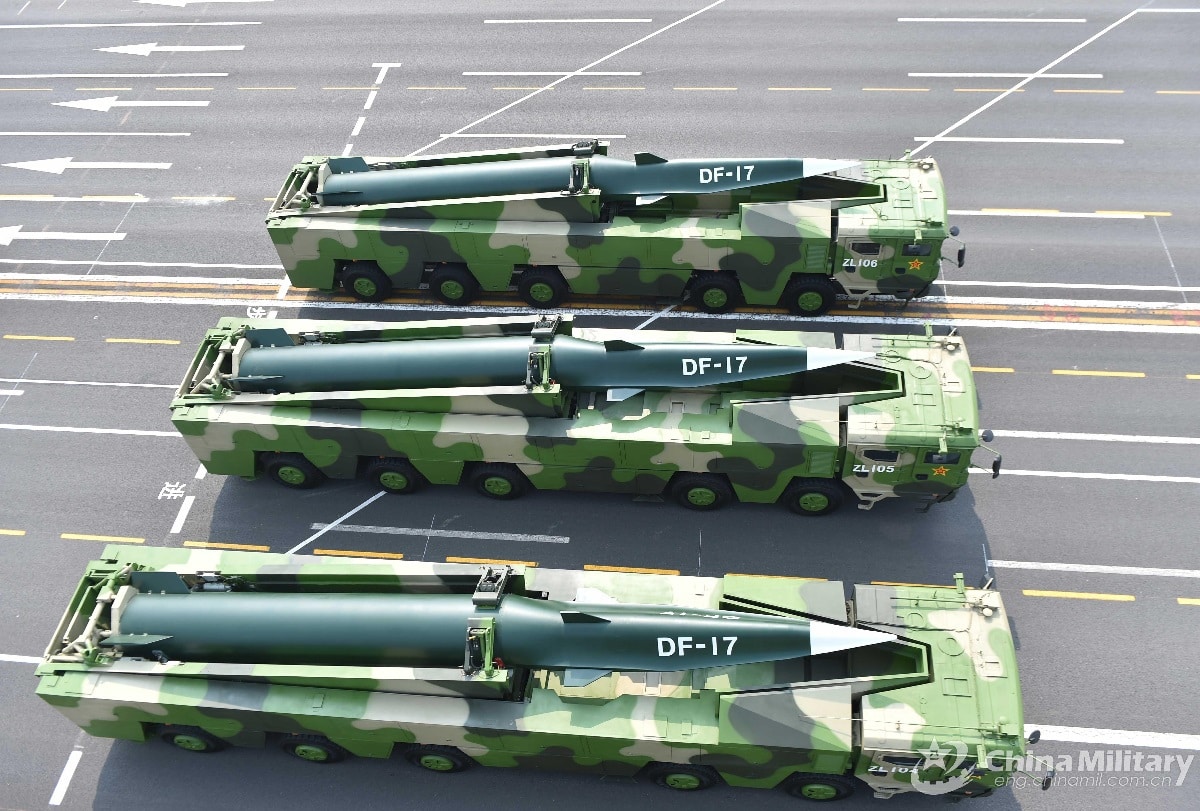
Chinese DF-17 missiles. Image: Chinese internet.
The Chinese believe they have a superior strategy with Assassin’s Mace weapons and A2/AD. Admirals and generals are certain that at least one carrier could be eliminated with the DF-17.
Future combat (if the Americans and Chinese clash militarily) would be focused on what I call the “Kinetic Missile Fight.” The combat radius of the various missiles used will be a significant factor in war planning.
The U.S. Navy Has an Answer
The Americans are aware that their aircraft carriers could be in danger. One way the U.S. Navy can stay out of range of the DF-17 and other missile systems is to use its new MQ-25 Stingray aerial refueler.
The Stingray is a drone tanker that can extend the range of Navy fighters such as the F-35C Lightning II and the F/A-18E/F Super Hornet by 500 nautical miles. This is an important feature of carrier warfare. The Stingray will begin flying regularly in 2026.
Assassin’s Mace and the Chinese ability to wage the Kinetic Missile Fight style of combat is still extremely dangerous. However, it would take numerous hits from a DF-17 hypersonic glide vehicle to sink an aircraft carrier. Escort ships in a carrier strike group will also someday be equipped with lasers that can quickly send directed energy to “fry” a hypersonic glide vehicle as it flies toward the strike group.
However, the Chinese are building more hypersonic weapons like the DF-17 that they believe are carrier killers. Assassin’s Mace is an asymmetric strategy that will allow the Chinese to execute A2/AD.
Fortunately, the U.S. Navy is ready for these threats, and individual American sailors must take their jobs seriously and train realistically for these Chinese assets. The United States must realize that it could lose a carrier to missiles and should prepare accordingly.
About the Author: Brent M. Eastwood
Author of now over 3,000 articles on defense issues, Brent M. Eastwood, PhD is the author of Don’t Turn Your Back On the World: a Conservative Foreign Policy and Humans, Machines, and Data: Future Trends in Warfare plus two other books. Brent was the founder and CEO of a tech firm that predicted world events using artificial intelligence. He served as a legislative fellow for US Senator Tim Scott and advised the senator on defense and foreign policy issues. He has taught at American University, George Washington University, and George Mason University. Brent is a former US Army Infantry officer. He can be followed on X @BMEastwood.