
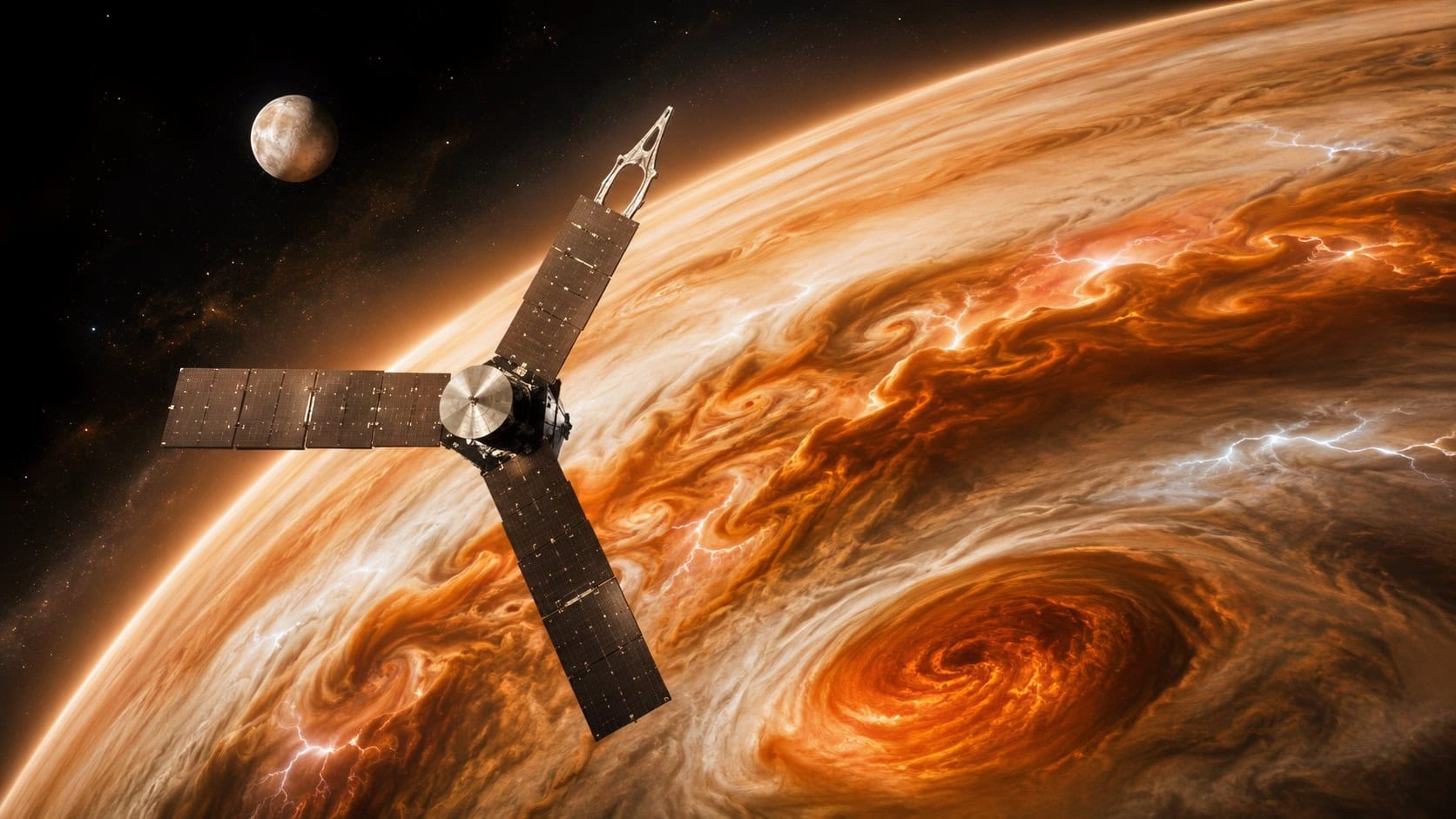
When NASA sent Juno to Jupiter, it wrote into the plan the same ending it had given Galileo and would give Cassini. Once the mission was finished, the spacecraft would be deliberately flown into the planet and destroyed. The reason those two probes were doomed was planetary protection. Galileo had found that Jupiter’s moon Europa likely hides an ocean beneath its ice, one of the best candidates for life in the solar system, and a dead, uncontrolled spacecraft carrying Earth microbes could one day crash into that ocean and contaminate it. The only safe ending was a commanded plunge into Jupiter, where the planet would incinerate the machine and anything living on it. Juno was marked for that same death. Then it escaped. Over years of looping through the Jovian system, the gravity of Jupiter’s moons bent Juno’s orbit again and again until the spacecraft no longer passed anywhere near Europa, and the contamination risk that required the plunge fell away. So NASA canceled the deliberate destruction. The probe built to die a clean, scripted death now faces two messier ones instead. Jupiter’s radiation is slowly killing it from the outside, and a budget decision in Washington may kill it first.
The Goddess Who Saw Through The Clouds
NASA Space Shuttle onboard USS Intrepid. Image Credit 19FortyFive Original Image.
Juno launched from Cape Canaveral on August 5, 2011, aboard an Atlas V rocket, and entered a polar orbit of Jupiter on July 4-5, 2016, becoming only the second spacecraft to orbit the planet after Galileo. It was built by Lockheed Martin and is operated by NASA’s Jet Propulsion Laboratory, with Scott Bolton of the Southwest Research Institute as principal investigator, the same institution whose instrument work appeared on Cassini. The mission has cost over a billion dollars, with later extensions pushing the lifetime total higher. The name fits the job. In Roman mythology, the god Jupiter wrapped a veil of clouds around himself to hide his mischief, and his wife, the goddess Juno, could see through the clouds to his true nature, an apt name for a probe built to pierce the thick clouds of the planet Jupiter and read what lies beneath.
A Solar-Powered Tank For The Worst Place In The Solar System
Every earlier spacecraft sent to the outer solar system ran on nuclear power because sunlight is so weak that far out. Juno is different. It is the first solar-powered spacecraft to operate at Jupiter, which required the three largest solar wings ever fitted to a planetary probe, each panel spanning roughly 30 feet, to gather enough of the faint sunlight to run. The bigger problem was radiation.
Jupiter has the most intense radiation environment of any planet, a field so powerful that, outside the Sun itself, nothing in the solar system is a more punishing place for electronics. Juno was built like a tank, its most delicate instruments riding inside a vault of titanium walls, and its orbit was deliberately threaded through a relatively narrow gap to avoid the worst of the radiation belts, absorbing most of its dose during each brief, close pass over the cloud tops.
The Spacecraft That Rewrote The Textbooks
Juno overturned much of what scientists thought they knew about Jupiter. Flying over the poles, which no spacecraft had done before, it found enormous clusters of cyclones arranged in geometric patterns, including eight surrounding cyclones circling a single central storm at the north pole, each nearly as wide as the distance from Naples to New York, an arrangement no one had predicted.
It was discovered that Jupiter’s weather runs astonishingly deep. The east-west jet streams that create the planet’s banded appearance reach deep into the interior, extending roughly 3,200 kilometers down, and the storms are far taller than expected, with the Great Red Spot’s roots reaching some 300 kilometers deep below the cloud tops.
The biggest surprise was the planet’s core. Juno’s measurements of Jupiter’s gravity and magnetic field indicated the core is not the neat, solid ball that planet-formation theory assumed, but is much larger than expected and partially dissolved, with no clear boundary between it and the hydrogen around it, a structure scientists now call dilute, or “fuzzy,” possibly the result of a giant collision early in the planet’s history.
The findings forced a rethink of how giant planets form. Juno also turned its instruments on the moons, capturing fresh lava fields on the volcanic moon Io during close passes in late 2023 and early 2024, and it even measured a severe solar flare in October 2024, compressing Jupiter’s vast magnetic bubble more sharply than ever recorded.
Space Shuttle. Smithsonian Exhibit back in 2025. 19FortyFive.com Image
The Death That Was Planned
From the beginning, the mission had a scripted ending. The original plan called for Juno to make roughly 33 to 37 orbits, complete its mapping of the planet, and then enter its planned final phase, the deorbit, a commanded plunge into Jupiter’s atmosphere to burn up.
The reasoning was identical to what had governed Galileo and would govern Cassini. Despite every precaution taken while building and launching the spacecraft, Earth microbes could have hitched a ride and lain dormant, and a dead, uncontrolled Juno drifting through the Jovian system could not be allowed to eventually crash into one of Jupiter’s ocean-bearing moons, Europa above all. Destroying the spacecraft in Jupiter, where nothing could survive, was the clean solution that met planetary protection requirements. Juno was built to join Galileo and Cassini in a deliberate, fiery death.
The Escape
Two things changed that. The mission kept getting extended, first toward 2025 and then through September 2028, and over those years Juno’s orbit evolved on its own. As the extended mission brought the spacecraft into range of Jupiter’s largest moons, their gravity reshaped its path. A close flyby of Ganymede in June 2021 cut Juno’s orbital period from 53 days to 43, a Europa flyby in September 2022 shortened it further to 38 days, and encounters with Io in December 2023 and February 2024 brought it down to a 33-day orbit, each pass migrating the trajectory.
The result was that Juno’s evolved orbit no longer posed a risk of contaminating Europa or the other ocean-candidate moons, which were now beyond its reach. With the planetary-protection rationale gone, NASA canceled the deliberate plunge. Juno is now approved to keep orbiting until contact is lost, after which Jupiter’s gravity will eventually pull it in on its own, an uncommanded fall whenever it comes. It dodged the scripted ending its two predecessors received.
Jupiter Killing It Slowly
What Juno cannot dodge is the radiation, and the toll is finally showing. The clearest sign came from JunoCam, the spacecraft’s visible-light camera, which was a late addition intended largely for public engagement and which, unlike the core science instruments, sits outside the protective titanium vault because there was no room in the vault for it. Engineers expected it to survive perhaps eight orbits.
It worked normally through the entire 34-orbit prime mission, but during the 47th orbit, it began showing radiation damage, and by its 55th orbit in late 2023, nearly all its images were corrupted with streaks and noise.
The team traced the trouble to a damaged voltage regulator in the camera’s power supply, and with no way to physically repair a spacecraft hundreds of millions of miles away, they tried heating the camera with its own internal heater, a process called annealing, to mend the silicon at a microscopic level. The first attempt helped briefly, then the damage returned. With a close flyby of Io approaching that nobody wanted to miss, the team cranked the heater to its maximum and waited. It worked.
By December 30, 2023 Io pass, the images came back crisp and detailed. The fix has since been applied to other instruments, and Bolton has said the effort is teaching NASA how to build spacecraft that can withstand radiation. But the reprieve is temporary. The image noise returned again around Juno’s 74th orbit, and the mission’s life is ultimately limited by a radiation dose that will eventually claim something it cannot heal.
Washington Killing It First
The more immediate threat is on Earth. The administration’s fiscal year 2026 budget request proposed zeroing out Juno’s funding entirely, naming it among the missions to be canceled as part of a proposed cut of roughly 47 percent to NASA’s science budget that would end around 19 active missions.
A budget request is a proposal, not a law, and Congress controls the final appropriations, but the threat is real, and the mission’s future is now a political question rather than a technical one. Juno survived a 2025 government shutdown, and the end of its latest extension that September, and it remained operational and in contact through the Deep Space Network into 2026, still returning data this spring, including a close pass of Thebe, one of Jupiter’s small inner moons, on May 1, 2026, imaged with the spacecraft’s star-tracker camera.
As of now, its long-term fate is unresolved, tied to a funding decision still being debated. Critics, among them the astrophysicist Ethan Siegel, have argued it makes little sense to switch off a healthy, irreplaceable orbiter that is still producing first-rate science, especially when scientists are seeking a further extension, and ending Juno before the Europa Clipper spacecraft arrives in 2030 would leave a years-long stretch with no working probe at Jupiter at all.
The Trilogy Inversion
Juno completes a trilogy with Galileo and Cassini, but as their opposite. Galileo was deliberately crashed into Jupiter in 2003, and Cassini into Saturn in 2017, both destroyed at the height of their success to protect the ocean worlds they had discovered. Juno was built to join them, to end with the same noble, scientist-scripted plunge broadcast as a grand finale, and its own wandering orbit took that ending away.
So it stands to die one of the unheroic deaths that claim most spacecraft, a slow fade as radiation wears it down, or an abrupt cancellation due to budget, rather than a triumphant dive watched live from Earth.
There is a final irony in the timing. NASA spent billions on Europa Clipper and Europe on its JUICE spacecraft, both now en route to study the very ocean moons whose protection once dictated Juno’s death sentence, even as the healthy probe already orbiting Jupiter may be switched off to save money.
The tank built to outlast the most hostile radiation in the solar system may, in the end, be undone not by Jupiter but by budget politics.
About the Author: Harry J. Kazianis
Harry J. Kazianis (@Grecianformula) was the former Senior Director of National Security Affairs at the Center for the National Interest (CFTNI), a foreign policy think tank founded by Richard Nixon based in Washington, DC. Harry has over a decade of experience in think tanks and national security publishing. His ideas have been published in the NY Times, The Washington Post, The Wall Street Journal, CNN, and many other outlets worldwide. He has held positions at CSIS, the Heritage Foundation, the University of Nottingham, and several other institutions related to national security research and studies. He is the former Executive Editor of the National Interest and the Diplomat. He holds a Master’s degree focusing on international affairs from Harvard University.

