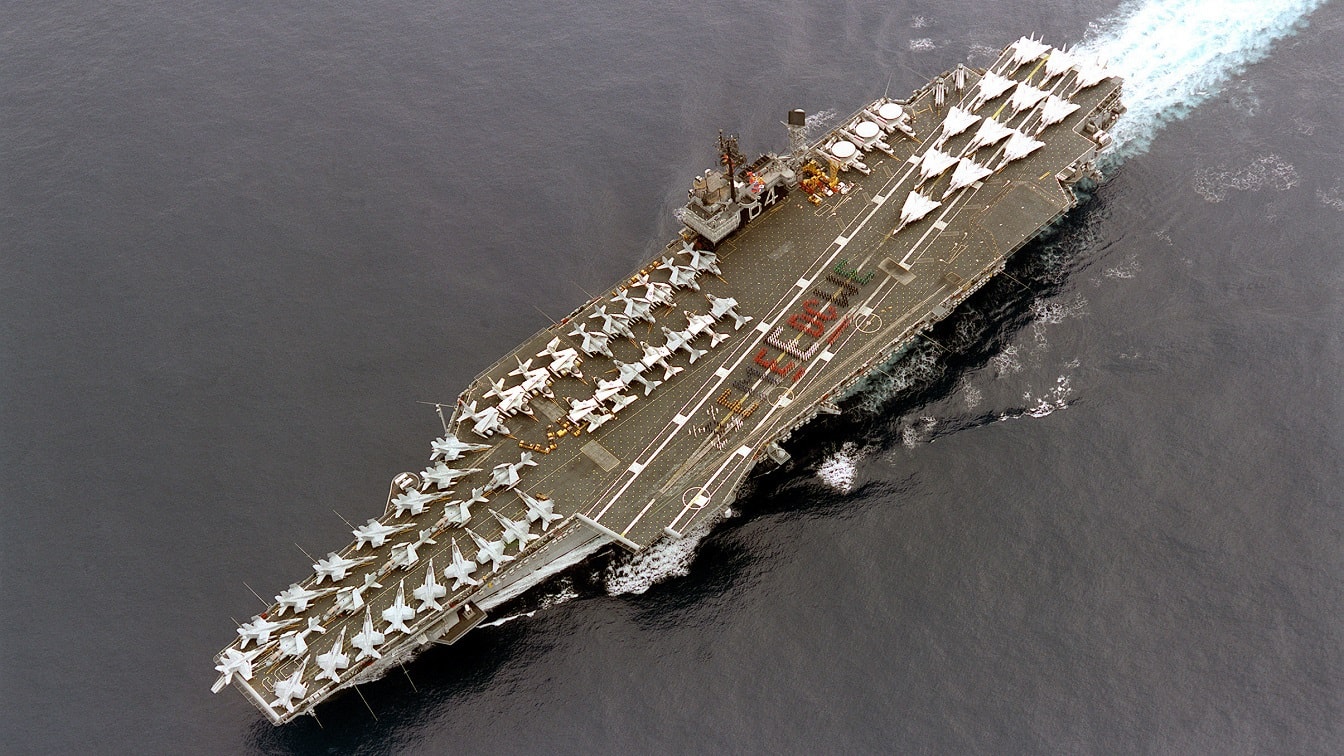
Nicknamed “Connie,” then later “America’s Flagship,” the USS Constellation (CVA-64/CV-64) was one of the United States Navy’s most accomplished conventionally powered supercarriers.
She served more than 40 years through the Cold War, the Vietnam War, the Persian Gulf, and the opening phases of the Global War on Terror (GWoT).
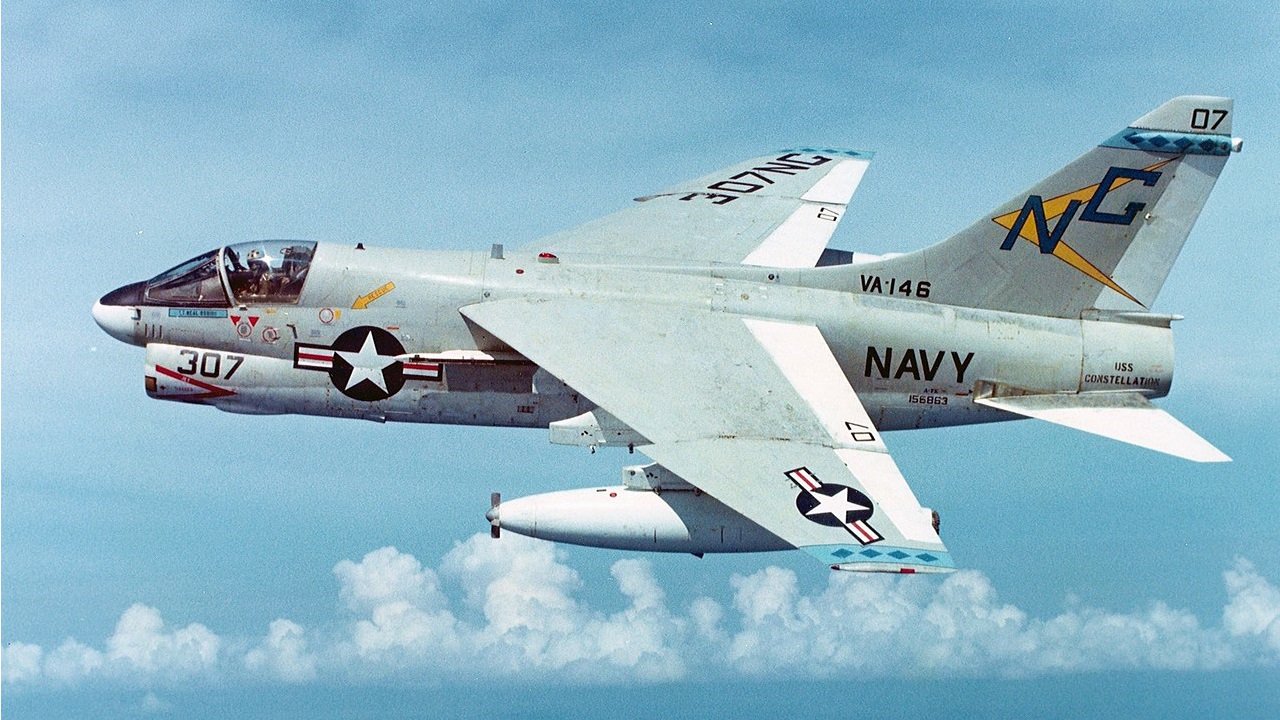
A U.S. Navy Ling-Temco-Vought A-7E-5-CV Corsair II (BuNo 156863) of Attack Squadron 146 (VA-146) “Blue Diamonds” in flight on 16 November 1974. VA-146 assigned to Attack Carrier Air Wing 9 (CVW-9) aboard the aircraft carrier USS Constellation (CVA-64) for a deployment to the Western Pacific and the Indian Ocean from 21 June to 23 December 1974.
She’s considered one of the finest ships of the iconic Kitty Hawk aircraft carrier class.
The Constellation
The “Connie” was built by the New York Naval Shipyard in Brooklyn, New York. The contract was awarded on July 1, 1956.
The ship was launched on October 8, 1960, and was commissioned on October 1, 1961.
Despite the incredible ship she became, the Constellation initially had a run of bad luck. A catastrophic fire erupted on the unfinished ship on December 19, 1960.
That fire killed 50 workers and caused $75 million in damage, making it one of the deadliest industrial accidents in US shipbuilding history.
“America’s Flagship” displaced around 60,100 tons (standard) and 82,500 tons at full load. Measuring more than 1,040 feet long, she could steam at speeds exceeding 33 knots, powered by four steam turbines fed by eight boilers.
Connie carried an air wing comprising 85 aircraft. Over time, she operated successive generations of fighters, attack aircraft, reconnaissance birds, helcopters, and other dynamic craft.
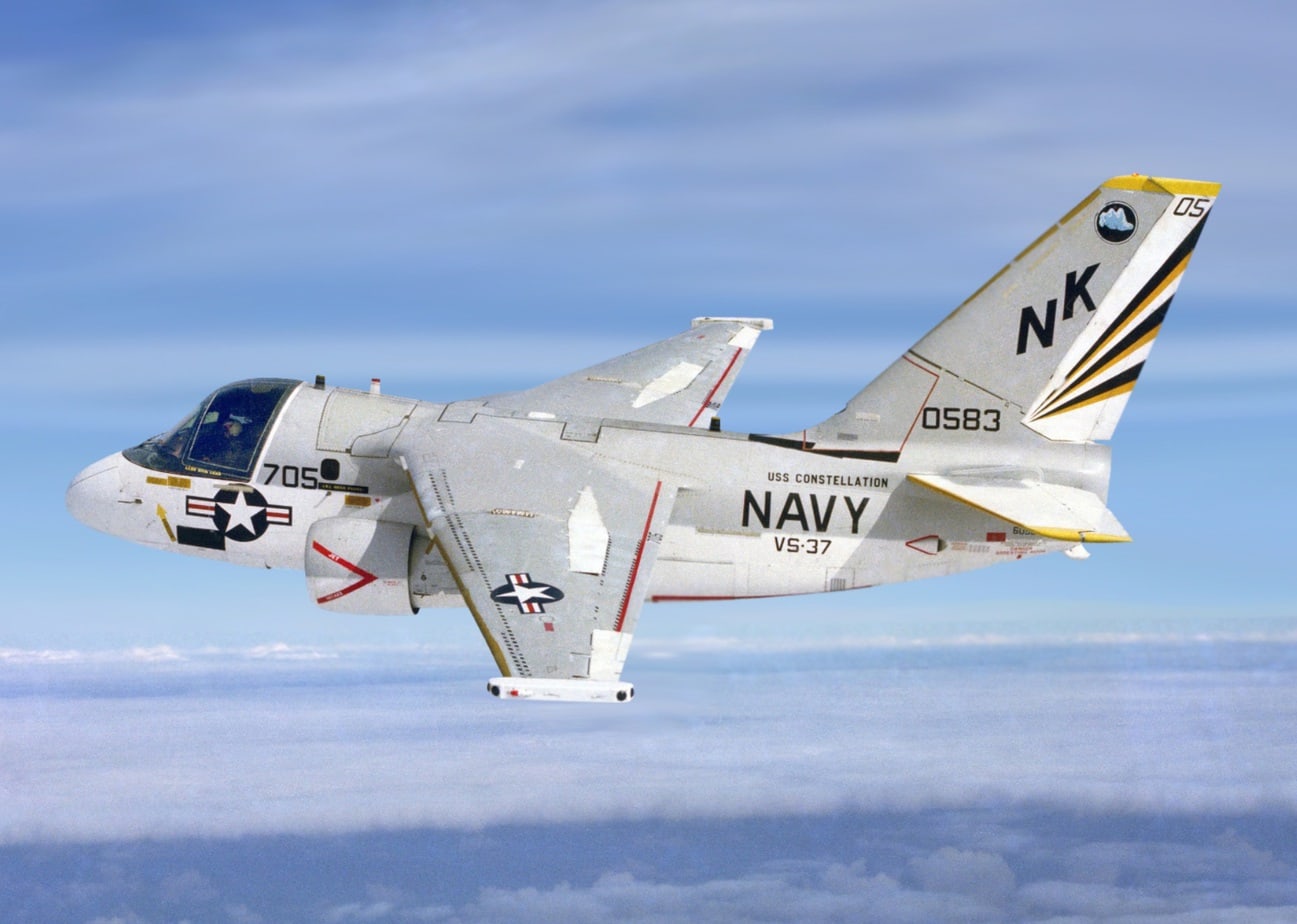
A Lockheed S-3A Viking aircraft from the anti-submarine squadron VS-37 Sawbucks on 11 Dec 1986, assigned to Carrier Air Wing Fourteen (CVW-14) aboard the aircraft carrier USS Constellation (CV-64).
The Constellation was also among the last conventionally powered aircraft carriers built outside Newport News Shipbuilding.
In early 1963, after her initial shakedown cruise, the Connie was deployed to the Western Pacific, as part of the US Navy’s Seventh Fleet.
Her combat career began the following year during the Gulf of Tonkin Incident.
While operating off Vietnam in August 1964, the USS Constellation launched strikes against North Vietnamese naval facilities following the alleged attacks on American destroyers.
Those operations helped mark the start of sustained US naval aviation involvement in the Vietnam War (and earned the Connie and her embarked air wing a Navy Unit Commendation).
Vietnam: The Defining Moment for The Connie
The Vietnam War defined the first part of the Constellation’s service.
Between 1964 and 1973, the carrier completed multiple combat deployments to Yankee Station in the Gulf of Tonkin.
Aircraft launched from her decks flew thousands of strike and reconnaissance missions as well as close air support (CAS) missions against North Vietnamese targets. Connie’s most intense deployment in the Vietnam War came in 1966.
During that year, her air wing spent 111 days on the combat line, while later cruises supported Operation Rolling Thunder, Operation Linebacker, and Linebacker II.
In May 1972, Navy aviators flying from Constellation achieved several MiG victories.
In fact, Navy Lieutenants Randy Cunningham and Willie Driscoll of the Connie became the first US aces of the Vietnam War after downing multiple MiG-17 fighters in combat.
When the Vietnam War ended, the Navy prioritized power projection in the Cold War. Thus, the Constellation became the first US carrier to enter the Arabian Gulf since 1949.
A major overhaul of the Connie eventually took place at Puget Sound Naval Shipyard.
During that overhaul, the Constellation was modernized for broader air support functions and given the ability to conduct more effective surface and antisubmarine warfare missions.
Because of the redesign, the Navy redesignated Connie from CVA-64 to just CV-64 in 1975.
Fighting America’s Middle East Wars
Indeed, throughout America’s various Middle Eastern crises, the Constellation seemed always to be present. She responded to regional instability during the Iran-Iraq War and later supported Operation Desert Shield (after Iraq invaded Kuwait in 1990).
Throughout the 1990s, the carrier conducted repeated deployments enforcing the southern Iraqi No-Fly Zone under Operation Southern Watch. During that time, planes from the Connie launched patrols and strike missions designed to contain and constrain Saddam Hussein’s military following the Gulf War.
Because of that mission against Iraq in the 1990s, the Constellation was continuously deployed long after the Cold War ended.
The final deployment of “America’s Flagship” began in November 2002, not long after the horrific September 11 attacks had transformed US military priorities.
Constellation supported Operation Enduring Freedom over Afghanistan before moving into the Persian Gulf for Operation Iraqi Freedom in March 2003.
Aircraft launched from her flight deck conducted combat missions during the opening phase of the invasion of Iraq, making the aging carrier an active participant in America’s newest wars before her retirement later that year.
Her commissioning pennant was lowered in August 2003, ending more than four decades of continuous naval service.
The Greatest Conventionally Powered Carrier Ever?
Over 42 years, USS Constellation served through the Vietnam War, Cold War, and multiple Persian Gulf operations. Her longevity and extensive combat record demonstrate the Constellation’s adaptability.
That’s why naval historians look so fondly upon the Connie’s service and legacy.
It’s why so many consider the Constellation to be the finest conventionally powered supercarrier ever operated by the United States Navy.
About the Author: Brandon J. Weichert
Brandon J. Weichert is the Senior National Security Editor at 19FortyFive.com. He also manages The Weichert Brief on Substack. Weichert also hosts “National Security Talk” on Rumble. He is the author of four bestselling national security books, the most recent of which is A Disaster of Our Own Making: How the West Lost Ukraine (Encounter Books). Follow him via Twitter/X @WeTheBrandon.