
Space Shuttle Retired in 2011: Why NASA Walked Away After 135 Missions
The Space Shuttle program began in 1981. The Space Shuttle Columbia blasted off on April 12, 1981, from historic Launch Pad 39A at the Kennedy Space Center. More than 30 years later, when Space Shuttle Atlantis landed on July 21, 2011, the program officially came to a close. It had flown 135 missions, making it the core of U.S. crewed spaceflight efforts for nearly four decades.
The Space Shuttle program was a revolutionary, yet flawed, endeavor. It made possible the construction of the International Space Station, the Hubble telescope repairs, and unmatched heavy-payload capacity. However, its legacy is also defined by high operational costs, complex maintenance, and tragic safety failures.
Whether the U.S. retired the Space Shuttle program too soon in 2011 is debated, with arguments highlighting both the loss of capabilities and the urgent need to move past an expensive, aging system.
While it created a multi-year gap in U.S. crewed spaceflight, the shuttles were immensely costly at $450 million per launch, and technically unviable to fly much longer.
Was it too soon to retire the shuttle?
Pros And Cons Of The Space Shuttle Program:
The shuttle had unique capabilities. It was the only vehicle capable of bringing large satellites back from orbit and repairing them—as it did for the Hubble Space Telescope.
The vehicle was crucial for assembling the International Space Station, acting as a heavy-lift vehicle for modules and interplanetary probes Magellan, Ulysses, and Galileo. It also served as a flying laboratory for scientific research in microgravity.
The winged orbiter and its main engines were reused, which was a major advancement in reusability. It could carry up to seven crew members, allowing for specialized teams.
But the program was extremely expensive. Its cost per launch far exceeded initial projections, making it less economical than expendable rockets.

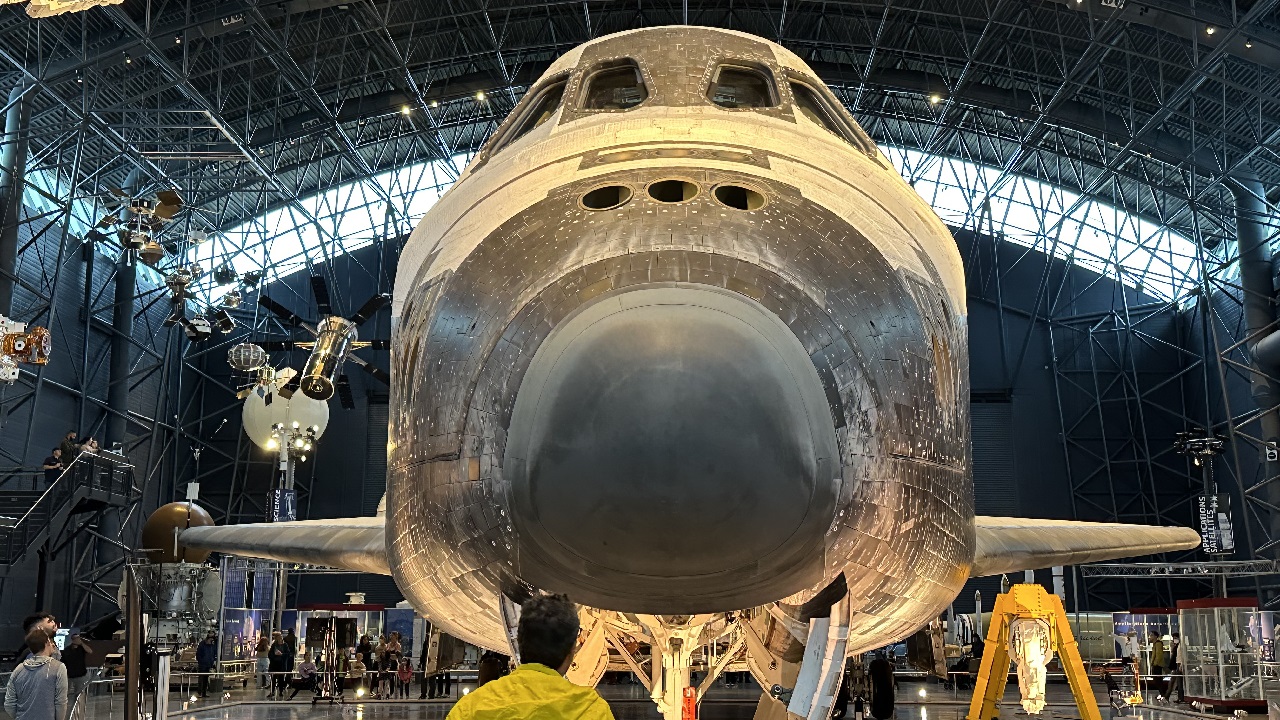
Shuttle Discovery at National Air and Space Museum on October 1, 2022. Image Credit: 19FortyFive.com

NASA’s Space Shuttle Discovery. Image Taken by 19FortyFive.com on October 1, 2022.
The program suffered two major major catastrophes—Challenger in 1986 and Columbia in 2003—resulting in the loss of 14 astronauts.
The shuttles required intensive, time-consuming, and costly refurbishment between flights, thus failing the goal of rapid reusability. The proposed launch schedules and turnaround times for the shuttle fleet were far from what had been envisioned. Due to budgetary and development constraints, the final design was riskier than initially planned, with no practical crew escape system.
The fastest turnaround for any shuttle in the history of the program was 54 days. After the 1986 Challenger disaster, the fastest turnaround was 88 days. With fewer flights taking place, customers began to seek other avenues to space.
Arguments That The Shuttle Was Retired Too Soon:
The retirement created a nine-year gap in U.S. capability to launch astronauts, forcing reliance on Russian Soyuz rockets until SpaceX’s Crew Dragon arrived in 2020. It was a huge loss of prestige for NASA to rely on Russian rockets.
The retirement dispersed specialized teams, hardware, and infrastructure at the Kennedy Space Center that had taken decades to build.
Safety measures were enhanced after the Columbia disaster, and some argued the fleet could have continued with reduced risk.
Arguments That The Shuttle Was Retired On Time:
The program ended with no ready replacement. It was actually set to end sooner, but its extension forced the development of new, safer, and more cost-effective vehicles to the backburner.
The shuttles were 30-year-old technology, and they were only supposed to last ten years. While mid-life refits helped to a degree, NASA was demanding more from the orbiters than the designers had planned for.
Ending the program forced NASA to pivot toward commercial partnerships.
Ultimately, while the shuttle program did its job in building the International Space Station, its high cost, age, and maintenance requirements made it unsustainable as a long-term option.
NASA’s Artemis Mission Heading Back To The Moon:
NASA’s long-awaited Artemis II mission is on track to conduct a critical test of its Space Launch System rocket, as well as the Orion capsule that will house the mission’s four astronauts. The test will occur as soon as this Saturday and is a key step toward sending astronauts back into moon orbit.
NASA said it plans to perform a “wet dress rehearsal,” which means the massive rocket will be fully fueled and run through launch-day procedures without liftoff. If this upcoming test goes well, the space agency says the Artemis II mission could begin in a few months.
Artemis II will pave the way for future missions that aim to return astronauts to the moon’s surface and eventually establish a sustained presence there. NASA says lessons learned from Artemis II will directly inform Artemis III, which will include a lunar landing.
About the Author: Steve Balestieri
Steve Balestrieri is a National Security Columnist. He served as a US Army Special Forces NCO and Warrant Officer. In addition to writing on defense, he covers the NFL for PatsFans.com and is a member of the Pro Football Writers of America (PFWA). His work was regularly featured in many military publications.