
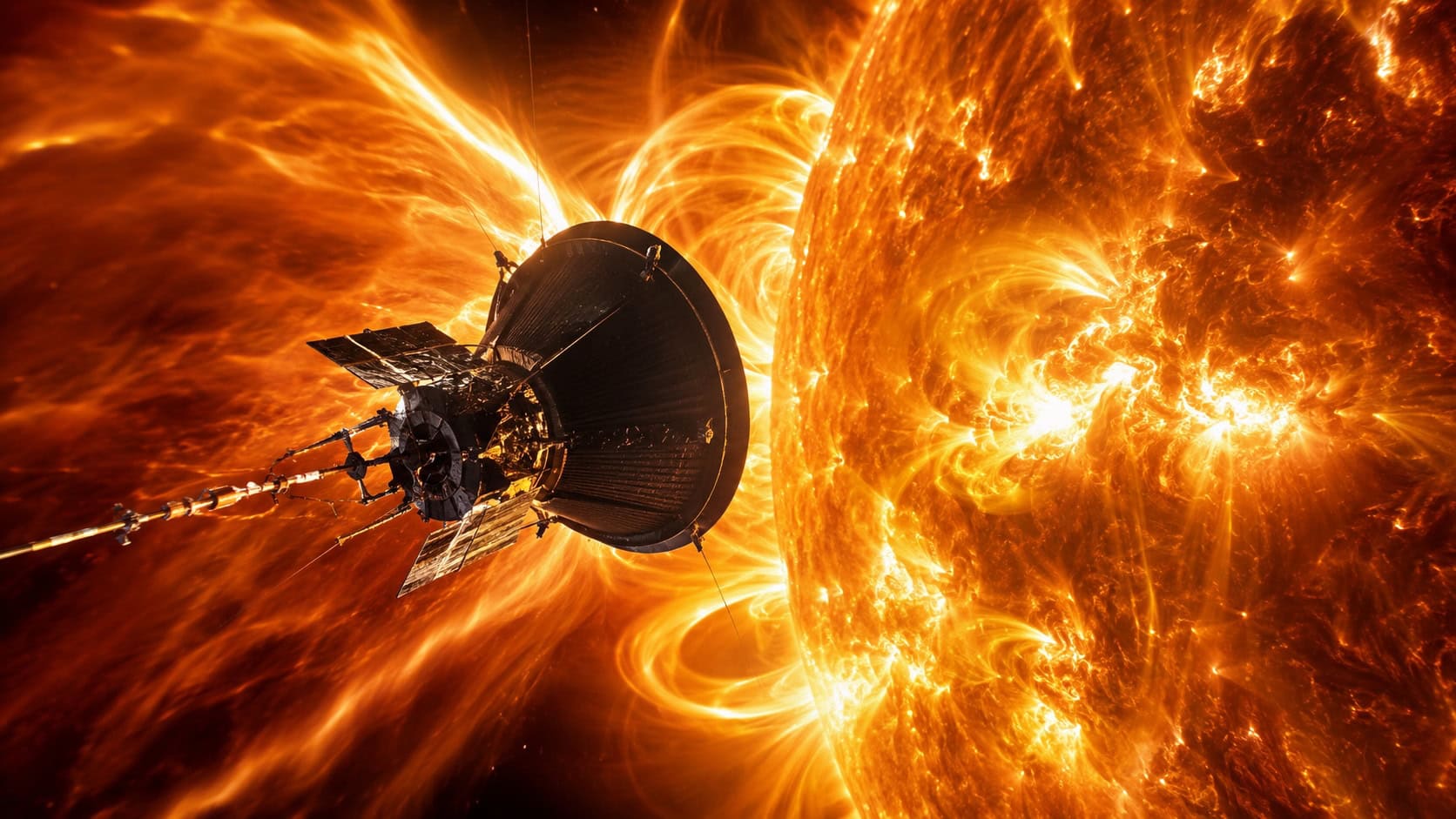
It has been almost eight years since launch, and NASA’s Parker Solar Probe is still one of the most ambitious space missions ever undertaken.
The remarkable spacecraft even returned to the headlines again this year when it completed another close pass of the Sun during its extended mission, continuing a series of record-breaking journeys as close to the Sun as it can get and giving the world a better look at our star than we’ve ever had.
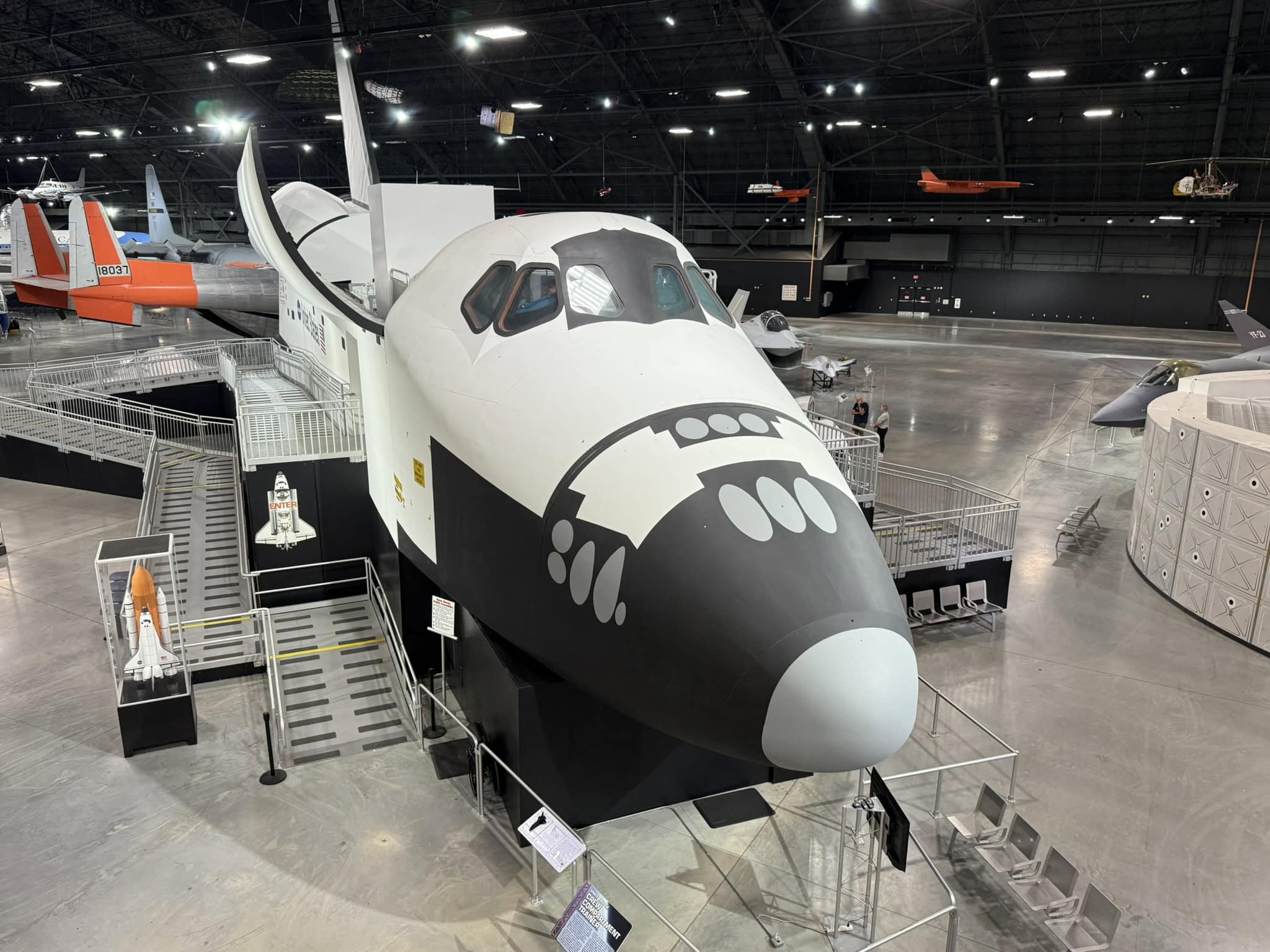
NASA Space Shuttle Demo at the National Museum of the U.S. Air Force. Taken by Harry J. Kazianis, July of 2025.
Parker Solar Probe Explained
On Christmas Eve 2024, Parker – a robotic spacecraft launched to observe the Sun’s upper atmosphere, or “corona” – passed within approximately 3.8 million miles of the Sun’s surface.
During that time, the spacecraft also reached incredible speeds of 430,000 miles per hour.
That record-breaking flyby made the Parker Solar Probe the fastest human-made object ever built.
NASA also confirmed that the probe survived the flyby and successfully transmitted data back to Earth.
And today, Parker is still orbiting the sun and gathering data from a region of space that scientists and engineers once thought would have been impossible to reach.
The spacecraft is still helping researchers answer big questions about the universe and the Sun, including how the star’s atmosphere behaves and why streams of charged particles known as solar wind are frequently sent hurtling into space.
How Decades Of Work Made This Possible
What the Parker Solar Probe is doing today is cutting-edge. It was designed to address questions posed more than half a century ago, when American astrophysicist Eugene Parker proposed that the Sun was continuously emitting a stream of charged particles that flowed throughout the entire Solar System.

NASA Space Shuttle Demo at the National Museum of the U.S. Air Force. Taken by Harry J. Kazianis, July of 2025.
At the time, the idea was radical and controversial – but over the years, observations proved his theory, and the phenomenon became better known as “solar wind.”
Over time, scientists determined that most of the Sun’s most important processes could not be understood from Earth, or even from spacecraft operating from great distances.
To solve those mysteries and gain a better look at exactly what is happening, scientists and researchers began exploring methods for sending a heavily shielded spacecraft to the edges of the Sun’s atmosphere.
It was an enormous challenge for obvious reasons: the Sun, after all, emits “solar wind” that becomes more intense the closer an object gets.
There is also the matter of the intense radiation and extreme temperatures. Any spacecraft intended to get close to the sun must survive all of this.
And for a long time, the technology that would have been necessary to conduct the mission didn’t exist.
In the early 21st century, that changed.
Advances in both materials science and spacecraft engineering meant that NASA could not only reach the Sun and carry all the necessary equipment to send back useful data, but also protect that equipment from being scorched.
The breakthrough was largely the result of advances in carbon-composite materials capable of withstanding heat.
Engineers developed a Thermal Protection System that was 4.5 inches thick and composed of reinforced carbon-carbon panels with a lightweight carbon foam core.
That construction method allowed the spacecraft to survive intense heat and radiation that it encountered as it approached the Sun.
The technological advances didn’t simply mean the onboard hardware could survive the heat – it meant that the interior of the spacecraft, incredibly, stayed at roughly room temperature.
Without those materials, a mission to the edge of the sun would have been utterly impossible – and on August 12, 2018, the probe was launched from Cape Canaveral, Florida. The probe was also named after Eugene Parker while he was still alive – the first such time a NASA mission has been named after a living person.
The Most Important Solar Mission Ever Flown
Since reaching the Sun, the Parker Solar Probe has provided information that has transformed how scientists view our star. Among the most significant discoveries came in 2021, when it became the first spacecraft to ever fly through the Sun’s corona.
The mission confirmed that the boundary between the Sun’s atmosphere and the rest of space is far more complicated than researchers had originally expected.
During that journey, the probe detected magnetic disturbances known as “switchbacks.”
These are sudden reversals in the direction of the solar wind’s magnetic field, and scientists have since theorized that the structures may play a huge role in how solar wind is accelerated away from the sun.
The spacecraft has also allowed scientists to determine why the corona is hotter than the sun’s visible surface.
The probe’s data suggests that while the solar surface reaches around 10,000 degrees Fahrenheit, the corona’s temperature is far higher and can even exceed two million degrees.
The data collected so far suggest that magnetic turbulence in the corona helps transfer heat from the sun into the outer atmosphere.
Today, the probe is still in an elliptical orbit around the Sun and is fully operational.
About the Author: Jack Buckby
Jack Buckby is a British researcher and analyst specializing in defense and national security, based in New York. His work focuses on military capability, procurement, and strategic competition, producing and editing analysis for policy and defense audiences. He brings extensive editorial experience, with a career output spanning over 1,000 articles at 19FortyFive and National Security Journal, and has previously authored books and papers on extremism and deradicalization.