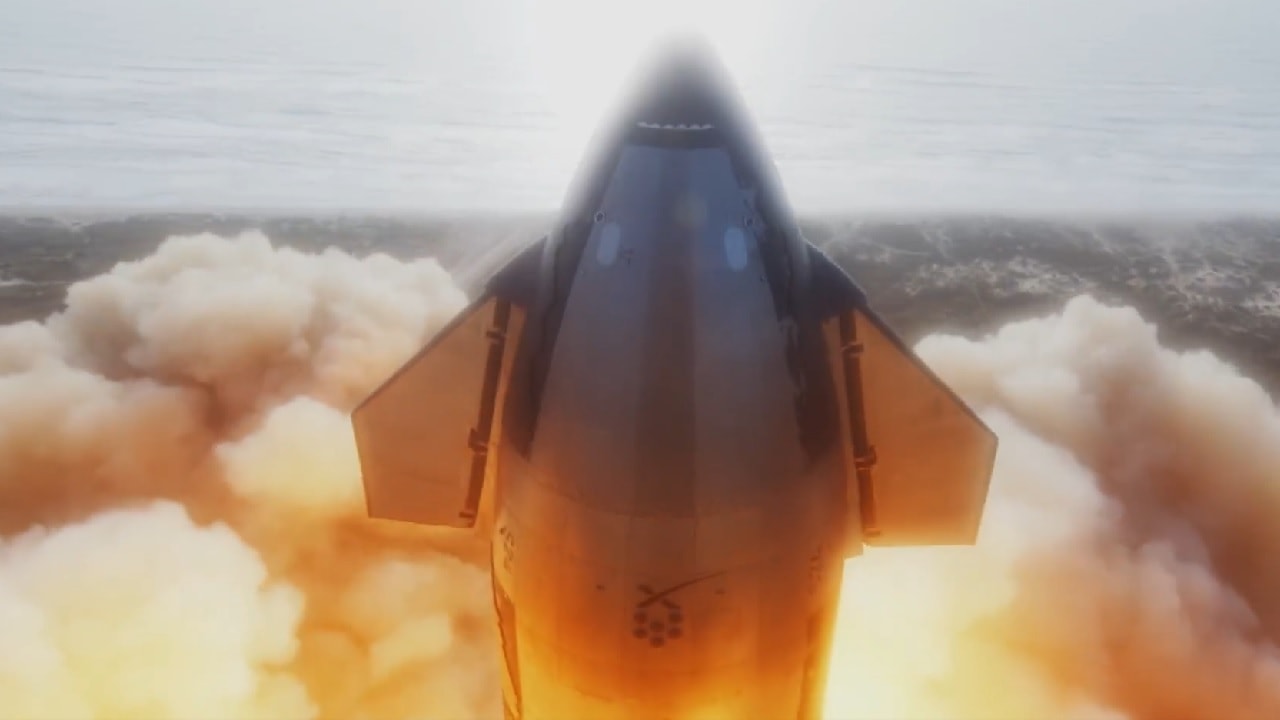
Summary and Key Points: Elon Musk’s recent pivot toward lunar missions has reignited debate over the billionaire’s ultimate goal: Mars. While critics like Peter Thiel suggest Musk has abandoned the Red Planet, the reality is a calculated gamble on Starship’s reusability. As NASA’s $2 billion SLS rocket faces recurring technical failures, SpaceX is positioning Starship as the only viable path back to the Moon.
-This strategic shift serves as a critical test range to perfect the heavy-lift technology needed to defeat China in the second Space Race.
-The fate of SpaceX’s credibility—and American space dominance—now hinges on Starship conquering the lunar surface.
MORE: Want more space? 19FortyFive has spent a lot of time at the Space Shuttle exhibit at the Smithsonian. We present original video and photos from that visit back in 2022.
Beyond Starship: Is Elon Musk’s xAI Actually the Key to Reaching Mars?
Peter Thiel made an interesting comment to Ross Douthat not long ago about Elon Musk. According to Thiel, who has known Musk since they were in the so-called “PayPal Mafia” in the 1990s, the space-and-tech billionaire has “given up on Mars.”
The Comment That Won’t Go Away
That seemingly throwaway line appears to be on other people’s minds several months later. Eric Weinstein recently told a podcaster that he thinks SpaceX, Musk’s rocket company, is not his real space company. Weinstein believes that Musk’s real space company is xAI, which is the company responsible for Musk’s artificial intelligence (AI) endeavors.
The notion that Musk has either given up on his dreams of settling Mars utilizing SpaceX’s massive reusable Starship rocket—or that he has abandoned SpaceX’s main mission and handed it off to xAI—sounds ridiculous.

NASA’s Discovery. Image Credit: 19FortyFive.com taken on October 1, 2022.

NASA’s Space Shuttle Discovery. Image Taken by 19FortyFive.com on October 1, 2022.
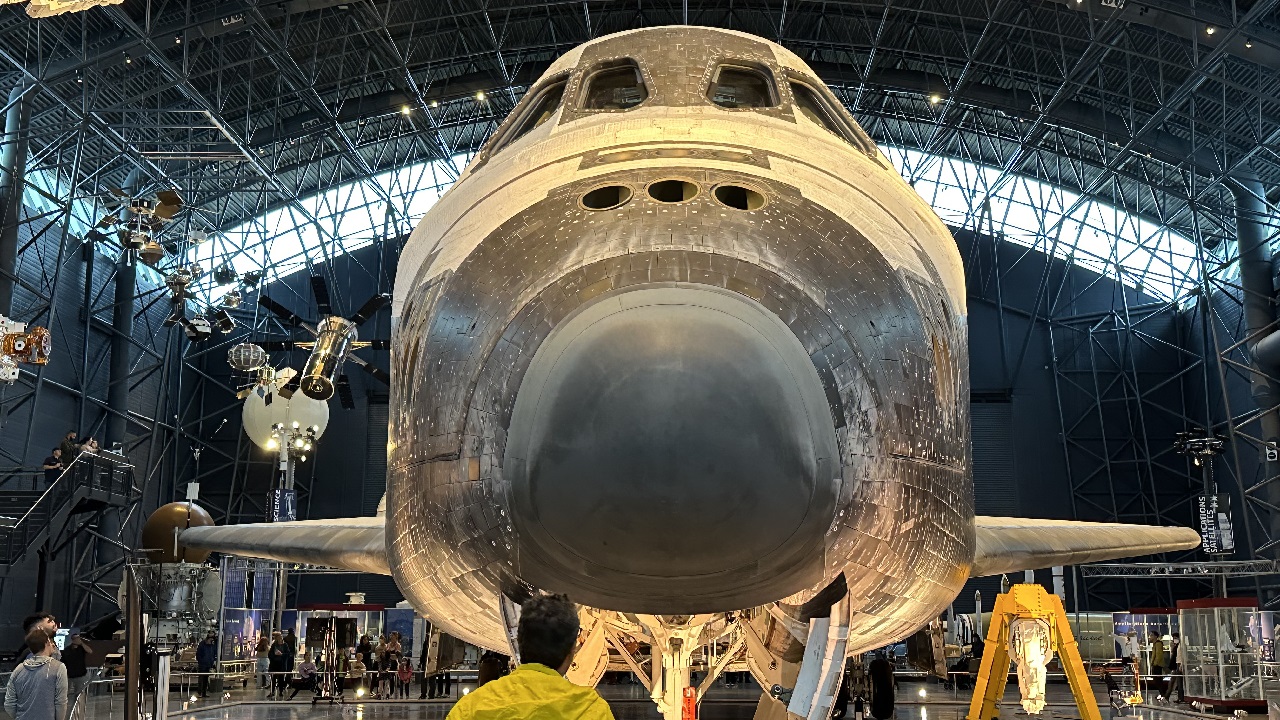
NASA Space Shuttle Discovery. Image Credit: 19FortyFive.com taken on October 1, 2022.
While SpaceX’s reusable rockets continue to be key for the United States’ space program, and Starlink has fundamentally shifted the way global telecommunications work (for the better), Starship continues running into snags.
According to Musk’s original Mars landing timeline, astronauts should have already landed on Mars. Of course, developing a heavy-lift rocket that is reusable and able to place astronauts on the Martian surface is no easy feat.
Starship’s Growing Pains
So, technical setbacks can occur.
Perhaps Musk has assessed that the mission to Mars needs to be tabled due to the staggering complexity involved in making a rocket that can launch from Earth, travel the void between the Earth and Mars, land on the surface of the Red Planet, and potentially return to Earth—landing back at SpaceX’s Starbase in Boca Chica, Texas.
Rather than betting the farm on an unproven rocket, such as Starship, Musk might be looking to work out its glitches by dedicating the reusable rocket to reaching a celestial body much closer to the Earth.

Elon Musk interviewed by Chris Anderson at TED2017 – The Future You, April 24-28, 2017, Vancouver, BC, Canada. Photo: Marla Aufmuth / TED
After a recent announcement by Musk about SpaceX retooling their Starship to focus not on getting to Mars soon but on getting the moon, it seems like Musk is slowing down his march to Mars.
The Moon as a Strategic Test Range
It makes sense that Musk would do this, but it’s unlikely he’s giving up on Mars. Indeed, by adding this intermediary step of testing Starship on the moon, Musk is ensuring this complex piece of machinery will inevitably be fully prepared to land Americans on Mars.
And this move couldn’t come at a more important time.
Recently, NASA attempted to launch four astronauts aboard the Space Launch System (SLS) Rocket, which is NASA’s only heavy-lift rocket that can get Americans to the moon. Yet again, the mission was scrubbed due to technical problems. Specifically, there was an issue with the SLS’s liquid hydrogen fuel tank.
This is a problem that has long plagued the SLS since its creation more than a decade ago. It is one of the primary reasons why, despite having been in possession of this rocket, NASA has been unable to return humans to the moon.
NASA’s $2 Billion Problem
At a cost of more than $2 billion (compared to the around $100 million for Starship), this rocket has been a failure for NASA (plus, it is not reusable).
With China seeking to get to the moon, the U.S. cannot afford to let any more time slip between when NASA can have a heavy-lift rocket capable of returning to the moon and when the Chinese believe they will be able to put their taikonauts on the lunar surface.
To clarify: The scrubbed NASA mission was not intending to land people on the moo, but rather to orbit around the moon. But it was a chance to work out any problems that might arise when NASA did decide to send astronauts back to the moon.
Because they missed their launch window, and NASA’s new leader, former SpaceX astronaut Jared Isaacman clearly thinks that the SLS is a boondoggle, Isaacman wants SpaceX’s Starship to replace the SLS rocket.
That’s a smart move for NASA.
The Real Risk: Credibility
It also means they will have to wait a year until SpaceX’s Starship is totally aligned with the mission parameters of the Artemis II lunar return mission that was just scrubbed. It is not a guarantee that Starship will be any more successful than the SLS. But that’s why Musk is now prioritizing the moon, rather than Mars. He wants to get his Starship reusable rocket primed for future missions to Mars.
Of course, with the drastic shift away from SpaceX’s long-time mission of prioritizing Mars over the moon, this signals that not all is well with the Starship program. If the rocket works as advertised, there will be a clear impetus to get to Mars in another decade.
If, however, by next March the Starship rocket cannot achieve its promises, SpaceX will lose money—and credibility. Musk has bet both his reputation and his firm’s profitability on the notion that he is going to Mars.
He can reliably spin the move to focus on the moon as a necessary intermediary step to better perfect the Starship launch system for an eventual Mars mission. But if the Starship system doesn’t perform as expected in the lunar return missions for NASA, or if there are many setbacks, such a failure could irreparably damage SpaceX.
Elon Musk has not given up on Mars.
But if Starship can’t conquer the moon soon, getting humans to Mars under the banners of the United States and SpaceX will remain a dream, and China will own the space between Earth and that planet. SpaceX would not survive such a catastrophic failure and, right now, there is no other U.S. space firm that can support the country’s need to restore its space power before China takes it from them.
About the Author: Brandon J. Weichert
Brandon J. Weichert is the Senior National Security Editor at 19FortyFive.com. He was previously the senior national security editor at The National Interest. Weichert is the host of The National Security Hour on iHeartRadio, where he discusses national security policy every Wednesday at 8pm Eastern. He hosts a companion show on Rumble entitled “National Security Talk.” Weichert consults regularly with various government institutions and private organizations on geopolitical issues. His writings have appeared in numerous publications, among them Popular Mechanics, National Review, MSN, and The American Spectator. And his books include Winning Space: How America Remains a Superpower, Biohacked: China’s Race to Control Life, and The Shadow War: Iran’s Quest for Supremacy. Weichert’s newest book, A Disaster of Our Own Making: How the West Lost Ukraine, is available for purchase wherever books are sold. He can be followed via Twitter/X @WeTheBrandon.