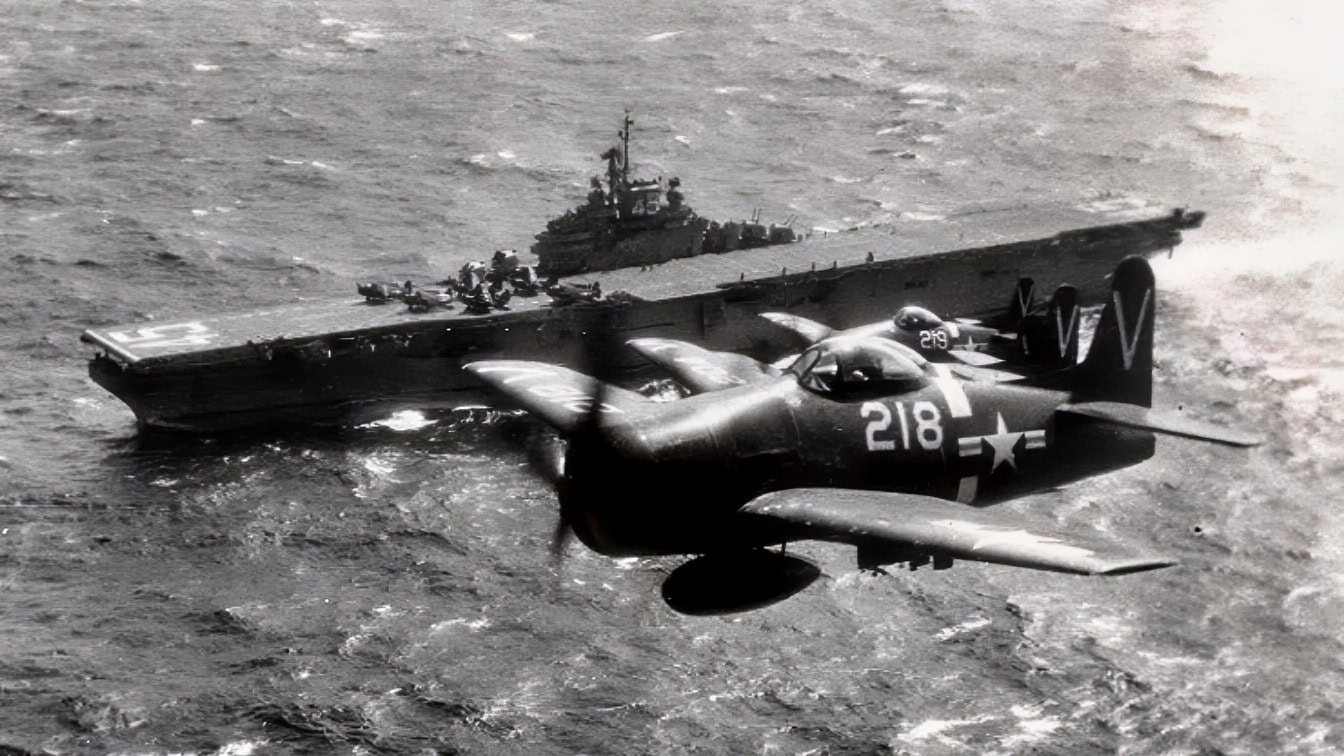
When people think of American aircraft carriers, they usually think about one of the many nuclear-powered carriers that the Navy has built over the years.
But the conventionally powered carriers, many of which served or were designed during the Second World War, are truly iconic. One of the best carriers that the Navy ever developed was the Essex-class.
The Great Ship
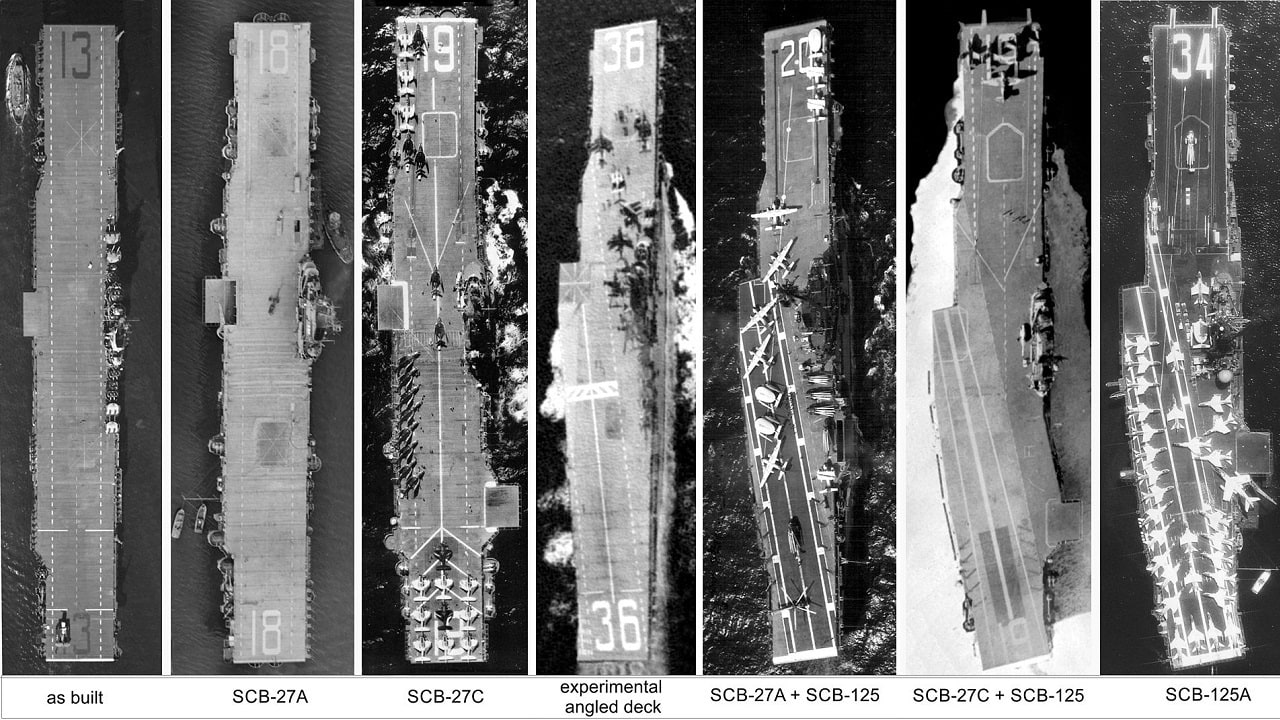
Seven aerial photographs showing the major different modernizations of the U.S. Navy Essex-class aircaft carriers (l-r): USS Franklin (CV-13), a “short hull” type as delivered, 21 February 1944. Franklin, USS Bunker Hill (CV-17), USS Boxer (CV-21), USS Princeton (CV-37), USS Tarawa (CV-40), USS Valley Forge (CV-45) and USS Philippine Sea (CV-47) received no or little modernization. USS Wasp (CV-18), after her SCB-27A conversion in late 1951: new hydraulic catapults, new island, removal of the deck guns, new bow. Modernized as such were USS Essex (CV-9), USS Yorktown (CV-10), USS Hornet (CV-12), USS Randolph (CV-15), Wasp, USS Bennington (CV-20), USS Kearsarge (CV-33) and USS Lake Champlain (CV-39). USS Oriskany (CV-34) was completed as such. USS Hancock (CV-19) after her SCB-27C modernization, circa 1955: like SCB-27A but new steam catapults and relocation of the aft elevator to the deck edge. USS Intrepid (CV-11) and USS Ticonderoga (CV-14) also received SCB-27C. USS Antietam (CV-36) after the installation of an experimental angled deck, circa 1954. USS Bennington (CV-20) after SCB-125: enclosed hurricane bow, angled deck, starboard deckedge elevator. USS Essex (CV-9), USS Yorktown (CV-10), USS Hornet (CV-12), USS Randolph (CV-15), Wasp, USS Bennington (CV-20) and USS Kearsarge (CV-33) received SCB-125. USS Hancock (CV-19) after SCB-125 in April 1957. The three SCB-27C ships were modernized as such an had the starboard deckedge elevator located further aft. The forward elevator was enlarged. USS Oriskany (CV-34) received SCB-125A, here on 30 May 1974. Similar to SCB-27C/SCB-125, only the starboard deckedge elevator was located further forward, as with the SCB-27A/SCB-125 ships. USS Lexington (CV-16), USS Bon Homme Richard (CV-31) and USS Shangri-La (CV-38) received SCB-27C/SCB-125 in one refit but had the starboard elevator in the same position as Oriskany.
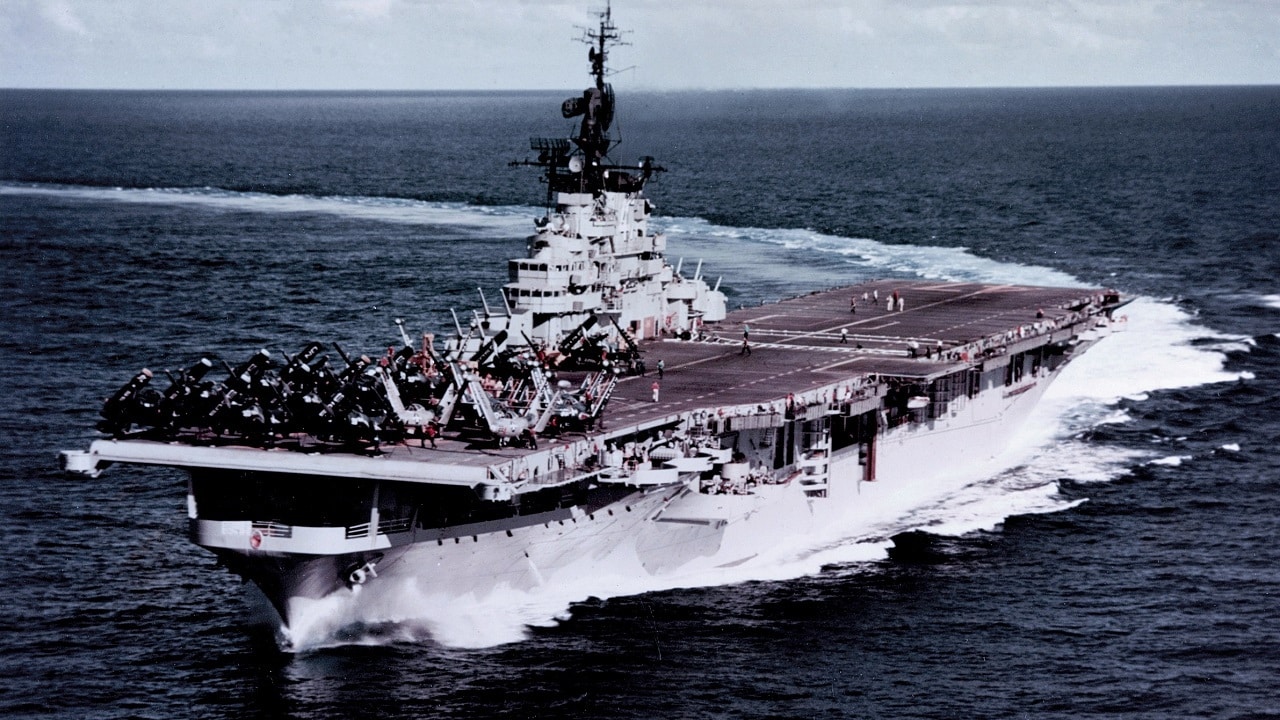
The U.S. Navy aircraft carrier USS Philippine Sea (CVA-47) makes a sharp turn to starboard, while steaming in the Western Pacific with the U.S. Seventh Fleet, 9 July 1955. Philippine Sea, with assigned Air Task Group 2 (ATG-2), was deployed to the Western Pacific from 1 April to 23 November 1955.
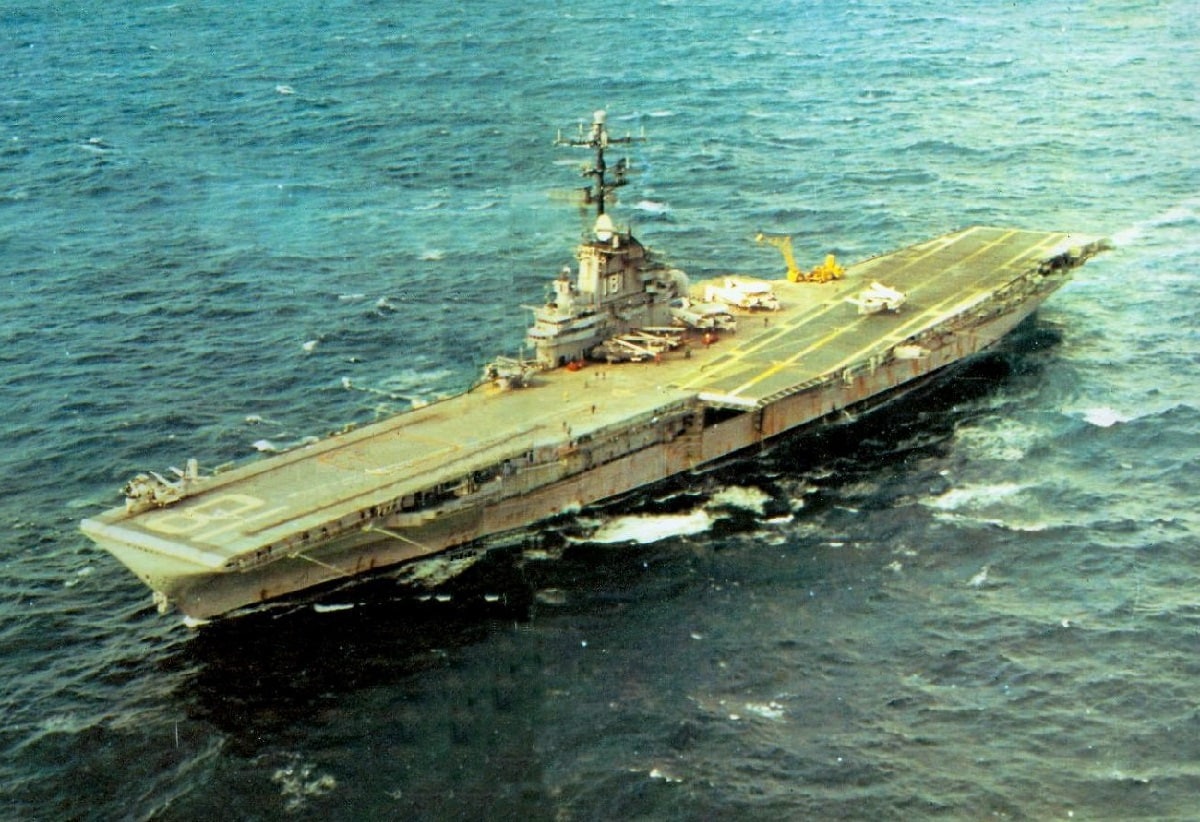
The USS Valley Forge, one of the most memorable of this legendary carrier class, served for more than 23 years.
During her time in service, she went from a conventional aircraft carrier to a dynamic anti-submarine platform, ending her service as a helicopter assault ship supporting US Marines during the Vietnam War.
The Valley Forge was ordered by the Navy in 1943. She was born at the Philadelphia Naval Shipyard in Pennsylvania.
The Valley Forge’s keel was laid on September 14, 1943, at the height of America’s involvement in World War II.
Ultimately, the Valley Forge was not completed before the Empire of Japan unconditionally surrendered to the United States.
Valley Forge was launched in November 1945 and commissioned a year later. She was the final Essex-class carrier to enter active US Navy service.
Valley Forge displaced 27,100 tons (standard).
The ship measured 888 feet long.
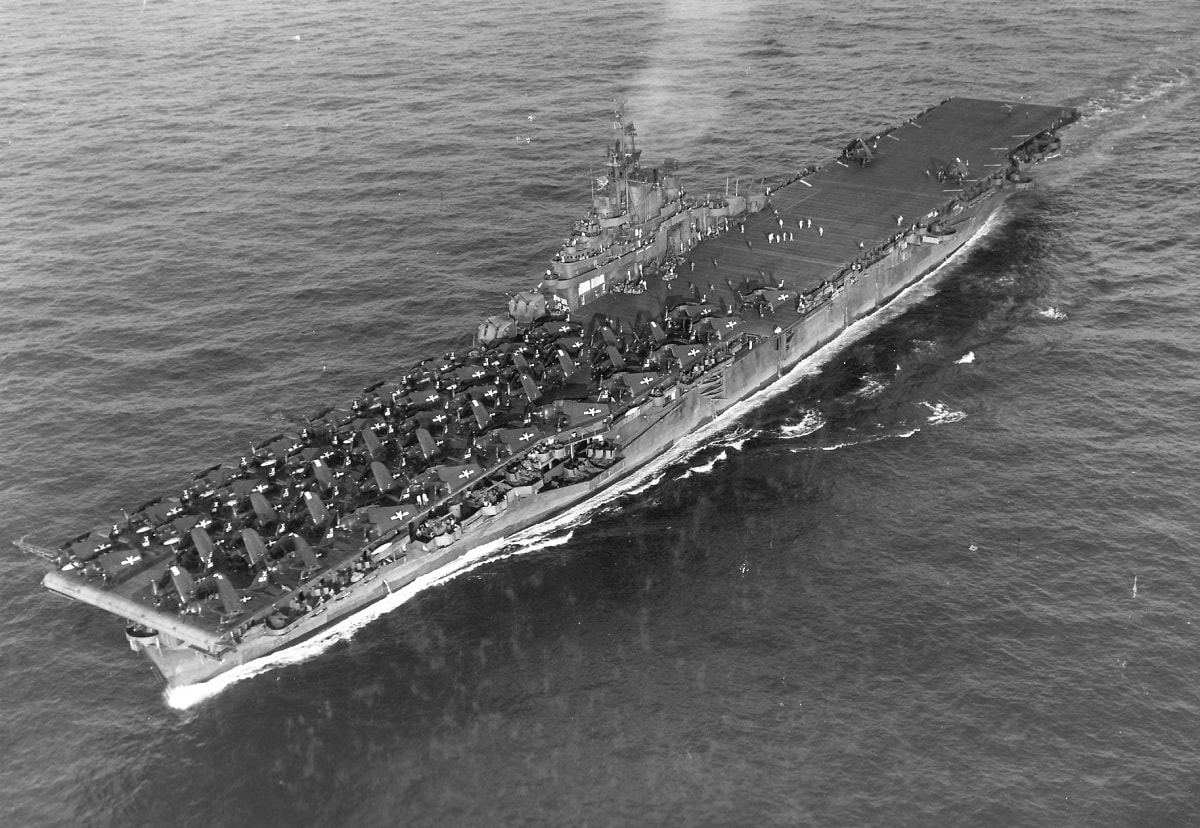
USS Wasp. Image: Creative Commons.
USS Wasp Essex-Class Aircraft Carrier. Image: Creative Commons.
Valley Forge could operate up to 100 aircraft as well. Steam turbines powered by eight boilers drove four propeller shafts, giving the carrier a maximum speed of 33 knots.
Impressive Combat Service
She initially served with the Pacific Fleet.
She completed a round-the-world cruise in 1948.
Her most important early combat assignment began after North Korea invaded South Korea on June 25, 1950.
The carrier was already in Asian waters and quickly joined Task Force 77.
Meanwhile, on July 3, 1950, warplanes from Valley Forge launched the first US carrier strike of the Korean War.
During that mission, Douglas AD Skyraiders and Vought F4U Corsairs attacked airfields and fuel facilities essential to the North Korean war effort.
That mission also struck railroad yards near Pyongyang. Grumman F9F Panther jets provided cover.
Some of the Panther jets launched from the Valley Forge encountered North Korean aircraft, too.
USS Valley Forge completed four Korean War combat deployments, becoming the only American carrier to return to the Korean combat zone four times.
One of the most important missions carrier warplanes conducted was providing close air support (CAS) for United Nations troops during the defense of the Pusan Perimeter, the Inchon Campaign, and the counterattack into North Korea.
Planes from the Valley Forge also targeted Chinese forces after they entered the war.
In fact, during the Valley Forge’s first deployment in the Korean War, the carrier’s air group flew more than 5,000 combat sorties and delivered more than 2,000 tons of bombs and rockets.
During its second deployment, its aircraft flew more than 2,500 sorties (while dropping around 1,500 tons of ordnance)!
On its historic fourth deployment to the warzone, the air group from Valley Forge dropped 3,700 tons of bombs before the carrier eventually returned to the United States in June 1953.
This carrier was one of America’s heaviest hitters in the early Cold War.
From Aircraft Carrier to Amphibious Lander
The Navy decided to give Valley Forge a new mission in 1961 (and a bit of a makeover). She was converted from a conventional aircraft carrier into an amphibious assault ship.
Its fixed-wing role ended, meaning helicopters became its primary aviation force.
The ship could not transport Marines, landing forces, and other equipment needed to support any Marine landing anywhere in the world.
In her new role, from 1964 through 1969, the USS Valley Forge supported multiple US Marine landings in the Vietnam War.
After the Gulf of Tonkin incident, the ship remained off Vietnam to support any potential Marine landings.
After that, Valley Forge supported multiple iconic Marine landings into Vietnam–these included Blue Marlin, Dagger Thrust, and others.
Helicopters from the Valley Forge moved Marines into intense combat landing zones, moved supplies, and evacuated casualties in support of troops operating near Da Nang, Quang Tri, and the Demilitarized Zone (DMZ).
When the war on shore got too dangerous for helicopters to be based there, the Valley Forge effectively became a floating helicopter base.
Valley Forge was an example of how the Essex-class carriers experienced multiple adaptations that allowed them to serve long after WWII, the war they were designed to wage, ended.
It Lost Its Fight to Become a Museum Ship
Ultimately, the Navy decommissioned the Valley Forge on January 15, 1970, ending active service that began in 1946.
It was originally meant to be a museum ship. Sadly, financing for that project fell through. The carrier was inevitably sold for scrap in 1971 and dismantled.
Valley Forge received eight battle stars for Korean War service, nine for its time supporting Marines in the Vietnam War, and three Navy Unit Commendations.
About the Author: Brandon J. Weichert
It’s only too bad the Navy didn’t fight harder to preserve this historic carrier as a museum.
Brandon J. Weichert is the Senior National Security Editor at 19FortyFive.com. He also manages The Weichert Brief on Substack. Weichert also hosts “National Security Talk” on Rumble. He is the author of four bestselling national security books, the most recent of which is A Disaster of Our Own Making: How the West Lost Ukraine (Encounter Books). Follow him via Twitter/X @WeTheBrandon.