
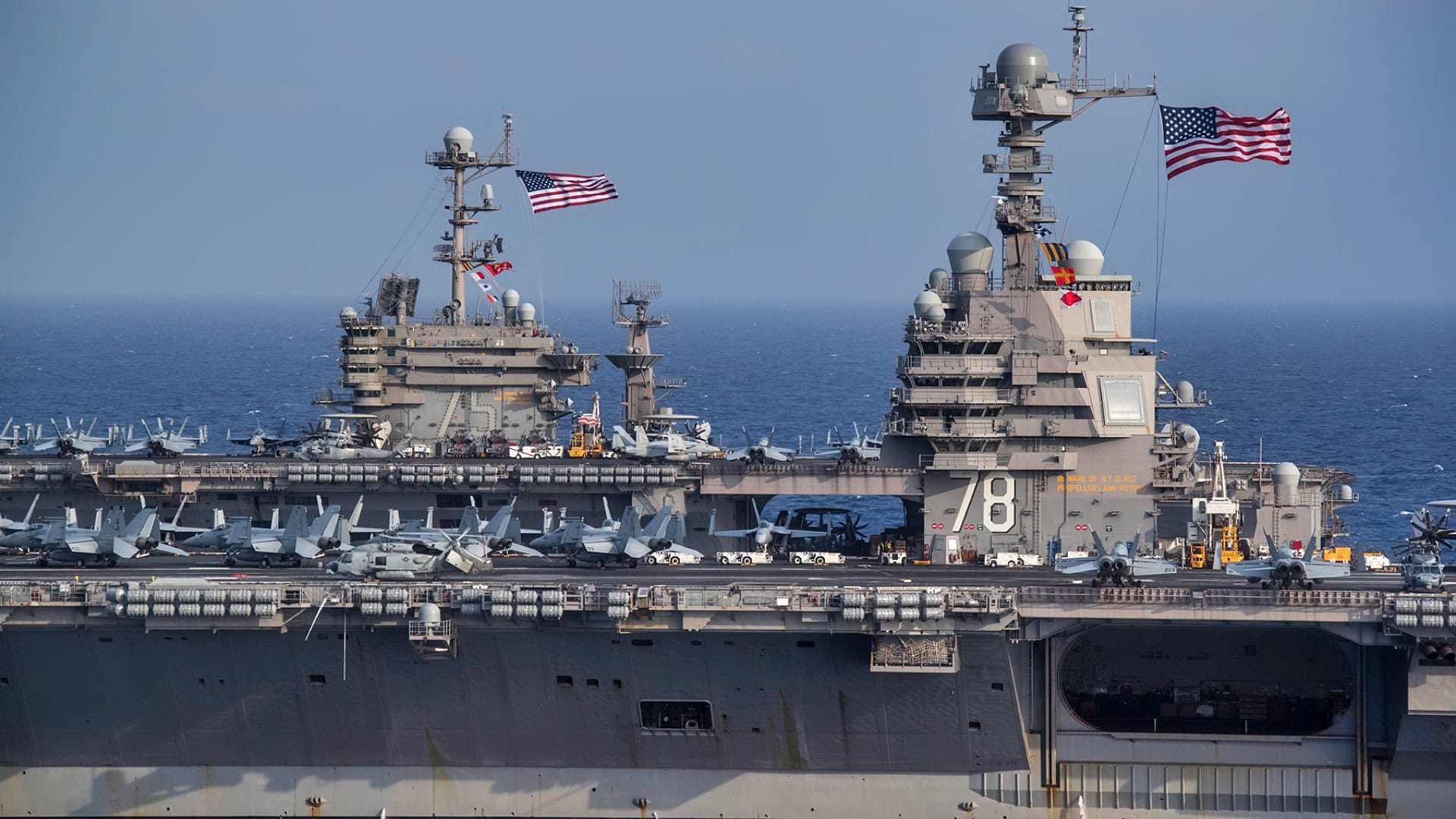
The U.S. Navy commissioned 17 Essex-class aircraft carriers between December 1942 and the end of World War II, then completed seven more ships from the design after the fighting stopped. USS Essex went from keel laying to commissioning in 20 months. USS Yorktown made the same transition in about 16 months.
The modern comparison is severe. The Congressional Budget Office reported in April 2026 that Nimitz-class carriers took seven to eight years to build, while Ford-class ships now require 10 to 11 years under current schedules. Some follow-on Fords stretch much longer when early construction work is included.
The ships themselves explain part of the difference. An Essex displaced about 27,100 tons and carried 80 to 100 piston-engine aircraft. A Ford-class carrier displaces roughly 100,000 tons, operates two nuclear reactors, carries more than 75 aircraft and supports a ship, air wing and staff totaling about 4,660 people.
World War II production also rested on parallel construction. Essex-class hulls came from Newport News, the New York Navy Yard, Norfolk, Philadelphia and Bethlehem Steel’s Fore River yard. Newport News Shipbuilding now stands alone as the American yard that designs and builds nuclear-powered aircraft carriers.
The Essex-Class Aircraft Carrier Was Built for Repetition
The Essex was advanced for its time, but it remained a standardized conventionally powered warship built around boilers, turbines, hydraulic machinery and mechanical systems familiar to a broad industrial base. The Navy used prefabricated sections and centralized equipment purchasing to accelerate work. Wartime changes improved protection and weapons without forcing every yard to learn a new carrier design.
That repetition turned one class into combat mass. The United States commissioned 102 carriers of all types during World War II, including fleet, light and escort ships. The Essex program supplied fast fleet carriers, while converted cruiser hulls and merchant-derived designs filled different missions. The class’s wartime record and long postwar service explain why the Essex fleet still occupies an unusual place in naval history.
The Ford program follows a more demanding design logic. Each ship is expected to serve for 50 years while accepting new aircraft, sensors, weapons and networks. The class introduced electromagnetic catapults, software-controlled weapons elevators, advanced arresting gear, far greater electrical capacity and a new nuclear plant. Every hull is therefore a shipbuilding project, a nuclear program and a systems-integration effort.
A Ford-Class Carrier Consumes Far More Money and Industrial Capacity
USS Gerald R. Ford received about $13.3 billion in procurement funding, excluding roughly $6 billion in research and development associated with the class. At the lead ship’s procurement cost, 24 modern carriers would exceed $319 billion before buying air wings, escorts, munitions, bases or decades of operations. Congressional Research Service estimates show why even a slow carrier replacement program consumes a major share of the Navy’s shipbuilding account.
The hull price understates the work inside it. John F. Kennedy contains 2,615 spaces and required about 10.5 million feet of electrical cable. Nuclear propulsion adds reactor manufacturing, naval nuclear certification, radiological controls and a specialized workforce. Newport News also performs carrier refueling overhauls and contributes to nuclear-submarine construction.
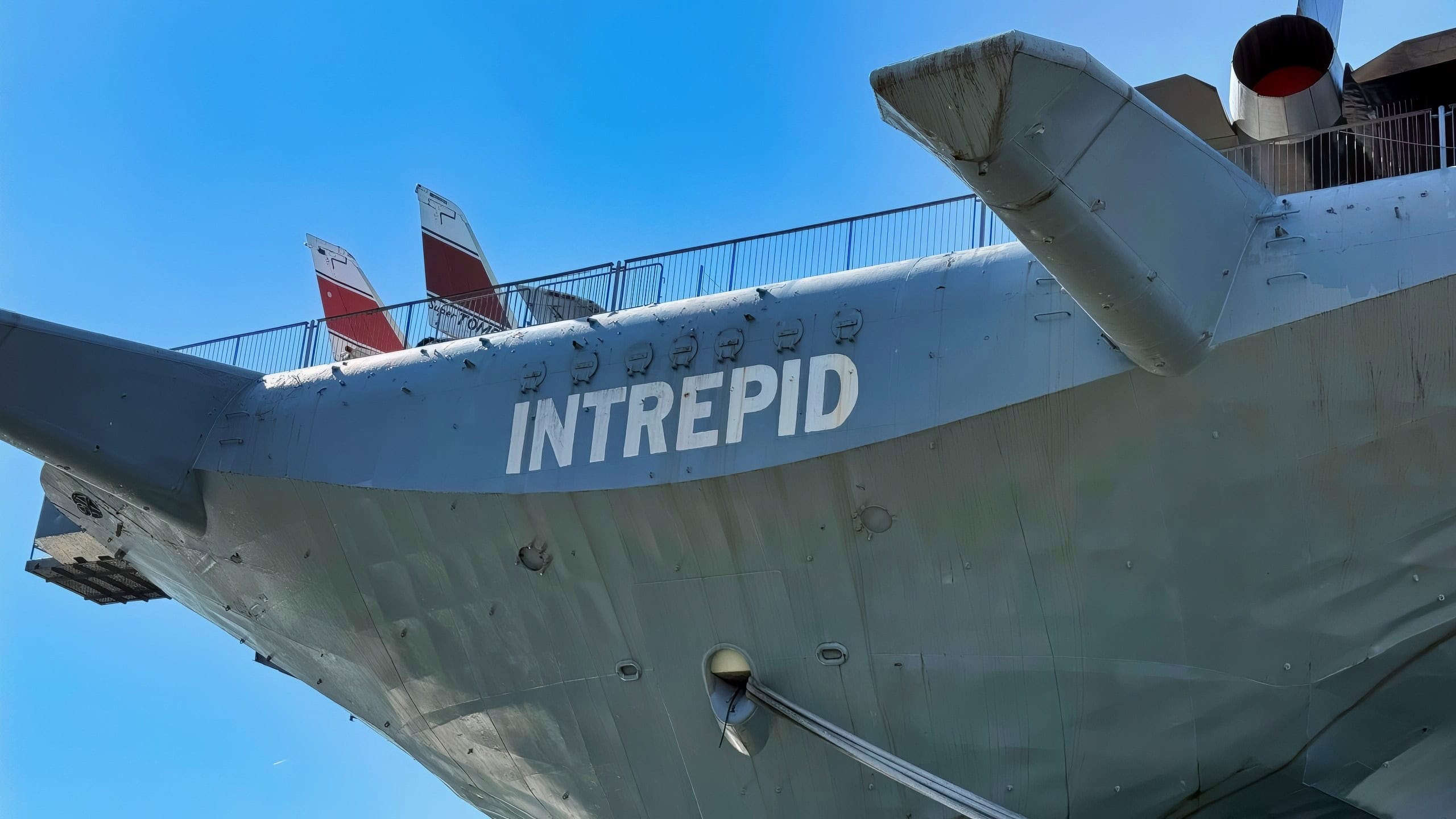
USS Intrepid of the Essex-Class Aircraft Carriers. Image Credit: 19FortyFive.com Original Photo.
That concentration makes delay contagious. A late component or unfinished module occupies dry-dock space, crane time, staging areas and workers needed by the next ship. The result is visible in construction schedules stretching toward 15 years and a wider carrier availability problem as older Nimitz-class ships approach retirement.
America No Longer Has Five Aircraft Carrier Yards
The Navy’s May 2026 shipbuilding plan states that the shipbuilding budget doubled over two decades while the fleet ended up no larger than it was in 2003. The document points to fewer yards, atrophied capacity, changing requirements and schedules built on optimistic assumptions.
The Government Accountability Office reported that 17 private defense shipyards closed or left the business over the previous 50 years. Roughly 25 medium- and large-vessel yards remained in 2021, and none of the seven builders producing Navy battle-force ships was positioned to meet the service’s delivery goals. The shipyard gap has become a strategic constraint, not a temporary scheduling problem.
Workforce expansion moves slowly. GAO found that skilled tradespeople often need three to five years to reach proficiency, while inexperienced employees require more supervision and generate more rework. A second GAO assessment released in April 2026 found persistent cost, schedule, workforce and infrastructure problems across the shipbuilding portfolio. Those limits sit behind the widening U.S.-China shipbuilding-capacity gap.
World War II Mobilization Reordered the Economy
The Essex surge came from national mobilization rather than an ordinary procurement cycle. Congress approved the Naval Expansion Act in July 1940, authorizing another 1.325 million tons of combat ships before Pearl Harbor. Federal money expanded public and private yards, secured machine tools and funded production facilities. Wartime priorities then directed steel, labor, transportation and factory output toward military demand.
The United States retains the wealth and engineering base to enlarge naval production. Rebuilding wartime depth would still require years of stable orders, new facilities, additional dry docks, expanded suppliers, trade schools and a larger maritime workforce. One large appropriation does not create a nuclear-qualified welder, a reactor-component line or a carrier-sized construction dock during the next budget year.
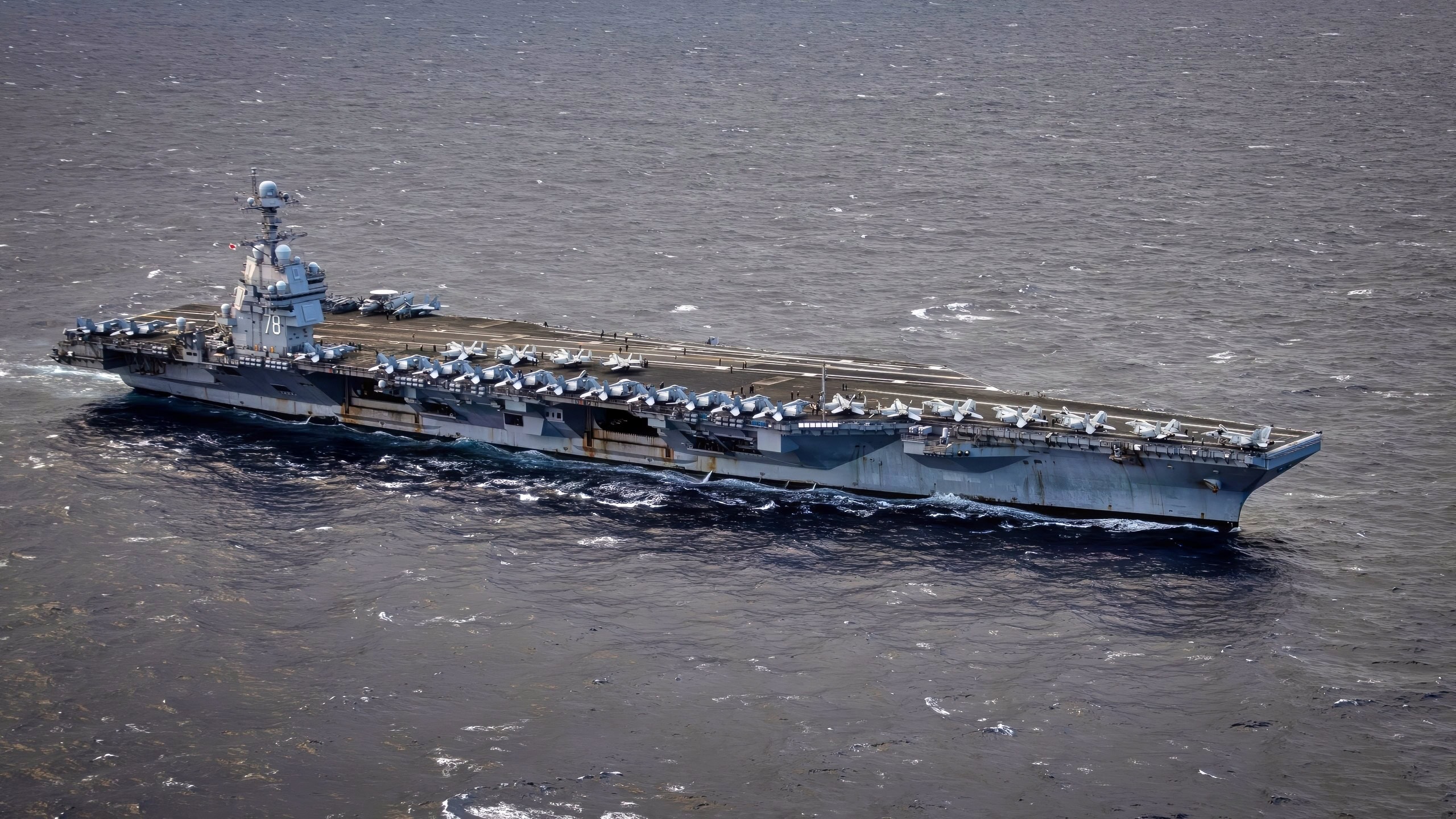
The world’s largest aircraft carrier, USS Gerald R. Ford (CVN 78), transits the Eastern Mediterranean Sea, March 22, 2026. Gerald R. Ford is on a scheduled deployment in the U.S. 6th Fleet area of operations to support the warfighting effectiveness, lethality and readiness of U.S. Naval Forces Europe Africa, and defend U.S., Allied and partner interests in the region. (U.S. Navy photo by Mass Communication Specialist 2nd Class Tajh Payne)
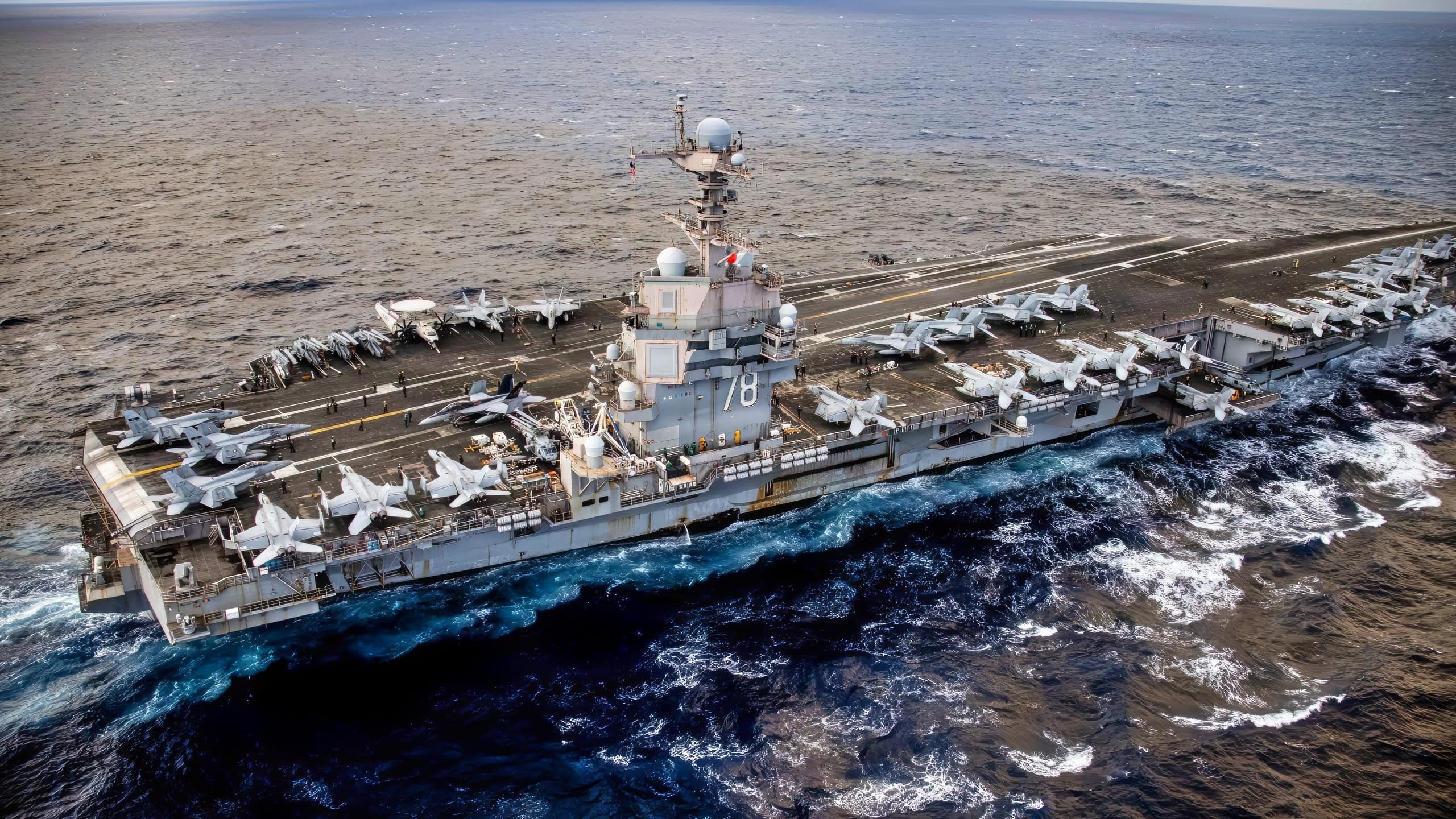
The world’s largest aircraft carrier, USS Gerald R. Ford (CVN 78), transits the Eastern Mediterranean Sea, March 22, 2026. Gerald R. Ford is on a scheduled deployment in the U.S. 6th Fleet area of operations to support the warfighting effectiveness, lethality and readiness of U.S. Naval Forces Europe Africa, and defend U.S., Allied and partner interests in the region. (U.S. Navy photo by Mass Communication Specialist 2nd Class Tajh Payne)
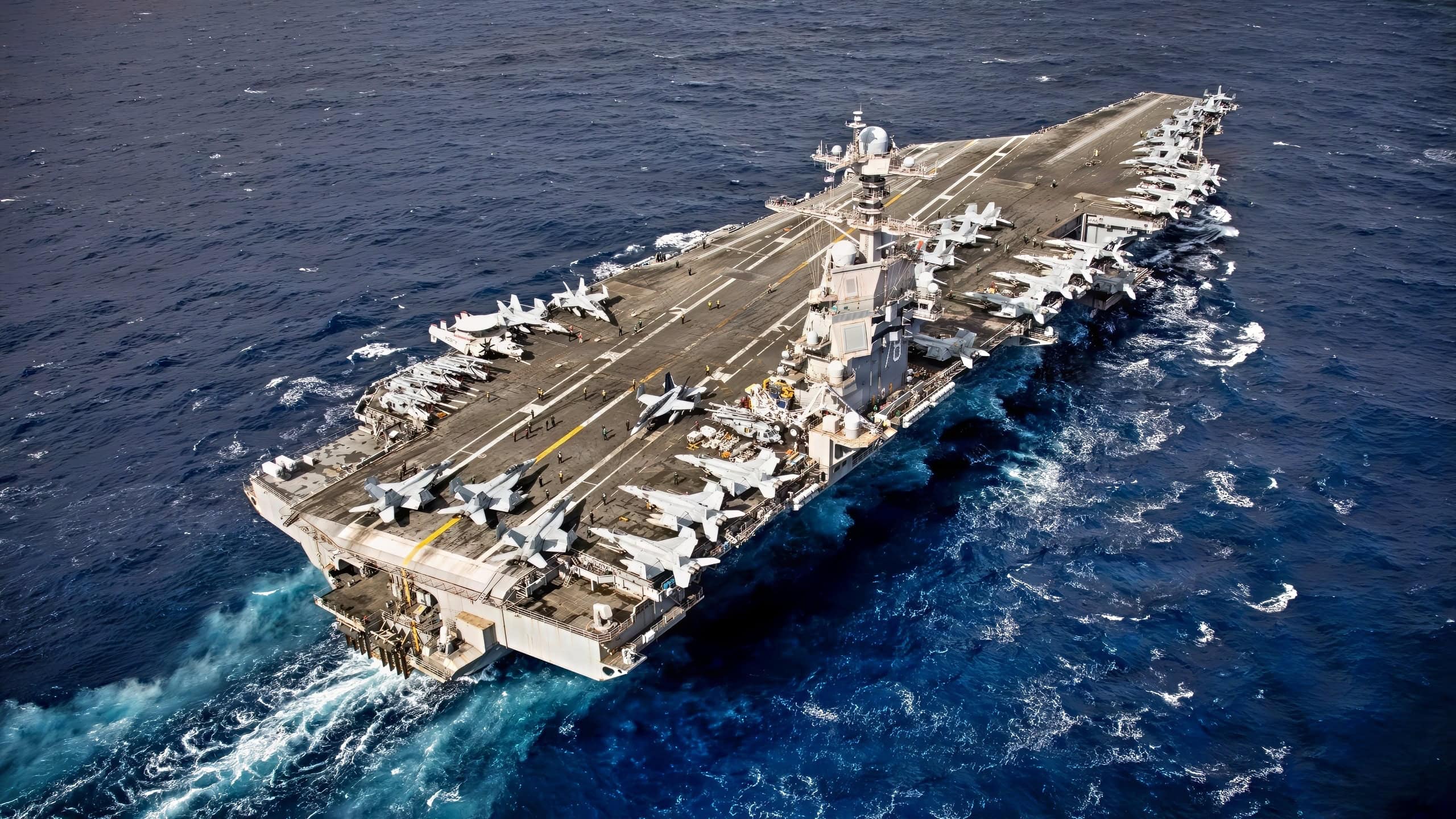
U.S. Sailors conduct routine flight deck operations on the flight deck of the world’s largest aircraft carrier, USS Gerald R. Ford (CVN 78), while underway in the Eastern Mediterranean Sea, March 22, 2026. Gerald R. Ford is on a scheduled deployment in the U.S. 6th Fleet area of operations to support the warfighting effectiveness, lethality and readiness of U.S. Naval Forces Europe Africa, and defend U.S., Allied and partner interests in the region. (U.S. Navy photo by Mass Communication Specialist 2nd Class Tajh Payne)
Even a mobilized industry would not produce 24 Ford-class carriers on an Essex timetable.
A true mass-production program would require a smaller, conventionally powered ship assembled from mature modules across several yards. It would sacrifice some endurance, electrical power, air-wing capacity and survivability while adding a second training and logistics system.
The long Nimitz production run shows the value of design stability, but it never recreated the multi-yard carrier industry of 1943.
The Essex Lesson Is Buildability, Not Nostalgia
An Essex rebuilt today would not meet the demands of a 2030s war.
Modern aircraft, long-range missiles, submarines and networked targeting require the sensors, defenses, power generation and aviation systems carried by newer ships.
The useful historical standard is a force designed around stable requirements, repeatable construction, several producers and enough supplier depth to replace losses.
The Navy’s 2026 plan now calls for more distributed construction, with modules and components produced away from the final assembly yards.
That approach may ease pressure across the fleet, but Ford-class production still moves through one nuclear-carrier line.
John F. Kennedy completed builder’s sea trials in February 2026 and is scheduled for delivery in March 2027. Enterprise and Doris Miller remain behind it at Newport News, and the United States has no second shipyard qualified to assemble a nuclear-powered aircraft carrier.
MORE – China’s J-20 Stealth Fighter Is Being Built In Massive Numbers
About the Author: Harry J. Kazianis
Harry J. Kazianis (@Grecianformula) is the former Senior Director of National Security Affairs at the Center for the National Interest (CFTNI), a foreign policy think tank founded by Richard Nixon based in Washington, DC. Harry has over a decade of experience in think tanks and national security publishing. His ideas have been published in the NY Times, The Washington Post, The Wall Street Journal, CNN, and many other outlets worldwide. He has held positions at CSIS, the Heritage Foundation, the University of Nottingham, and several other institutions related to national security research and studies. He is the former Executive Editor of the National Interest and the Diplomat. He holds a Master’s degree focusing on international affairs from Harvard University.