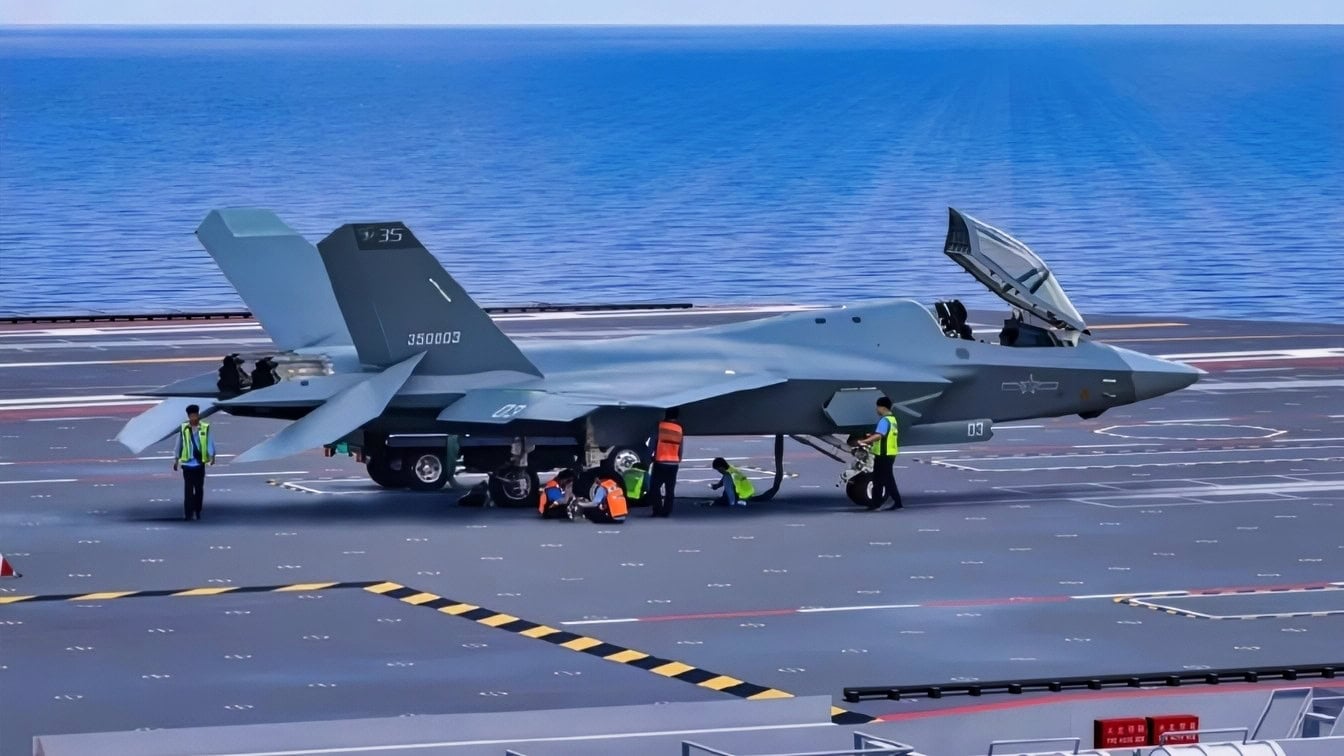
MANILA – It’s official, the Shenyang J-35 stealth fighter aircraft carrier variant now has a new name. The service nickname given to the aircraft by the People’s Republic of China (PRC) military is the “Blue Shark” or “Lan Sha.”
This name also appears to be the one given specifically to the J-35 carrier-capable version, which is supposed to replace the previous Shenyang aircraft, the J-15. That aircraft has long carried the label of “Flying Shark,” or “Electric Shark” – neither name is associated with the J-35A program.
Analysts of the People’s Liberation Army Navy (PLAN) assess that assigning this name to the aircraft now is an indication that it is officially moving forward from its developmental and testing phases. It will now begin its initial operational integration within the PLAN AF, the service’s air arm.
This change in status also demonstrates that Beijing’s priority is to introduce a stealth-capable carrier fighter into service ahead of the introduction of the land-based J-35A.
The intention of having this aircraft operating off the PLAN’s carriers in place of the J-15 is that it should extend carrier-based air superiority zones. Thereby, the ranges at which carrier-based aircraft could strike will now be further ahead of the fleet of aircraft carriers.
Observers of the PRC’s next-generation combat aircraft note that this designation is not a brand-new, overnight moniker for the jet. Instead, it formalizes a designation for the J-35 that had already been seen at the PRC’s Zhuhai Airshow China in November 2024. This was in the form of a Shenyang Design Institute uniform or flight suit patch, used by the pilots and crew of the PRC aerospace company.
References to the Blue Shark label had already been circulating since at least 2022, indicating that the designation was internally approved well before any public revelation of the name. Fighters seen thus far associated with the naval, carrier-capable J-35 design have previously been photographed with PLA Navy insignia and fuselage markings.
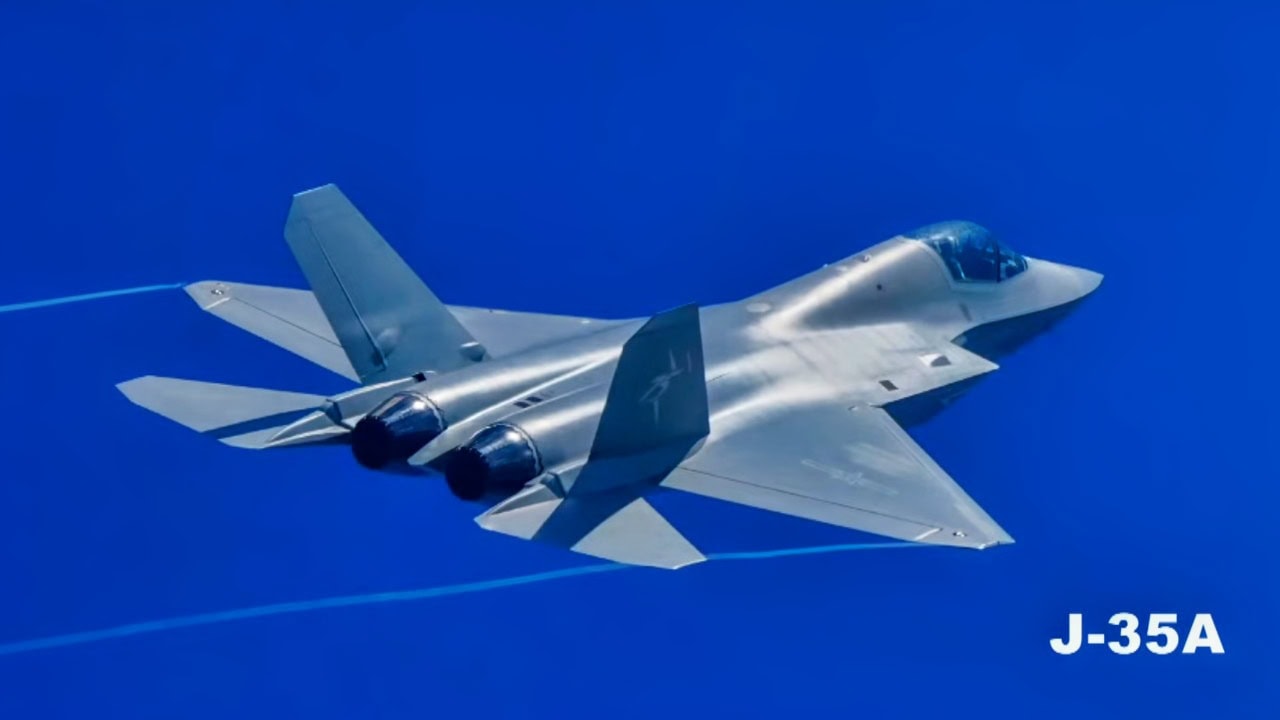
J-35 flying at Zhuhai Airshow 2024.
However, these fighters have been seen without the fuselage/nose section numbers found on aircraft with operational squadrons.
Aircraft Carrier J-35 Design and Mission
Both versions of the J-35 design are often characterized as the PLA’s answer to the US F-35 “Lightning II” program. The J-35 carrier variant specifically has a mission similar to that of the US Navy’s F-35C carrier variant.
Unlike the F-35C, which has a wing with a 43-foot wingspan – roughly 8 feet (23 percent) wider than the 35-foot wingspan of the F-35A and F-35B – the J-35 wing dimensions appear to be uniform across both variants.
While the 8-foot difference in the width of the different F-35 models may not seem like much, it accounts for a significantly greater total wing area of 668 square feet, roughly 45 percent larger than the 460 square feet of the F-35A/B variants.
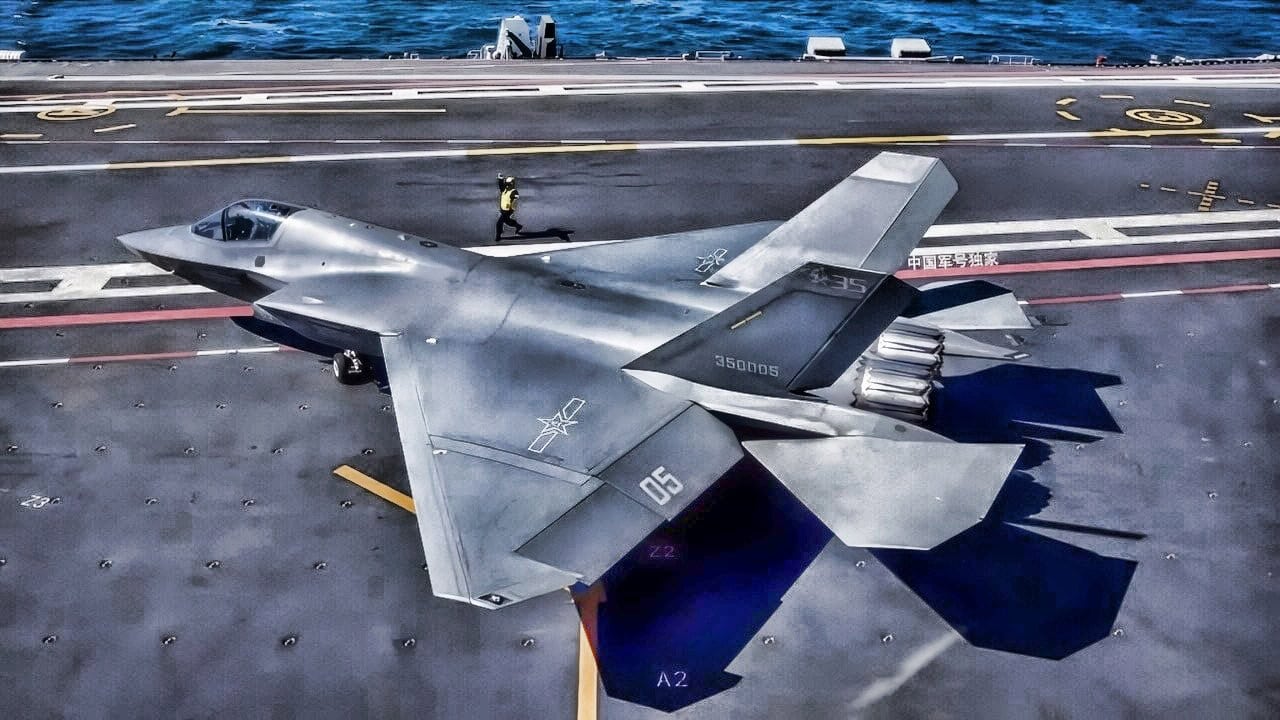
China J-35 Naval Stealth Fighter. Image Credit: PLAN.
The F-35C’s larger wing is the design team’s answer to provide the lower approach speeds for carrier landings. The J-35 wing is no larger than the J-35A because the aircraft is said to be using conventional horizontal tailplanes for pitch control, improving its stealth profile, specifically for carrier operations.
The J-35 basic design has progressed through numerous iterations since its first official test flight, then called “FC-31,” in October 2012. Numerous redesigns were carried out, and two different, but better, Chinese-made engines were developed to replace the Russian RD-93 that powered the original prototypes.
A second prototype was produced and then unveiled on 23 December 2016. This variant featured a structural redesign, a single-piece canopy, and Chinese-made WS-13E engines rated at 87 kN of thrust, replacing the RD-93. The carrier version J-35 prototype made its first flight on 29 October 2021 and was fitted with a catapult launch bar, folding wings, an arrested-landing tailhook, and more robust landing gear – all requirements for carrier operations.
The design team also significantly improved the aircraft’s stealth and aerodynamic performance. This involved, among other modifications, a completely new configuration of the vertical tails.
Stealth, Weapons, and Systems
Like almost all stealth aircraft, the J-35 carries ordnance in an internal weapons bay. The angular lines of the airframe were also developed to reduce the aircraft’s radar cross-section (RCS) as much as possible. The aircraft also has its engines arranged so that there is no direct line of sight from the air inlets to the front of the engines’ fan frames – another standard requirement for low-observable design.
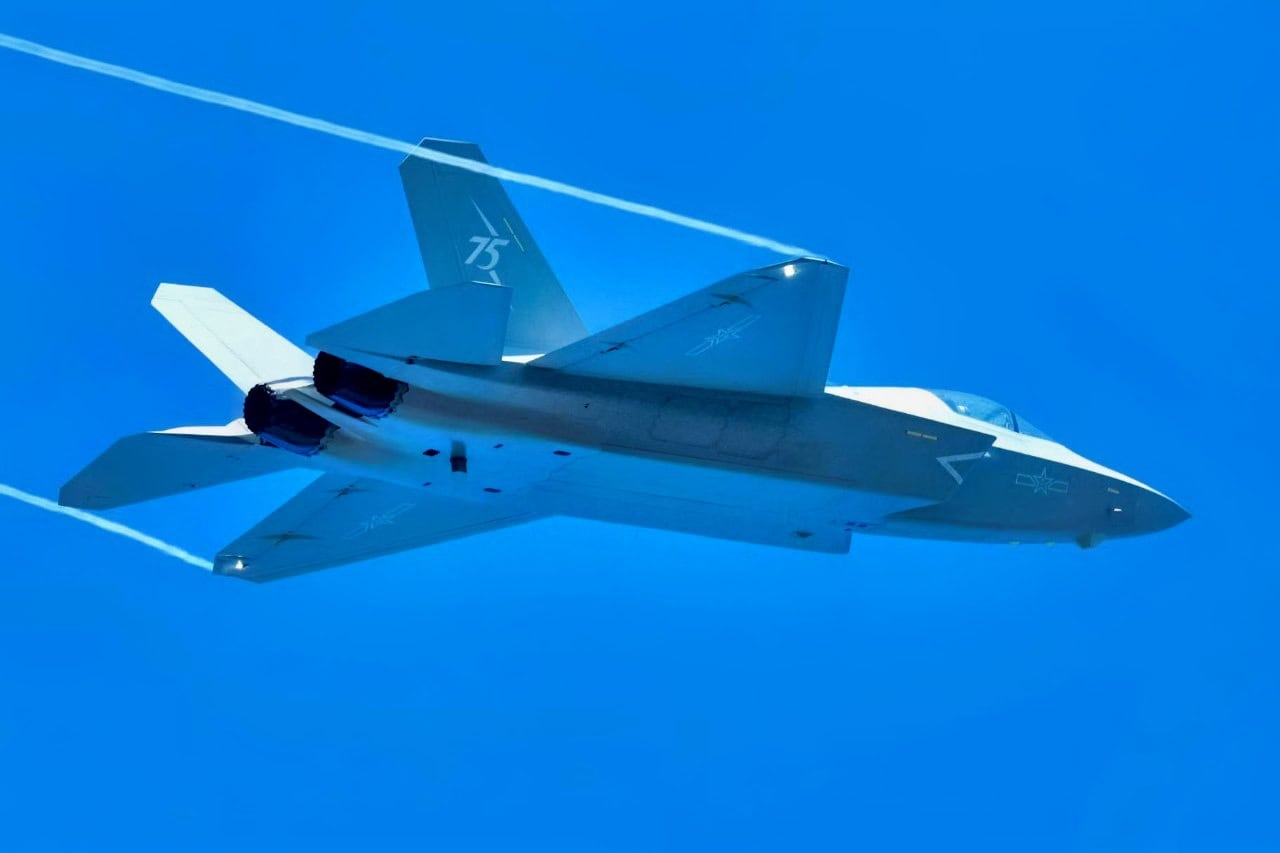
J-35 Fighter. Image Credit: Chinese State Media.
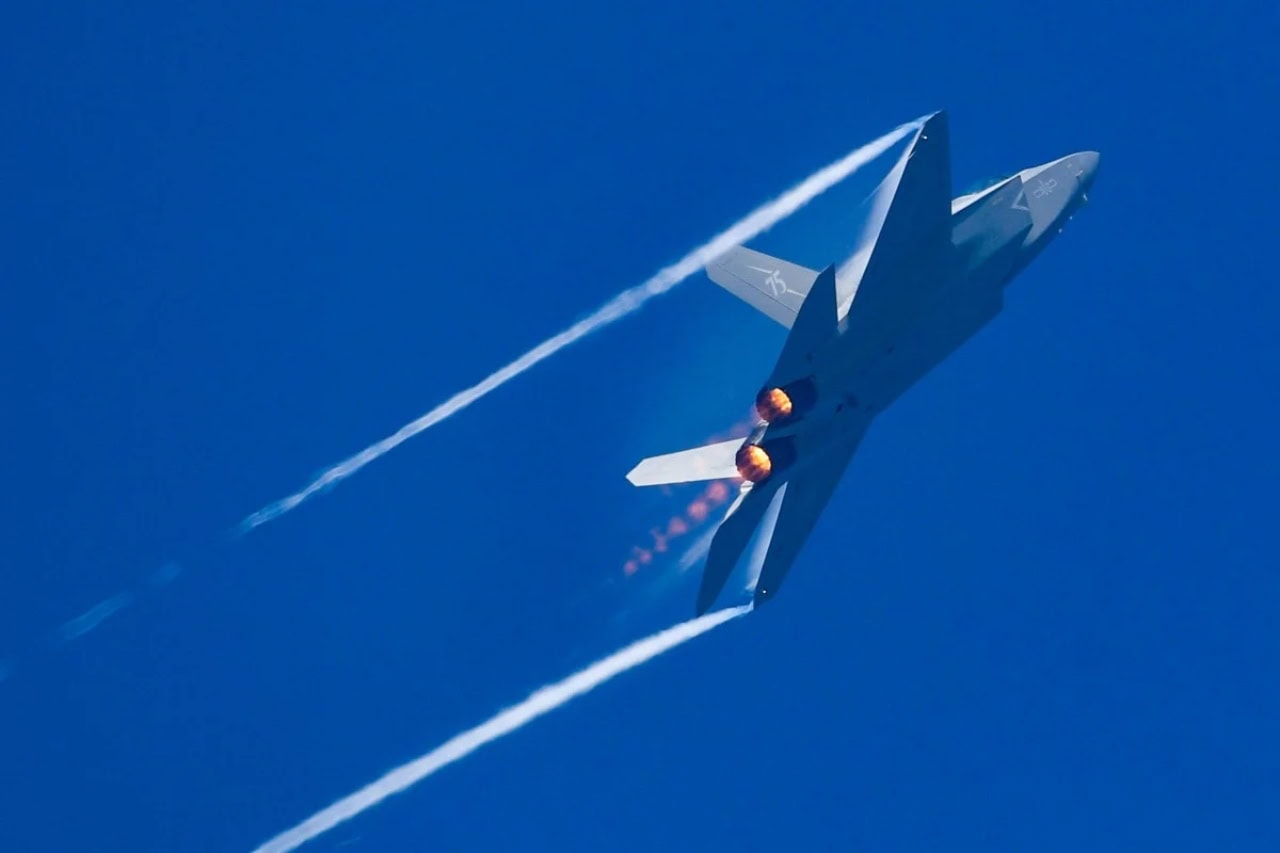
J-35. Image Credit: Chinese State Media.
Previous reports on the J-35 design portray it as an aircraft capable of carrying a wide variety of weapons loadouts. It can carry a mix of missiles or bombs internally, but it can also operate with munitions mounted externally on up to six hard points when the need for a larger weapons load overrides stealth considerations.
Among the weapons cleared for the aircraft are the PRC’s most advanced missiles, namely the LETRI PL-15 and PL-21. Its combat range is reported to be around 746 miles with a maximum take-off weight of about 66,139 pounds.
What is not known is if the J-35 carrier variant carrying a full weapons load would be required to dump munitions into the sea before being trapped back aboard the deck of the carrier.
The US Navy’s F/A-18E/F Super Hornets do not routinely dump munitions before recovering aboard the carrier, but they must land below a specific maximum weight or “max trap” to avoid damaging the landing gear or breaking arresting wires.
If the aircraft must return while overweight due to excess ordnance, pilots will first dump fuel to reduce weight. The practice of jettisoning weapons is a last resort due to cost and safety considerations.
About the Author: Reuben F. Johnson
Reuben F. Johnson has thirty-six years of experience analyzing and reporting on foreign weapons systems, defense technologies, and international arms export policy. Johnson is the Director of Research at the Casimir Pulaski Foundation. He is also a survivor of the Russian invasion of Ukraine in February 2022. He worked for years in the American defense industry as a foreign technology analyst and later as a consultant for the U.S. Department of Defense, the Departments of the Navy and Air Force, and the governments of the United Kingdom and Australia. In 2022-2023, he won two awards in a row for his defense reporting. He holds a bachelor’s degree from DePauw University and a master’s degree from Miami University in Ohio, specializing in Soviet and Russian studies. He lives in Warsaw.