
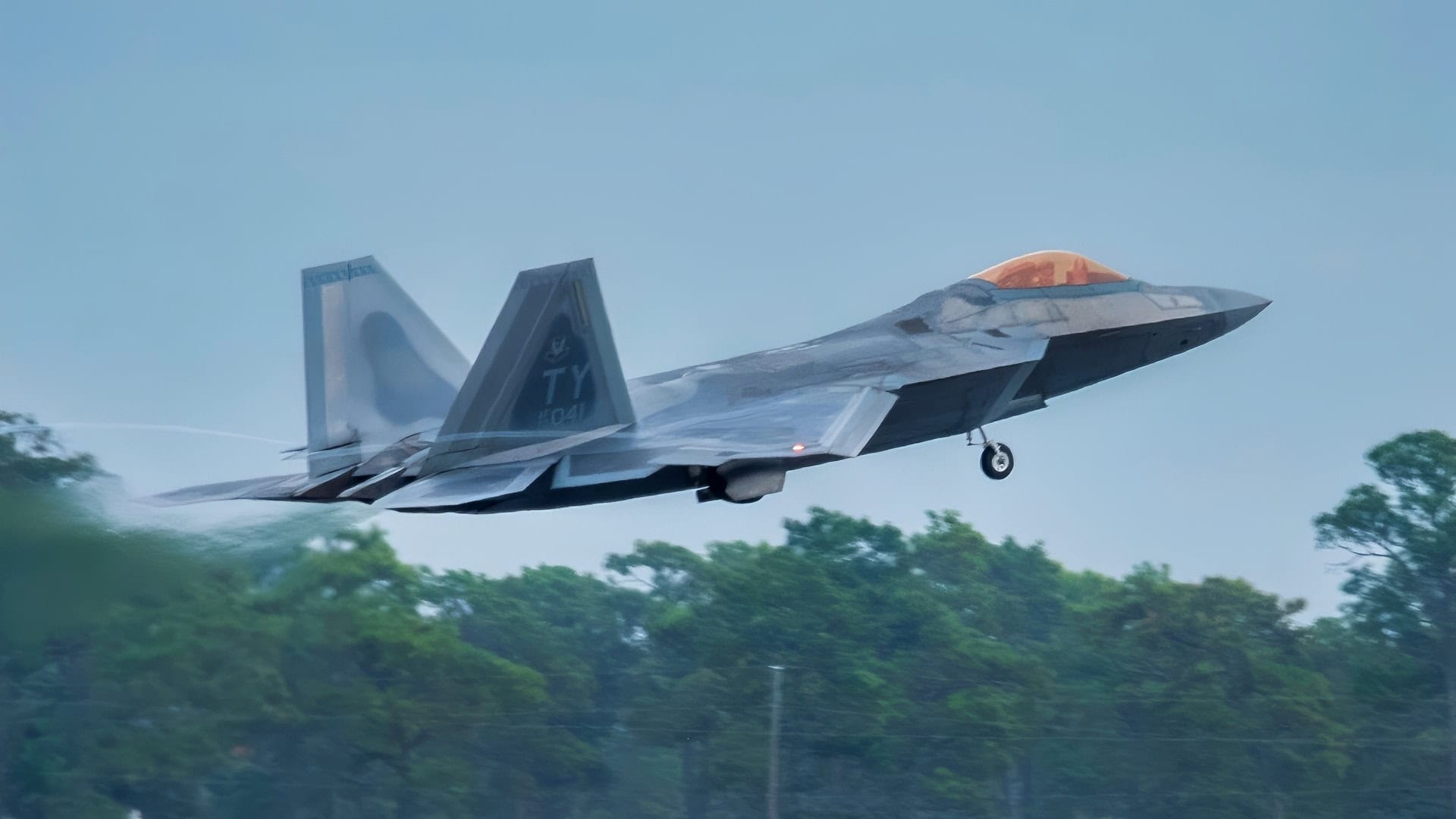
The F-22 Raptor Takes on China’s J-20 and Su-57: To be brutally frank, the United States of America is engaged in a New Cold War with the People’s Republic of China (PRC) along with China’s former “old” Cold War adversary cum present-day erstwhile ally Russia.
Should that New Cold War—heaven forbid—turn into a “hot war,” one of the big debates rages as to which nation would win in a fight between the adversaries’ 5th Generation stealth fighters.
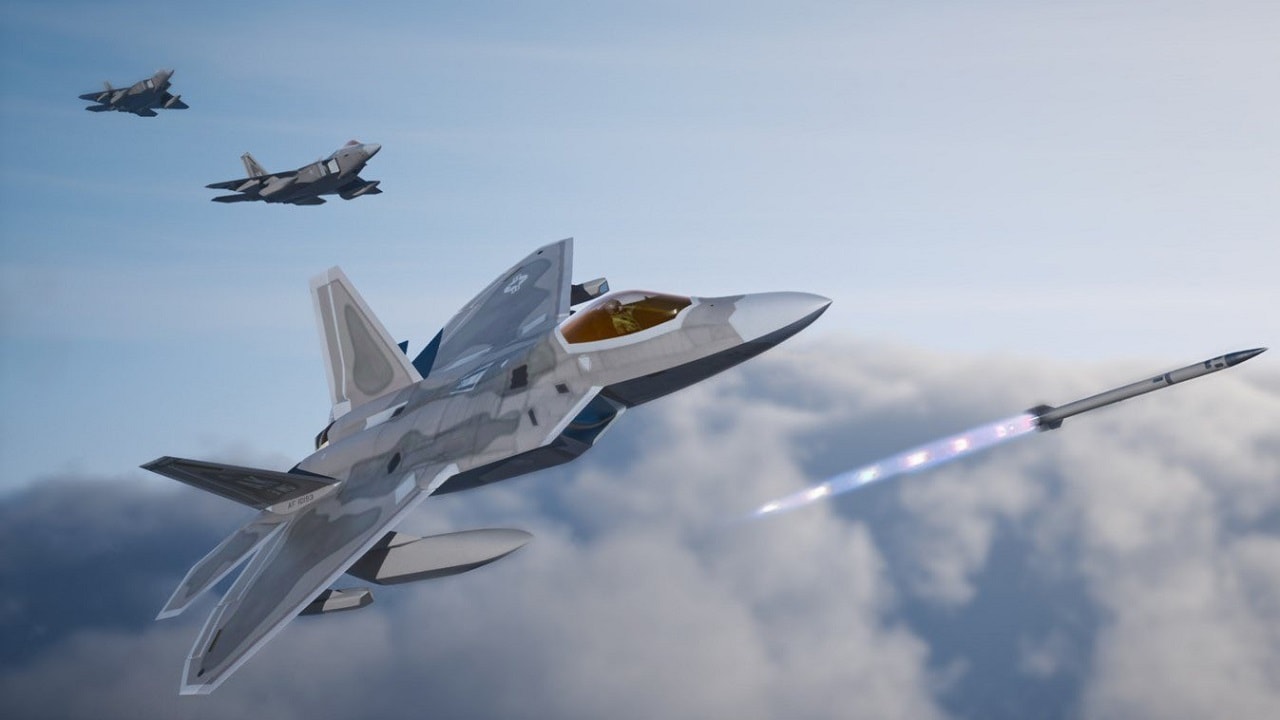
F-22 Raptor. Image Credit: U.S. Air Force Social Media.
The People’s Liberation Army Air Force has the Chengdu J-20 (“Mighty Dragon;” NATO reporting name “Fagin”), the Russian Federation has the Sukhoi Su-57 “Felon,” whilst the U.S has the F-22 Raptor and the F-35 Lightning II, both of which are products of Lockheed Martin’s famed “Skunk Works” division.
For now, we’re going to focus on how the F-22 stacks up against both the J-20 and the Su-57.
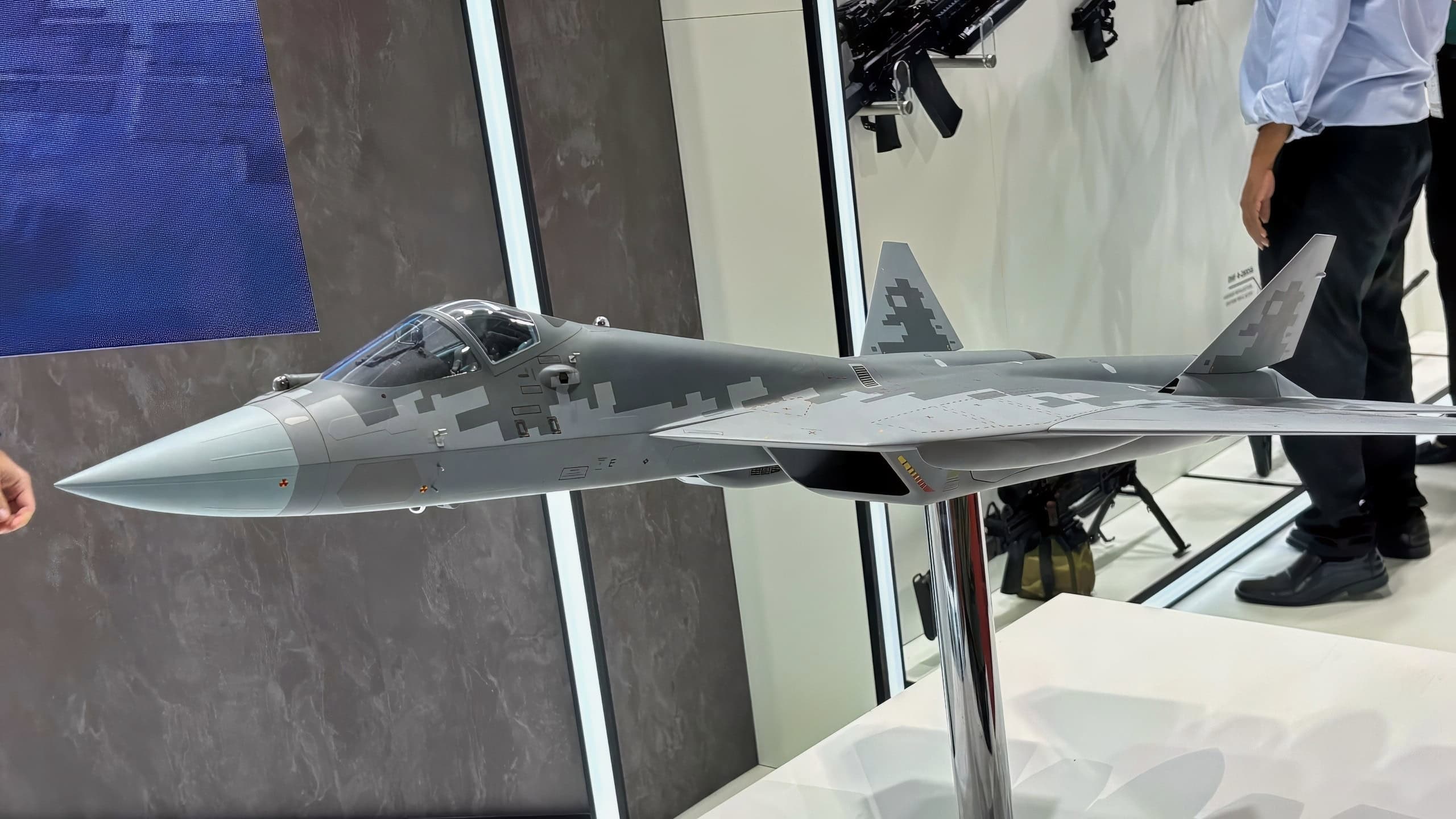
Su-57 Model 19FortyFive Original Photo
Matchup #1: F-22 vs. J-20
The Chinese stealth warbird has the following advantages against its American adversary:
–Less expensive and maintenance-intensive
-Superior side and rear-angle stealth
-Max airspeed of Mach 2.8, significantly faster than the Raptor’s Mach 2.25

J-20 Fighter. Image Credit: Chinese CCTV.
-Slightly superior supercruise speed, e.g., Mach 1.8 vs. Mach 1.76
-Larger payload
-Superior data-link capabilities, making it more suited for modern information-centric warfare
On the flip side, the Raptor beats the “Mighty Dragon” in the following aspects:
-Superior in frontal stealth
-Superior maneuverability for close-range dogfighting
-Thrust vectoring nozzles, enabling extreme post-stall maneuvers like the Cobra maneuver
-Northrop Grumman APG-77 AESA radar, providing excellent detection and tracking range
-Actually having a gun—specifically the 20mm General Dynamics M61A2 Vulcan rotary cannon—in case the fight’s still on after all the missiles have been expended
Matchup #2: F-22 vs. Su-57
Though the Russian defense industry has taken a collective reputational hard hit in the current decade, the Felon does have certain advantages over the Raptor:
-Better Vertical and Short Takeoff and Landing (V/STOL) capabilities
-More versatile mission capabilities across the spectrum of multi-role, air-to-air and air-to-ground missions
-Better sensors that can detect and engage targets at longer ranges, particularly beyond visual range (BVR), along with missile defense systems, countermeasures, and jamming capabilities
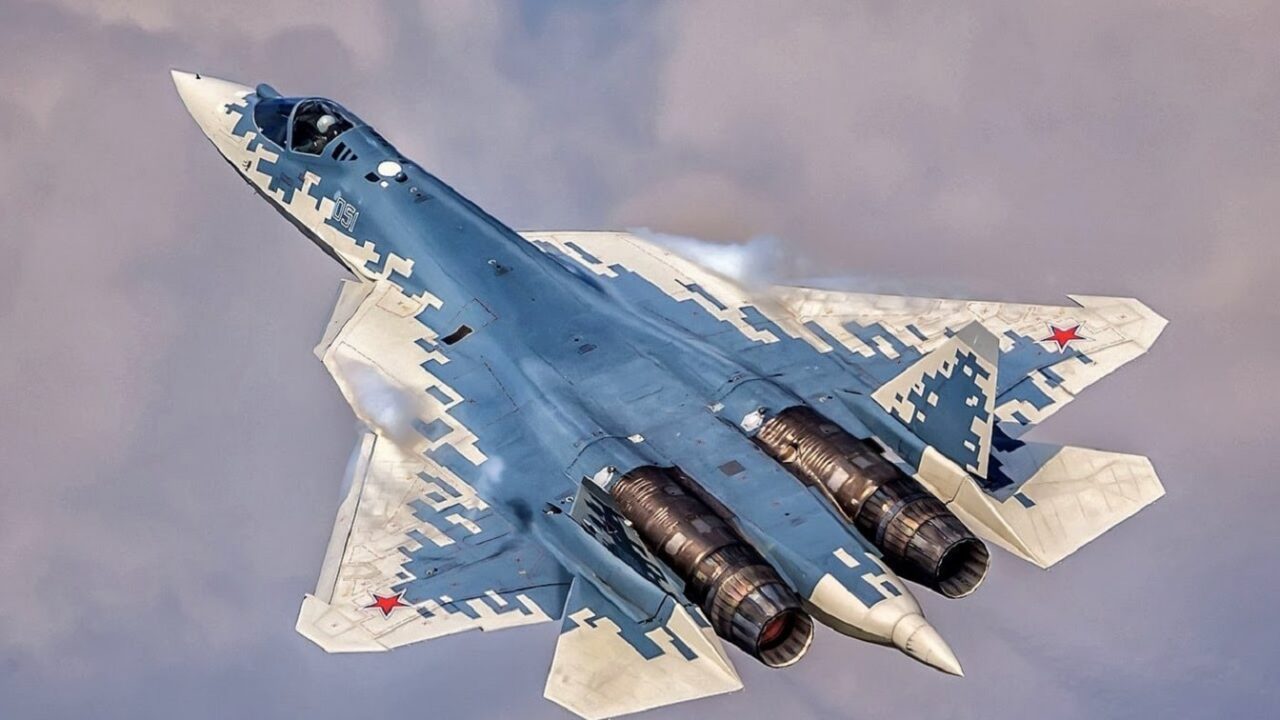
Russia’s Su-57 Felon Stealth Fighter. Image Credit: Creative Commons.
Lower cost
As for the F-22 advantages over the Su-57:
-Superior ergonomics and user interface, as exemplified by the HOTAS (Hands On Throttle And Stick) feature
-More reliable and maintenance-friendly despite higher cost
-Reduced radar cross-section (RCS), thus making it much harder to detect
-Superior flight performance, maneuverability, avionics and electronics, survivability, and scalability
Going Beyond Tech Specs: The Production Numbers Game
Now for a disturbing variable that goes beyond the mere tech specs of each contending stealth fighter: the sheer production numbers game, past, present, and future alike. “Quantity has a quality of its own” is a saying apocryphally attributed to Joseph Stalin but is *correctly* attributed to British aerodynamicist Frederick Lanchester.
Or to put a new spin on the old proverb “A bird in the hand beats two in the bush,” a fully armed warbird in the air beats two languishing on the tarmac or in the hangar due to lack of spare parts.
Total F-22 production sits at a measly 187 airframes, and that pathetic numerical shortage can be narrowed down to three words: Robert Michael Gates.
Back in 2009, then-US Secretary of Defense (SECDEF) Bob Gates made the incredibly short-sighted decision to kill the Raptor after a measly 49 percent of the originally planned number of airframes had been built.
By contrast, the Royal United Services Institute (RUSI), a U.K.-based think tank, projected that, by late 2025, production rates for the Fagin had likely reached around 120 aircraft per year, and that around 300 of the “Mighty Dragons” were in service across at least 13 PLAAF regiments.
As if that weren’t ominous enough, the January 2026 RUSI report added that “The total produced is likely to be higher, since a significant number of newly produced fighters will still be awaiting delivery to units.”
As for the Su-57 numbers? Well, they’re not nearly as scary on paper, and they’re indeed rather embarrassing for Vladimir Putin and his generals: production number estimates run anywhere from as low as 21 Felons to an underwhelming high of 30.
Moreover, the combination of expenditures on the war in Ukraine and international sanctions has hobbled Felon production.
However, at last the Su-57 *still is* in production, which is more than can be said for the Raptor.
For reasons that’re unfathomable to this writer and Air Force veteran, nobody seems to be willing to publicly ask the question of whether the Donald Trump Administration would be willing & able to order a resurrection of the F-22 program in the same way that the Ronald Reagan Administration resurrected both the B-1 bomber and the Nimitz-class carrier after the Jimmy Carter Administration had put the kibosh on both of those programs.
Why can’t current Secretary of War (SECWAR) Pete Hegseth override and supersede his Obama Administration predecessor’s directive and ask Lockheed Martin to revive F-22 production lines?
If the practical answer is “No,” then fine, fair enough, but why not at least broach the question in the first place!?
About the Author: Christian D. Orr
Christian D. Orr is a Senior Defense Editor. He is a former Air Force Security Forces officer, Federal law enforcement officer, and private military contractor (with assignments worked in Iraq, the United Arab Emirates, Kosovo, Japan, Germany, and the Pentagon). Chris holds a B.A. in International Relations from the University of Southern California (USC) and an M.A. in Intelligence Studies (with a concentration in Terrorism Studies) from American Military University (AMU). He is also the author of the book “Five Decades of a Fabulous Firearm: Celebrating the 50th Anniversary of the Beretta 92 Pistol Series,” the second edition of which was recently published.