
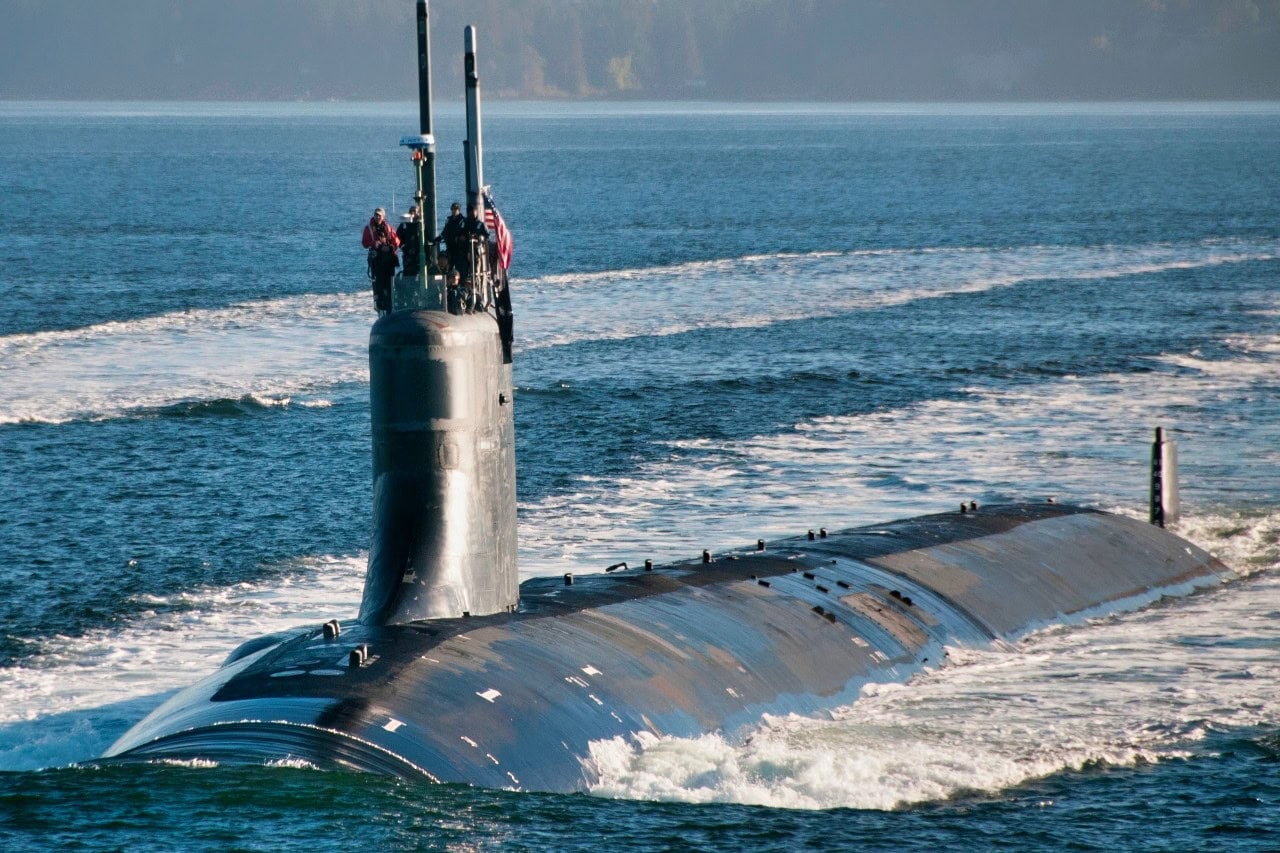
USS Jimmy Carter: The US Navy Added 100 Feet to This Submarine and Has Never Said What’s Inside – Moored at Naval Base Kitsap-Bangor in Washington State sits the United States’ most secretive warship. USS Jimmy Carter looks like her two Seawolf-class sisters until you measure her: 453 feet against their 353, roughly 12,100 tons submerged against their 9,100. The difference is a 100-foot, massively sized section inserted amidships during construction, called the Multi-Mission Platform, and in the two decades since her 2005 commissioning, the Navy has never publicly described what happens inside it. What exists instead is a paper trail, and it is eloquent.
USS Jimmy Carter The Plug in the Paperwork
The trail starts with a contract. On December 10, 1999, Electric Boat received an $887 million modification to the third and final Seawolf hull, altering the design for test and development work and for classified missions of the sort “previously carried out” by USS Parche, the intelligence-collection submarine then nearing retirement.
That sentence, naming Parche, is the closest thing to a mission statement the program has ever produced. The boat that emerged was launched in May 2004 and commissioned on February 19, 2005, with a crew of about 144, a single S6W reactor, and a namesake unique in the fleet: Jimmy Carter, the only American president ever to qualify in submarines, with Rosalynn Carter as the ship’s sponsor and the vessel only the third American submarine named for a living person.
What the Navy Admits Is Inside
The official description is careful and geometric. The Multi-Mission Platform provides added payload volume, a pressure-resistant passage connecting the fore and aft crew spaces, and an ocean interface: a section where the sea can be let in and out, through which divers, remotely operated vehicles, and unmanned undersea craft can leave and return while submerged.
The boat carries auxiliary thrusters at the bow and stern, allowing her to hover in place over a precise point on the seafloor, a capability no ordinary attack submarine needs, and this one specifically received.
The program language describes support for special operations forces, a reconfigurable electronics suite, and research and development for naval special warfare, while stressing that it retains the full Seawolf combat suite, the fastest, deepest-diving, most heavily armed attack design America ever fielded. Everything beyond that is silence.
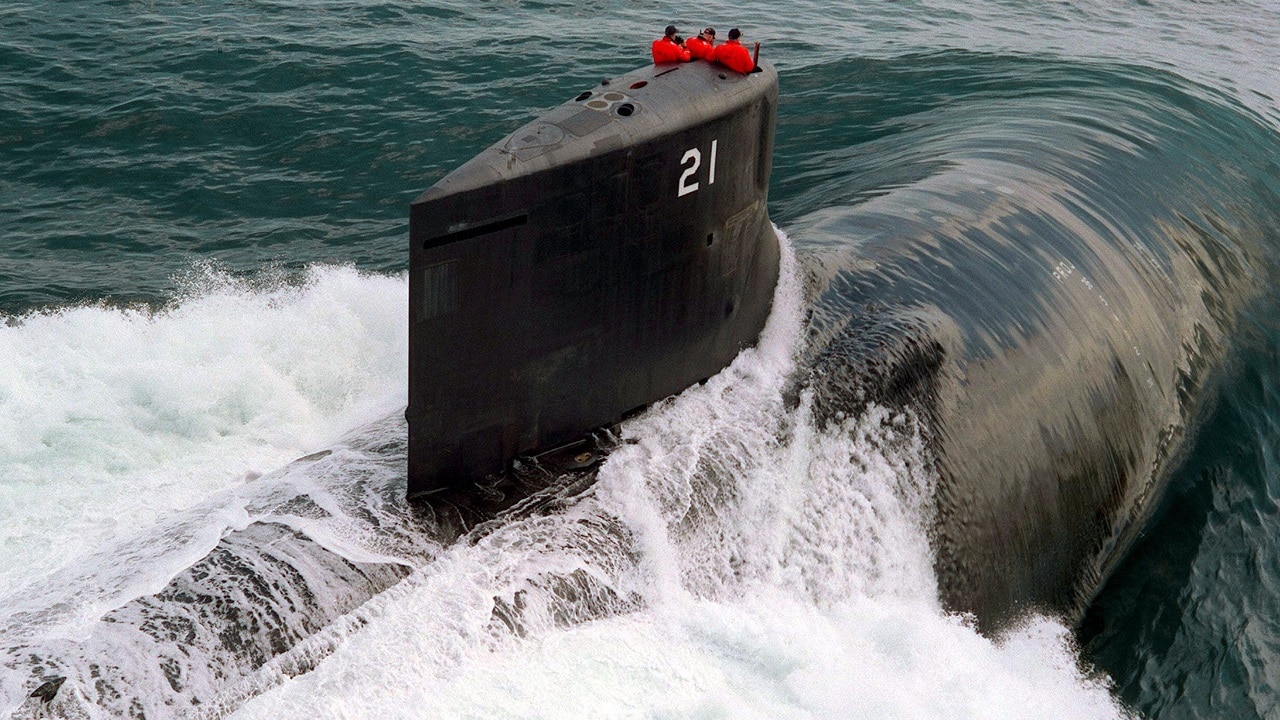
The U.S. Navy’s newest attack submarine, USS Seawolf (SSN 21), conducts Bravo sea trials off the coast of Connecticut in preparation for its scheduled commissioning in July 1997.
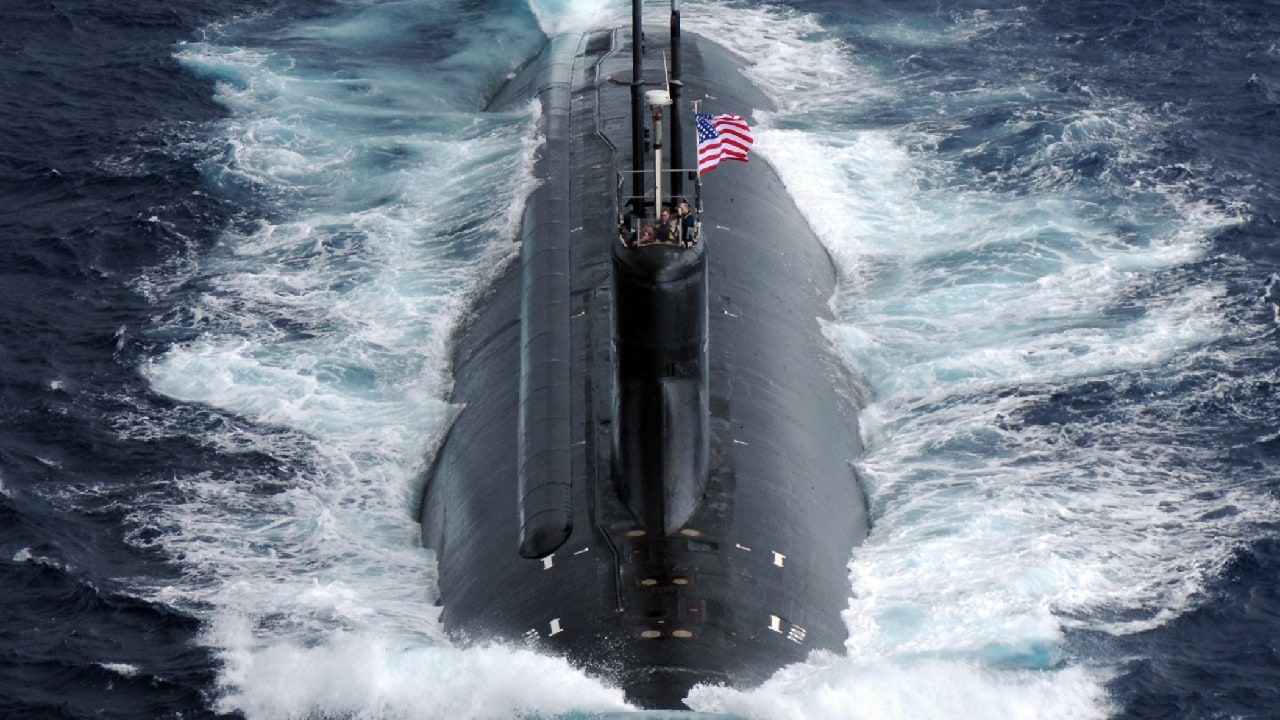
The Seawolf-class fast-attack submarine USS Connecticut transits the Pacific Ocean during Annual Exercise. ANNUALEX is a yearly bilateral exercise with the U.S. Navy and the Japan Maritime Self-Defense Force.
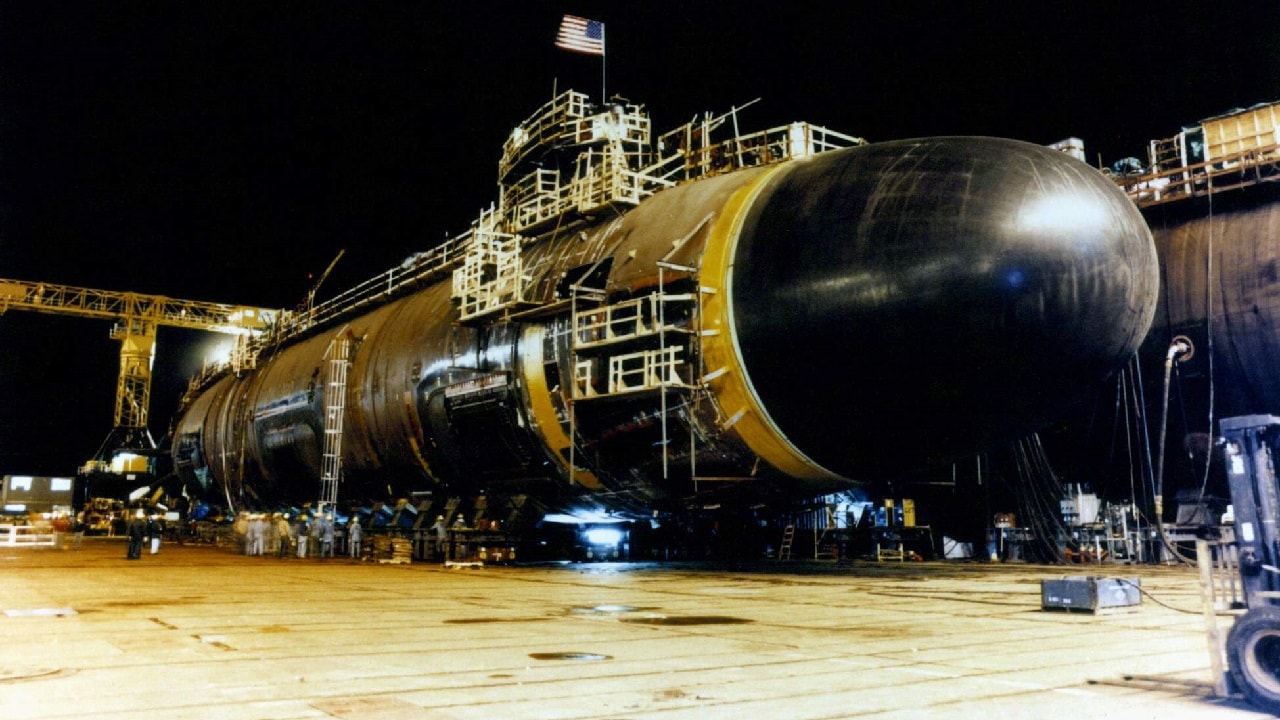
The first of a revolutionary new class of fast attack submarine, the Seawolf (SSN-21). Shown during construction at the Electric Boat Division of General Dynamics Corporation in Groton, Conn. She was christened by Margaret Dalton, wife of Secretary of the Navy John H. Dalton, on June 24, 1995.
The Lineage That Explains the Silence
The silence has a family history. American seabed espionage ran through a sequence of one-of-a-kind boats: the converted USS Halibut, then the first USS Seawolf, then USS Parche, each stretched with special sections for work on the ocean floor, most famously the Cold War cable taps on Soviet lines in the Sea of Okhotsk.
Parche retired in the fall of 2004 as the most decorated vessel in Navy history, with nine Presidential Unit Citations for missions still classified, and Jimmy Carter commissioned four months later. Specialist analysts describe her flatly as the premier seabed-warfare boat of the U.S. Navy, and the presumption that has followed her for twenty years, in an age when fiber-optic cables carry the world’s communications across the seabed, requires no elaboration.
The Navy has never confirmed it. The Navy has never denied it either.
The Evidence in the Margins
Occasionally, the record does reveal something. Documents obtained under the Freedom of Information Act by the reporting outlet War Is Boring showed the submarine departing Bangor on January 20, 2013, surfacing in the official annual history months later with a single-line notation, and her crew receiving a Presidential Unit Citation, an award whose official description cites “extraordinary heroism in action against an armed enemy,” for something the documents call only Mission 7.
In the released photographs of the ceremony, Navy censors blacked out one participant’s face.
In 2017, the boat twice returned home through the Hood Canal flying the Jolly Roger, the submariner’s traditional signal of a successful operation, a flag the Navy declined to explain.
She has since been observed deploying the Dry Combat Submersible, the enclosed delivery craft that carries SEALs to a target dry and rested, and analysts assess her as built for exactly the seabed fight, cables, sensors, and infrastructure, that now anchors great-power competition.
The honest accounting stays disciplined: the citations, the flags, and the geometry are facts; everything about what the ocean interface has actually touched is inference resting on them.
The Successor That Confirms the Job
Two later developments corroborate the inference better than any leak. The first is scarcity: the Seawolf program was cut from 29 boats to three at the Cold War’s end, a decision now widely counted among the Navy’s costliest, which left a single hull carrying an entire mission set, a boat valued at roughly $3.5 billion that analysts rank among the best submarines ever built, and one whose classified portfolio no other vessel in the fleet can absorb.
The second is the budget: the Navy is procuring a one-off Modified Virginia-class boat for subsea and seabed warfare, begun at Electric Boat with an estimated $5.1 billion price in the fiscal 2024 budget, explicitly to augment or succeed Jimmy Carter.
Navies do not spend five billion dollars replacing a capability that does not matter.
As of the record’s latest entries, the original entered Dry Dock 6 at Puget Sound Naval Shipyard in 2024 for a months-long maintenance availability, her twentieth year of service, with the shipyard noting only that she possesses everything a standard Seawolf has, plus the 100-foot section, purpose officially unstated, that a $5.1 billion successor is now being built to carry on.
About the Author: Harry J. Kazanis
Harry J. Kazianis (@Grecianformula) was the former Senior Director of National Security Affairs at the Center for the National Interest (CFTNI), a foreign policy think tank founded by Richard Nixon based in Washington, DC. Harry has over a decade of experience in think tanks and national security publishing. His ideas have been published in the NY Times, The Washington Post, The Wall Street Journal, CNN, and many other outlets worldwide. He has held positions at CSIS, the Heritage Foundation, the University of Nottingham, and several other institutions related to national security research and studies. He is the former Executive Editor of the National Interest and the Diplomat. He holds a Master’s degree focusing on international affairs from Harvard University.