
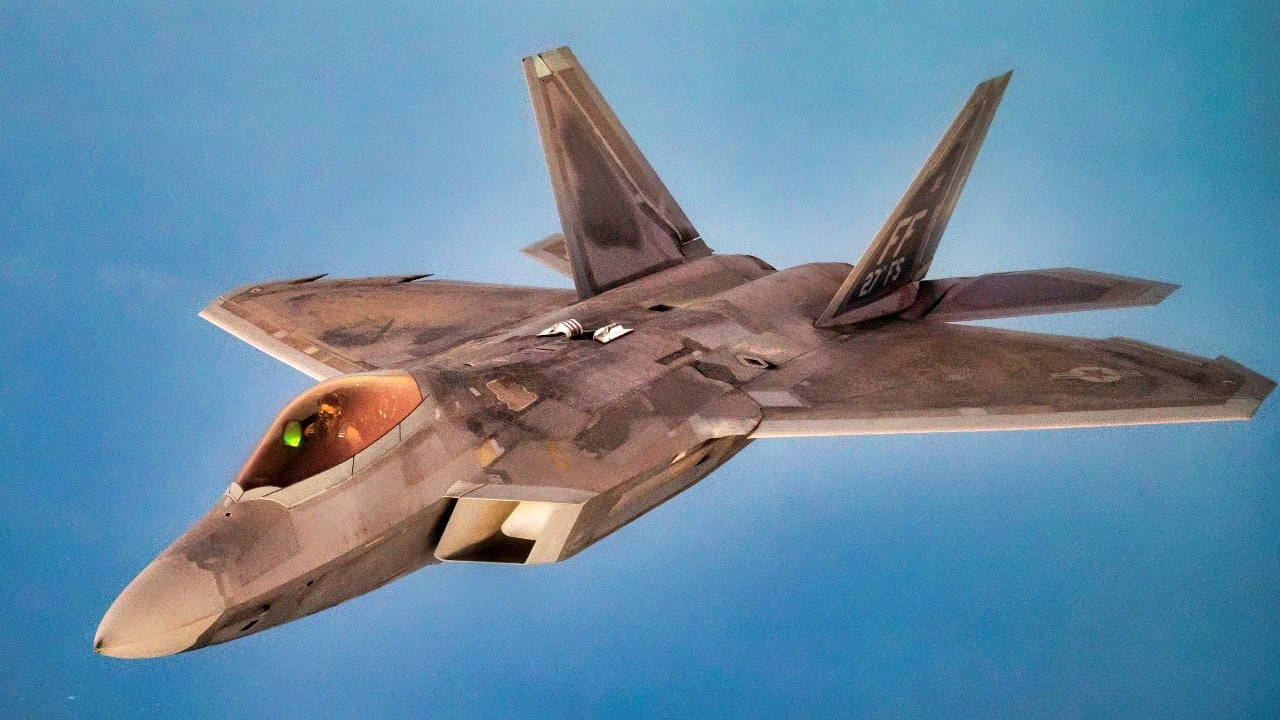
The Navy’s F-22 Aircraft Carrier Fighter Died Before a Prototype Was Built – The U.S. Navy never planned to place the production F-22A on an aircraft carrier. The proposal began before the operational Raptor existed, when the Navy joined the Air Force’s Advanced Tactical Fighter process and studied a carrier-based derivative called the Naval Advanced Tactical Fighter, or NATF. Its intended replacement was the F-14 Tomcat.
In 1988, the Navy funded competing contractor teams to define naval requirements and examine carrier suitability. The YF-22 and YF-23 first flew in late 1990, and the Lockheed-led YF-22 team won the Air Force competition in 1991.
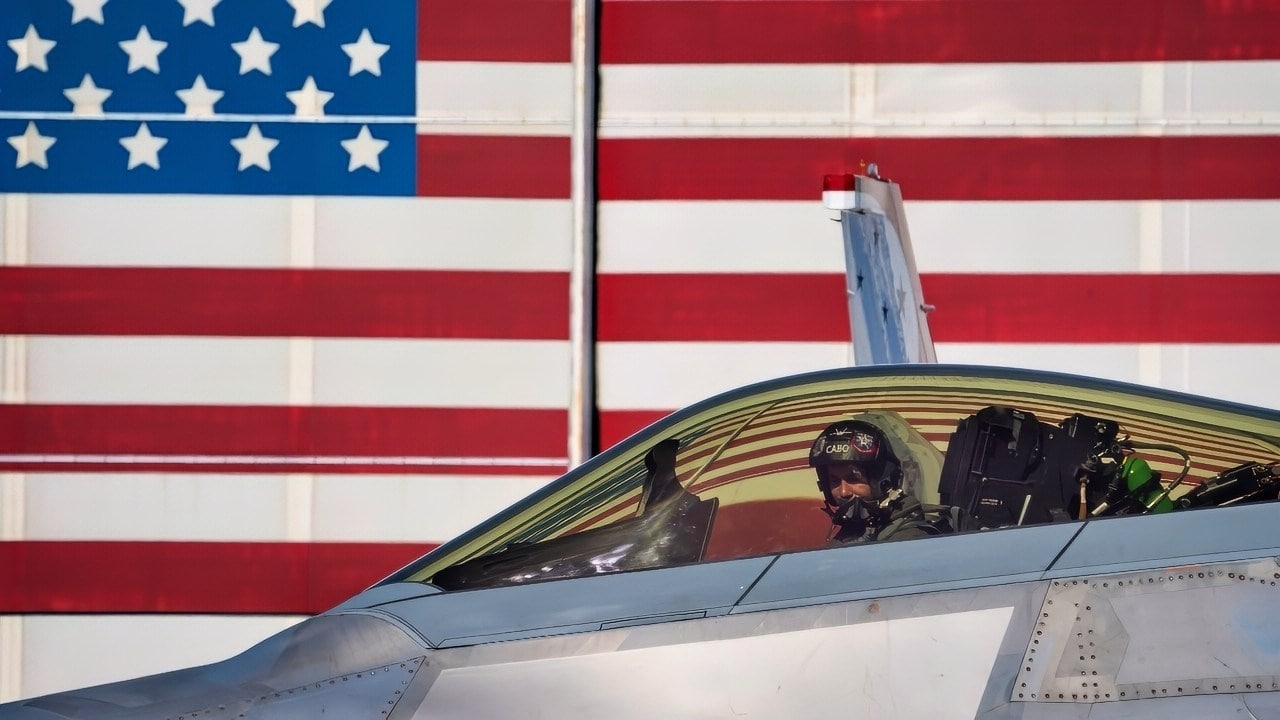
U.S. Air Force Maj. Josh Gunderson, F-22 Demo Team commander, taxis by the Wallops Island Flight Facility NASA hanger June 17, 2021, at Wallops Island, Va. The primary function of the F-22A Raptor is an air dominance and multi-role stealth fighter, and can carry a combination of air-to-air missiles and air-to-ground bombs. (U.S. Air Force photo by Staff Sgt. Don Hudson)
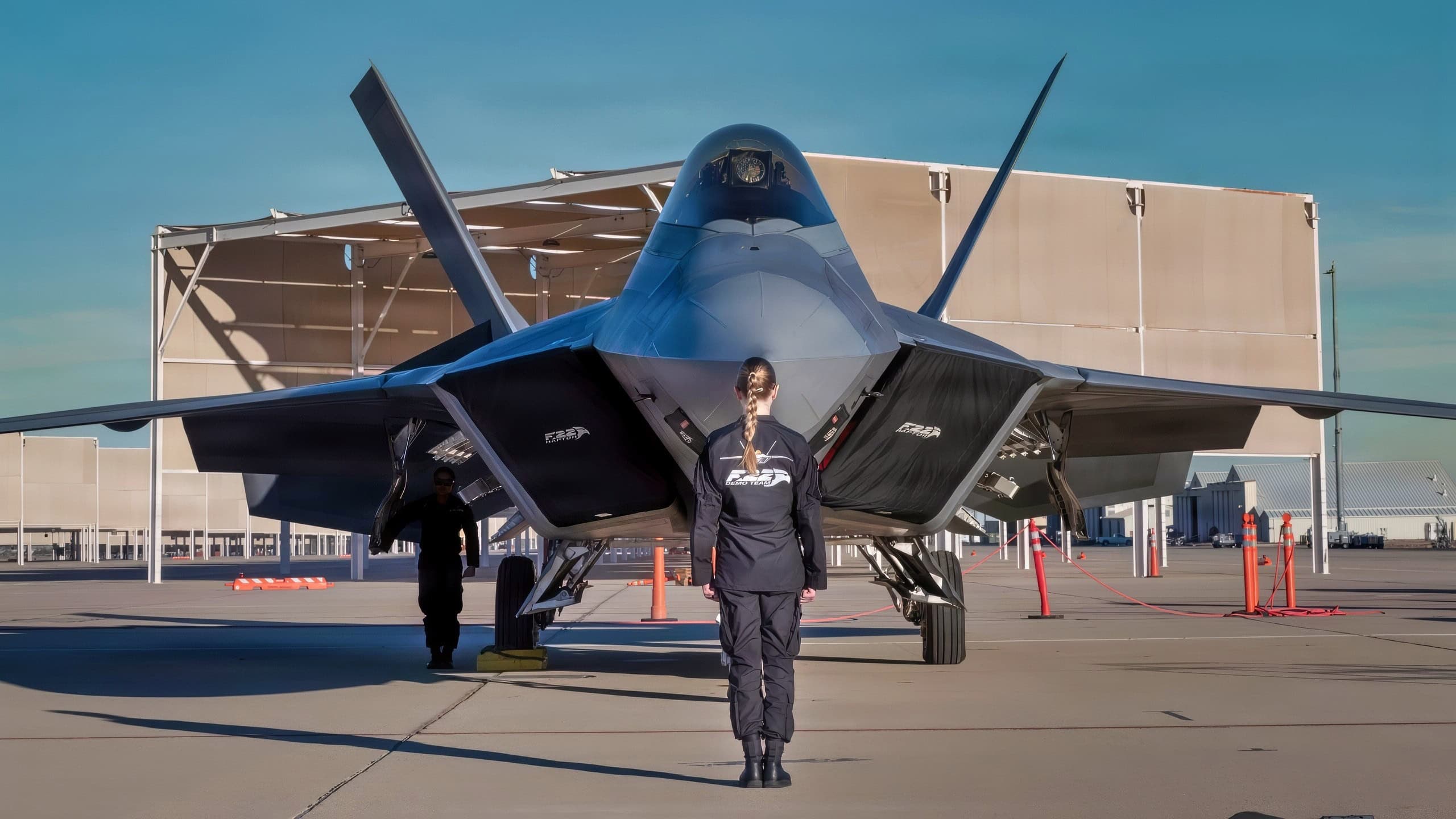
Maintainers assigned to the U.S. Air Force F-22 Raptor Demonstration Team perform preflight inspections on an F-22 during the Heritage Flight Training Course at Davis-Monthan Air Force Base, Arizona, Feb. 26, 2026. The team consists of 14 specialized Airmen who maintain and support the Raptor’s mission of providing undisputed air superiority. (U.S. Air Force Photo by Senior Airman Jhade Herrera)
By March 1990, the Navy estimated NATF acquisition at $66.1 billion in escalated dollars. That included $8.5 billion for development and $57.6 billion to procure an estimated 618 aircraft. The Navy had budgeted $724 million for fiscal years 1990 through 1994, although only $131.9 million had been budgeted through fiscal year 1990.
No naval prototype was included in the demonstration phase. Contractors produced preliminary designs and wind-tunnel data, while the Air Force tested prototypes for land-based performance.
The Navy therefore decided to cancel before building a carrier flight-test fleet.
The Navy Needed More Than a Tailhook
GAO calculated that an arrested carrier landing subjected an aircraft to 24 times the deceleration of a land-based landing, while vertical impact exceeded three times the land-based level. The NATF needed stronger landing gear, wings, and fuselage, a catapult-compatible nose gear, and an arresting hook.
Program officials estimated naval requirements would add about 4,000 pounds to empty weight, the physical problem at the center of the carrier F-22 debate.
The Navy set a 65,000-pound maximum takeoff goal and a 52,000-pound carrier landing limit. The aircraft could be no longer than the F-14, and its folded footprint could occupy no more deck space.
Planners wanted two NATFs to fit on a 70-by-52-foot elevator rated for 130,000 pounds. The final Air Force F-22A later reached a published maximum takeoff weight of 83,500 pounds.
The carrier aircraft also needed low-speed handling, better over-the-nose visibility, folding wings, corrosion protection, and shielding from electromagnetic interference.
Those physical demands explain why naval hardware could not simply be added to a finished Raptor.
The Navy Wanted an F-14 Successor With More Range
The NATF’s primary assignment was fleet air defense. It had to remain far from the carrier and destroy Soviet bombers before they launched cruise missiles. The Navy therefore wanted larger wings, more fuel, longer-range sensors and weapons, plus compatibility with its Advanced Air-to-Air Missile and AGM-88 HARM. It had not yet decided whether the aircraft would carry one or two crew members.
Those requirements pulled the naval airframe away from the Air Force fighter. GAO expected the engines, avionics, and subsystems to provide the strongest commonality, but said the airframe would likely be significantly different.
Engines and avionics represented about 44 percent of the estimated ATF flyaway cost. The Navy still faced the cost of designing and testing a separate carrier aircraft, while the F-14’s long-range fleet-defense role remained difficult to replace.
The familiar “Sea Raptor” artwork often depicts variable-sweep wings resembling those of the F-14. Such a wing could improve low-speed performance while limiting deck width, but the program ended during preliminary design. The Navy never selected a final wing, cockpit arrangement, or production configuration.
The Cold War Ended Before the Navy Could Afford It
The 618-aircraft estimate depended on a Cold War force large enough to spread development costs across hundreds of fighters. That assumption weakened as the Soviet threat receded and naval aviation faced expensive decisions involving the A-12, F-14D, A-6 replacement, and an enlarged F/A-18.
The fiscal 1991 NATF research line received $65.7 million. The fiscal 1992 and 1993 request reduced it to zero and described the program as suspended while the Navy remained involved in Air Force source selection.
A contemporary Naval Institute analysis concluded that naval aviation could afford only one major new aircraft development at a time. NATF never regained a funded route to a prototype.
The Super Hornet Became the Practical Replacement
There was no flyoff between NATF and the Super Hornet.
The F/A-18E/F followed an evolutionary route from an aircraft already designed for carrier operations, and a contemporary estimate placed its nonrecurring development cost at $3.3 billion.
It entered fleet service in 1999 and became the replacement for the F-14, which retired in 2006.
The F-35C achieved initial operational capability in 2019, giving carrier air wings a low-observable fighter with a different mission balance.
The current demand for F/A-XX reflects the same pressure behind the F-14’s fleet-defense legacy: range, survivability, and deck suitability must fit inside one affordable aircraft.
Modern accounts of the F-22 and F-14 replacement proposal, and of other fighters the Navy nearly built, keep the “Sea Raptor” nickname alive. Official records call the program NATF, and the surviving artwork represents concepts rather than an aircraft ready for engineering development.
The Super Hornet production line is reaching its final aircraft, while the F/A-XX faces another round of debate over cost, industrial capacity, and priorities. Naval aviation still wants a stealthy fighter capable of long-range operations, but carrier requirements must shape the airframe from its initial design.
The Navy never funded a NATF prototype, and no F-22 has ever made a catapult launch or arrested landing at sea.
About the Author: Harry J. Kazianis
Harry J. Kazianis (@Grecianformula) was the former Senior Director of National Security Affairs at the Center for the National Interest (CFTNI), a foreign policy think tank founded by Richard Nixon based in Washington, DC. Harry has over a decade of experience in think tanks and national security publishing. His ideas have been published in the NY Times, The Washington Post, The Wall Street Journal, CNN, and many other outlets worldwide. He has held positions at CSIS, the Heritage Foundation, the University of Nottingham, and several other institutions related to national security research and studies. He is the former Executive Editor of the National Interest and the Diplomat. He holds a Master’s degree focusing on international affairs from Harvard University.