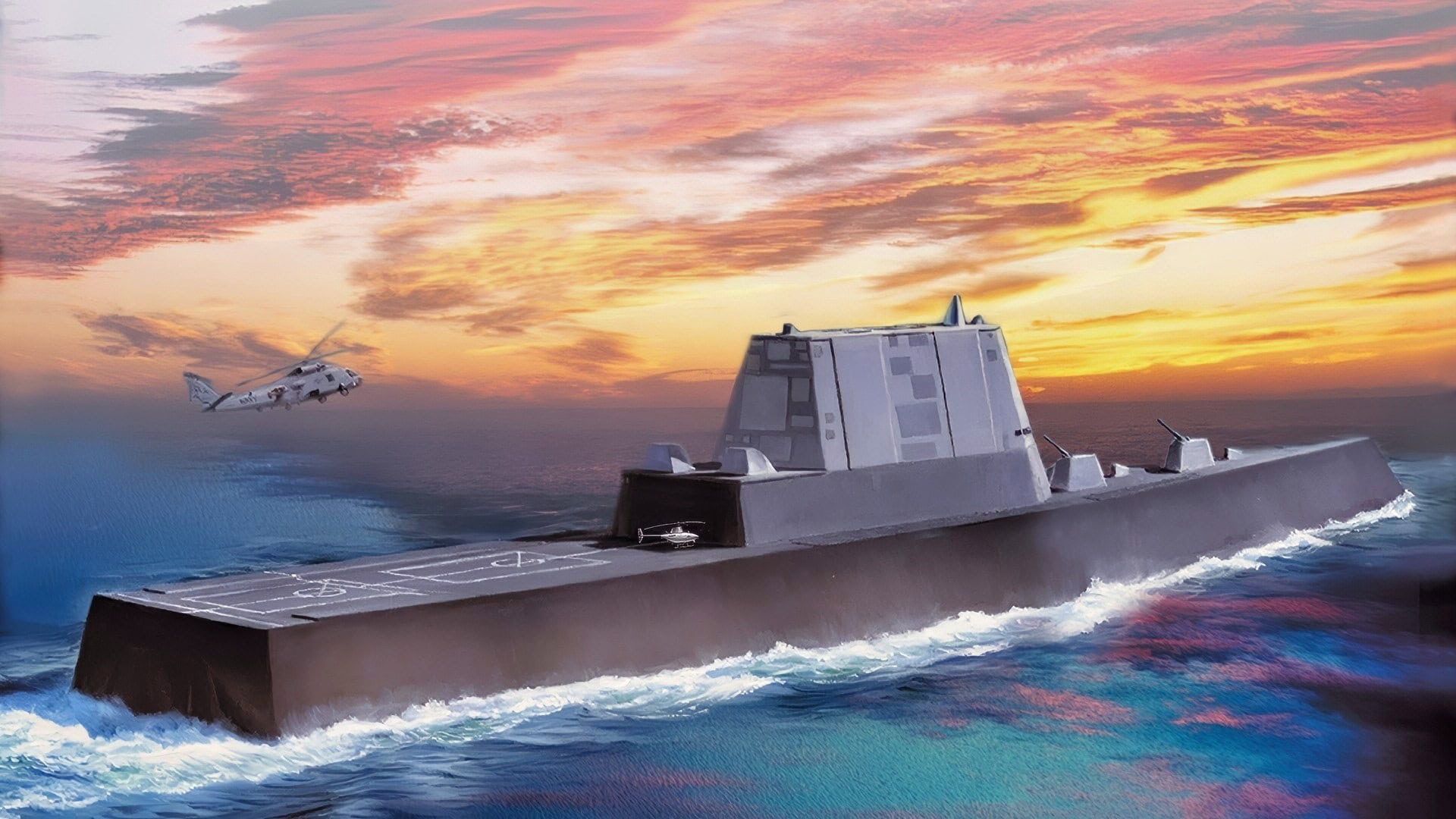
The United States Navy is struggling. It struggles to build new warships and submarines reliably, and the naval shipyards have great difficulty maintaining the systems they already possess. One of the enduring failures of the post-Cold War Navy has been the Zumwalt-class destroyer.
Ironically, it was named after one of the greatest innovators in American naval history. But that’s where the feel-good vibes are going to end.
The Most Overhyped Ship Ever?
And, on paper, the Zumwalt was a highly innovative, unique design.
In practice, it has been an undying disaster for the US Navy, sucking up vast resources that could have gone to other more worthwhile programs and becoming an enduring symbol of the Navy’s failures.
Designated as a guided-missile stealth destroyer, the Zumwalt-class destroyer looks less like a warship and more like something from a science fiction series.
Indeed, it looks as though a B-2 Spirit long-range nuclear-capable stealth bomber had a baby with an Arleigh Burke-class destroyer.
That was the point.
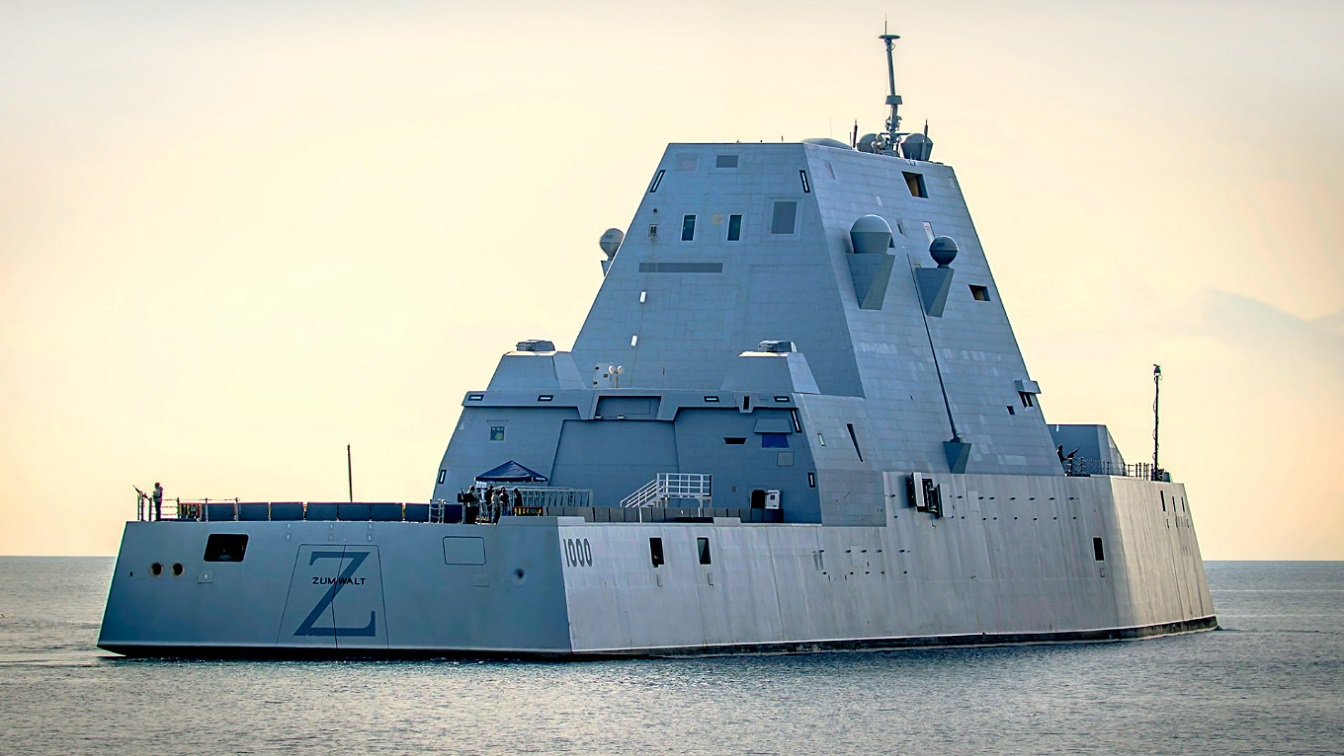
Zumwalt-Class, the largest destroyer on Earth today.
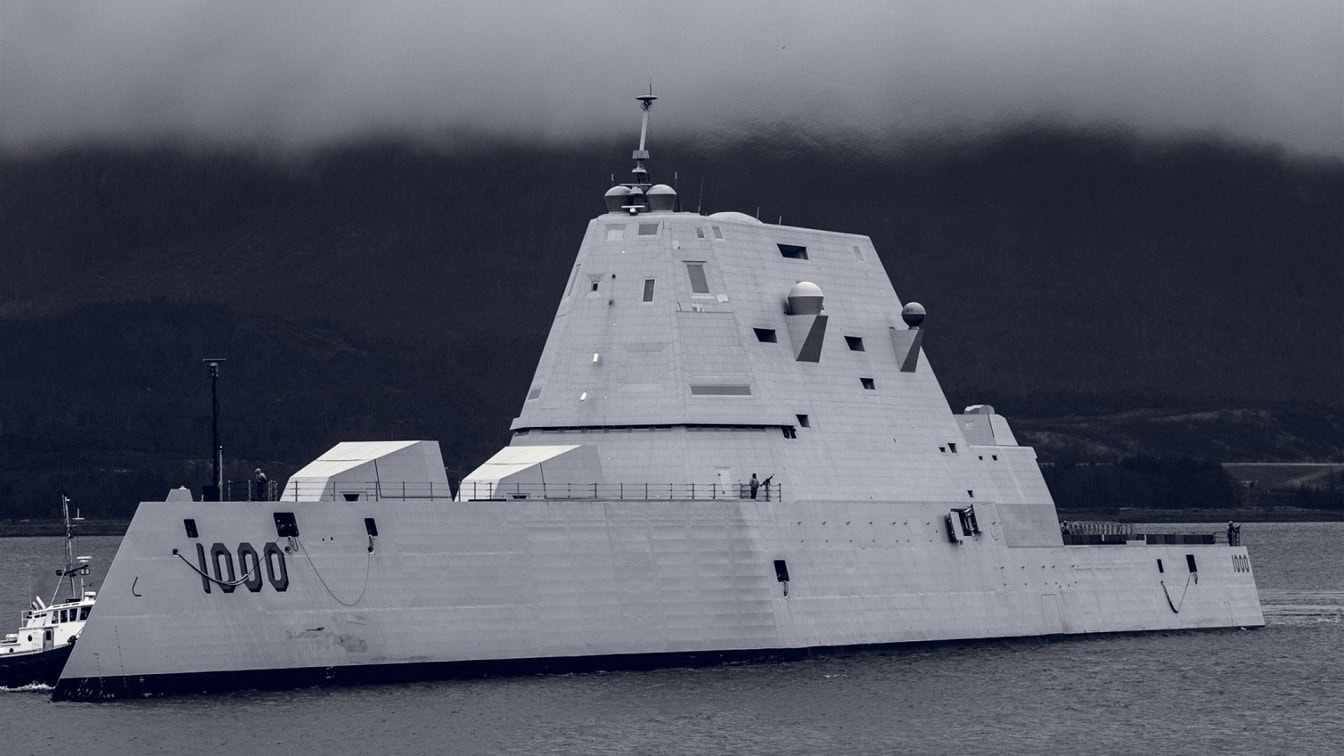
Zumwalt-Class. Image Credit: Creative Commons.
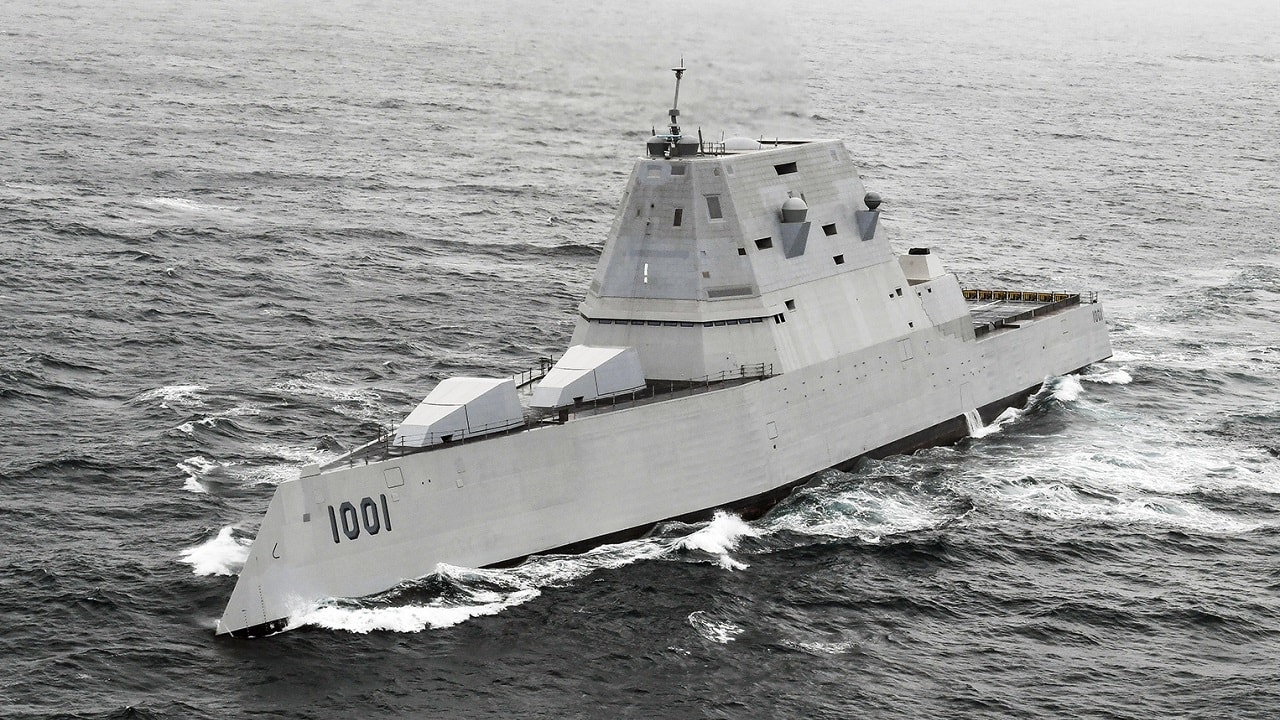
210421-N-FC670-1062 PACIFIC OCEAN (April 21, 2021) Zumwalt-class guided-missile destroyer USS Michael Monsoor (DDG 1001) participates in U.S. Pacific Fleet’s Unmanned Systems Integrated Battle Problem (UxS IBP) 21, April 21. UxS IBP 21 integrates manned and unmanned capabilities into challenging operational scenarios to generate warfighting advantages. (U.S. Navy photo by Chief Mass Communication Specialist Shannon Renfroe)
At the end of the Cold War, the Navy wanted to experiment with stealth designs to see if it could build a warship for the twenty-first century that was hard to detect, could get in close to an enemy, and could launch devastating salvos.
Powered by two Rolls-Royce MT30 gas turbines and two RR4500 generators, the ship featured an integrated power system.
Its sensor suite included the powerful AN/SPY-3 multi-function radar and an AN/SQS-60/61/SQR-20 sonar capacity.
Meanwhile, the ship was designed with a hangar and flight deck capable of supporting MH-60R helicopters or MQ-8 Fire Scout Unmanned Aerial Vehicles (UAVs). A crew of 147 people plus a 28-person air detachment manned the warship.
Originally, the Zumwalt-class destroyer came with an 80-cell Mk 57 Vertical Launch System designed for various missiles.
But the core of this warship design was the Advanced Gun System (AGS). You see, when the Navy retired its battleships, it lost a key capability that it never truly replaced.
The Navy initially did not want to maintain the ship-to-shore artillery capacity that only battleships could provide because the Pentagon assumed missiles would take over that role.
But missiles are expensive and complex, meaning they take longer to replace.
$1 Million Per Round Main Gun
So, the Navy fixated on the AGS. That was a 155mm/62-caliber naval artillery system developed by BAE Systems.
It was intended to provide long-range fire support for Marines. The AGS was designed to fire ten rounds per minute per gun (two were placed on each Zumwalt-class ship).
AGS was totally automated, too.
It was to hold 335 rounds per turret.
It was a great idea that would have made the Zumwalt a unique platform (irrespective of all the other problems with the ship, of which there were many).
Sadly, BAE Systems designed the AGS only to launch the Long Range Land Attack Projectile (LRLAP). The idea was that the Zumwalt-class would have 32 ships, meaning the supporting systems would be affordable because they would be produced at scale.
But then Congress understandably saw the issues with the Zumwalt-class and decided to reduce the order from 32 to just three.
At that point, the economy of scale evaporated.
The price of the ammunition for the AGS exploded to nearly $1 million per round.
To compound matters, the AGS was so specialized that it could not fire the standard US military 155 mm shells (without expensive redesigns).
A Hypersonic Missile Carrier?
There was much debate over the years about how the Navy should handle the Zumwalt-class destroyer. Many wanted to scrap the remaining three ships and start over.
At nearly $9.5 billion per ship (that’s including total lifecycle costs), with no way to make the ship work as advertised, this was the least bad of terrible options.
Yet, the military’s bureaucracy just could not quit the Zumwalt-class.
So, they yanked the AGS from the destroyers and have now invested heavily in making these warships the equivalent of hypersonic missile trucks.
The Navy Won’t Have Hypersonic Missiles For At Least Two Years
The only problem is that the United States military lacks hypersonic missiles.
In July, the Navy Times reported that the Navy was “two years behind on hypersonic missile installation” for the three Zumwalt-class destroyers. Somehow, the Navy has installed the launchers, but it has not built the weapons themselves.
In fact, the Government Accountability Office (GAO) determined that the project “does not have a comprehensive strategy” for completing its goals.
Meanwhile, the hypersonic weapons themselves have experienced a series of failed tests and massive quality control problems going back to 2023.
Again, the US Navy is paying exorbitant fees to maintain three aging warships that lack relevance to the needs of the modern Navy and have no weapons to shoot at the enemy—and won’t have weapons for possibly two or more years.
About the Author: Brandon J. Weichert
Brandon J. Weichert is the Senior National Security Editor at 19FortyFive.com. He also manages The Weichert Brief on Substack. Weichert also hosts “National Security Talk” on Rumble. He is the author of four bestselling national security books, the most recent of which is A Disaster of Our Own Making: How the West Lost Ukraine (Encounter Books). Follow him via Twitter/X @WeTheBrandon.