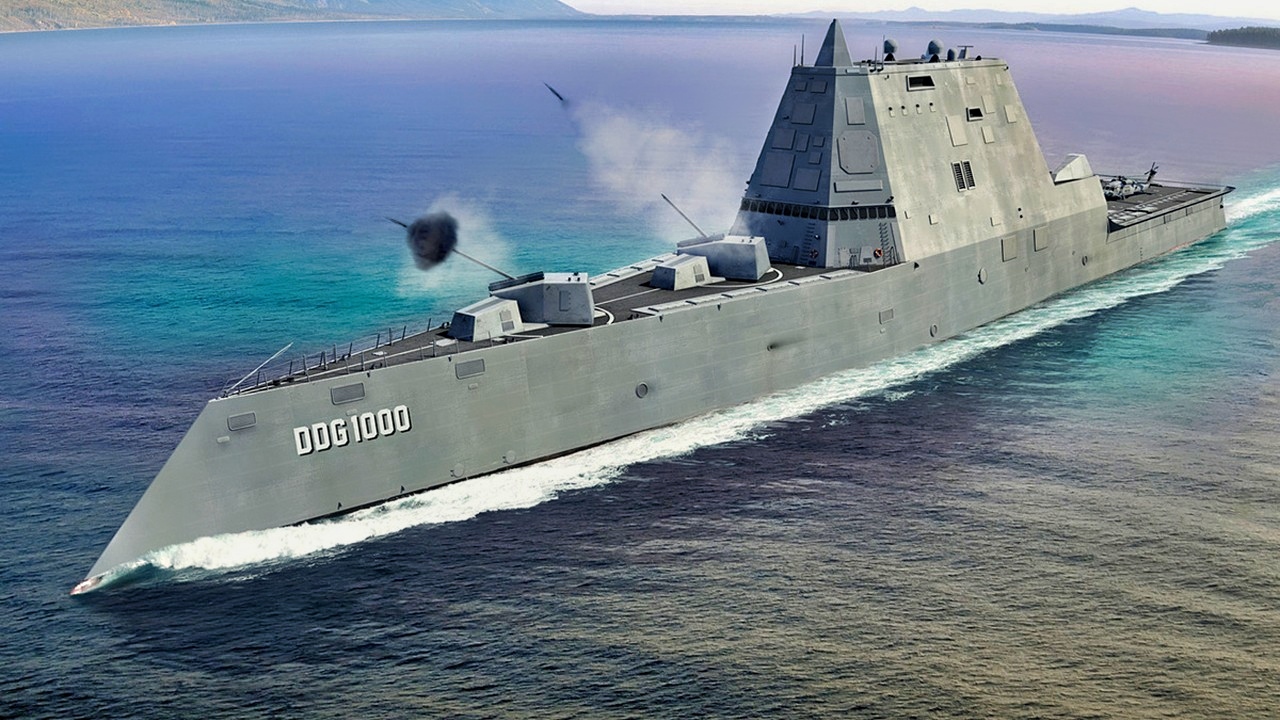
One of the most expensive warship programs in US military history is also one of the greatest failures. The Zumwalt-class destroyer began as one of the Navy’s most ambitious post-Cold War programs.
Originally conceived as a land-attack warship incorporating new-age designs, such as a reduced radar signature, electric propulsion, and two Advanced Gun Systems (AGS), the Navy believed the Zumwalt would revolutionize naval warfare.
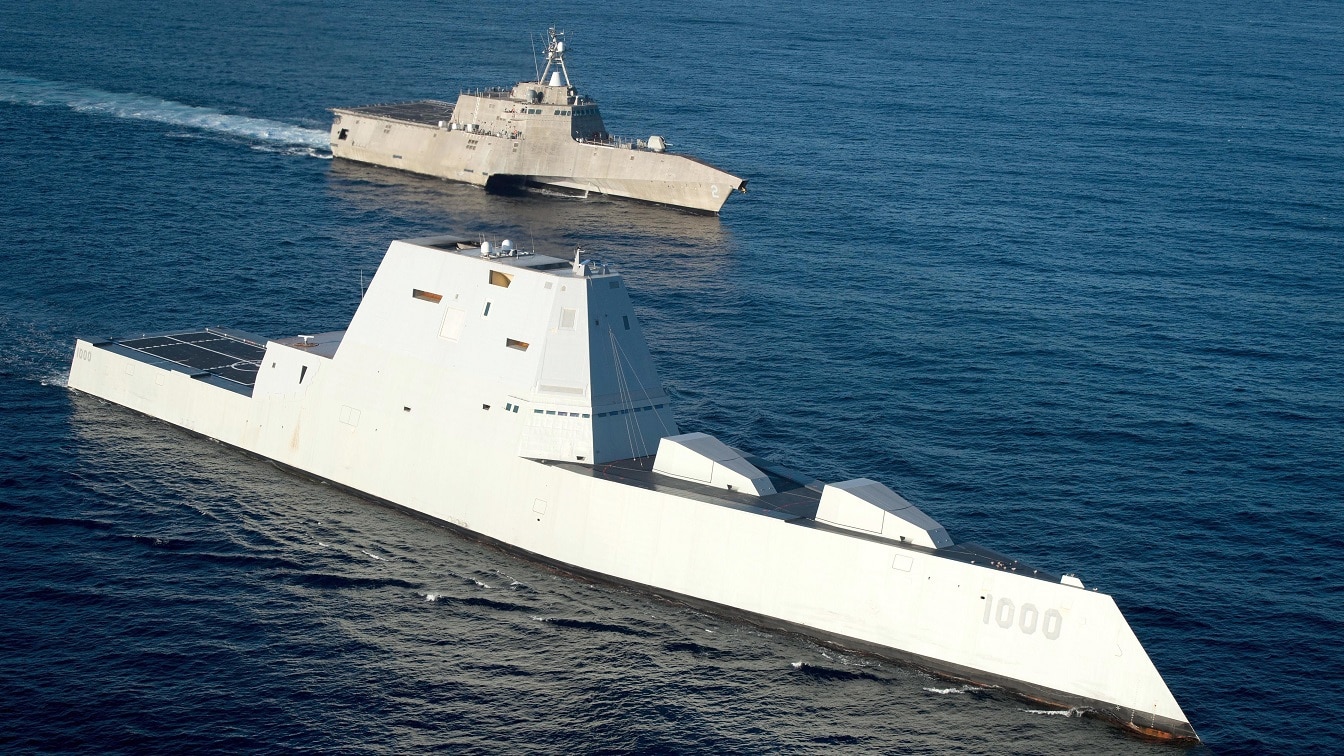
PACIFIC OCEAN (Dec. 8, 2016) The guided-missile destroyer USS Zumwalt (DDG 1000), left, the Navy’s most technologically advanced surface ship, is underway in formation with the littoral combat ship USS Independence (LCS 2) on the final leg of its three-month journey to its new homeport in San Diego. Upon arrival, Zumwalt will begin installation of its combat systems, testing and evaluation, and operation integration with the fleet. (U.S. Navy photo by Petty Officer 1st Class Ace Rheaume/Released)161208-N-SI773-0401
That never happened. As costs exploded, the planned fleet of 32 stealth destroyers shrank to 32, then 24, then seven, and finally only three warships of this class were built–after 20 years.
But the biggest damage this ship caused to the United States was in terms of cost (and, therefore, opportunity cost).
The program cost roughly $27 billion, with research and development going over $10 billion.
The procurement cost was well over $13 billion, with an average procurement cost of around $8 billion per ship. But fully burdened cost (including R&D spread across only three ships): roughly $9.5 billion per destroyer.
That makes the Zumwalt among the most expensive surface combatants ever built.
Zumwalt-Class: A Destroyer That Nearly Costs as Much as a Carrier
Let’s compare that to some other high-ticket projects.
An Arleigh Burke-class Flight III destroyer costs the Navy about $2.6 billion. The failed Constellation-class frigate was roughly $1.5 billion. The Zumwalt-class costs $9.5 billion all-in. And it was nowhere near as combat-effective as its designers claimed it would have been.
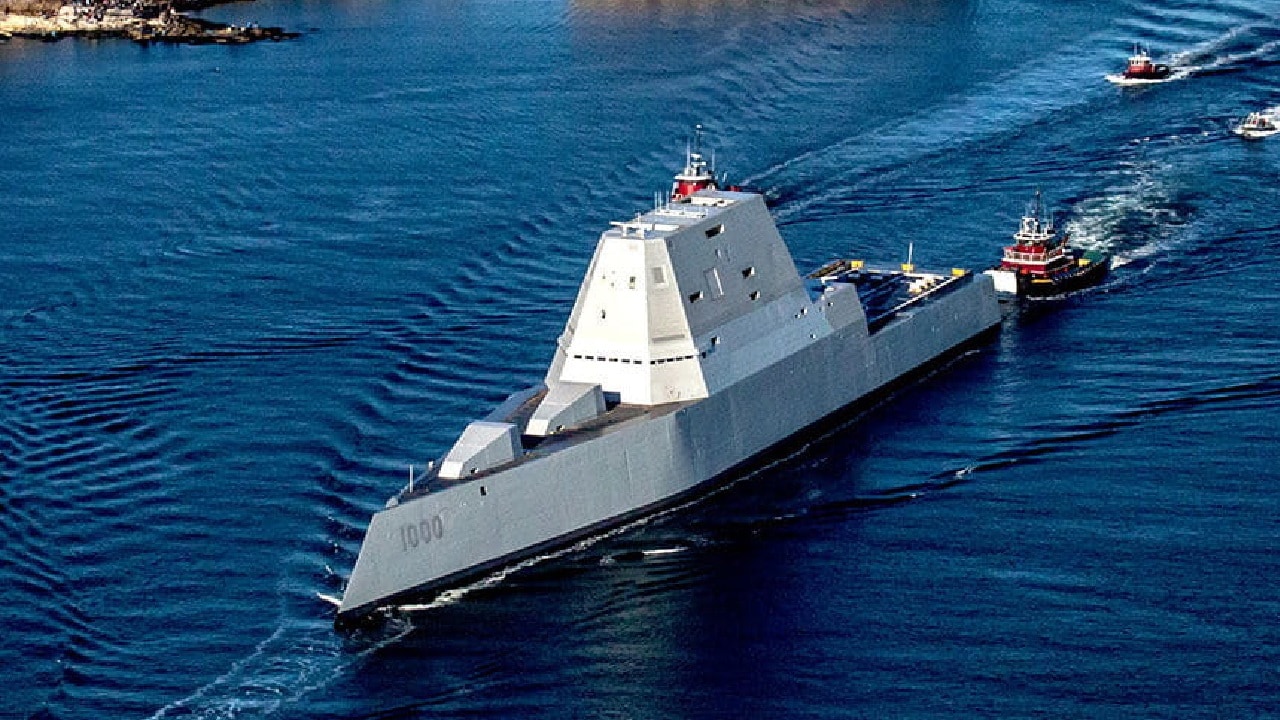
Zumwalt-class destroyer. Image Credit: Raytheon.
Compare that cost to the new Gerald R. Ford-class aircraft carrier. The first ship in the class, the USS Gerald R. Ford, cost $13 billion. That, too, had some unfortunate complications that led to cost overruns and delayed deployment. But the US relies far more on carriers than on next-generation destroyers. And there’s simply no excuse for the Zumwalt-class destroyer to cost nearly as much as America’s new carrier.
The Failed Gun System
The core of the Zumwalt-class destroyer was the 155mm Advanced Gun System (AGS). The problem wasn’t the firing mechanism itself.
The issue was the specialized ammunition for the AGS. It rested on a single ammunition type known as the Long Range Land Attack Projectile (LRLAP).
The shell initially looked affordable while the Navy expected to buy dozens of ships.
But once procurement collapsed to three destroyers, the production value collapsed. The result was that each round eventually cost nearly $1 million.
To be clear, that’s upwards of $1 million per round. As a result, the Navy canceled the procurement. And the guns never became operational.
The three ships the Navy built had two guns that could never fire–because the ammunition for those 155mm AGS was never made.
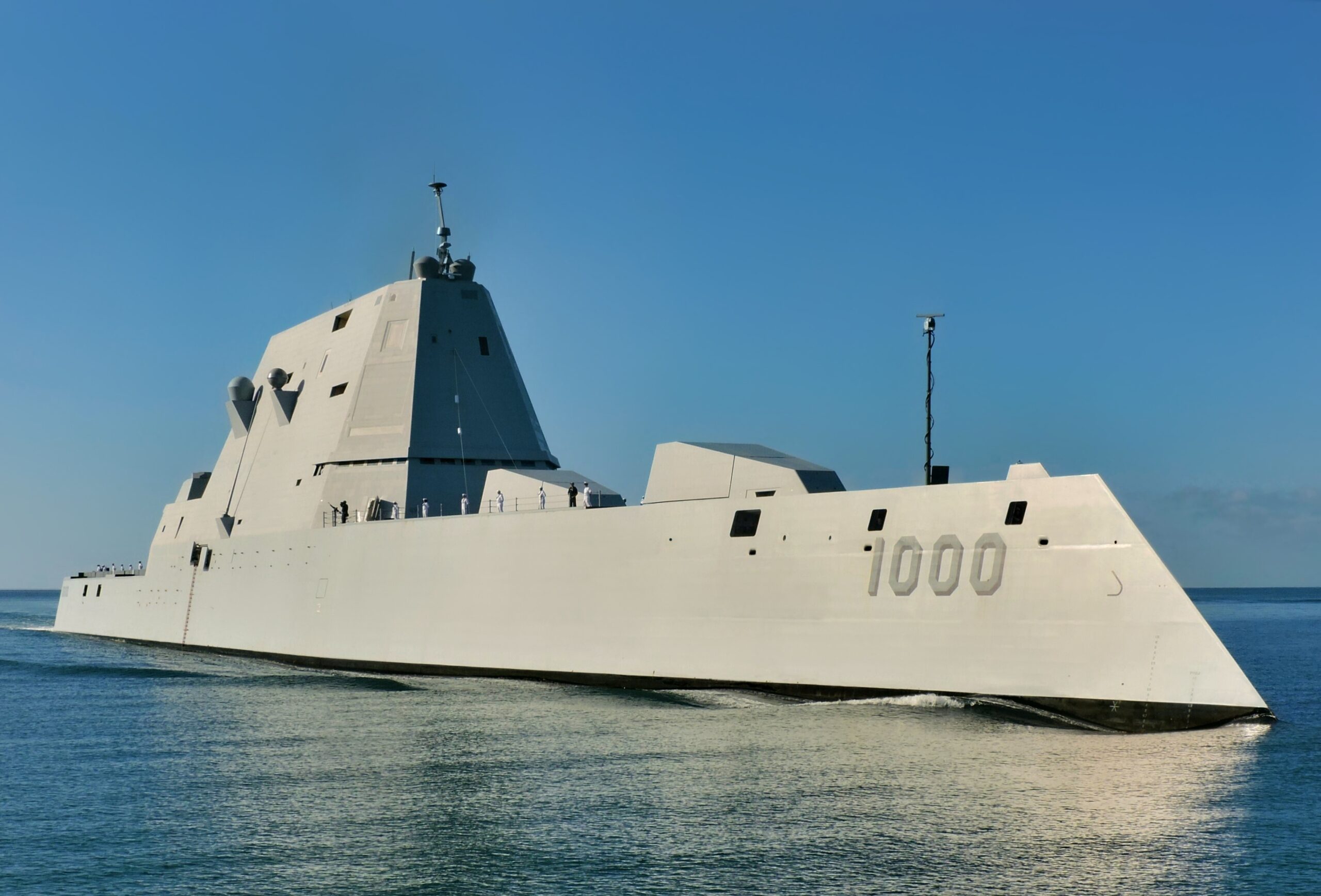
Zumwalt-Class Destroyer U.S. Navy. Image Credit: Creative Commons.
Sunk Cost Fallacy
Not wanting to admit failure after more than 20 years and gobs of cash invested into these ships, the Navy has decided to upgrade the weapons system of the Zumwalt-class.
Gone are the AGS. In its place, the Navy installed four large missile tubes. Each of those tubes carries three Conventional Prompt Strike (CPS) hypersonic missiles (a total of 12 hypersonic missiles for the three Zumwalt-class destroyers).
So, the Navy is keen on making the Zumwalt relevant to the modern battlefield, which prizes long-range precision strikes over close-in combat.
But are 12 hypersonic missiles per ship enough? Even if the Navy deployed all three of these overrated boondoggles into a contested area to conduct long-range precision strikes, say, against Chinese military targets, that’s a total of 36 hypersonic missiles. And once those missiles are expended… that’s it.
Compare that to China, which has manufacturing supremacy in mass production over the United States. They’ve not only got a panoply of hypersonic weapons at the ready (whereas the US is still developing its own), but they’re also sitting on abundant supplies of conventional long-range precision-strike missiles and swarms of advanced drones.
Let’s say that, in a perfect world, three Zumwalt-class destroyers, armed with 12 hypersonic missiles each, manage to launch–and destroy significant targets belonging to China’s military in the First Island Chain (the region extending south from the Kamchatka Peninsula through Japan and Taiwan down to the Philippines and the South China Sea).
Even if those US hypersonic missile strikes eliminate their intended targets, the Zumwalts are unable to reload at sea. Anyway, there is a dearth of US hypersonic weapons available for the Zumwalt-class.
Not only are we living in the age of long-range precision strikes, but also in the age of beyond-visual-range (BVR) warfare. We are also living in an age in which those systems must be mass-produced cheaply and quickly.
The US lacks China’s scale.
Compare that to older warships in America’s fleet.
A 40-year-old Ticonderoga-class cruiser possesses 122 Mk 41 Vertical Launch System (VLS) cells.
Those launchers can fire combinations of Tomahawks, SM-2, SM-3, and SM-6 missiles. They can also fire ESSM in a quad-packed formation and ASROC weapons. Meanwhile, an Arleigh Burke-class destroyer carries 90 VLS cells or 96 VLS cells, depending on the flight.
Again, the Navy is selling itself short by trying to force the failed, way-too-expensive Zumwalt-class destroyers into serving as hypersonic missile carriers.
What the Navy Still Doesn’t Solve
Besides, the Navy’s conversion of the Zumwalt-class destroyer does not solve several structural problems.
The ships remain extraordinarily expensive to operate and maintain. Meanwhile, every hypersonic launch expends one of a very limited number of premium weapons that cannot be reloaded at sea.
They still carry only 80 Mk 57 peripheral VLS cells for conventional weapons–fewer than the older Ticonderoga’s 122 Mk 41 cells.
And the CPS launchers replace the gun mounts rather than adding large numbers of additional missile cells.
The Navy has likely rescued the failed Zumwalt-class from complete irrelevance.
Instead of being remembered as a stealth destroyer whose signature guns never fired in combat, the Navy converted its expensive Zumwalt-class ships into the first operational surface platforms for hypersonic weapons.
But the economics are impossible to ignore.
After spending just shy of $10 billion per ship (including development costs), the Navy is left with just three destroyers, each carrying a meager 12 hypersonic missiles.
In contrast, much older warships possess far greater missile launchers.
In other words, the Navy can’t seem to grasp that its Zumwalt-class was a dead end. They should be cutting their losses.
Instead, they are engaged in a classic sunk cost fallacy. We, the People, are going to pay for this mistake.
About the Author: Brandon J. Weichert
Brandon J. Weichert is the Senior National Security Editor at 19FortyFive.com. He also manages The Weichert Brief on Substack. Weichert also hosts “National Security Talk” on Rumble. He is the author of four bestselling national security books, the most recent of which is A Disaster of Our Own Making: How the West Lost Ukraine (Encounter Books). Follow him via Twitter/X @WeTheBrandon.