
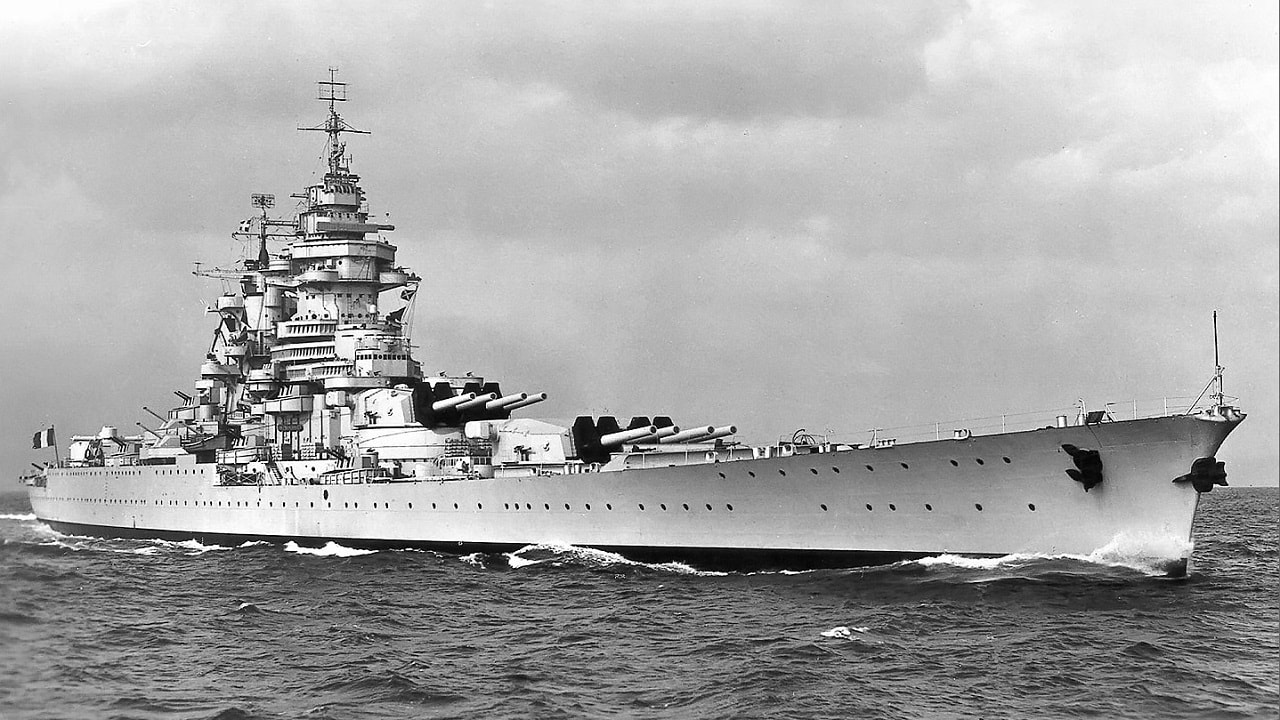
The battleship Richelieu was the finest capital ship France ever built, and her war was the strangest any battleship ever fought. She fled her builders’ yard days ahead of the German army, took a British torpedo at Dakar, traded salvos with a Royal Navy battleship, then crossed the Atlantic to be rebuilt in Brooklyn and finished the war escorting the same fleet that had tried to sink her. What made her great was the design underneath the odyssey: the boldest solution any navy found to the treaty era’s impossible math.
Born to Fight Italy
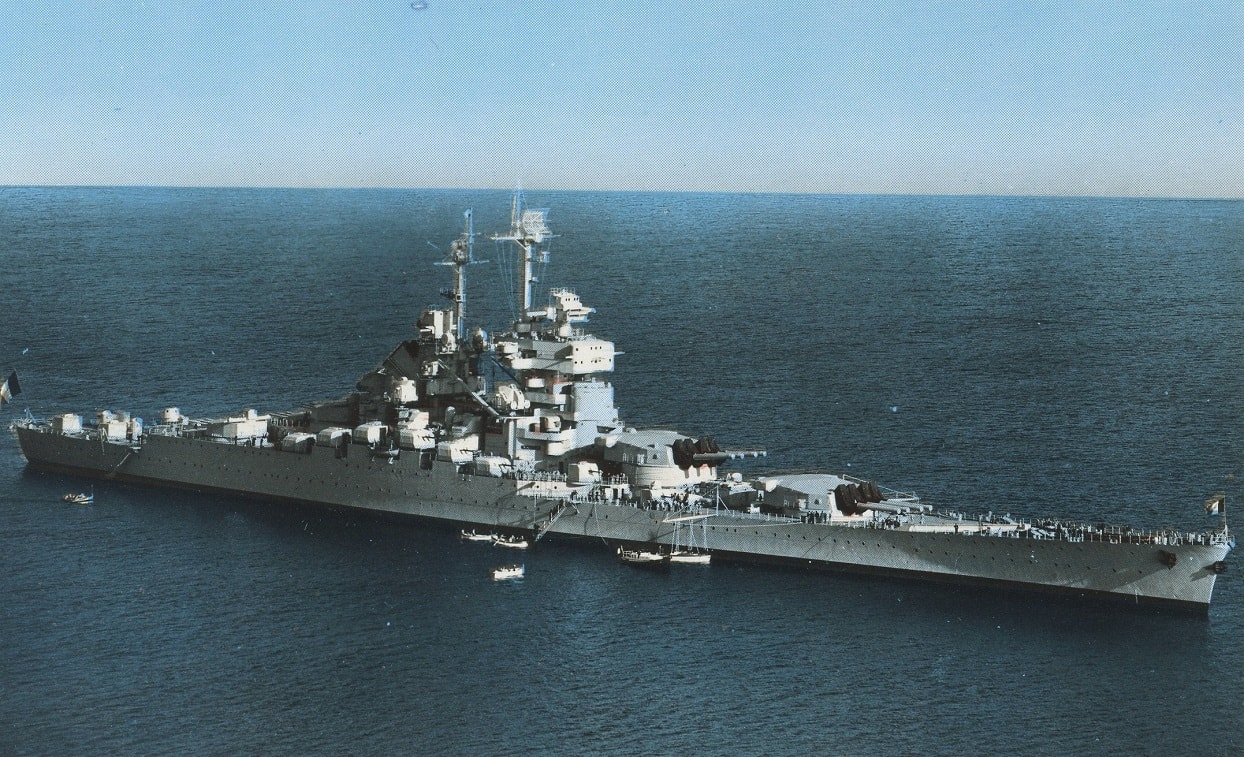
Image: Creative Commons.
Richelieu was France’s answer to Mussolini. When Italy announced the 15-inch-gun Littorio class in 1935, France laid down a counter within months, scaling up the layout of its smaller Dunkerque class. The signature was the armament: all eight 380mm guns mounted forward in two quadruple turrets, with nine 152mm guns aft. The arrangement looked eccentric and was actually the whole point.
Concentrating the main battery in two turrets shortened the armored citadel, and every meter of citadel saved was weight that could go into thicker armor or bigger engines while staying nominally inside the 35,000-ton treaty limit. It carried a tactical logic too: a ship whose every heavy gun fires forward can charge an enemy bow-on, presenting the smallest possible target while shooting with everything she has. The result squared the triangle every treaty battleship compromised on: a belt over a foot thick, eight heavy guns, and 32 knots, making her one of the fastest battleships ever built. Each quadruple turret was internally divided by an armored bulkhead into paired gun houses, so a single hit could silence half a turret but not all of it. She was launched in January 1939, her hull famously built in sections because no slipway at Brest was long enough to hold her whole.
The Escape
War outran her. Rushed toward commissioning in the spring of 1940, she had fired only six shots from each gun in abbreviated trials when the German army broke through. On June 18, 1940, about 95 percent complete, she slipped out of Brest for Dakar, carrying Bank of France gold, 250 naval cadets, a partial crew, and propellant for barely fifty firings of her main battery.
The British, terrified she would end up in German hands, came after her. On July 8, Swordfish torpedo bombers from HMS Hermes put a torpedo into her stern, and she settled aft in Dakar harbor, where the U.S. Navy’s own photo archive records her lying behind anti-torpedo nets that summer. In September came Operation Menace, a full Anglo-Free French assault backed by the battleships Barham and Resolution and the carrier Ark Royal. Richelieu fired back, and her war luck held to form: two guns of Turret II failed on the first salvo due to defective propellant charges; one barrel shattered outright, and the other bulged, its rifling gashed for eight meters. Yet she traded hits with Barham, a French submarine that torpedoed Resolution, and after three days the British withdrew.
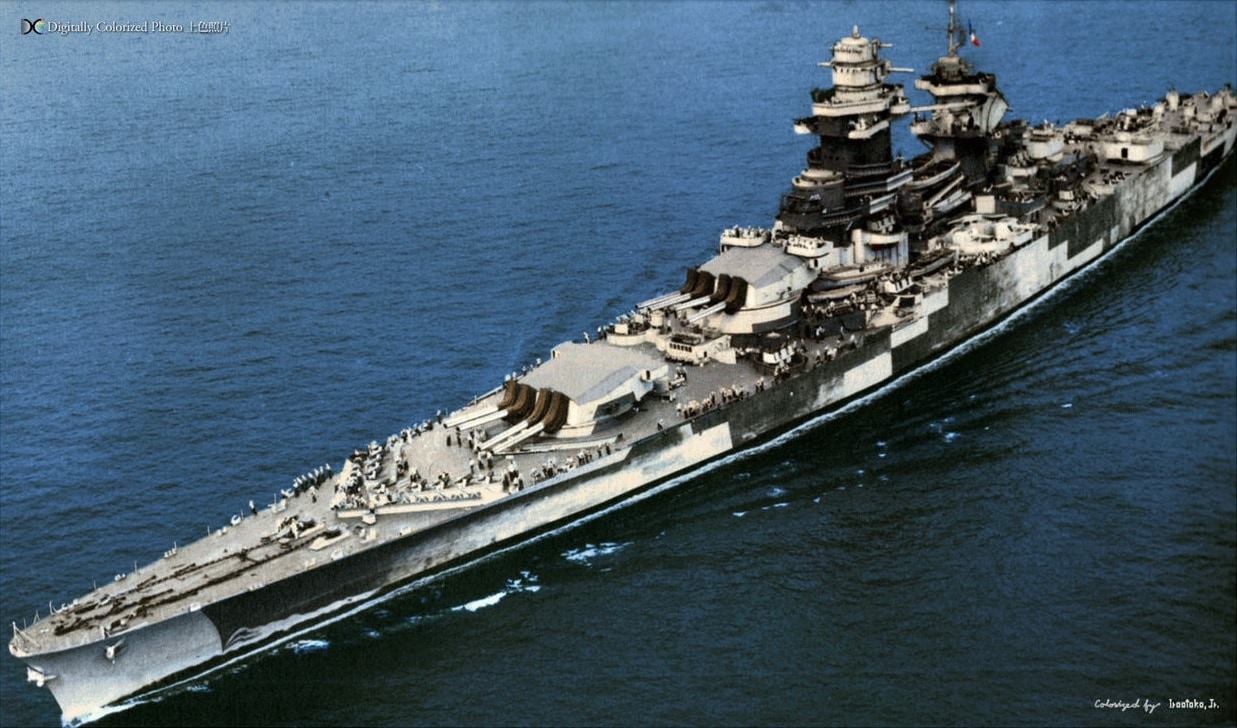
French battleship Richelieu off the east coast of the United States, following the completion of her refit there in September 1943. Creative Commons Image.
Rebuilt in Brooklyn
Everything turned in November 1942. After the Torch landings flipped French Africa to the Allies, the damaged giant sailed for New York, limping across the Atlantic at 14 knots with her rudder held seven degrees over to correct for a warped hull.
At the Brooklyn Navy Yard, she was rebuilt to American standards: modern radar, 56 Bofors barrels and 48 Oerlikons in place of her feeble original anti-aircraft suite, and replacement 380mm barrels pulled from the single turret of her stranded sister Jean Bart, her rear mast cut down, by one account, so she could pass beneath the Brooklyn Bridge.
From Scapa to Singapore
The rebuilt Richelieu joined the British Home Fleet at Scapa Flow, standing watch on the Arctic convoy routes against the Tirpitz, then sailed for the Indian Ocean. Through 1944 and 1945, she bombarded Japanese-held Sabang alongside battleships of the fleet she had fought at Dakar, screened British carriers striking Surabaya, and shot at Japanese aircraft with her American guns.
In September 1945, she steamed into Singapore with the British fleet to take the Japanese surrender. Five years earlier, she had been shooting at the Royal Navy; she finished the war as part of it.
What Made Her Great
Set her beside her peers, and the case is simple: no European navy got more fighting ships out of the treaty limits, which is why she still ranks among the five best battleships ever built, and why her sister Jean Bart fought her own strange war against the U.S. Navy at Casablanca.
Richelieu served into the late 1950s as a gunnery school and was scrapped at Genoa in 1968; a single 380mm barrel still stands at Brest.
Her combat ledger is the final oddity: she never sank an enemy ship, and she outlived every battleship that tried to sink her.
About the Author: Harry J. Kazianis
Harry J. Kazianis (@Grecianformula) was the former Senior Director of National Security Affairs at the Center for the National Interest (CFTNI), a foreign policy think tank founded by Richard Nixon based in Washington, DC. Harry has over a decade of experience in think tanks and national security publishing. His ideas have been published in the NY Times, The Washington Post, The Wall Street Journal, CNN, and many other outlets. He has held positions at CSIS, the Heritage Foundation, the University of Nottingham, and several other institutions related to national security research and studies. He is the former Executive Editor of the National Interest and the Diplomat. He holds a Master’s degree focusing on international affairs from Harvard University.

