
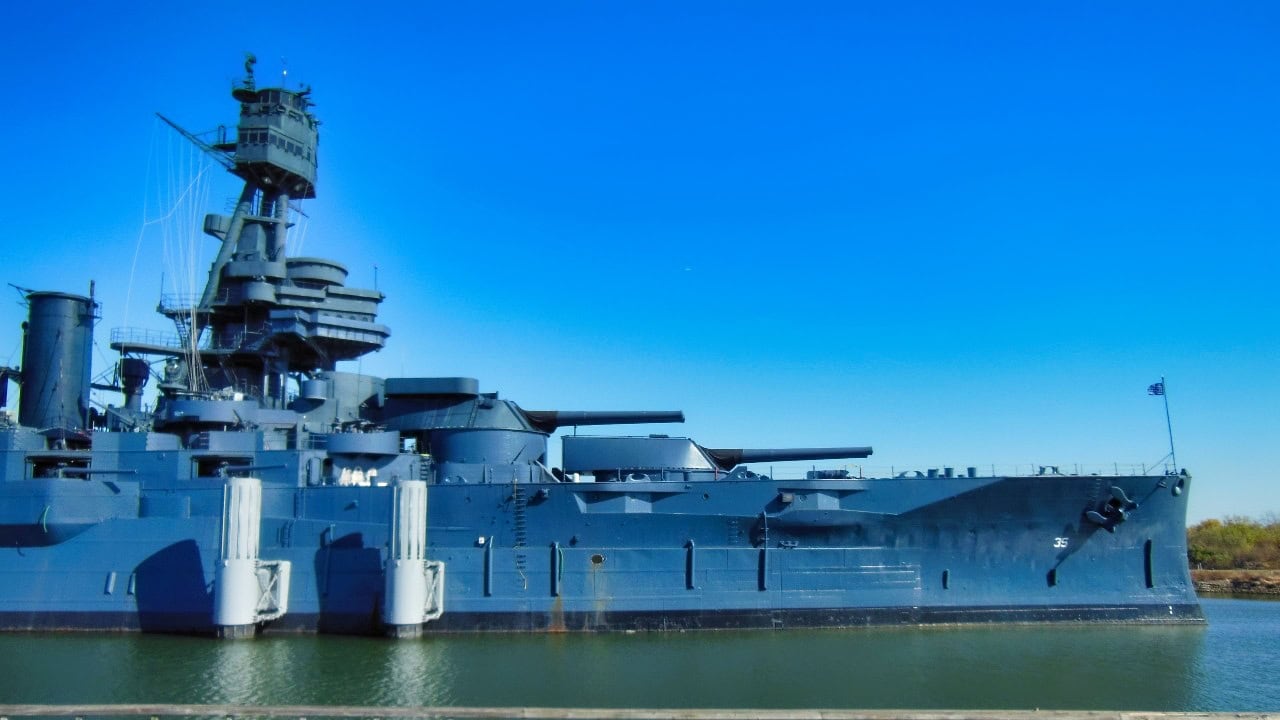
USS Texas by the Numbers: $5.83 Million, 34,000 Tons and a $75 Million Rescue – USS Texas entered the Navy at a contracted price of $5.83 million, carried ten 14-inch guns, and grew into a 34,000-ton battleship before leaving service. More than a century later, preserving the same hull is projected to cost $75 million.
The Battleship Texas Foundation is restoring the ship at Gulf Copper Shipyard in Galveston and targets a 2027 grand reopening at Pier 15. Workers have repaired or replaced about 700 tons of steel, rebuilt the underwater portions of the torpedo blisters, and returned the hull to its dark 1945 camouflage.
The ship’s 34-year naval career stretched from March 12, 1914, to April 21, 1948. Texas joined Britain’s Grand Fleet in World War I, supported invasions from North Africa to Okinawa in World War II, and earned five battle stars before becoming a museum.
Newport News Shipbuilding won the construction contract with a bid of $5.83 million. The figure excluded armor and armament. Workers laid the keel on April 17, 1911, launched Texas on May 18, 1912, and delivered her for commissioning less than two years later.
USS Texas Measured 573 Feet and Reached 34,000 Tons
At completion, Texas measured 573 feet long, 94 feet 9 inches across the beam, and drew 28 feet 6 inches of water. Normal displacement stood at 27,000 tons. Later modernization, added protection, radar, and a larger anti-aircraft battery pushed the ship to about 34,000 tons. Texas and USS New York introduced 14-inch guns to American battleships, making the New York class a major increase in firepower over the preceding Wyoming class.
28,100 Horsepower Moved USS Texas at 21 Knots
Two four-cylinder, triple-expansion steam engines drove twin screws. Their combined designed output was 28,100 horsepower. The machinery weighed 2,375 tons, and the propellers measured more than 18 feet in diameter. Fourteen coal-fired boilers originally supplied steam before a 1920s modernization installed six oil-fired units.
Top speed was 21 knots. That became modest beside later fast battleships, but Texas did not need carrier-escort speed during World War II. Her missions centered on convoy protection and sustained bombardment close to shore. Texas and New York were the last American battleships fitted with reciprocating engines, and only Texas survives.
Ten 14-Inch Guns Produced a Seven-Ton Broadside
Five twin turrets held ten 14-inch/45-caliber guns. Each weapon fired a 1,400-pound shell, so a full broadside placed 14,000 pounds of steel and explosive into the air. The original effective reach was about 12 miles. Those numbers explain why Texas was described as the “most powerful weapon in the world” when she entered service.
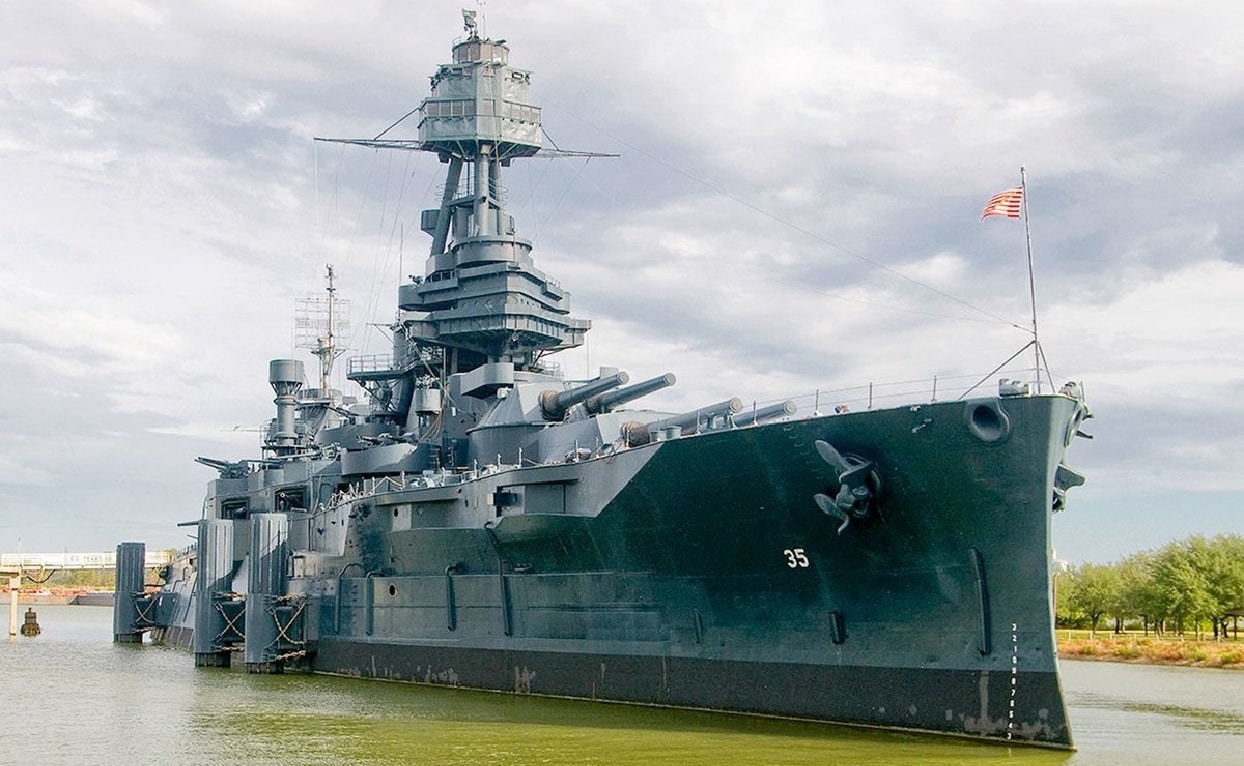
USS Texas battleship. Image: Creative Commons.
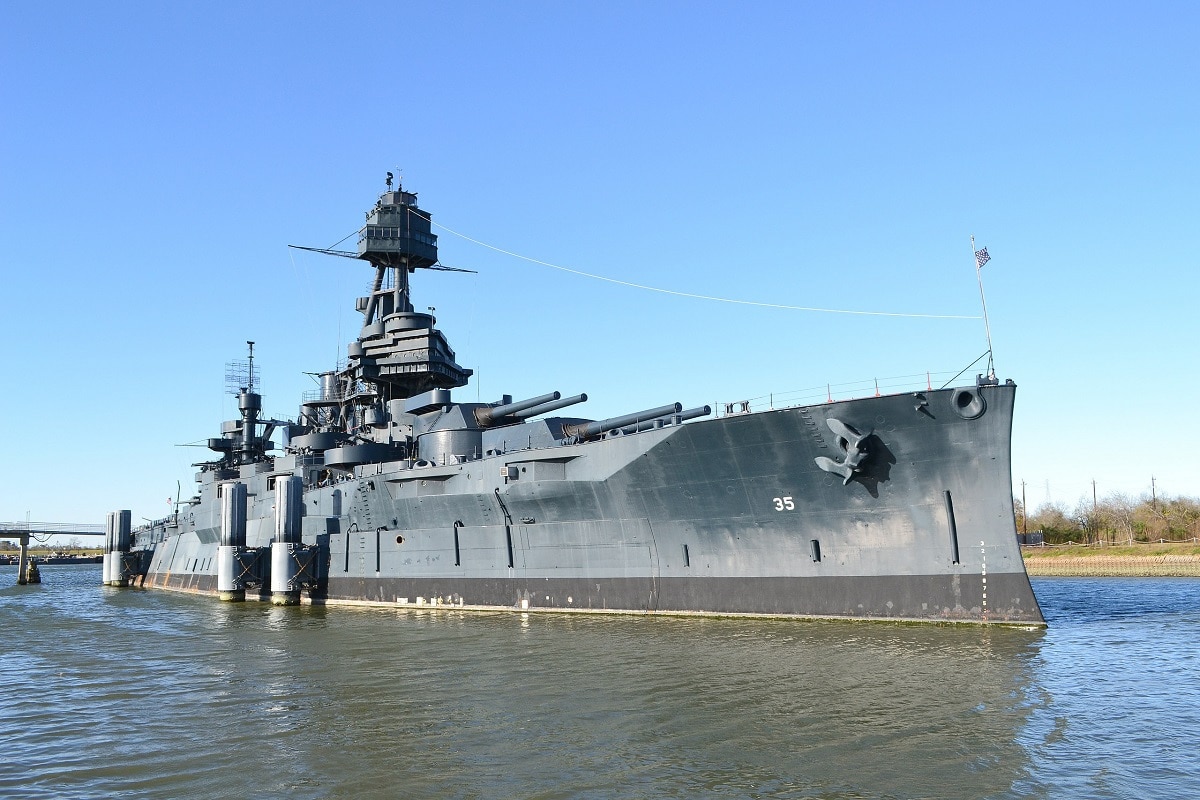
USS Texas Image: Creative Commons.
By 1945, the main battery remained while the anti-aircraft defense had grown to ten 3-inch guns, ten quadruple 40mm Bofors mounts, and forty-four 20mm Oerlikons. Radar, communications equipment, and dozens of new weapons helped push the wartime crew above 1,800.
USS Texas Served With the Grand Fleet in World War I
Texas entered service months before Europe went to war. She supported the American occupation of Veracruz in 1914, although the fighting had ended before she arrived. After the United States entered World War I, the Navy first used the ship to train engineers and armed-guard gun crews.
Texas crossed the Atlantic in early 1918 and joined the 6th Battle Squadron of Britain’s Grand Fleet. She patrolled the North Sea against a possible sortie by the German High Seas Fleet. The decisive gun battle never came, and Texas did not fire her main battery in combat.
Texas was present when the High Seas Fleet surrendered in November 1918. In 1919, a Sopwith Camel flew from a ramp above Turret Two, making her the first American battleship to launch an aircraft. Later modernization added tripod masts, oil-fired boilers, and torpedo blisters. Texas also served as the flagship of the United States Fleet and was among the first to receive radar.
USS Texas Fought From North Africa to Okinawa
Texas began World War II escorting Atlantic convoys. Her first major combat operation came during Operation Torch in November 1942, when she supported the invasion of French Morocco.
On D-Day, Texas opened fire on German positions at Pointe du Hoc at 5:50 a.m. She fired 255 14-inch shells in 34 minutes, then shifted her guns toward Omaha Beach. The battleship remained offshore, delivering supplies to Army Rangers and taking wounded men aboard.
At Cherbourg on June 25, a 240mm German shell struck the conning-tower area, wounded 11 sailors and killed Quartermaster Third Class Christen Christensen, the only crew member lost to enemy fire during the ship’s career.
Texas later supported Operation Dragoon in southern France before moving to the Pacific. Her guns struck Japanese positions at Iwo Jima and Okinawa. During 50 days around Okinawa, the ship fired 2,019 14-inch shells and thousands of rounds from its smaller weapons. Her record explains why the two-war veteran remains unique among surviving American battleships.
The Museum Ship Became the “Homeless Battleship”
The Navy decommissioned Texas in 1948 and transferred her to the state as a memorial. She became America’s first permanent battleship museum and spent 74 years beside the San Jacinto Battleground along the Houston Ship Channel.
Warm, brackish water caused relentless corrosion. A $15 million dry-dock repair from 1988 to 1990 bought time, but leaks returned. Pumps and emergency work kept the ship afloat while planners debated another restoration and a location able to attract enough visitors to support the museum.
Four tugboats pulled Texas away from San Jacinto on Aug. 31, 2022. The 40-mile tow ended at Gulf Copper in Galveston. The move left the ship without an agreed permanent berth, producing the “homeless battleship” nickname while restoration continued.
The current project is estimated at $75 million, with the Texas Legislature funding $60 million. Crews reconstructed the torpedo blisters, repaired the hull, renewed decking, restored smaller guns and prepared interior spaces. The work turned the old New York-class hull into a major preservation project.
Pier 15 Ends the Search for a Permanent Home
The Galveston Wharves Board and the foundation finalized an agreement for Pier 15 in July 2025. The site sits between cruise terminals and within walking distance of the Strand, giving the ship access to a much larger visitor market than the old San Jacinto berth.
Moving Texas there still requires final mooring engineering, federal permits, dredging and shoreside construction. The Pier 15 plan includes restored compartments, educational programs, overnight visits and modern exhibits inside spaces first occupied before World War I.
At Pier 15, the restored battleship will sit within sight of Galveston’s cruise traffic. When the gangways open in 2027, visitors will walk beneath the same ten 14-inch guns that fired at Pointe du Hoc, Cherbourg, southern France, Iwo Jima, and Okinawa.
About the Author: Harry J. Kazianis
Harry J. Kazianis (@Grecianformula) was the former Senior Director of National Security Affairs at the Center for the National Interest, a foreign policy think tank founded by Richard Nixon in Washington, D.C. Harry has more than a decade of experience in think tanks and national security publishing. His ideas have been published in The New York Times, The Washington Post, The Wall Street Journal, CNN and many other outlets worldwide. He has held positions at CSIS, the Heritage Foundation, the University of Nottingham and several other institutions related to national security research and studies. He is the former Executive Editor of The National Interest and The Diplomat. He holds a master’s degree focusing on international affairs from Harvard University.

