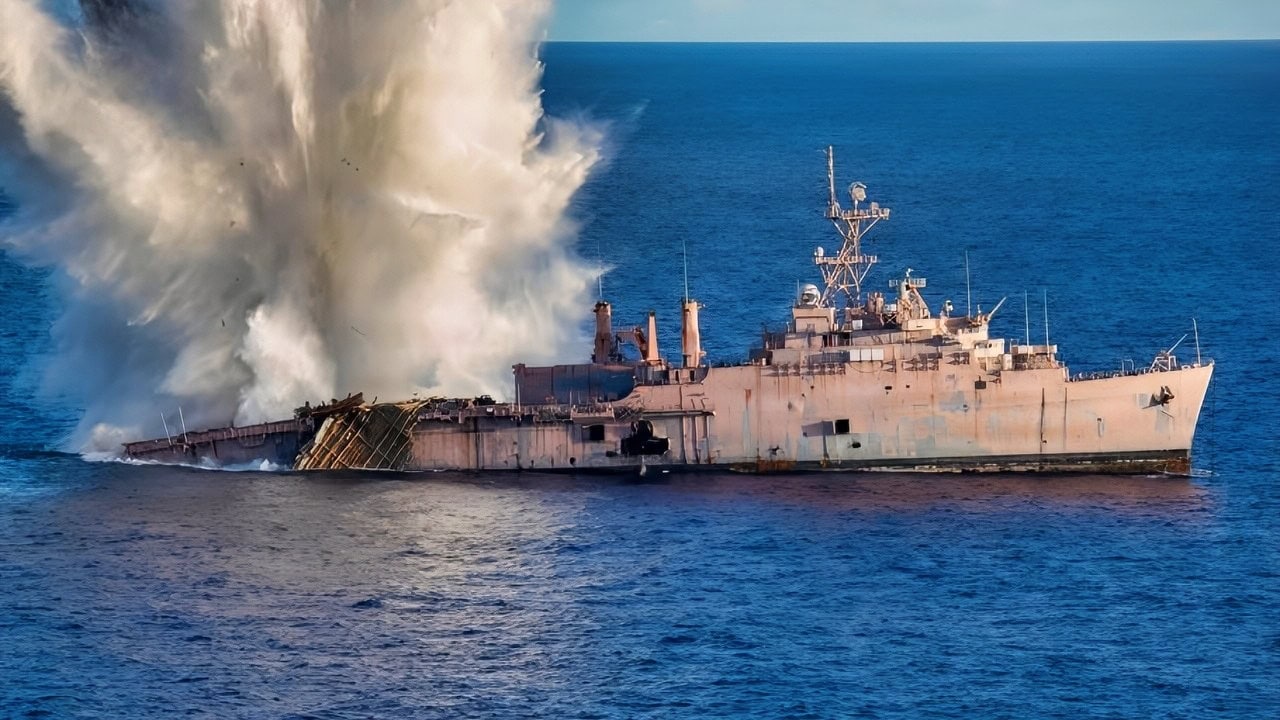
Two military exercises involving the United States and allies earlier this summer showcased anti-ship capabilities and some of the Pentagon’s most sophisticated air-to-surface weapons. The exercises in question were a pair of SINKEX (sinking exercises) during Exercise Valiant Shield and Rim of the Pacific (RIMPAC). The first of these SINKEX exercises occurred during Valiant Shield. During that exercise, a U.S. Air Force B-2 Spirit stealth bomber dropped an AGM-158C Long Range Anti-Ship Missile, also known as LRASM, at a decommissioned ship: the amphibious transport dock USS Juneau.
SINKEX Exercises
SINKEX exercises are the U.S. Navy’s live-fire drills against decommissioned warships.
The exercises offer a practical way to test weapons, tactics, and damage effects against a real ship hull with live ammunition.
They began as a fleet-racing and weapons-evaluation tool, and the U.S. Navy has previously described the exercises as an integral part of the utility of inactive ships for testing and training.
In practice, the ships are stripped, cleaned, and towed to a remote sea area, where ships, aircraft, and submarines fire torpedoes, missiles, bombs, and sometimes large-caliber guns at the ship until they sink.
The exercises must check relevant environmental and safety boxes, with the U.S. Navy surveying the area and preparing the decommissioned hulk for destruction.
In more recent years, the U.S. Navy’s SINKEX exercises have taken on new significance vis-à-vis the Indo-Pacific.
Now, the exercises serve as a kind of dress rehearsal for long-range anti-ship warfare, targeting by coalition forces, and a preview of the maritime attrition a fight with China might demand.
The message is not subtle — the United States and its partners are practicing to fight for a contested ocean, not one that is completely empty.
A Live Fire First for the B-2 Spirit?
This summer’s exercise is likely the first publicly acknowledged launch of an LRASM missile from a B-2 Spirit bomber — a significant development given the B-2’s status as the only stealth aircraft capable of launching the stealthy missile from its internal bomb bays.
The Spirit’s low radar detectability, as well as its long range, could prove of crucial importance to a dust-up in the Indo-Pacific, given the enormous distances needed to cross the region.
“The B-2’s impressive performance underscores the US military’s commitment to adaptability and flexibility in the face of emerging security challenges,” said General Kevin B. Schneider, Commander, Pacific Air Forces, in a U.S. Air Force statement. “By prioritizing counter-maritime strike operations, we can maintain a decisive edge over adversaries, protect our national interests and ensure the free and open Pacific that underpin our global security.”
In another release, the U.S. Navy said Valiant Shield helped multiple navies build “real-world proficiency in sustaining joint forces through detecting, locating, tracking, and engaging units at sea, in the air, in space, on land, and in cyberspace.”
AGM-158C Long Range Anti-Ship Missile
The LRASM is one of the more sophisticated missiles in the American arsenal.
Explicitly designed to hunt warships, and in particular high-value surface vessels like aircraft carriers, amphibious ships, and escorts from well outside an adversary’s air defense umbrella.
Its radar-mitigating stealth characteristics are designed for modern naval warfare against a peer adversary, and it is intended to operate in jammed, heavily defended waters where targeting links may be degraded, unstable, or absent entirely.
Like its launch platform, the B-2 Spirit, the LRASM’s significance to the Indo-Pacific is that it provides the United States with a credible means to threaten an enemy fleet without first engaging an air-defense envelope.
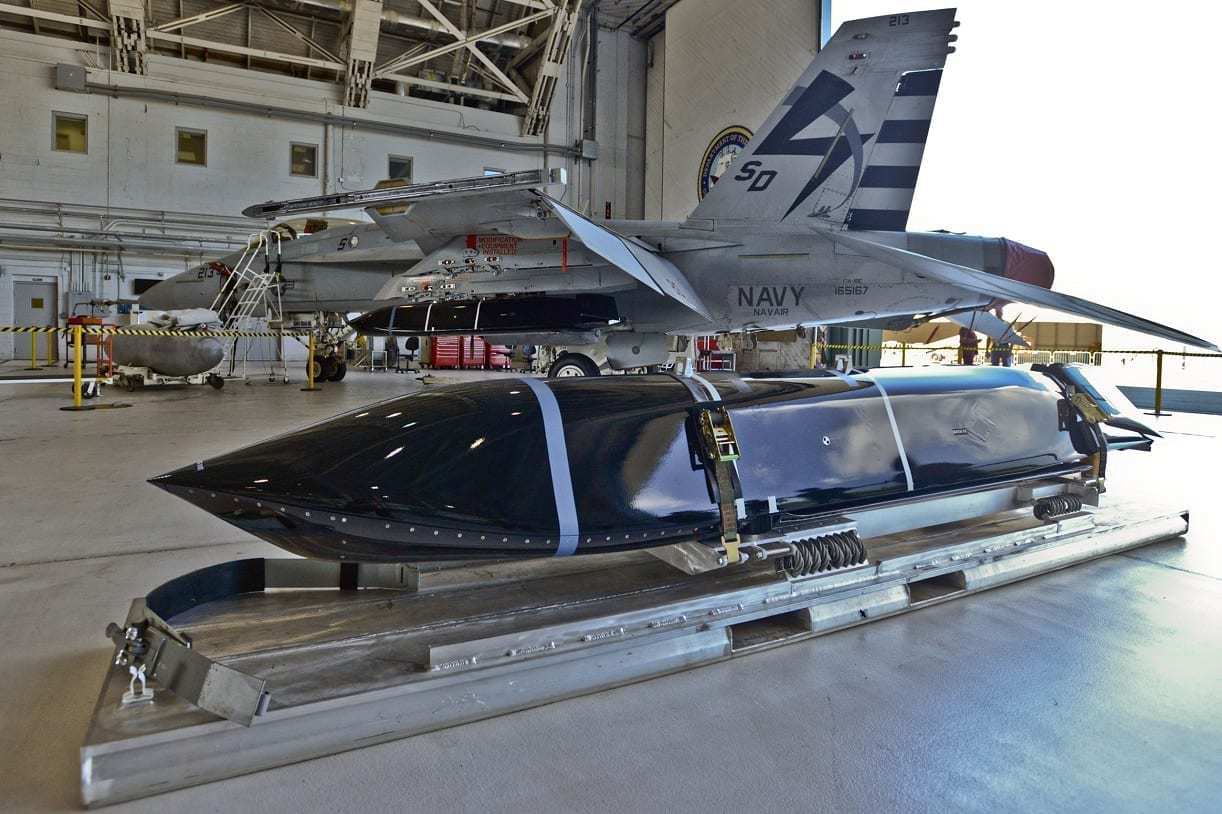
A Long Range Anti-Ship Missile (LRASM) integrated on F/A-18E/F Super Hornet 12 August 2005 at NAS Patuxent River, Md.
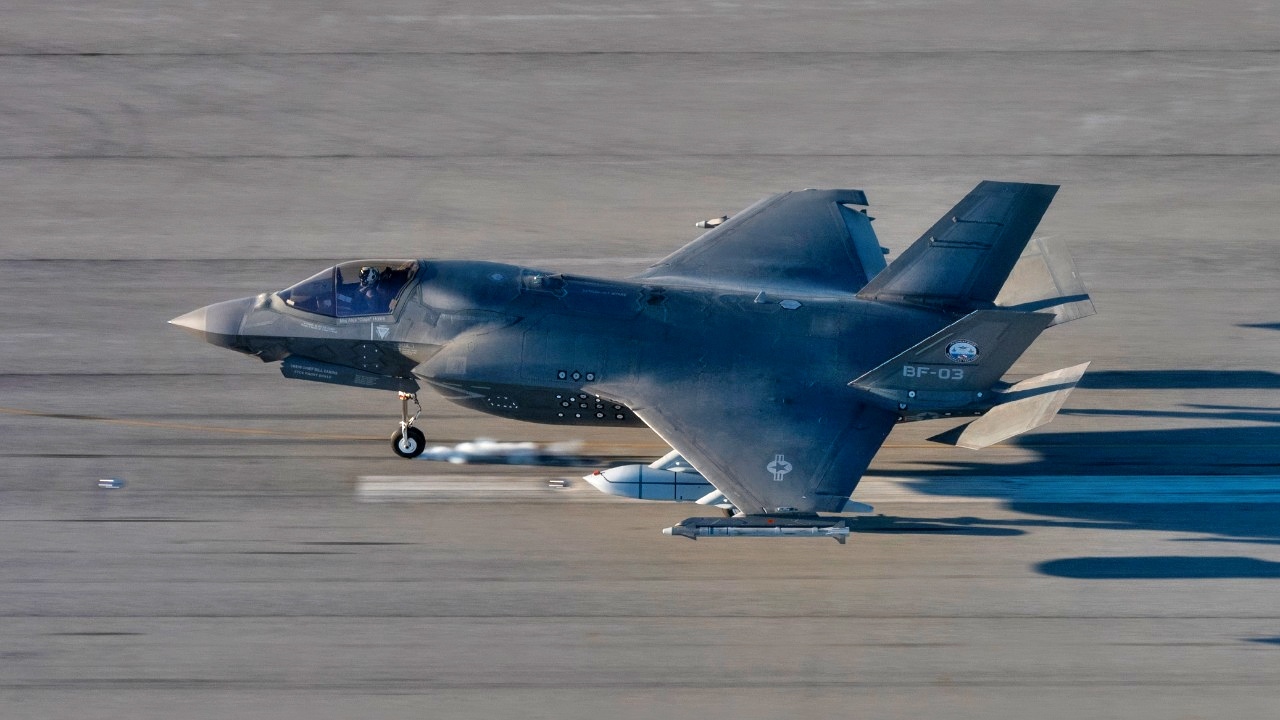
NAS PATUXENT RIVER, Md. — An F-35 Lightning II test pilot conducts the first flight test to certify the F-35B short takeoff and vertical landing variant of the fighter aircraft for carrying the AGM-158C Long-Range Anti-Ship Missile (LRASM). As part of ongoing weapon integration efforts, the Pax River F-35 Integrated Test Force (Pax ITF) team for the first time flew test flights Jan. 14 with two AGM-158 loaded on external stations. LRASM is a defined near-term solution for the Offensive Anti-Surface Warfare (OASuW) air-launch capability gap that will provide flexible, long-range, advanced, anti-surface capability against high-threat maritime targets. The Pax River ITF’s mission is to effectively plan, coordinate, and conduct safe, secure, and efficient flight test for F-35B and C variants, and provide necessary and timely data to support program verification / certification and fleet operational requirements.
For a contingency with China, distance, survivability, and striking first from standoff ranges may count for more than just numbers — and the LRASM missile turns the Western Pacific into a more difficult place for any navy to mass warships in safety.
Other Assets
One of the U.S. Navy’s USVs, or Unmanned Surface Vessels, made its debut at RIMPAC 2026, the 30th edition of that exercise, as well. Video provided by the Pentagon showed a Global Autonomous Reconnaissance Craft, or GARC, plunge into the hull of the decommissioned Tarawa-class amphibious assault ship USS Peleliu after surveying damage the vessel had sustained in other strikes.
About the Author: Caleb Larson
Caleb Larson is an American multiformat journalist based in Berlin, Germany. His work covers the intersection of conflict and society, focusing on American foreign policy and European security. He has reported from Germany, Russia, and the United States. Most recently, he covered the war in Ukraine, reporting extensively on the war’s shifting battle lines in Donbas and writing on its civilian and humanitarian toll. Previously, he worked as a Defense Reporter for POLITICO Europe. You can follow his latest work on X.