

The US Air Force B-2 Spirit stealth bomber may seem outdated compared with ICBMs, which cross thousands of miles in about half an hour at hypersonic speeds, making it exceedingly difficult to intercept.
Yet there’s a reason the US maintains a nuclear triad, including not just ICBMs but nuclear-capable strategic bombers like the B-2 (and SLBMs, too). Each delivery method solves a different problem and provides a different capability.
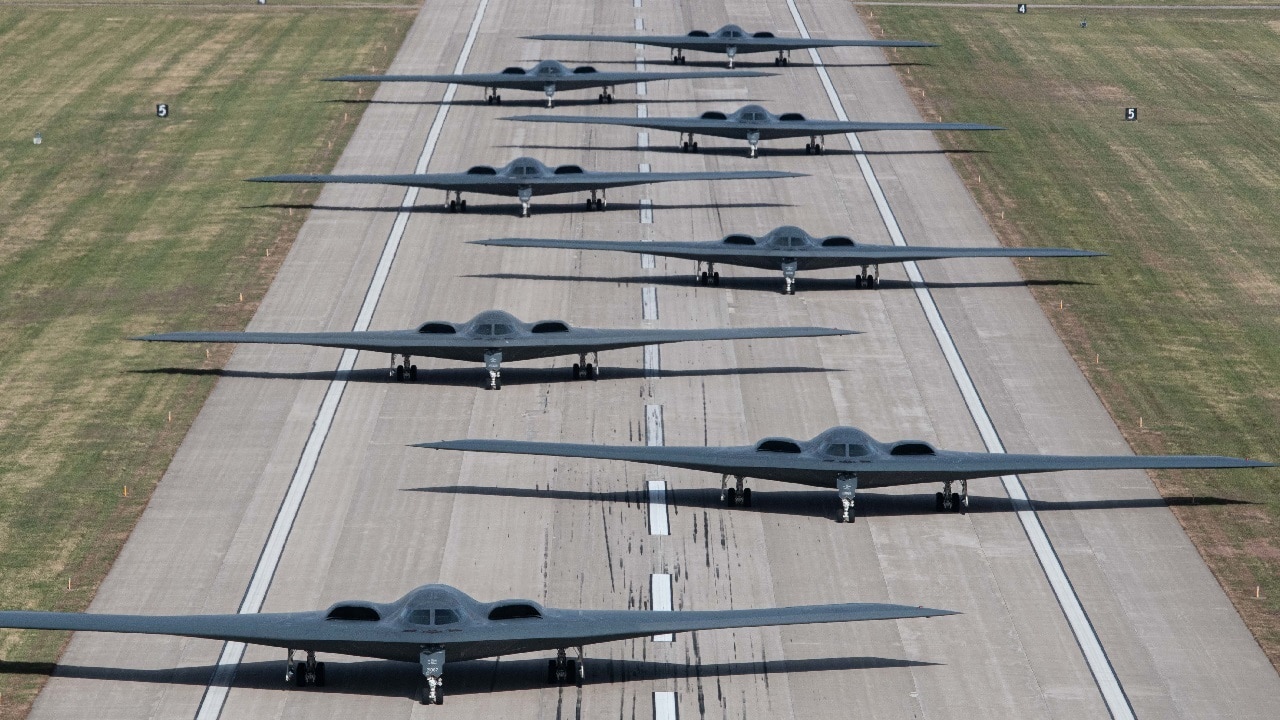
B-2 Spirit stealth bombers assigned to Whiteman Air Force Base taxi and take-off during exercise Spirit Vigilance on Whiteman Air Force Base on November 7th, 2022. Routine exercises like Spirit Vigilance assure our allies and partners that Whiteman Air Force Base is ready to execute nuclear operations and global strike anytime, anywhere. (U.S. Air Force photo by Airman 1st Class Bryson Britt)
ICBMs provide speed and responsiveness. SLBMs, carried on SSBNs, provide survivability, preserving second-strike optionality.
And bombers provide flexibility, signaling, and recallability.
The B-2 adds another element with its stealth capability, allowing a nuclear weapon to approach targets surreptitiously, without the announcement of an ICBM launch.
The Nukes Onboard
The B-2’s principal nuclear gravity weapon is the B61 family, which is currently centered on the modernized B61-12. Measuring 12 feet long and weighing 825 pounds, the B61-12 is a thermonuclear gravity bomb carried internally in the B-2’s weapons bays.
Crucially, the B61-12 has a selectable yield rather than one fixed explosive output. Publicly reported settings include 0.3 kilotons, 1.5 kt, 10 kt, and 50 kt.
For reference, Hiroshima was about 15 kt, giving the B61-12 a remarkable range of options from surgical to world-shattering.
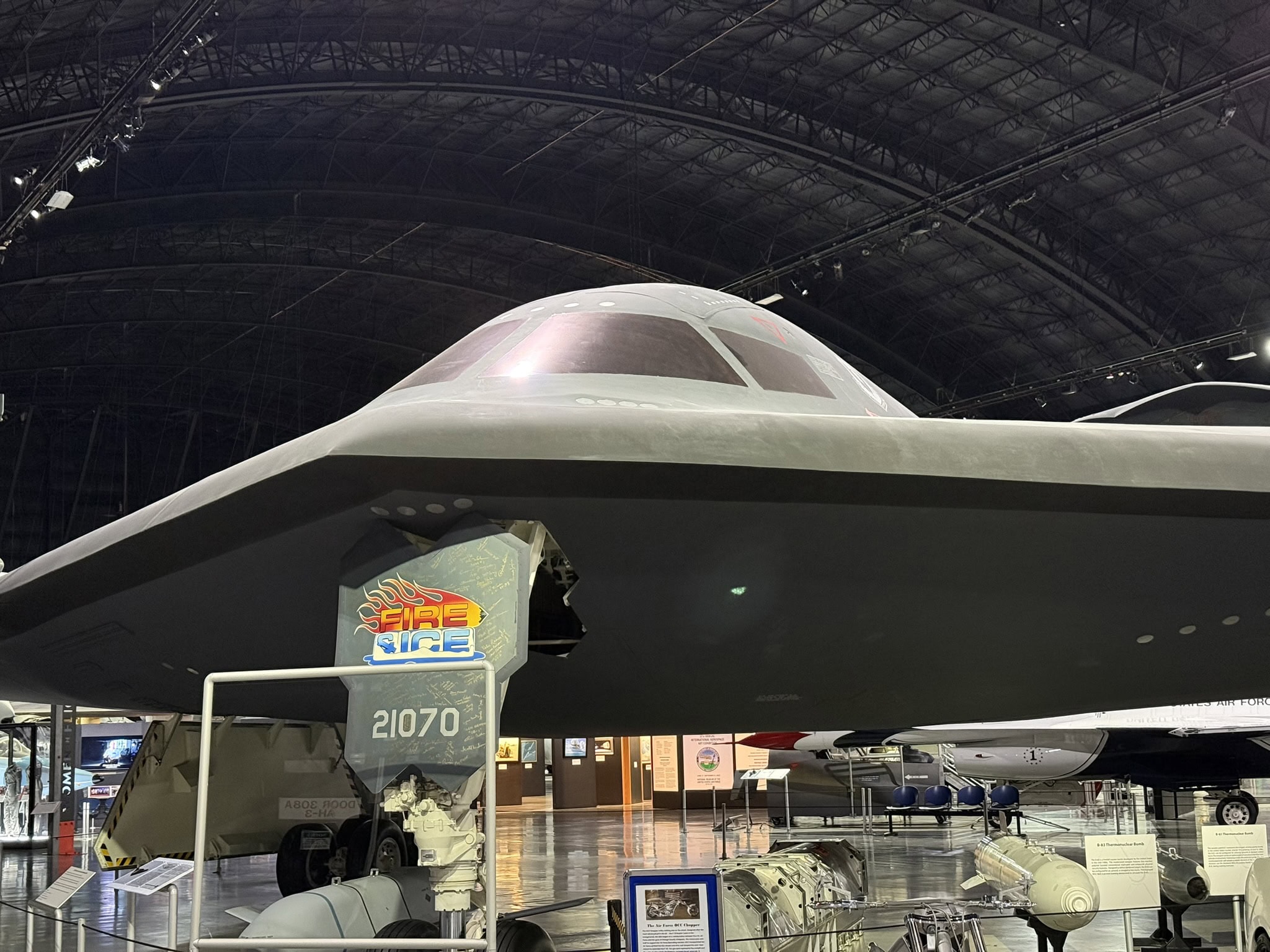
B-2 Spirit Stealth Bomber. 19FortyFive.com Photo from National Museum of the U.S. Air Force Visit in 2025.
The B61-12 also introduced a guided tail kit, which improved accuracy over older free-fall nuclear bombs. This improved accuracy matters strategically, potentially allowing deployment with smaller explosive yields, since accuracy can substitute for raw megatonnage.
The B-2 is also compatible with the B83-1, America’s highest-yield gravity bomb still in service.
At roughly 2,400 pounds and a maximum yield around 1.2 megatons, the B83-1 can unleash as much destructive force as 80 Hiroshimas at once.
The applicability of a bomb with 80 times the destructive force of Hiroshima is debatable, and the future of the bomb has been politically contested.
Depending on the configuration, the B-2 can carry up to 16 nuclear gravity bombs.
These gravity weapons can attack targets differently than ballistic warheads.
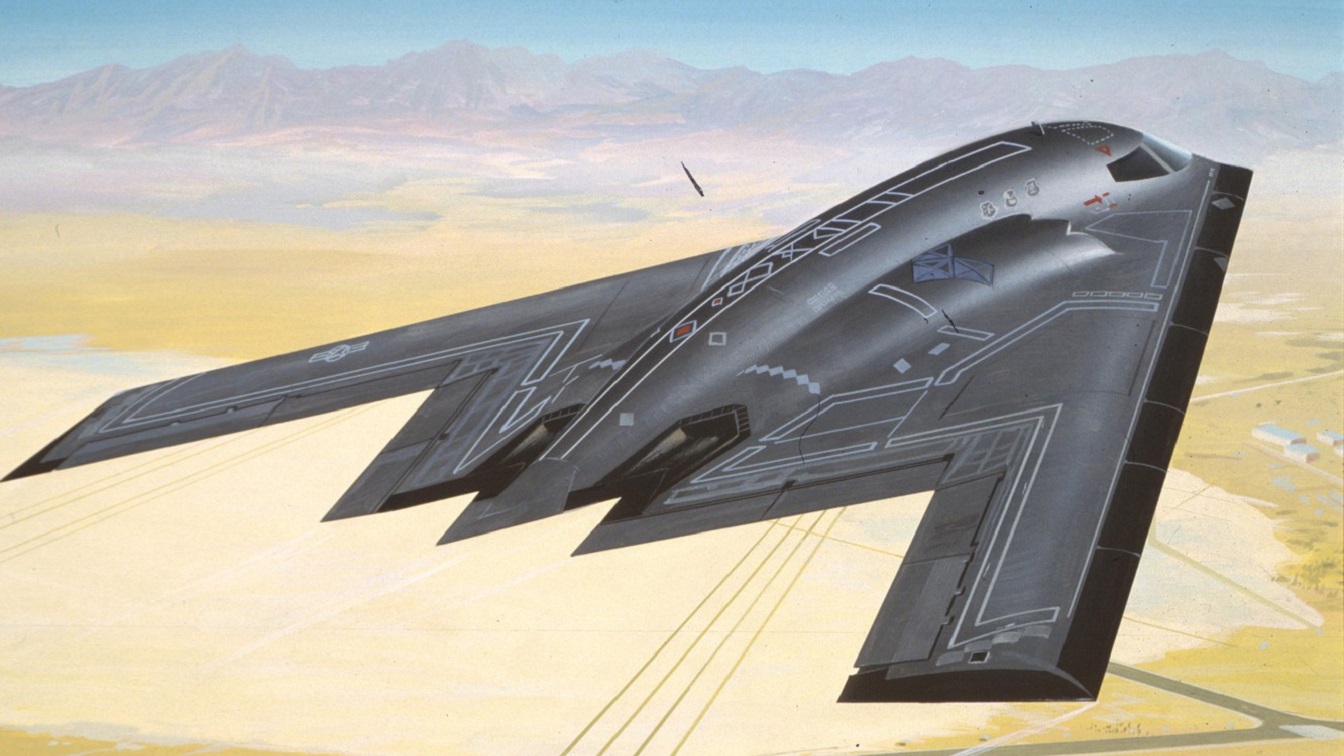
B-2 Bomber. Image Credit: Artist Rendition.
Specifically, the B61 variants can be employed differently depending on the mission. And because of the B61-12’s accuracy, it is a valuable tool against hardened military targets.
Of course, the B61-12 isn’t a magical tool against deep bunkers, but a precisely delivered nuclear weapon can serve to destroy hardened, underground targets.
The Recallability Benefit
Once deployed, you can’t call an ICBM back.
The decision is irreversible. The nuclear detonation is likely imminent.
That makes the technology effective but risky. A B-2 gives war planners a more flexible option, though; it can launch, fly toward the target, and linger.
It can orbit, redirect, or change targets. It can return home without ever releasing a weapon.
In effect, the B-2 serves as an entirely different, more nuanced escalation tool.
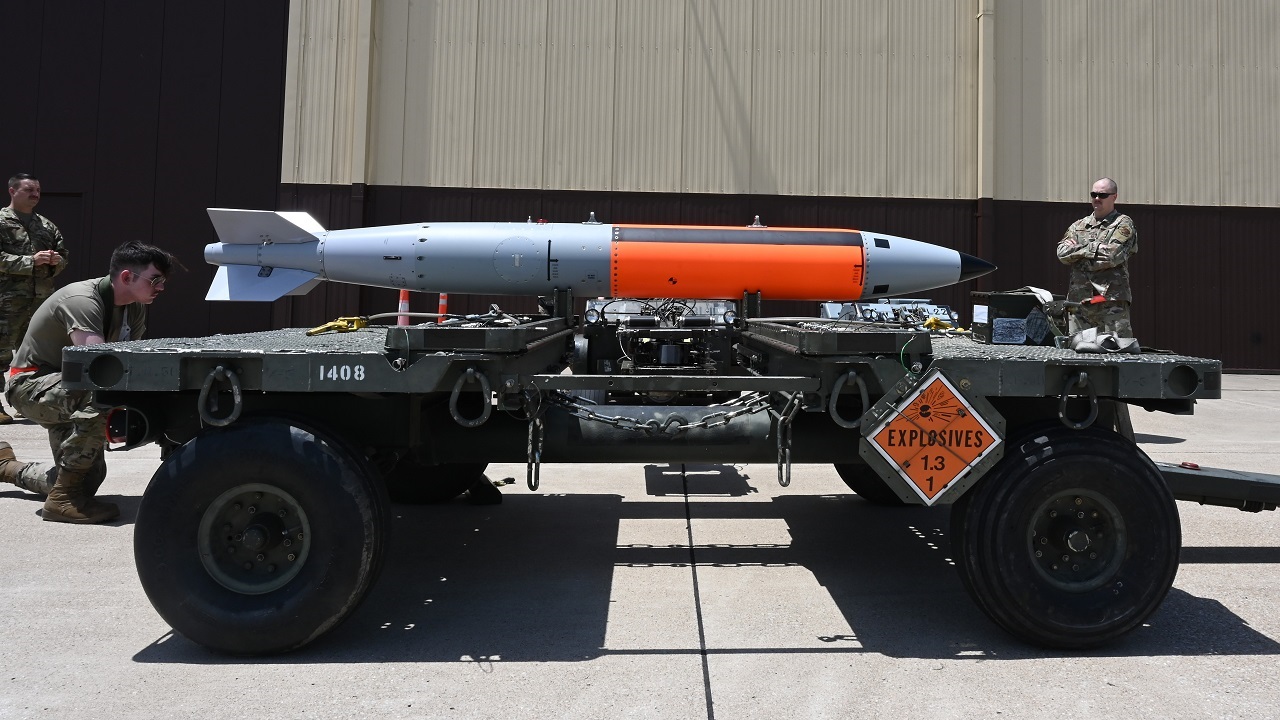
The 72nd Test and Evaluation Squadron test loads a new nuclear-capable weapons delivery system for the B-2 Spirit bomber on June 13, 2022 at Whiteman Air Force Base, Missouri. The 72nd TES conducts testing and evaluation of new equipment, software and weapons systems for the B-2 Spirit Stealth Bomber. (U.S. Air Force photo by Airman 1st Class Devan Halstead)
A president can credibly threaten nuclear deployment without having to actually use nuclear weapons.
B-2s can serve as a tangible threat, a warning not to escalate further. The adversary can see this as a cue to reconsider or de-escalate. Functionally, the B-2 serves as both a weapon and a diplomatic signal.
The Overlapping Triad
The US doesn’t have a perfect nuclear weapon that is ideal for all situations. Instead, nuclear deterrence is dependent on redundancy and overlap.
The dispersal and hardening of ICBMs creates a saturation problem.
SSBNs are exceedingly difficult to find. Bombers offer a backup, a gradual escalation method that can be adjusted mid-course, or recalled entirely.
Defeating one leg doesn’t neutralize the others.
The result is strategic depth rather than waste or unnecessary escalation.
The stealth bomber in particular is helpful.
The B-2 presents a difficult targeting problem for the enemy; it introduces uncertainty in route, target, weapon, and timing.
And because the B-2 can carry a wide variety of nuclear and conventional weapons, enemies don’t know whether the B-2 is nuclear-equipped.
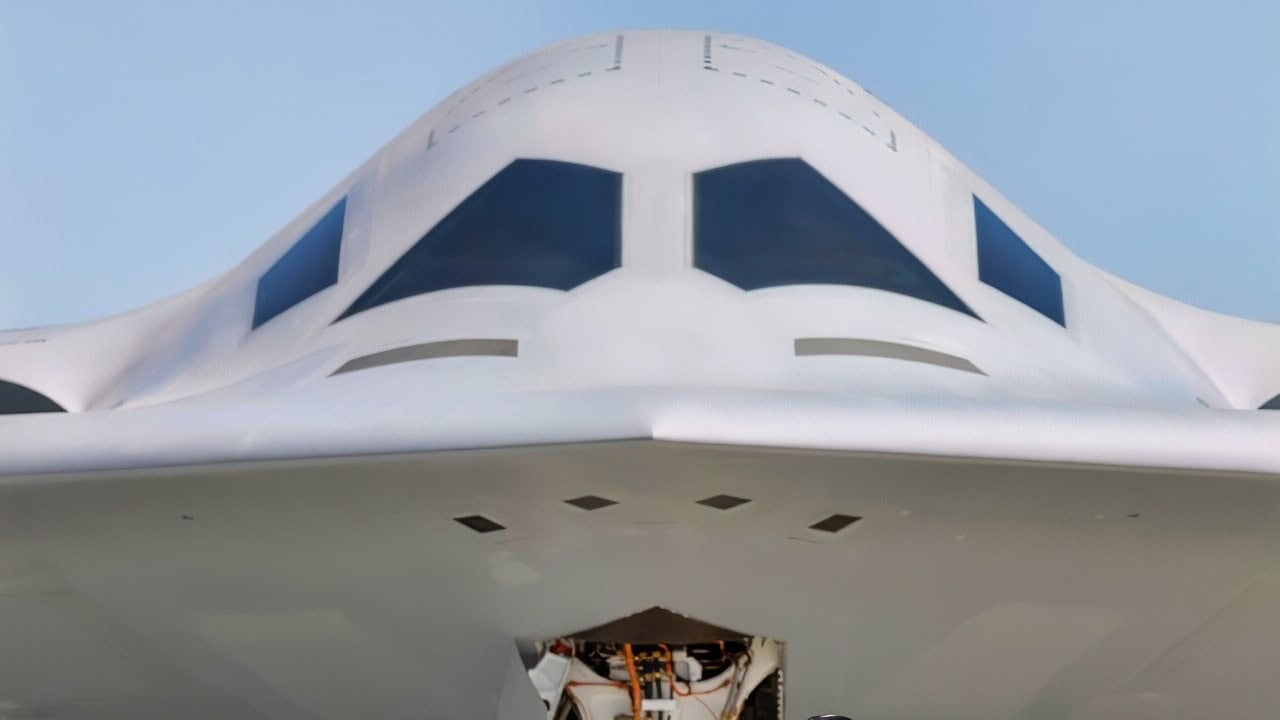
U.S. Air Force Airmen with the 912th Aircraft Maintenance Squadron prepare to recover the second B-21 Raider to arrive for test and evaluation at Edwards AFB, Calif., Sept. 11, 2025. The arrival of a second test aircraft provides maintainers valuable hands-on experience with tools, data and processes that will support future operational squadrons. (U.S Air Force photo by Kyle Brasier)
Still, the B-2 is on its way out and will soon be replaced.
The B-21 Raider will carry on the B-2’s mission, likely with enhanced stealth and easier sustainment. So while the B-2 is headed towards retirement, its role as the stealth bomber portion of the nuclear triad endures.
About the Author: Harrison Kass
Harrison Kass is a writer and attorney focused on national security, technology, and political culture. His work has appeared in Tablet, City Journal, The Hill, The Spectator, and The Cipher Brief. He holds a JD from the University of Oregon and a master’s in Global & Joint Program Studies from NYU. More at harrisonkass.com.