
After years of appeasing Yemen’s Houthi militia in exchange for quiet, Saudi Arabia is again under fire. Just nine months after Saudi Crown Prince Muhammad Bin Salman kneecapped Yemen’s Southern Transitional Council, the anti-Houthi alliance’s most effective fighting force, the Houthis captured the strategically crucial port of Mokha on the shores of the Bab el-Mandeb.
Houthi control of the Bab el-Mandeb, coupled with their growing presence 725 miles further north in Port Sudan, cuts off Saudi Arabia’s ability to reliably export oil through the East-West Petroline terminal at Yanbu. Initially, Bin Salman again appeared to cave to Houthi extortion to let some oil flow, but weakness never invites peace.
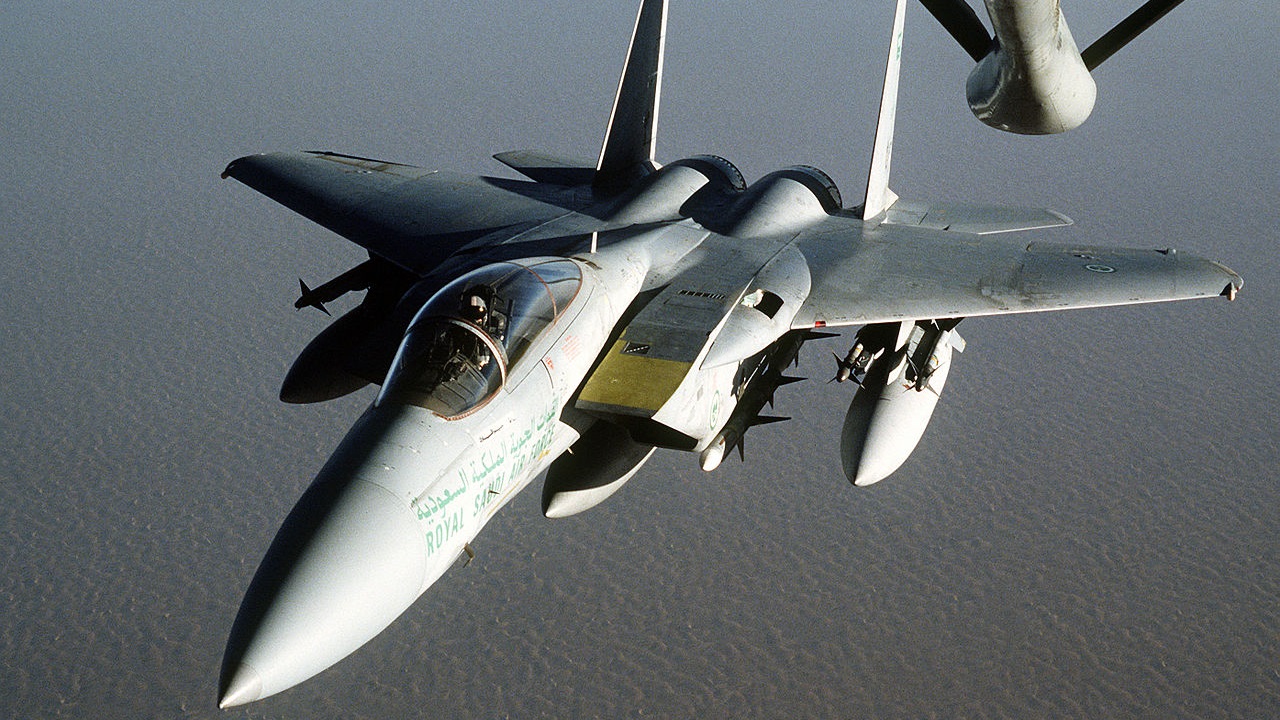
A Royal Saudi Air Force F-15 Eagle fighter aircraft approaches a KC-135 Stratotanker from the 1700th Air Refueling Squadron Provisional for refueling during Operation Desert Shield.
On October 8, 2026, the Houthis attacked Riyadh’s King Khalid International Airport, setting a parked Saudia Airlines Airbus A30 ablaze.

An October 10, 2026 missile attack struck passenger Terminals 3 and 4, killing a dozen people, including at least one American.
Many analysts said the Houthis’ strategy—perhaps backed by Iran itself—has been to isolate Saudi Arabia by air and by sea. If so, the strategy has worked. Many airlines, including Lufthansa, Air India, IndiGo, Emirates, Etihad, KLM, Air France, and British Airways, have already suspended flights to the Saudi capital.
While the Mecca Joint Defense Agreement promises a NATO-like alliance, only Pakistani forces have been deployed to Saudi Arabia, and there is no indication they will participate directly in operations against the Houthis.
Yemeni forces have reportedly retaken Mokha, largely because the Saudis have allowed the Southern Transitional Council to operate freely. While the Saudis do not publicly credit the Emirati-trained force, a Southern Forces commander I knew was killed in the fighting; his allegiance was no secret.
Saudi authorities talk about launching a ground invasion with 100,000 troops to recapture Mokha and, presumably, take the main port of Hodeidah along the way, but such an operation is easier said than done; Saudi officials have discussed it periodically for over a decade. Disjointed strategy and Bin Salman’s apparent unawareness that his forces are less capable than his subordinates claim, however, make further Houthi gains likely.
That suggests a stalemate, but not a nightmare. The problem with ideological enemies, however, is they do not compromise.
Saudi Arabia is an artificial country—most countries that named themselves after a living person are. British historian Malcolm Yapp noted that across the 19th and 20th centuries, the total number of states in the Persian Gulf region stayed similar, but only a couple—Yemen and Oman—remained the same. Saudi Arabia was formed by conquest, absorbing smaller entities such as the Kingdom of Hejaz, the Sultanate of Nejd, the Emirate of Jabal Shammar, and Asir. While many scholars describe a compact between the ruling al-Saud family and the religious establishment—a topic Saudi officials allow—many academics, with few exceptions, discuss regionalism; Saudi officials find this too sensitive to tolerate.
Saudi Arabia’s Achilles’ heel, however, has never been Yemen but its Eastern Province. With a large, if not majority, Shi‘a population, the Eastern Province also holds much of the Saudi oil and gas reserves. If the Islamic Revolutionary Guard Corps smells blood in the water, especially as the crown prince seeks to prioritize quiet over victory, expect an effort to ramp up unrest in the East. During the Arab Spring 15 years ago, there were haphazard attempts, but Saudi security proactively crushed much of the resistance.
Today, with drones flying and the Saudis seemingly overwhelmed, it is likely only a matter of time until the Iranian regime and its proxies seek to spark renewed unrest and insurgency in the Eastern Province. Energy analysts should expect not only drone and missile attacks, but also sabotage. The foreign engineers upon whom Saudi Aramco depends will have targets on their backs as they face magnet bombs on their cars and assassination, with the goal of getting foreigners to leave.
Neither Saudi Shi‘a nor the Iranian regime have forgotten, let alone forgiven, the execution a decade ago of Saudi Shi‘i cleric Nimr al-Nimr. Bin Salman and his cohort in Riyadh may also have confused quiet in the Eastern Province with endorsement of his rule, but the resentments and blood feuds born of decades of repression run deep.
Disruption in the Strait of Hormuz and the Red Sea might be a bad dream for Saudi authorities and the global energy markets,ts but insurgency in Eastern Saudi Arabia, if Iranian agents successfully spark it, will be the true nightmare.
About the Author: Dr. Michael Rubin
Dr. Michael Rubin, a Director of Policy Analysis at the Middle East Forum, specializes in Iran, Turkey, and the Horn of Africa. His career includes time as a Pentagon official, with field experiences in Iran, Yemen, and Iraq, as well as engagements with the Taliban prior to 9/11. Mr. Rubin has also contributed to military education, teaching U.S. Navy and Marine units about regional conflicts and terrorism. His scholarly work includes several key publications, such as “Dancing with the Devil” and “Eternal Iran.” Rubin earned his Ph.D. and M.A. in history and a B.S. in biology from Yale University.