
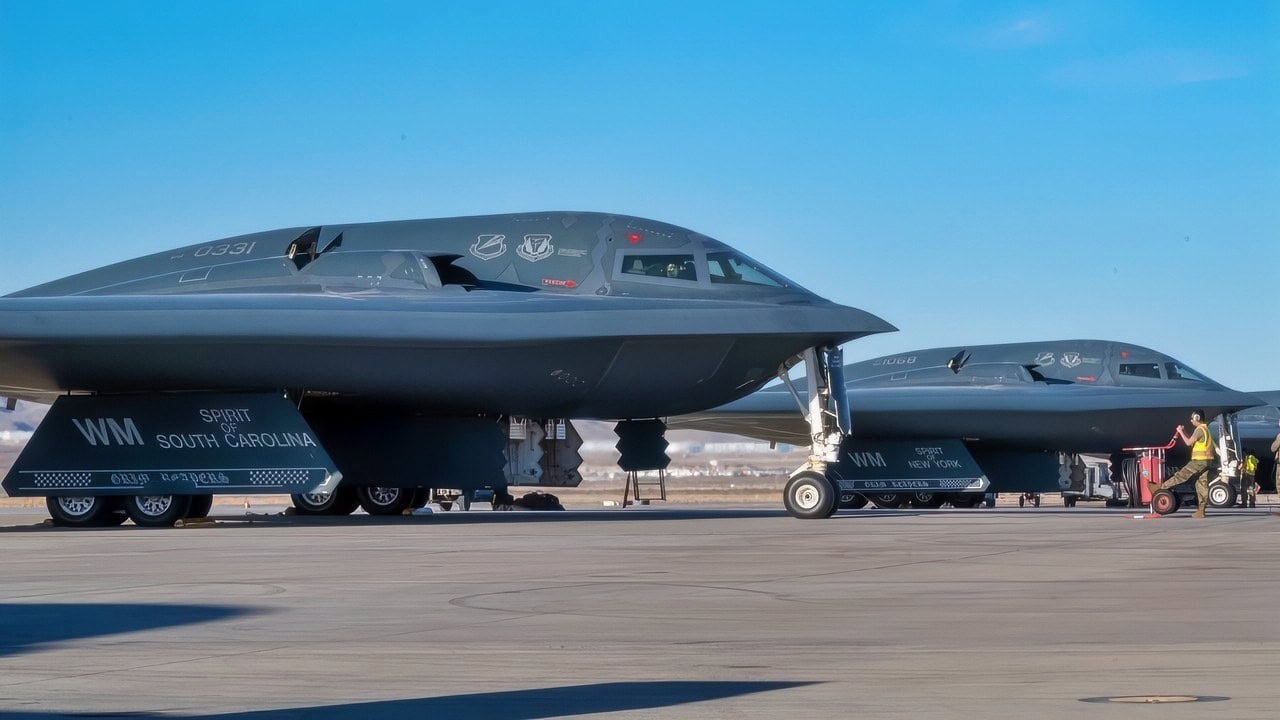
Summary and Key Points: The B-2 Spirit of Kansas was destroyed by rainwater — moisture inside three sensors fed false data to its computers, which pitched it into a stall seconds after takeoff on Guam in 2008, a $1.4 billion loss and the costliest crash in aviation history. The B-2 Spirit of Hawaii was killed by a failed hydraulic coupling in 2022 and written off two years later as uneconomical to repair. The line that built them closed in the 1990s; repairs take years, and 19 bombers now carry the whole mission until the B-21 Raider arrives in strength.
How Nearly 10 Percent of the B-2 Bomber Fleet Was Lost
America built exactly 21 B-2 Spirit stealth bombers, and it can never build another one.
The production line closed in the 1990s, the tooling and supplier base dissolved, and the workforce scattered, which means the fleet can only ever shrink.
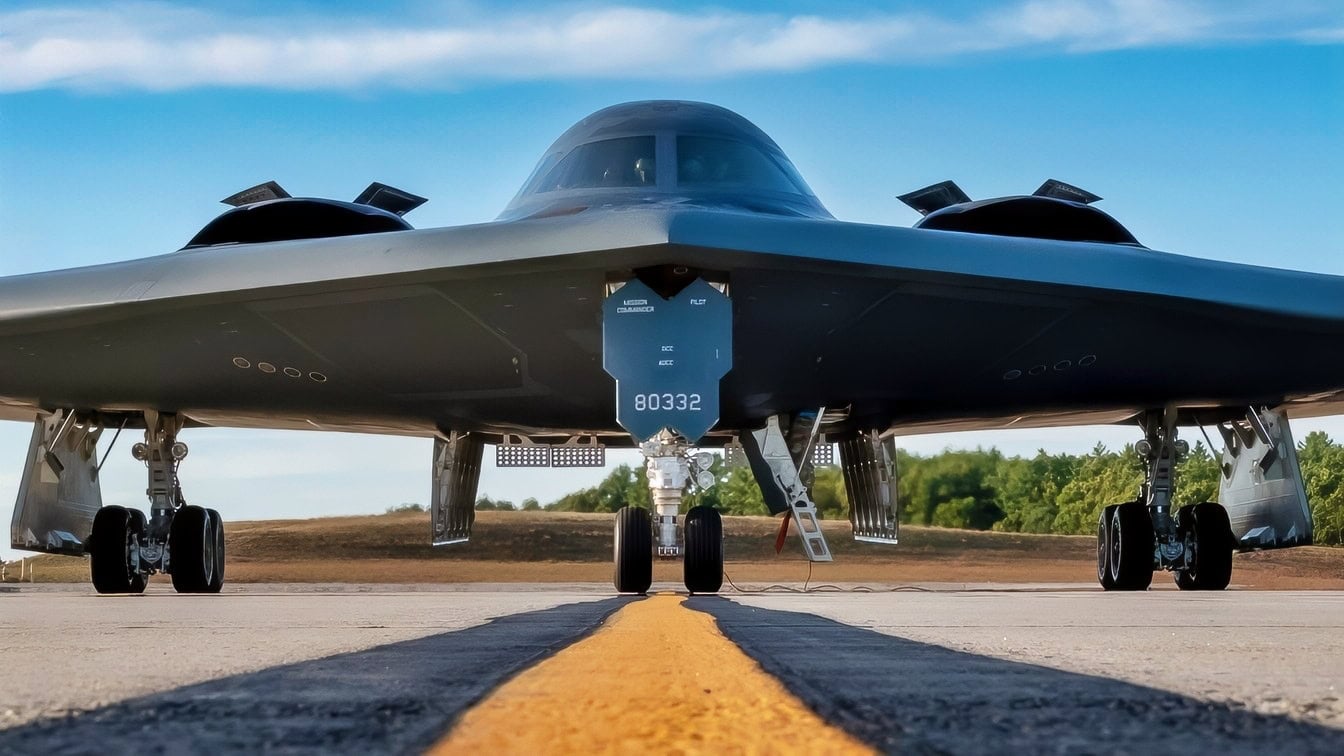
A U.S Air Force B-2 Spirit aircraft is shown on the flight line at Pease Air National Guard Base, New Hampshire, Sept. 20, 2025. The aircraft is the first operated by the 509th Bomb Wing to land at Pease ANGB, formerly Pease Air Force Base, since the 509 BW, formerly 509th Bombardment Wing, was stationed at Pease AFB and the active-duty base closed nearly 35 years ago. The lineage of the 509th BW traces back to the World War II Era when the 509th Composite Group dropped the atomic bombs on Japan. (U.S. Air Force photo by Staff Sgt. Joshua Hastings)
It has shrunk twice. One bomber died in a fire on a Guam runway in 2008, and one was written off with a sentence in a Pentagon budget document after a 2022 emergency landing, leaving 19 aircraft to carry the entire penetrating-strike and stealth nuclear mission of the United States until the B-21 Raider arrives in numbers.
The two losses deserve to be understood in detail, because they are not the same kind of loss, and together they explain the arithmetic of scarcity that now governs American air power.
The First Loss: Spirit of Kansas, Guam, 2008
On the morning of February 23, 2008, four B-2s prepared to leave Andersen Air Force Base in Guam at the end of a four-month Pacific deployment. Aboard the Spirit of Kansas, tail number 89-0127, a bomber with 5,100 flight hours, the crew had no way of knowing that Guam’s heavy, lashing rains had left moisture inside three of the aircraft’s 24 skin-flush sensors that feed the flight-control computers, and that the sensors had been calibrated with the water still inside.
The corrupted data told the crew they had reached takeoff speed when they were rolling roughly ten knots slower, and the instant the wheels left the runway, the computers, sensing a nose-down attitude that did not exist, commanded a violent 30-degree pitch-up.
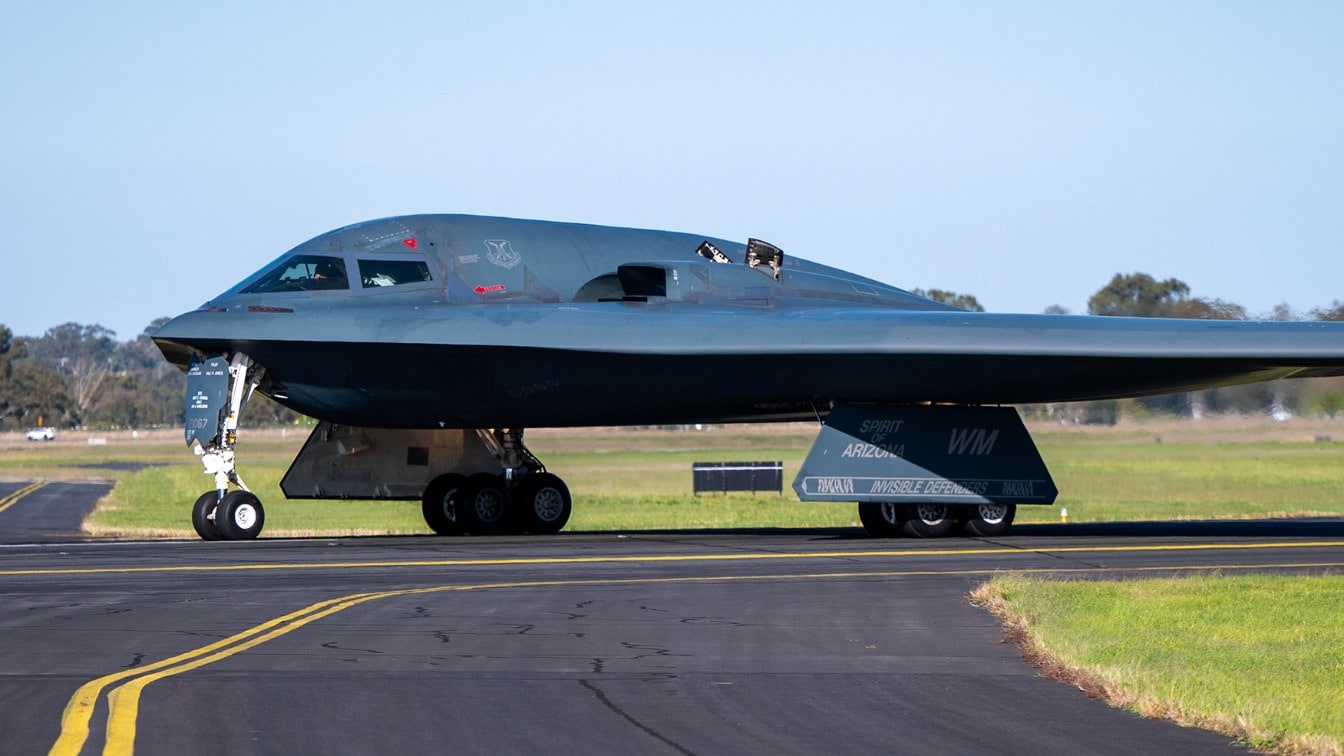
A U.S. Air Force B-2 Spirit stealth bomber arrives after a Bomber Task Force mission at Royal Australian Air Force Base Amberley, Australia, Sept. 5, 2024. U.S. Indo-Pacific Command routinely and visibly demonstrates commitment to its allies and partners through the employment of military forces, demonstrating strategic predictability, while becoming more operationally unpredictable to adversaries. (U.S. Air National Guard photo by Staff Sgt. Whitney Erhart)
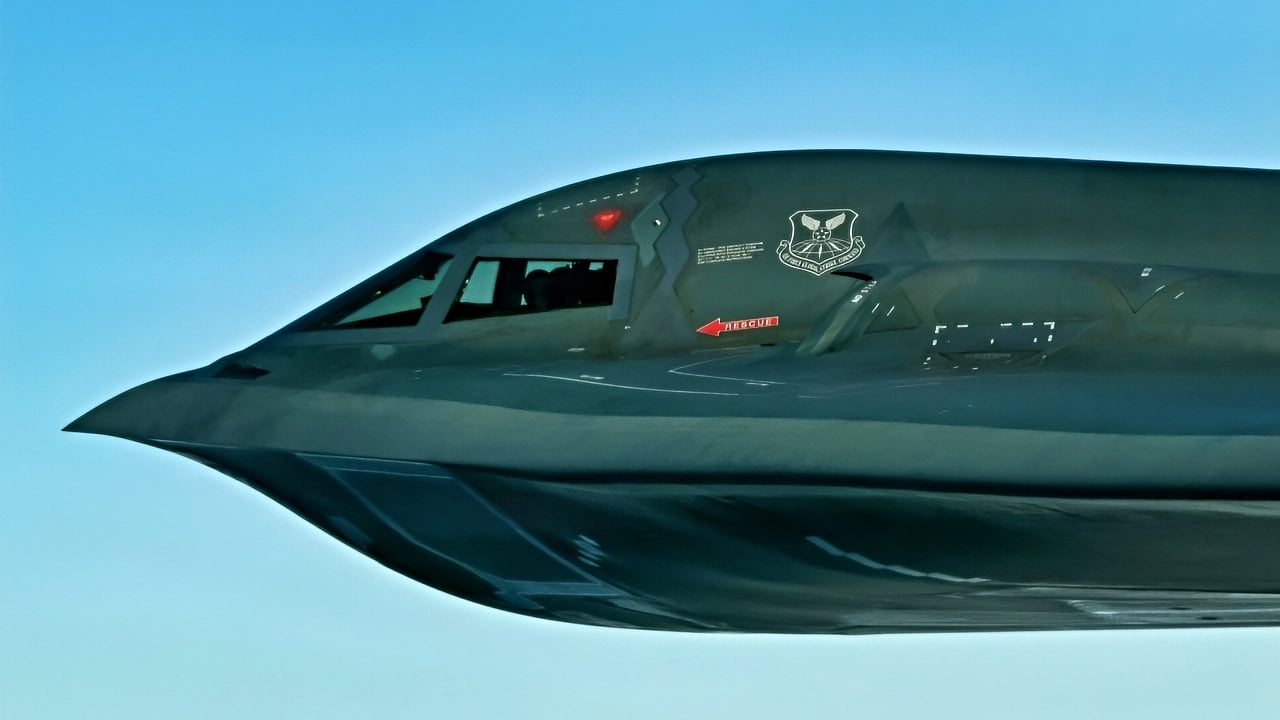
A U.S. Air Force B-2 Spirit conducts an integrated maritime strike training exercise with U.S. Navy F-35C Lightning II and F/A-18E Super Hornets from Carrier Air Wing Eleven (CVW-11) off the coast of California, on Feb. 10-11, 2026. Practicing innovative methods to employ and integrate strategic bombers like the B-2 with Navy carrier strike groups enhances combat capabilities through synchronized, integrated power projection. (U.S. Navy photo by Katie Archibald)
The bomber stalled, veered left, and dragged a wingtip; Major Ryan Link and Captain Justin Grieve ejected at almost zero altitude and survived as the aircraft tumbled and burned. NASA’s engineering case study on the mishap prices the destroyed bomber at $1,407,006,920, the most expensive aviation accident in history.
The cruelest findings came from the investigation: maintenance crews had discovered the moisture problem in 2006 and even found the fix, running the sensor heaters before calibration to boil the water off, but the workaround was never formally documented; another crew at the same base had once aborted a takeoff over the very same false readings, and that knowledge never traveled either. The men flying that morning had never heard of any of it. The fleet stood down for weeks, and the B-2 force was reduced to 20.
The Second Loss: Spirit of Hawaii, Whiteman, 2022
The second loss took years to become official. On December 10, 2022, a B-2 on a routine mission from Whiteman Air Force Base in Missouri declared an in-flight emergency and returned to the base’s only runway, where its left main landing gear collapsed on touchdown; the bomber skidded off the pavement and caught fire. The crew walked away, but the aircraft blocked Whiteman’s single runway for more than a week, and the whole fleet entered a grounding the Air Force called a safety pause that stretched for months, public enough that the B-2 skipped its traditional Rose Bowl flyover, with the service insisting throughout that the bombers could still fly their nuclear mission if ordered.
Then, in the spring of 2024, a Pentagon force-structure report disclosed the verdict in bureaucratic deadpan: the damaged B-2 was being divested, its condition “presumed to be uneconomical to repair.” The jet was the Spirit of Hawaii, and the accident investigation, released in 2025, traced the disaster to something almost absurdly small: a failed hydraulic coupling deep in the landing-gear system, a fitting type that has now been documented failing 25 times across the fleet, ten of them in landing-gear hydraulics. A $2 billion aircraft was killed by a connector. The fleet became 19.
Why a Damaged B-2 Is Almost a Dead B-2
The Hawaii decision looks cold until you see the repair math, and the fleet’s own history supplies it. The Spirit of Washington, badly damaged by a ground fire on Guam in 2010, took nearly three years to fly operationally again.
The Spirit of Georgia, which skidded off Whiteman’s runway in September 2021 when worn springs let its landing gear fold, needed a repair that grew from an initial $10.1 million estimate into a $23.7 million, four-year odyssey through Northrop’s Palmdale plant, returning to service only at the end of 2025, a restoration engineers initially doubted was possible.
Every repair of a stealth aircraft is partly a re-manufacturing of materials and coatings that no active production line supports, performed by a vanishing pool of specialists, and while it happens, five percent of the entire force sits in a hangar. Against that arithmetic, rebuilding a burned airframe would have cost years of money for a bomber already scheduled to retire, and the Air Force chose to spend the money on the 19 that remained.
Nineteen Aircraft, One Bridge
Which is the real story of the two losses: each one permanently shrank a national capability, because nothing on Earth can replace a B-2 except its successor.
The scarcity even photographs well; when Whiteman taxied eight bombers down its flight line in a 2022 show of force, that single frame held 40 percent of the entire fleet. The survivors have spent 2025 and 2026 proving how thin the margin is, striking Iran’s hardened nuclear sites, rotating through the Pacific opposite China, and carrying their share of the nuclear deterrent, all from one ramp at one Missouri base.
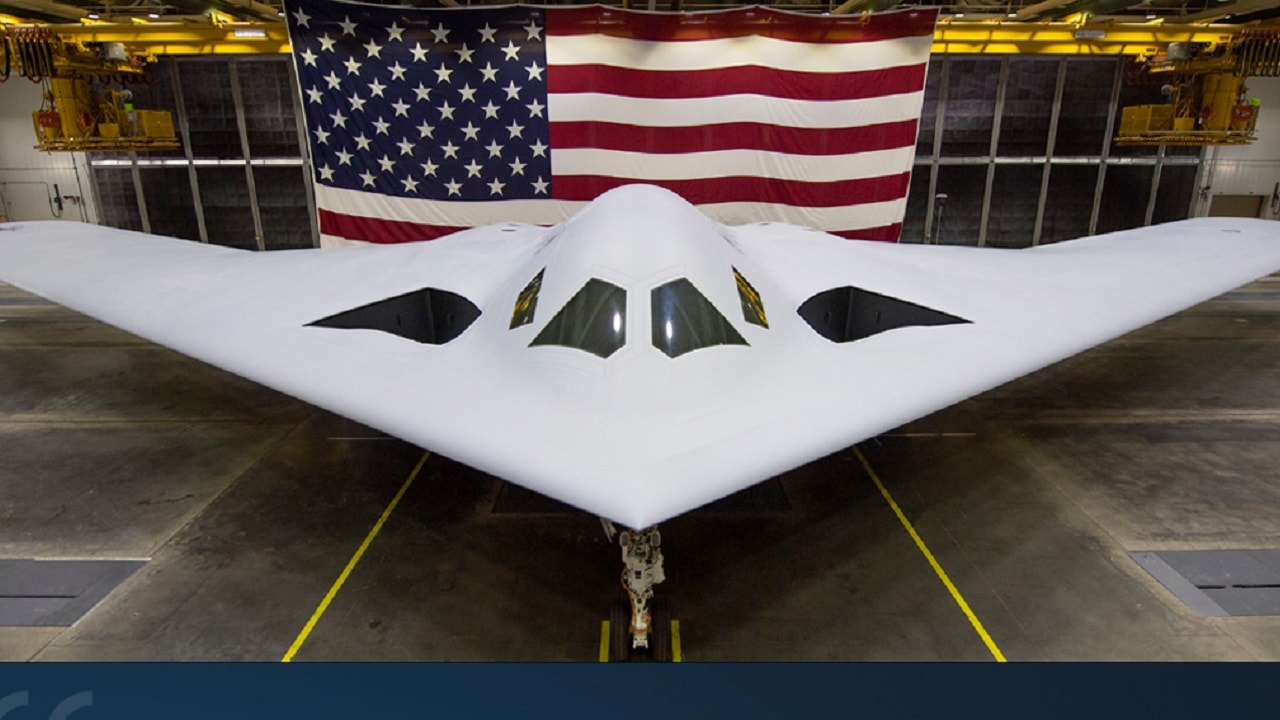
B-21 Raider
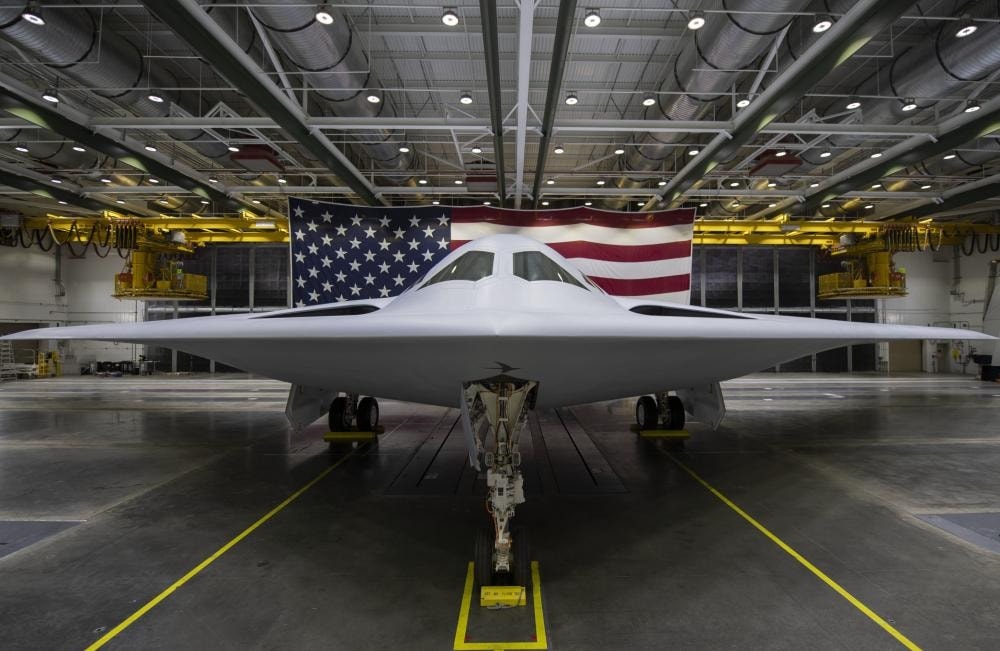
B-21 Raider. Image Credit: Creative Commons.
Relief exists, but it is not here yet: the B-21 Raider is in low-rate production at Palmdale and flying at Edwards, with a program of record of at least 100 aircraft and squadrons expected before the decade ends, and until those Raiders arrive in strength, every B-2 that rolls down a runway carries a simple, unforgiving truth in its wings.
The Spirit of Kansas burned on Guam. The Spirit of Hawaii died in a budget table. There are 19 left; there will never be 20 again, and the replacement line in Palmdale is the only thing standing between that number and smaller ones.
About the Author: Harry J. Kazianis
Harry J. Kazianis (@Grecianformula) was the former Senior Director of National Security Affairs at the Center for the National Interest (CFTNI), a foreign policy think tank founded by Richard Nixon based in Washington, DC. Harry has over a decade of experience in think tanks and national security publishing. His ideas have been published in the NY Times, The Washington Post, The Wall Street Journal, CNN, and many other outlets. He has held positions at CSIS, the Heritage Foundation, the University of Nottingham, and several other institutions related to national security research and studies. He is the former Executive Editor of the National Interest and the Diplomat. He holds a Master’s degree focusing on international affairs from Harvard University.

