
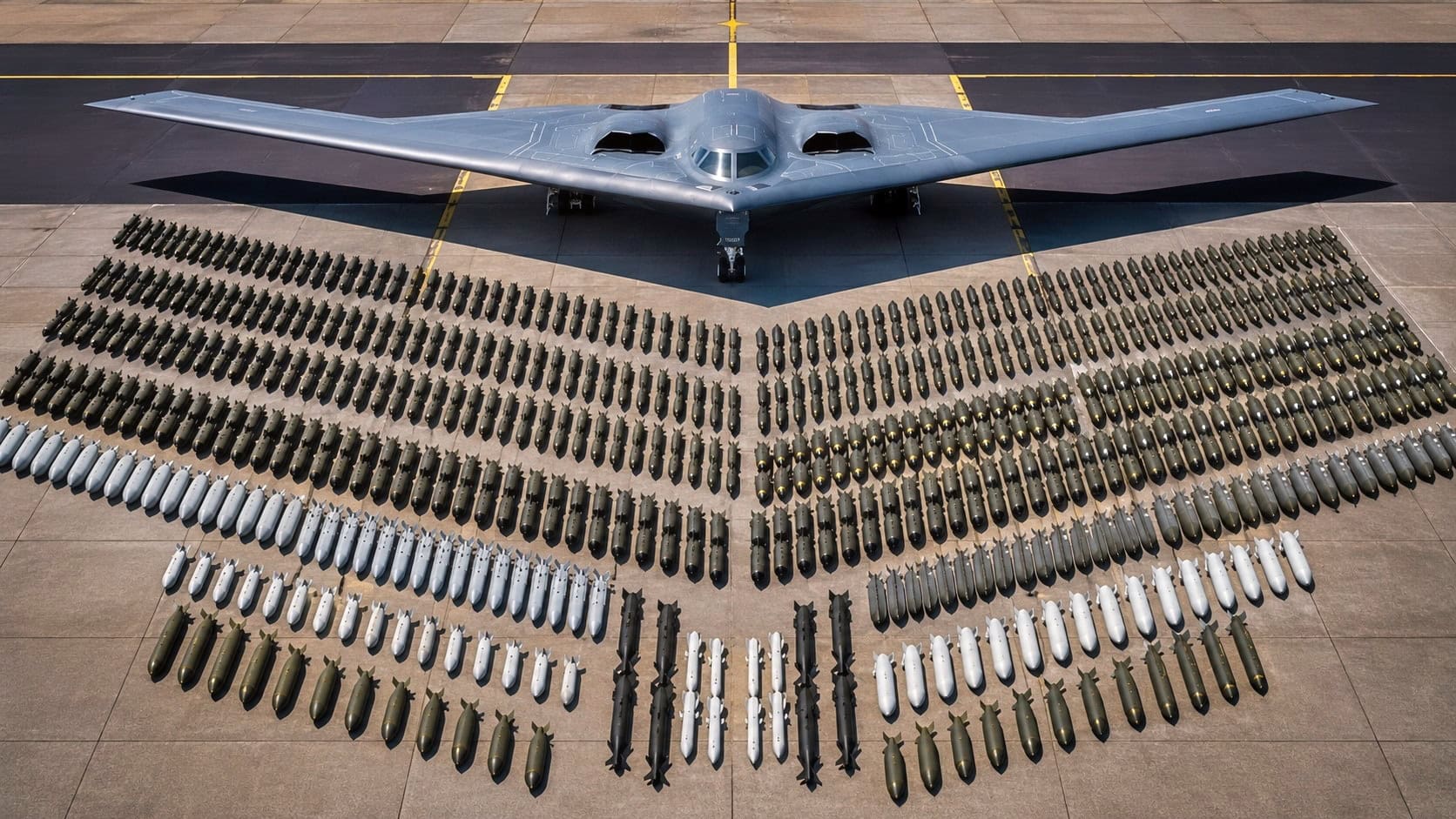
The B-2 Spirit is the only aircraft on earth that can slip through modern air defenses and drop the 30,000-pound bunker-buster that struck Iran’s deepest underground nuclear sites — and the entire fleet numbers 19 aircraft. When the United States needed to hit the enrichment plant buried under a mountain at Fordow, and when the B-2 flew the penetrating missions of Operation Epic Fury against Iran earlier in 2026, it did so because nothing else in the American arsenal could. The most irreplaceable airplane the country owns is also one of its rarest, and the number 19 is not the result of a single bad day. It is the sum of a 40-year subtraction — a fleet meant to number in the hundreds whittled down by cost, by the end of the Cold War, and by two accidents, until losing two aircraft meant losing a tenth of the force.
The Ambition: A Fleet Of 132 B-2 Bombers
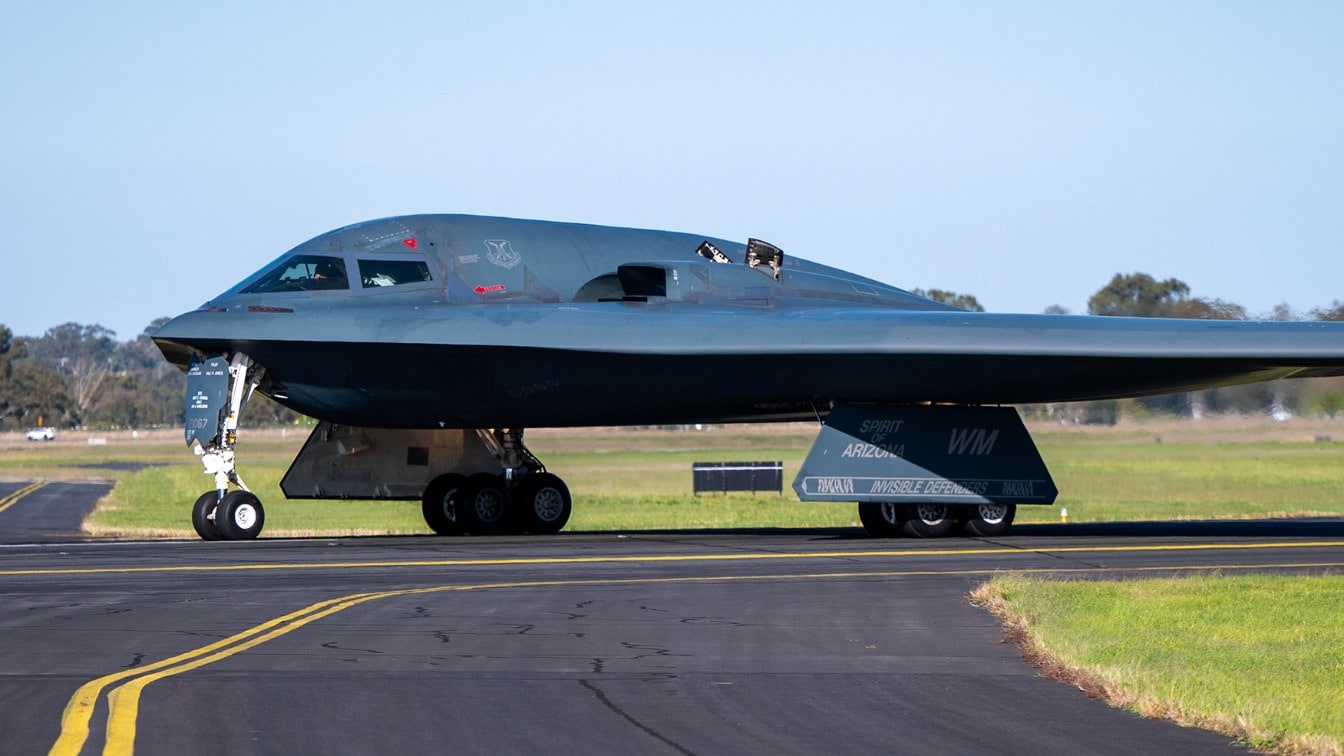
A U.S. Air Force B-2 Spirit stealth bomber arrives after a Bomber Task Force mission at Royal Australian Air Force Base Amberley, Australia, Sept. 5, 2024. U.S. Indo-Pacific Command routinely and visibly demonstrates commitment to its allies and partners through the employment of military forces, demonstrating strategic predictability, while becoming more operationally unpredictable to adversaries. (U.S. Air National Guard photo by Staff Sgt. Whitney Erhart)
The B-2 was conceived in the late Cold War, in the early 1980s, as the answer to a specific and daunting problem: how to penetrate the dense Soviet air-defense network and hold Moscow’s most hardened targets at risk with a bomber the radars could not see.
The solution was a flying wing built around radar-absorbent materials and a shape with no vertical surfaces to reflect a return — the most technically ambitious aircraft program of its era, and the first true stealth bomber. To matter in a great-power war against the Soviet Union, it needed to exist in numbers, and the Air Force planned to buy 132 of them.
That figure was the premise of the entire program. A force of 132 penetrating stealth bombers would have been large enough to absorb losses, sustain a high operational tempo, and represent a credible strategic threat across a long conflict.
Almost none of those 132 were ever built, and the story of the B-2 is really the story of how that number kept falling.
Cost Cuts It To 75
The first cut came from the price. Pioneering operational stealth meant exotic materials, painstaking manufacturing, and a maintenance burden no previous bomber had ever carried — the radar-absorbent coatings alone demanded specialized climate-controlled hangars and constant attention. As the technical difficulty mounted through the 1980s, so did the cost per aircraft, and by the late 1980s, the planned buy had already been trimmed from 132 to 75.
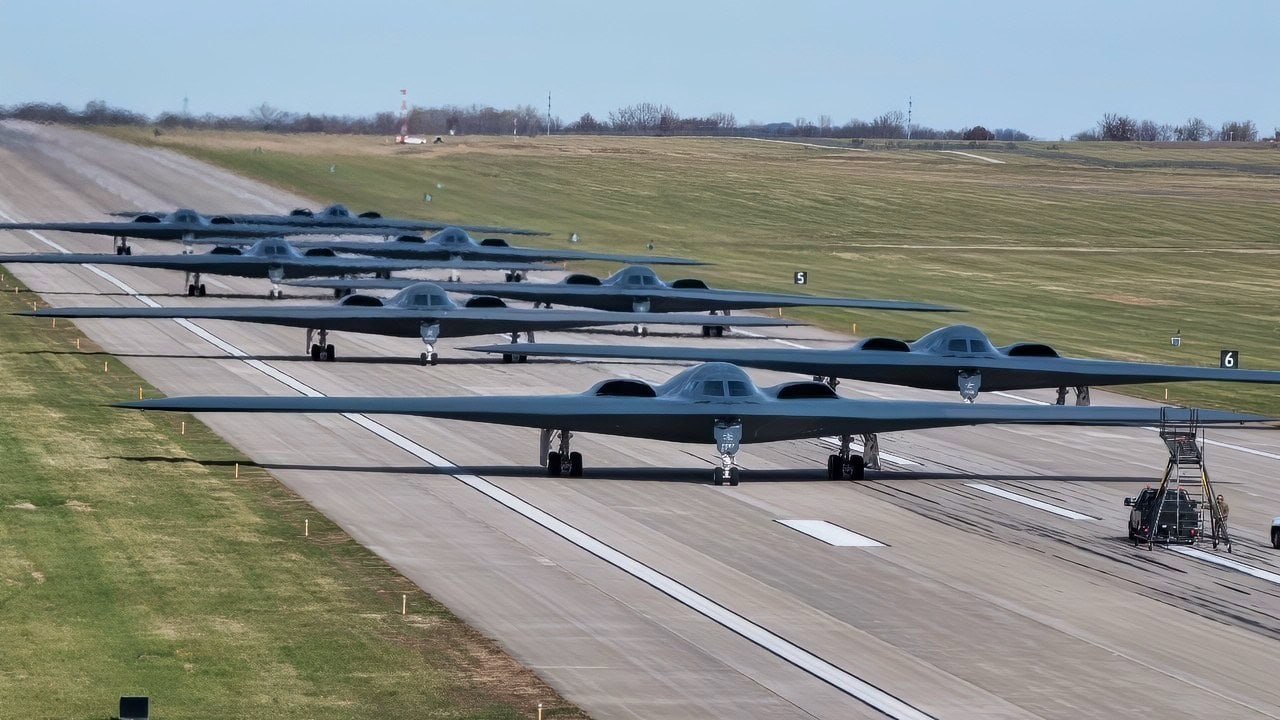
B-2 Spirit stealth bombers assigned to Whiteman Air Force Base taxi and take-off during exercise Spirit Vigilance on Whiteman Air Force Base on November 7th, 2022. Routine exercises like Spirit Vigilance assure our allies and partners that Whiteman Air Force Base is ready to execute nuclear operations and global strike anytime, anywhere. (U.S. Air Force photo by Airman 1st Class Bryson Britt)
Cost and quantity then fed on each other in a spiral that has since become a textbook lesson in defense procurement. The B-2’s enormous research-and-development bill was effectively fixed, so spreading it across fewer aircraft drove the cost of each remaining copy higher, which in turn made the program look more expensive and justified buying still fewer.
On a total program basis, dividing every dollar spent across the small number eventually built, each B-2 worked out to more than $2 billion, with figures often cited around $2.1 billion per aircraft, though the flyaway cost of building one more airframe was considerably lower. The price tag became the headline, and the headline kept shrinking the fleet.
The Soviet Collapse Cuts It To 21
The decisive blow was not financial. It was geopolitical, and it is the part most people never connect to the number. In December 1991, the Soviet Union dissolved, and the near-peer adversary the B-2 had been designed to defeat simply ceased to exist.
That same year, Operation Desert Storm had demonstrated overwhelming American conventional dominance, and Washington reached for a “peace dividend” — if the threat that justified a fleet of strategic penetrating bombers was gone, the reasoning went, there was no case for buying dozens of them.
The axe fell in 1992, when the program was capped at 21 aircraft — 20 operational bombers plus one test airframe later brought up to operational standard. The same post-Cold War drawdown gutted other high-end programs built for a war that suddenly seemed unlikely: the Navy’s Seawolf attack submarine was slashed from 29 boats to three, and the F-22 fighter would later be capped far below its planned buy for similar reasons.
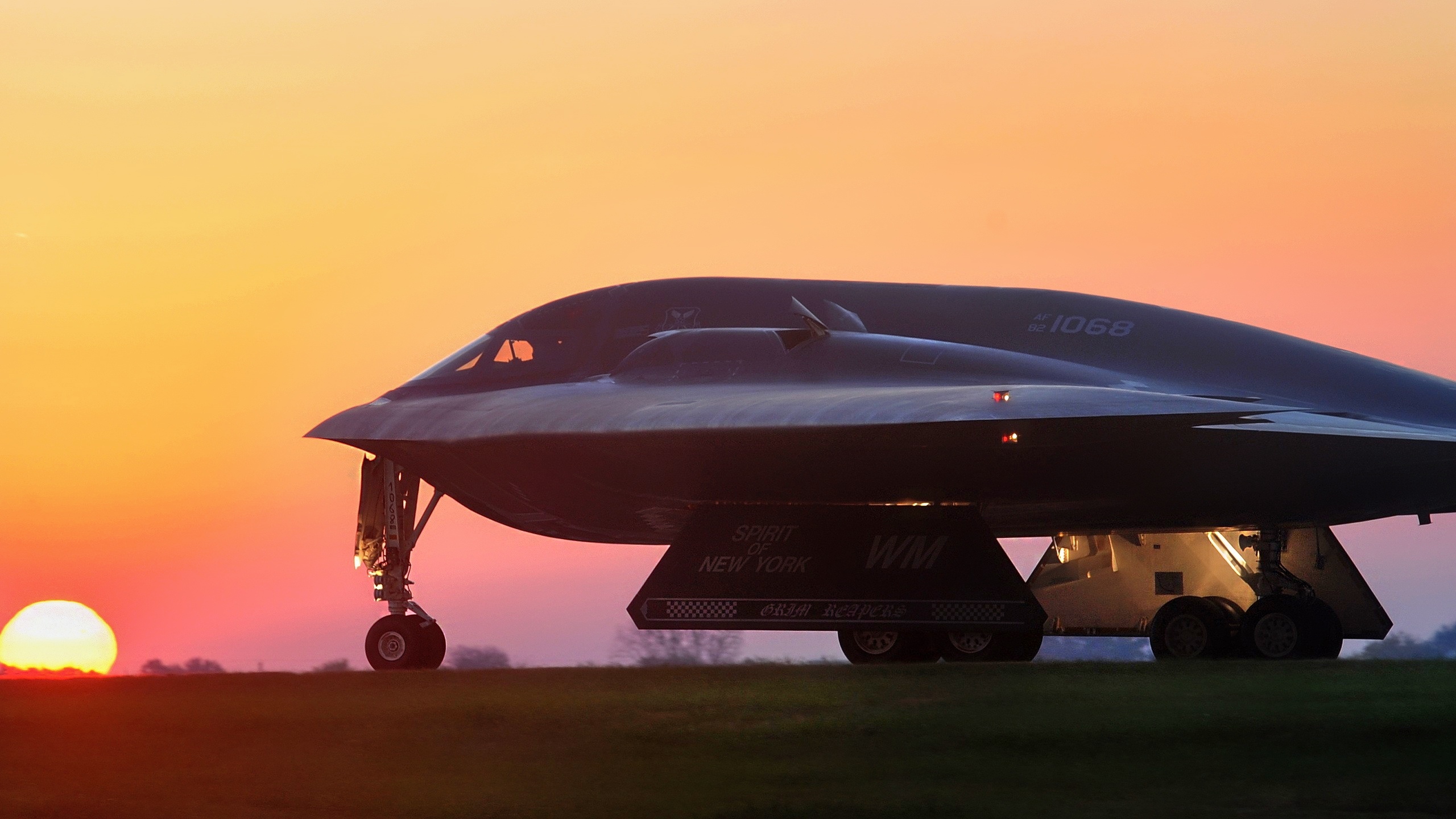
B-2 Bomber. Image Credit: Creative Commons.
The 21st and final B-2 was completed in 2000. A bomber meant to number 132 had been built in a quantity smaller than a single Cold War bomber squadron, and the cap, not the crashes, is the largest single reason the fleet is so small.
Two Losses Cut It To 19
Twenty-one were built; 19 fly today, and the gap is the story of two accidents that were not the same. The first was a destruction. On February 23, 2008, the Spirit of Kansas lifted off from Andersen Air Force Base in Guam, and moisture that had collected on the bomber’s air-data sensors fed erroneous data to its flight-control computers. The aircraft pitched up roughly 30 degrees, stalled, and struck the runway; both crew members ejected and survived, but the bomber was a total loss. At about $1.4 billion, it became the most expensive aviation accident in history, and the fleet dropped to 20.
The second loss was a choice. On December 10, 2022, the Spirit of Hawaii suffered a hydraulic failure that caused its left main landing gear to collapse during landing at Whiteman Air Force Base in Missouri; the aircraft skidded off the runway, came to rest about a mile from where it touched down, and caught fire. The bomber was not destroyed outright.
Instead, the Air Force assessed the damage as too costly to repair and decided in 2024 to retire it, permanently reducing the active fleet to 19. One jet was lost in a crash; the other was a damaged aircraft, the Air Force concluded was not worth fixing — a distinction that matters, because the very same kind of landing-gear collapse would soon produce the opposite decision on another bomber.
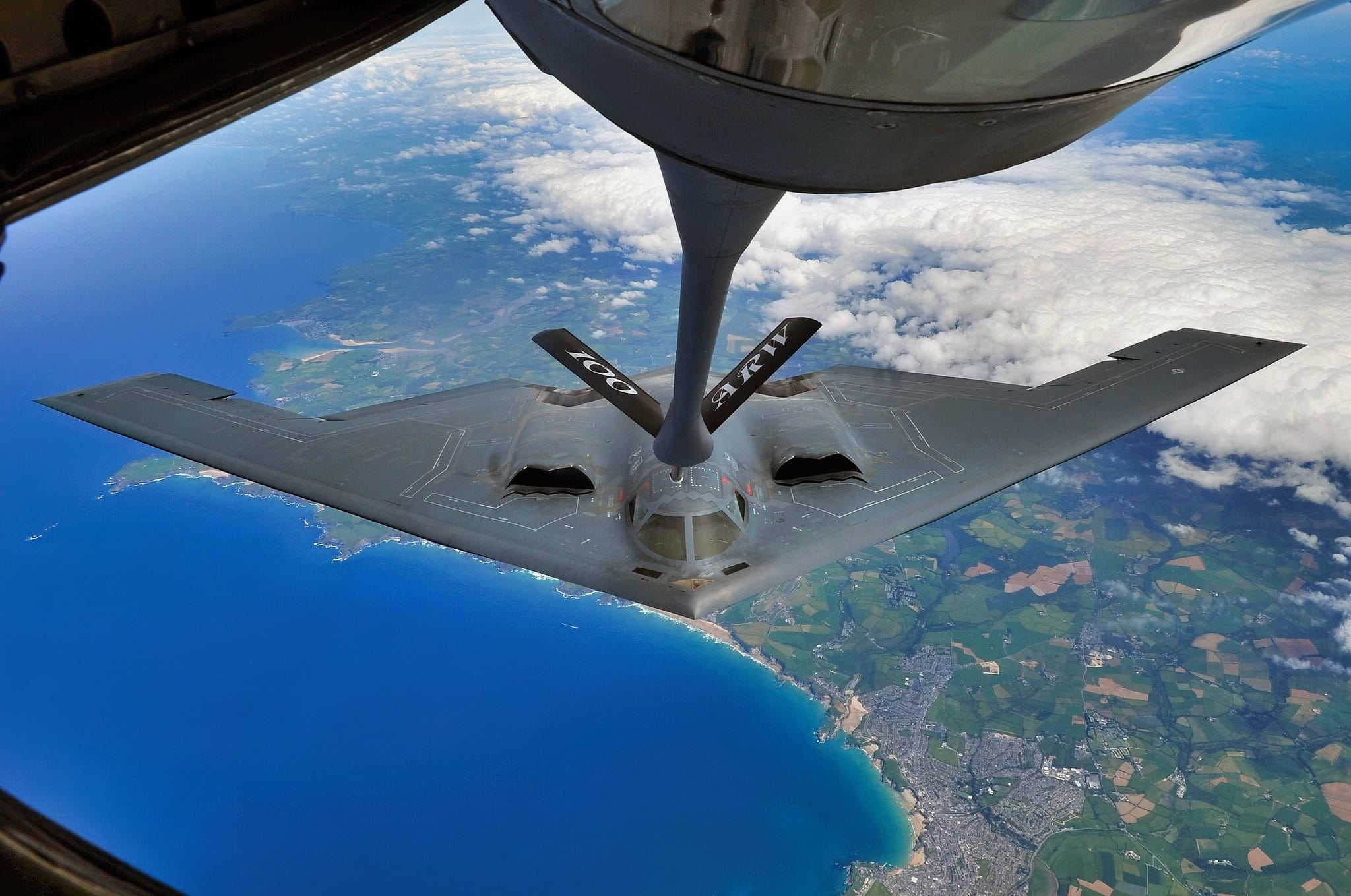
B-2 Bomber. Image Credit: Creative Commons.
What 19 B-2 Spirit Stealth Bombers Actually Costs You
To see what a 19-aircraft fleet forces a service to do, look at the bomber it did not scrap. On September 14, 2021, the Spirit of Georgia suffered a left main landing gear collapse at Whiteman — mechanically similar to the failure that would later doom the Spirit of Hawaii — and was badly damaged. Engineers initially doubted the jet could be economically saved.
But with the fleet this small, the Air Force chose to revive it, in a four-year restoration that became an exercise in improvised engineering: maintainers used giant industrial airbags to lift the 170,000-pound bomber enough to lock its gear and tow it into a hangar before the structural repairs could even begin.
The numbers tell the rest. The restoration cost just under $23.7 million and took nearly four years, and the Spirit of Georgia returned to flight on November 6, 2025, restoring the count to 19 airworthy aircraft. It was the second time the Air Force had brought a B-2 back from severe damage, after the Spirit of Washington was repaired following a major fire in 2010.
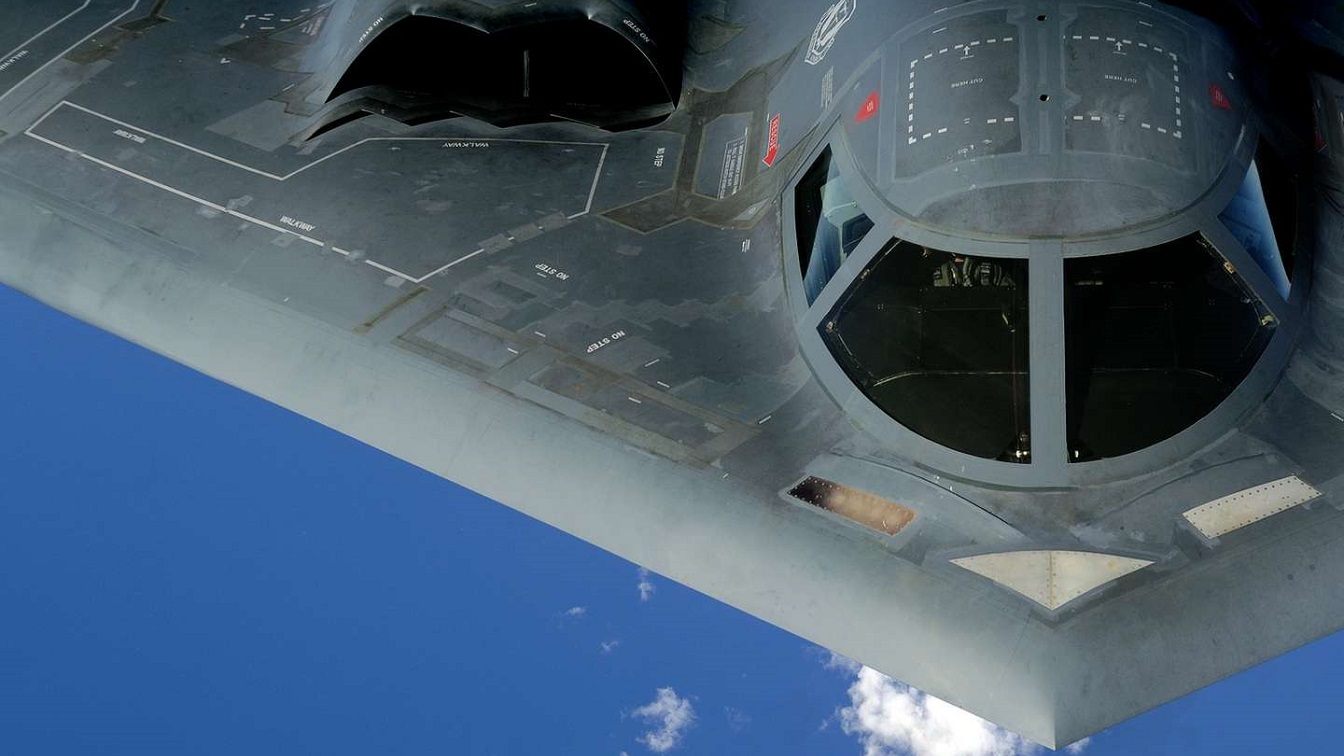
Image of B-2 Spirit stealth bomber. Image Credit: Creative Commons.
That is the strategic cost of a fleet too small to absorb a loss: when only 19 of something irreplaceable exist, the service will pour four years and tens of millions into resurrecting one of them — and reluctantly scrap another when the repair math finally tips the other way. Every B-2 that goes into depot maintenance is a measurable dent in America’s ability to strike hardened targets, because there are so few to begin with.
Why The B-21 Is Built So This Cannot Repeat
The B-21 Raider is the direct answer to the problem the number 19 represents.
Where the B-2 was built in a quantity that left no margin for error, the Raider’s program of record calls for at least 100 aircraft, with U.S. Strategic Command advocating for as many as 145 to deter simultaneous threats from China and Russia, and some force-structure studies arguing for as many as 200.
Built on a more mature design and a deliberately faster, continuous production tempo, the B-21 is intended to cost a fraction of the B-2 per aircraft and to avoid the cost spiral that crippled the earlier program.
In 2026, Congress added $4.5 billion to accelerate Raider production by 25 percent, and the first aircraft are on track to reach Ellsworth Air Force Base in 2027. The Raider will eventually carry the same bunker-buster mission the B-2 holds today, with the numbers the Spirit never had.
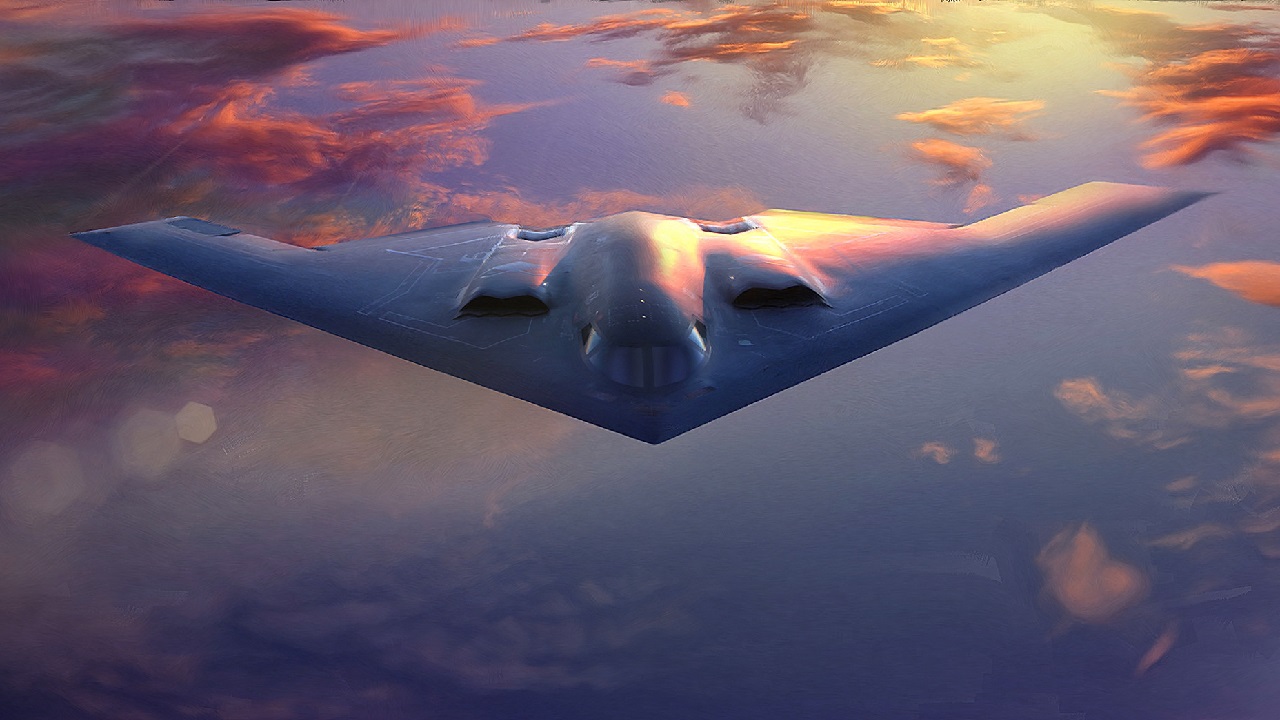
B-2 Spirit. Image Credit: Creative Commons.
The Arithmetic Of A Vanishing Fleet
19 is not a quirk of bad luck or a single accident. It is a 40-year accounting: a planned fleet of 132 cut to 75 by its own cost, cut to 21 by the collapse of the enemy it was built to fight, and reduced to 19 by two accidents a decade apart — one that destroyed a bomber and one that left the Air Force unwilling to pay the repair bill. The B-2 will carry the missions that nothing else can fly for roughly another decade, until the Raider takes over the penetrating strike role.
The entire design of that successor program — the hundred-plus aircraft, the faster line, the lower unit cost — is shaped by the lesson the number 19 taught: build the next stealth bomber fleet large enough that losing two aircraft never again means losing a tenth of it.
About the Author: Harry J. Kazianis
Harry J. Kazianis (@Grecianformula) was the former Senior Director of National Security Affairs at the Center for the National Interest (CFTNI), a foreign policy think tank founded by Richard Nixon based in Washington, DC. Harry has over a decade of experience in think tanks and national security publishing. His ideas have been published in the NY Times, The Washington Post, The Wall Street Journal, CNN, and many other outlets worldwide. He has held positions at CSIS, the Heritage Foundation, the University of Nottingham, and several other institutions related to national security research and studies. He is the former Executive Editor of the National Interest and the Diplomat. He holds a Master’s degree focusing on international affairs from Harvard University.