
Summary and Key Points: “Leadership consists of picking good men and helping them do their best.” Chester Nimitz said that, and 9 days after Pearl Harbor, he was handed a command with almost nothing left in it. On 16 December 1941, Navy Secretary Frank Knox told him he would take the Pacific Fleet and would be gone a long time. Nimitz was stunned. That night, packing for Hawaii, his wife Catherine remarked that he must be gratified. He turned to her and said what the country did not yet know: “Darling, the fleet’s at the bottom of the sea. Nobody must know that here, but I’ve got to tell you.”
-He was a rear admiral who had graduated 7th out of 114 at Annapolis and been court-martialed as a young officer for running a ship aground.
US Navy Admiral Chester Nimitz on Leadership
“Leadership consists of picking good men and helping them do their best.”—That quote belongs to Admiral Chester W. Nimitz, one of the most revered heroes and senior leaders in the hallowed history of the United States Navy.
We’ve written more about Nimitz-class supercarriers—both their strengths and weaknesses—than you can shake a stick at. Now we take a brief look at the life story of the flesh-and-blood human being who inspired the ship’s name.
Early Life
Chester William Nimitz was born on February 24, 1885, in Fredericksburg, Texas, to Anna Josephine (née Henke) and Chester Bernhard Nimitz, in the hotel belonging to his paternal grandfather, Charles Henry Nimitz, who had been a seaman in the German Merchant Marine.
Alas, Chester Bernhard died six months before his son was born, and in 1890, Anna married William Nimitz (1864–1943), Chester B. Nimitz’s brother.

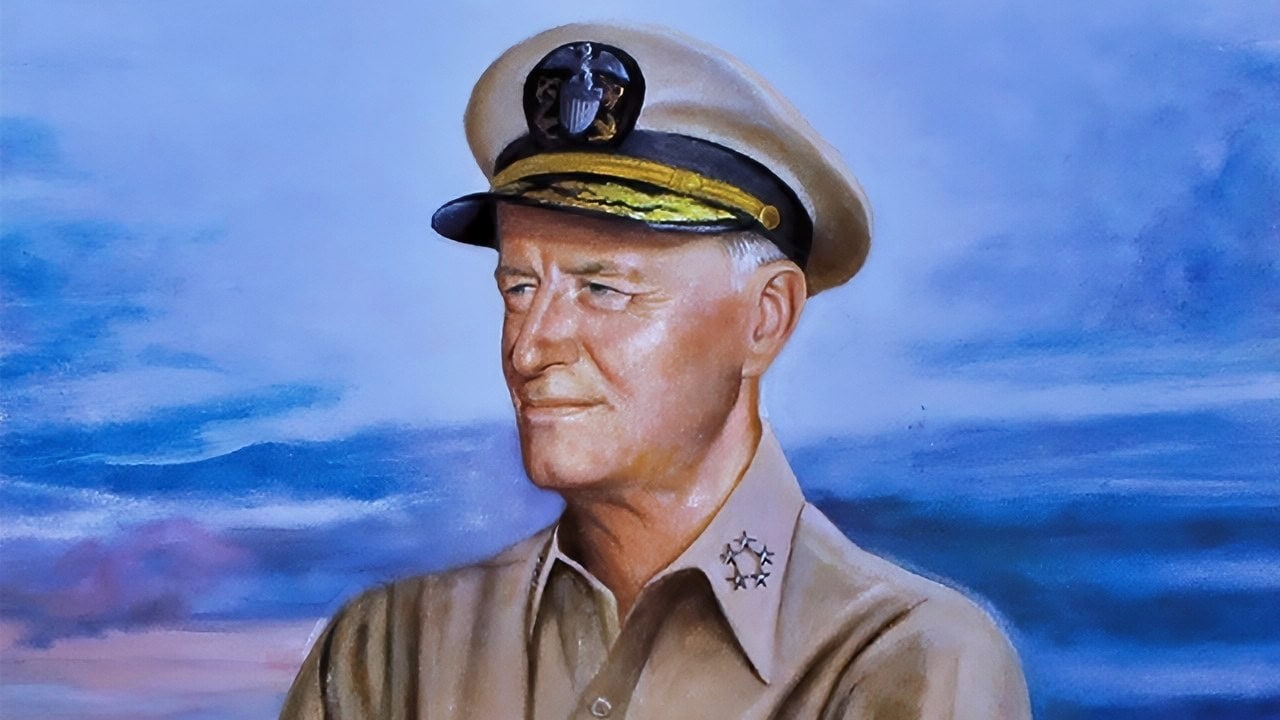
U.S. Navy Admiral Chester W. Nimitz Portrait. Image Credit: Creative Commons.
Charles Henry instilled in his grandson a fascination with the sea at an early age, so it was apropos that young Chester would eventually seek an appointment to the United States Naval Academy (USNA) in Annapolis, Maryland. In 1901, he received that appointment courtesy of Congressman James Luther Slayden (D-TX).
Annapolis
Ironically, Chester skipped his senior year of high school to attend Annapolis.
That lack of a secondary school proved to be no handicap, as Midshipman Nimitz excelled both academically (especially in mathematics) and athletically (stroking the crew team in his first-class year). He graduated with distinction from the Academy on January 30, 1905, seventh in a class of 114.
Junior Officer, WWI, and Interwar Years
As noted by his official Naval Heritage and History Command (NHHC) biography, “After graduation, he joined USS Ohio in San Francisco and cruised in her to the Far East. On January 31, 1907, after the two years’ sea duty then required by law, he was commissioned Ensign, and took command of the gunboat USS Panay. He then commanded USS Decatur and was court-martialed for grounding her, an obstacle in his career which he overcame.”
However, it was in submarines that Chester W. Nimitz established himself as a subject-matter expert, beginning in 1907. Among other things, he worked as an Aide and Chief of Staff to COMSUBLANT during WWI.
On April 9, 1913, he married Catherine Vance Nimitz, née Freeman.
With whom he had four children: Catherine Vance “Kate”, Chester William “Chet” Jr., Anna Elizabeth “Nancy”, and Mary Manson.
Fast-forward to the Japanese attack on Pearl Harbor, and by this time, Chester W. Nimitz was a rear admiral holding the billet of Chief of the Bureau of Navigation.
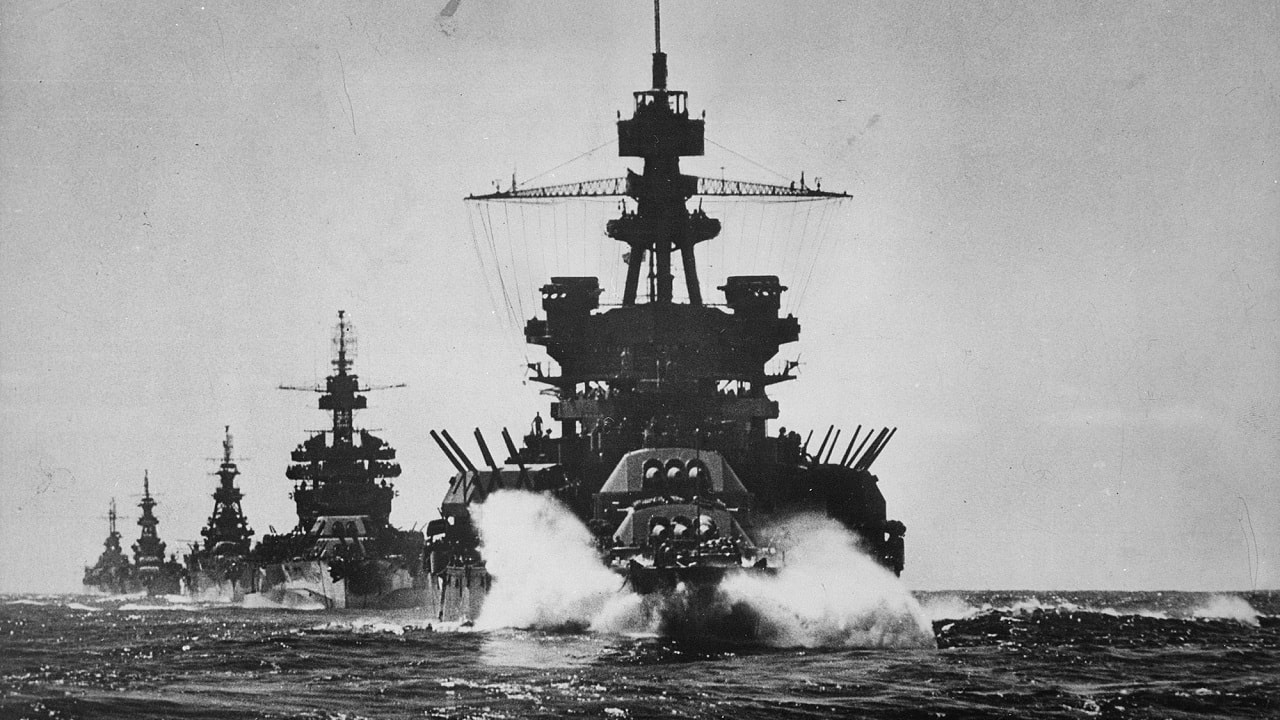
US Navy Battleships during World War II. Creative Commons Photos.
WWII: Cementing His Legendary Legacy
It was on December 16, 1941, a mere nine days after the Pearl Harbor raid, that Secretary of the Navy Frank Knox tabbed RADM Nimitz as Commander in Chief, US Pacific Fleet (CinCPac) and Commander in Chief, Pacific Ocean Areas, commanding Allied air, land, and sea forces in the region.
As noted by Dr. Tyler Bamford, “Knox answered, ‘You’re going to take command of the Pacific Fleet, and I think you will be gone a long time.’ Nimitz was stunned. That night, as he packed his things for the trip to Hawaii … Catherine noticed that he was lost in thought and commented that he must be gratified to have been given command of the U.S. Pacific Fleet. Unable to bear the weight of the nation’s secret any longer, Nimitz turned to her and confided, ‘Darling, the fleet’s at the bottom of the sea. Nobody must know that here, but I’ve got to tell you.’”
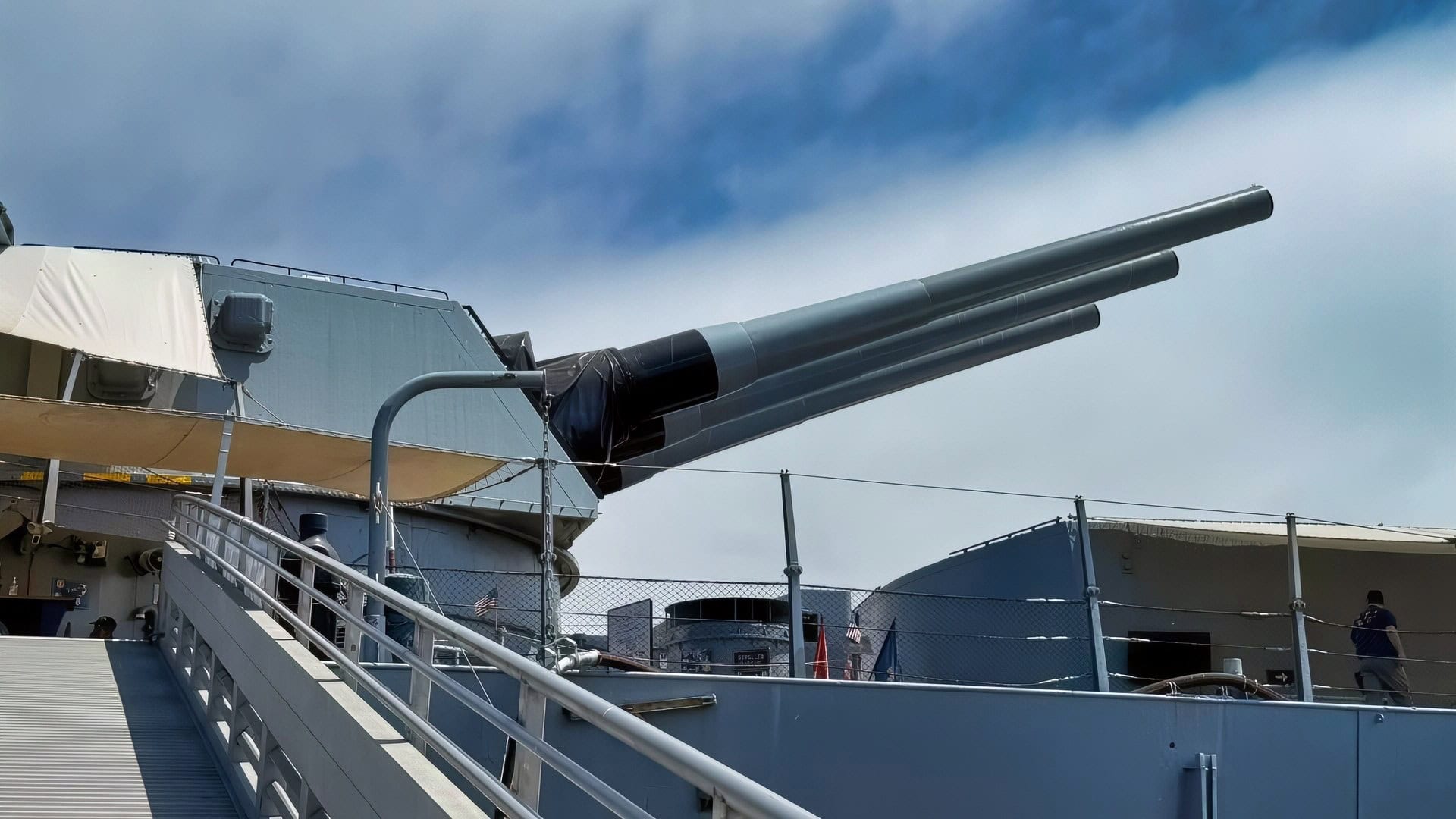
Iowa-Class 16-Inch Gun August 2025 19FortyFive Image. Taken by Harry J. Kazianis.
Despite his unease, he persevered and ultimately triumphed. Via the skillful employment of carrier-borne naval airpower, submarines, and surface warships alike, Nimitz went on to immortalize himself in smashing American naval victories over the Imperial Japanese Navy (IJN) during the Battle of Midway. The Battle of the Philippine Sea (AKA “The Great Marianas Turkey Shoot“), and the Battle of Leyte Gulf (to name just a few examples).
On December 19, 1944, he was promoted to the newly created rank of Fleet Admiral (5 stars).
More than A Quote: Life After WWII and Death
In December 1945 (three months after Imperial Japan’s surrender), Nimitz became the tenth Chief of Naval Operations (CNO). During his CNO stint, Nimitz eagerly endorsed the construction of nuclear-powered submarines, a mantle that would be picked up by ADM Hyman G. Rickover (“Father of the Nuclear Navy”).
He retired on December 15, 1947, thus becoming the last living U.S. Navy officer to hold the rank of Fleet Admiral.
He eschewed multiple requests to write his memoirs and offers to join the boards of private companies. He passed away on February 20, 1966, after a stroke complicated by pneumonia.
He was buried with full military honors at Golden Gate National Cemetery (which is a Veterans Administration [V.A.] national cemetery) in San Bruno, California, alongside his beloved Catherine (who lived ’til February 1, 1979).
And his lifelong friends ADM Raymond A. Spruance, ADM Richmond K. Turner, and Vice Admiral (VADM) Charles A. Lockwood (a fellow submariner) and their wives.
Admiral Nimitz’s Lasting Legacy
USS Nimitz (CVN-68) is the lead ship of the Nimitz-class nuclear-powered aircraft carriers, built by HII’s Newport News Shipbuilding (NNS) in Newport News, Virginia. She was ordered on March 31, 1967; laid down on June 22, 1968; launched on May 13, 1972 (christened by Catherine Nimitz, appropriately enough); and commissioned on May 3, 1975.

USS Nimitz in November 2025. Image Credit: Creative Commons.
Her motto is “Teamwork, a Tradition.” A total of 10 of these warships have been built and commissioned, and none have been retired yet, as their successors, the Gerald F. Ford-class supercarriers, are coming along rather slowly.
Appropriately, the National Museum of the Pacific War is located in the spot of his paternal grandfather’s hotel.
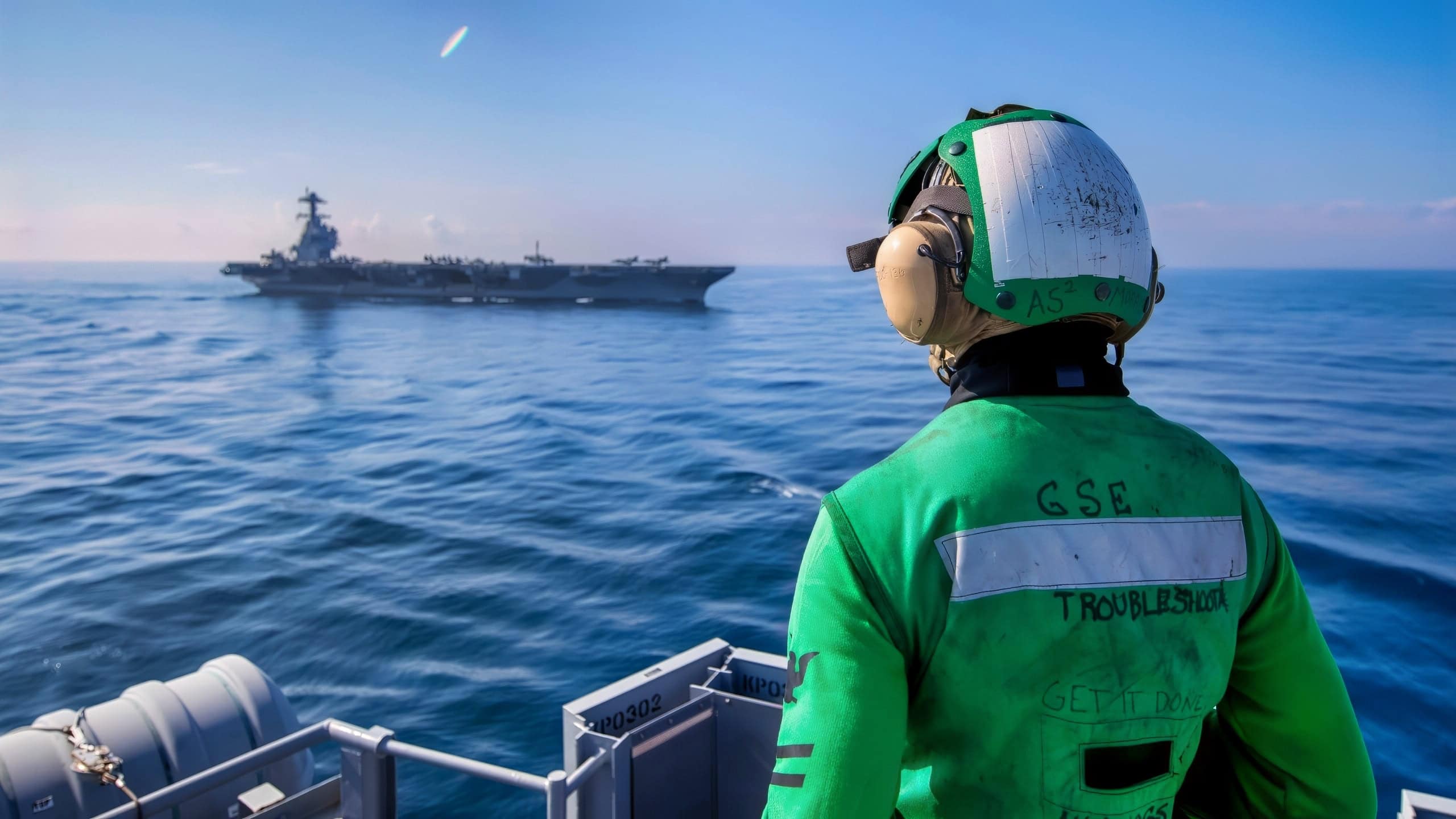
ATLANTIC OCEAN (June 27, 2025) Aviation Support Equipment Technician 2nd Class Jato Morris observes the Ford-class aircraft carrier USS Gerald R. Ford (CVN 78), conduct a vertical replenishment with the Nimitz-class aircraft carrier USS George H.W. Bush (CVN 77). George H.W. Bush is underway conducting Tailored Ship’s Training Availability and Final Evaluation Problem (TSTA/FEP). TSTA/FEP prepares the ship and crew for full integration as a carrier strike group through a wide range of mission critical operations. (U.S. Navy photo by Mass Communication Specialist 3rd Class Jayden Brown)
Naturally, Hollywood filmmakers and actors have taken their own turn at immortalizing (and embellishing) the Admiral. The two best-known examples are the 1976 film “Midway,” in which he was played by Oscar winner Henry Fonda, and the 2019 film “Midway,” in which it was Woody Harrelson’s turn to portray him.
About the Author: Christian D. Orr, Defense Expert
Christian D. Orr is a Senior Defense Editor. He is a former Air Force Security Forces officer, Federal law enforcement officer, and private military contractor (with assignments worked in Iraq, the United Arab Emirates, Kosovo, Japan, Germany, and the Pentagon). Chris holds a B.A. in International Relations from the University of Southern California (USC) and an M.A. in Intelligence Studies (concentration in Terrorism Studies) from American Military University (AMU). He is also the author of the newly published book “Five Decades of a Fabulous Firearm: Celebrating the 50th Anniversary of the Beretta 92 Pistol Series.”